
News
Journalism Awards Night on 13 December

The 23rd edition of the annual Journalism Awards for Excellence programme culminating with the ‘Awards Night’ will be held in the Empire Ballroom of the Mount Lavinia Hotel on Tuesday, December 13.
The programme is organised by The Editors’ Guild of Sri Lanka in partnership with the Sri Lanka Press Institute and its affiliated unions, the Newspaper Society of Sri Lanka, Free Media Movement and the Sri Lanka Working Journalists Association.
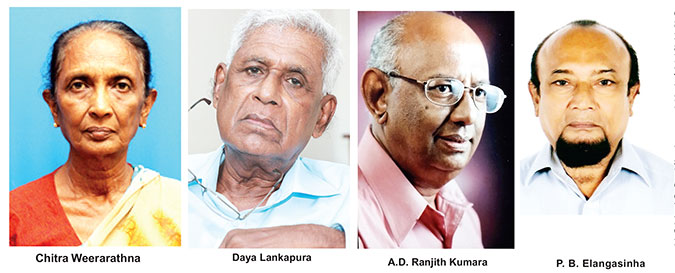
The annual programme is to recognise professionalism in journalism and reward those who have excelled.This year 34 journalists will receive the ‘Pen Trophy’ Award and 17 others will receive Certificates of Merit along with five Lifetime Achievement Awardees namely: Daya Lankapura, A. D. Ranjith Kumara, P. Manikavasagam, Chitra Weerarathna and P. B. Elangasinha. (There profile appears below).
A young reporter will awarded the Lakshman Kadirgamar scholarship to study in the leading Indian college of Journalism, MASCOM in Kerala, India. The scholar will be flown courtesy SriLankan Airlines.
Chief Editor Manik de Silva of the Sunday Island will be the Chief Guest at the event this year.The main sponsors of the event are John Keells Holdings, Dialog, LOLC, Sri Lanka Insurance Corporation and Olu bottled water. Other sponsors are: Sri Lanka Cricket and Insee Cement.
The Mount Lavinia Hotel is the host-hotel.A total of 251 applications from nine newspaper publishing groups was received by the distinguished eight-member independent Panel of Judges this year, said Journalism Awards for Excellence Convener Sukumar Rockwood.
LIFETIME ACHIEVEMENT AWARDS
This year the Life Time Achievement Award will be presented to the following senior journalists who have served the profession.
Daya Lankapura
Daya Lankapura, has served in the media field for over 55 years. He began his journalistic career at the Aththa newspaper as a reporter in 1966 while studying at the Colombo University. He joined the Daily Divana editorial staff of the Upali Newspapers Limited at its inception and served as its parliamentary and political reporter. Subsequently, he joined Lake House briefly as the deputy editor for the Dinamina in 1994 and later associate editor, Silumina and editor of Janatha from May 1994 to May 2004. He later accepted the post of news editor, Sunday Rivira. He also served as Night Editor, Lakbima, News Editor, Irudina, News Editor and Editorial Advisor to Divaina. During this period he was editor of the Information Department’s web site,news.lkuntil July 2020. He has followed journalism courses in the Western Ontario University in Canada, Bradford University, Britain and the Media Training Institute in South Korea. He is currently a visiting lecturer at the mass media section of the Sri Pali Campus of the University of Colombo.
A .D. Ranjith Kumara
A. D. Ranjith Kumara, held the post of Editor in the weekly newspapers of Sarasaviya and Sarasi. He has been associated with journalism for five decades especially in the field of Cinema. He is a past student of Carey College and Ananda College, Colombo. Some of the books he wrote include: Kosgashandiya, Gamini Hela Cinemawe Sakvithi, Rukmani Devi Yugayaka Swarna Geethaya, Sinhala Cinemawe Ridi Rekava and Nova Paraniya Lipi Saranaiya. He has also served as a member on the Advisory Board of the State Literary Awards, Chief Organiser of the Sarasaviya Film Festival and the Sumathi Telefilm Festival. At Sumathi Group of Companies, he held the post of Working Director. He has also received the Ranapala Bodinagoda Cinema Literary Memorial Award, Cyril C. Perera Memorial Award. OCIC Award and the Sumathipala Memorial Award. He is a historian who researchers cinema. In 2017, he received the Presidential Award for Cinema Literature by the National Film Corporation.
Ponniah Manikavasagam
Ponniah Manikavasagam known as P. Manikavasagam is a veteran journalist who worked amidst trying conditions for Virakesari for over four decades. His reporting on the conflict from the conflict zone was trues and accurate thereby earning the respect from both the local and foreign media. He was stringer for the BBC for 25 years until the BBC Tamil Radio Service was suspended in 2016 and Reuters for 10 years. He also had filed stories as a Sri Lanka Correspondent for Asia Calling of Indonesia and American Free Speech Radio News both web radios for several years. He has also won the Northeastern Provincial Governor’s Award for journalism, the Kalabooshana Award and the Lifetime Achievement Award from the Ministry of Cultural Affairs.
Chitra Weerarathna The Island
journalist Chitra Weerarathna had her primary and secondary education at Visakha Vidyalaya, Bambalapitiya, she earned a degree in natural sciences from the Colombo University before Chitra, as she is popularly known among scribes, cut her teeth in journalism at the now defunct Sun newspaper of the Independent Newspapers Group. She joined The Island in the early 90s and quickly carved a niche in the court rounds and no court was too small or too big for her, for the subject was literally in her blood being a daughter of the late Supreme Court Justice T. A. De S. Wijesundera. Besides, two of her sisters too had followed in their father’s footsteps. Chitra’s late husband, Dr. Susil Weerarathna was a lecturer in Chemical Engineering at the Moratuwa University.
P. B. Elangasinha
P. B. Elangasinha is an old boy of Dharmaraja College, Kandy. He joined Janatha Editorial of The Associated Newspapers of Ceylon Ltd (Lake House) as a trainee reporter in 1965. He moved to the Silumina Editorial in 1970 and assumed duties as a Sub-Editor under S. Subasinghe, Editor of Silumina. He became the Deputy Editor of Silumina in 1985. He then moved over to the Wijeya Group and joined Irida. Lankadeepa Editorial in January 1995 and is at present its Deputy Editor.


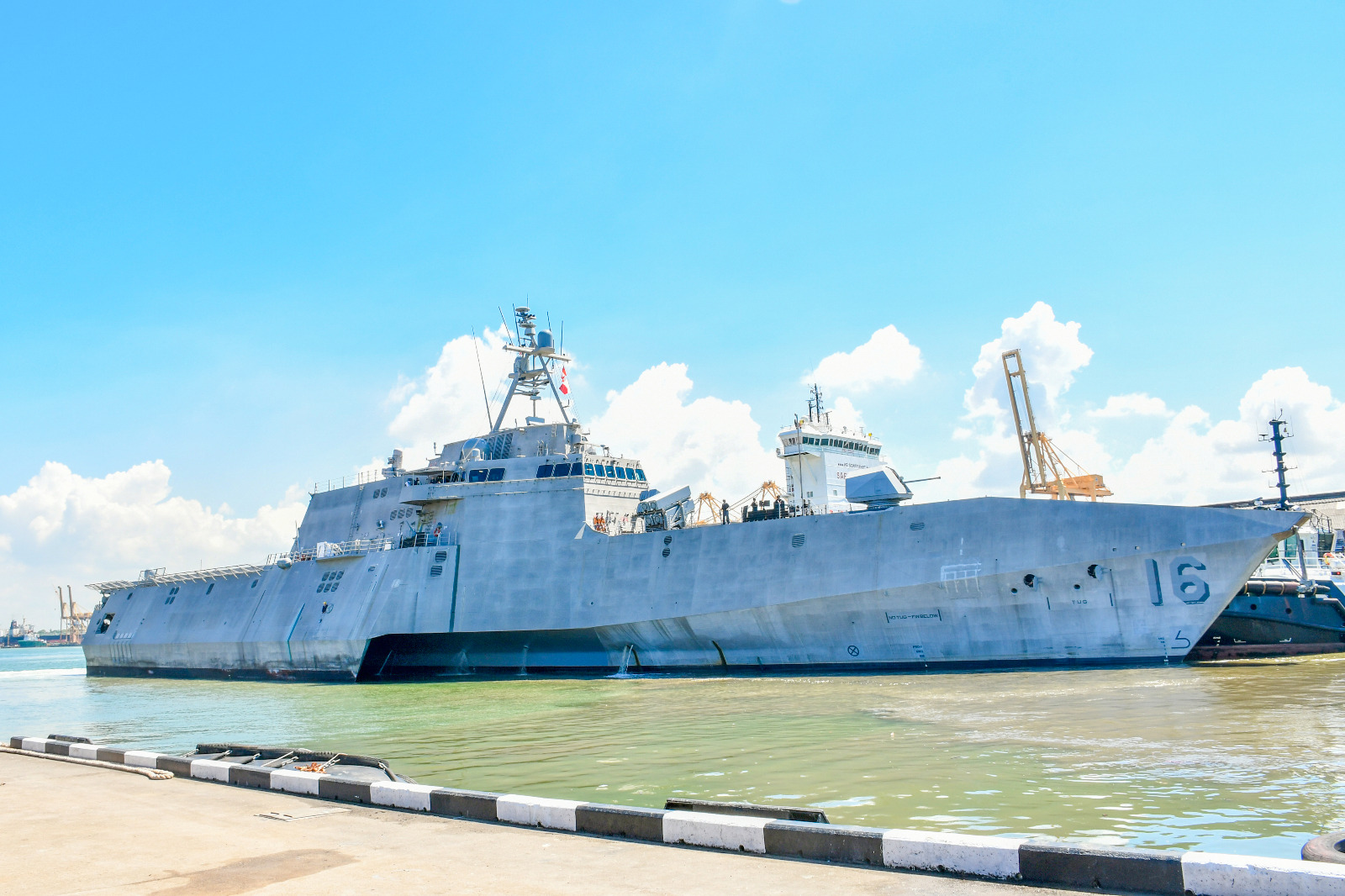
The U.S. Navy ship USS Tulsa (LCS 16) set sail from the port of Colombo today, 09 October 2026.
On her departure, the Sri Lanka Navy extended a traditional naval farewell to the ship.
USS Tulsa, a Littoral Combat Ship, and arrived in the island on 7 October on a replenishment visit and departed the island on completion of intended purposes.
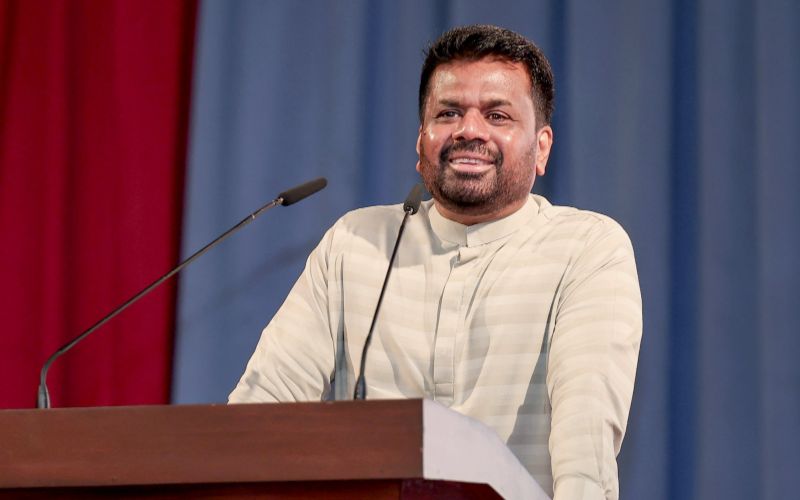
President Anura Kumara Dissanayake stated that the current Government’s economic and social development path is not about bringing rural communities to cities, but about creating economic opportunities and providing facilities within villages. He added that the Government’s objective is to establish a highly developed road network between villages and cities, a good communication system and an efficient and strong public service.
The President made these remarks while attending a ceremony at Temple Trees on Thursday (08) morning to present appointment letters to 1,540 officers who qualified for Grade III of the Grama Niladhari Service.
The President also noted that the current Government is one that greatly respects the public service and expects public servants to be placed on a good salary scale. He added that this was why the Government took steps to increase basic salaries and allowances despite facing extremely challenging circumstances.
Following the promulgation of the new Grama Niladhari Service Minute, appointment letters were presented to 1,540 officers selected for Grade III of the Grama Niladhari Service for the first time. Notably, these recruitments were carried out in accordance with the policy of recruiting qualified individuals to the public service based solely on examination results and merit at interviews.
The current Government has taken steps to re-establish the Grama Niladhari Service under a service structure unique to the position, with a distinct salary structure, while addressing a number of long-standing unresolved issues. As part of this process, steps were also taken to place the officers several salary increments above the salary they were receiving at the time and to adequately increase the allowances provided for various requirements.
The President symbolically presented appointment letters to the 28 candidates who secured first place at district level.
Speaking further, President Anura Kumara Dissanayake said:
“Today, you are entering one of the most important professions in Sri Lanka. If you ask which public official works most closely with the day-to-day lives of the people of our country, it is the Grama Niladhari officer. The relationship between the lives of ordinary people in a village and the State, as well as all services provided by the Government, is centred around the work of Grama Niladhari officers.
You are important to us not merely as officers responsible for a village, but because of the economic and social vision we have developed. Every country in the world is now facing the challenges arising from high population concentrations in cities. This is an issue faced by both developed and developing countries. When economic opportunities and services cannot be provided at the rural level, hundreds of thousands of people have left their villages and moved to cities. The translation of ‘The Grapes of Wrath’ illustrates very well how people living in remote areas, having lost their economic opportunities, faced immense hardships and migrated to cities. This is a challenge faced by many countries around the world today.
However, we are fortunate in this regard. The majority of our population still lives in rural areas. So, what should be our economic and social development path? It should certainly not be about bringing people living in rural areas to cities. It is now evident that this strategy has failed. Therefore, our development path is not about bringing rural communities to cities, but about creating economic opportunities and providing facilities for people within their own villages.
This requires a highly developed road network connecting villages and cities. We also need an effective communication system between villages and cities. To this end, we have discussed with the Ministry of Digital Economy and decided to establish a communication system covering the entire country within the next three years. At the same time, services provided to rural communities must be delivered quickly and conveniently. Therefore, our objective is to enable people to remain in their villages while meeting their economic and social needs.
Grama Niladhari officers will have a significant role to play in this process. In providing these services, the need for officers to visit households, as well as the need for citizens to travel to Grama Niladhari offices and wait for services, should be minimised. However, it is equally important to maintain a balance in the digitalisation process so that human relationships and human emotions are not undermined in any way.
We also plan to divide public service functions into three categories and incorporate them into the digital system: functions that can be completed at Grama Niladhari level, functions that can be completed at the Divisional Secretariat based on certification provided by the Grama Niladhari and functions that can be carried out by other government institutions based on certification from both the Grama Niladhari and the Divisional Secretary. The Ministry of Digital Economy and the Ministry of Public Administration have discussed the development of the digital system required for this purpose. We expect to allocate funds through the forthcoming Budget to commence this as a pilot project in two selected districts next year.
At the same time, we need a strong public service. Every developed country in the world has progressed through a strong public service. However, today, both public servants and citizens who obtain public services are not in a state of satisfaction. There is competition within the public service over positions and offices. The public service has also experienced a degree of decline due to outdated computers, old vehicles and dilapidated buildings. As a Government, we are taking steps to change this situation.
We have identified the need for 1,750 vehicles (cabs) for the public service and are taking steps to provide the necessary vehicles promptly to officials, including Divisional Secretaries. The Ministry of Public Administration will take steps to provide the required number of computers and equipment for digitalisation. Government institution buildings must be renovated, while new buildings must also be provided. Accordingly, we expect to allocate funds through the Budget to complete the third phase of Sethsiripaya and commence the fourth phase. At the same time, we must manage land properly. In this regard, I believe we need to change our preference for large buildings. Therefore, a formal assessment is being carried out to determine the amount of space required for offices and the specified land requirements and the responsibility for providing office facilities has been assigned to the Chief of Presidential Staff.
I acknowledge that the current salary scales in our public service are inadequate. As a result, there are difficulties in recruiting skilled professionals such as engineers, information technology specialists and legal officers into the public service. However, if the salaries of public servants are increased by Rs. 10, it would result in an additional monthly expenditure of Rs. 13 million, while an increase of Rs. 100 would result in an additional expenditure of Rs. 1.3 billion. Therefore, we have identified the need to increase the efficiency of the public service while reducing its size. In doing so, we will by no means abandon the public service. It is our policy that the public service is essential and must be developed. However, we believe that the mechanism through which these services are delivered should be made smaller.
Accordingly, a committee chaired by the Prime Minister has planned to merge government institutions. A decision has been taken to close 33 institutions identified by the Ministry of Finance. We have decided to provide compensation for this purpose. A number of institutions that should be merged have also been identified. The public service should not become a burden on the people. At the same time, we are a Government that recognises the need to provide the people with an efficient public service.
Therefore, in order to manage the public service effectively, it needs to be made smaller. In order to bring in teams with strong skills and capabilities, they must be placed on appropriate salary scales.
From our first Budget, we decided to increase the basic salaries of public servants in three stages. Accordingly, by 2027, we will bear an additional expenditure of Rs. 330 billion solely for salary increases. We should turn our attention to other allowances only thereafter. I believe that everyone should be treated fairly in this regard. We have provided a substantial increase in basic salaries. We have also increased the allowances provided to Grama Niladhari officers. The office allowance has been increased from Rs. 1,000 to Rs. 2,000. The uniform allowance has been increased from Rs. 5,000 to Rs. 15,000. The allowance for purchasing stationery has been increased from Rs. 1,500 to Rs. 3,000.
We will present the next Budget on 12 November. In that Budget, we will consider how to balance the Rs. 330 billion required for the increase in basic salaries in 2027. Only thereafter will we consider how much expenditure can be allocated for allowances.
I acknowledge that the public service should receive fair salaries. However, these salaries are paid from the taxes collected from the people. We are working towards reducing these tax rates. Our objective is to provide relief to the people by reducing Value Added Tax (VAT) rates over the next two to three years. If a child has to pay a tax when purchasing a book to read, we should remove that tax. Expenditure must be managed in line with these objectives. We have provided a substantial increase in basic salaries. We have also increased allowances while listening to the concerns of public servants. Therefore, let us act with an understanding of this situation. We have absolutely no intention of politicising the public service. We have a positive outlook for the future of this country and our public service has a major responsibility in achieving that vision.
As a Government, we can formulate policies and have the Budget approved by Parliament. However, the responsibility for implementing the Government’s policy decisions down to the village level lies with the State Mechanism. This requires a strong public service.
Those receiving appointments today will be the public officials closest to the people. In times of hardship or disaster, as well as at the birth of a child or at the time of a death, the first public official people turn to is the Grama Niladhari officer. Therefore, Grama Niladhari officers establish a significant part of the State’s relationship with the people. You are therefore entering a profession that carries great honour and bears a major responsibility towards the people. I wish you success in your new professional lives, with the confidence that you will be able to rebuild the traditional, caring and respectful relationship that existed between the people of the village and the Grama Niladhari officer”.
Minister of Public Administration, Provincial Councils and Local Government Professor A.H.M.H. Abayarathna
“This is the first group to join the Grama Niladhari Service following the establishment of a formal service minute for the Grama Niladhari Service last year. It is also another group recruited to the public service based solely on qualifications and merit. These two factors make today a historic day. At a time when we are making a major effort to develop our country’s economy, this occasion can also be described as another step towards creating a more positive political culture.
You are aware that this service has a long history dating back to the 4th century BC. You will therefore understand the importance and dignity of the Grama Niladhari Service within the public service. This era has created a special situation for us. Three or four years ago, the citizens of this country began to aspire towards a new system. They stood for a system change. You are receiving these appointments at a time when the people have placed their hopes in that change and when your active contribution is needed to bring about the change they have long desired. You have been entrusted with a tremendous responsibility towards all citizens of this country. What you do and say today will become history in the future. Accordingly, this is also an era in which history is being rewritten.
The people of our country have faced many difficulties. They shed blood and tears during the war. During the economic crisis, they even had to sacrifice their basic needs. You have been given an opportunity to fulfil a tremendous responsibility that goes beyond merely carrying out a duty or providing a service for such a people. We recently witnessed such an opportunity during the Ditwah disaster. While expressing our gratitude to those officers, I would also like to remind you that you should draw inspiration from their example.
If there is to be a system change, we must first change ourselves. We must change individually. If you, who are receiving these appointments today, are able to bring the same happiness to your parents and loved ones on the day you retire as they experience today, you can be satisfied that you have fulfilled a social responsibility that goes beyond merely performing your official duties. I call upon all of you receiving appointments today to dedicate your service towards building a Sri Lankan nation with a strong social foundation, as well as a strong economy.
Deputy Minister of Provincial Councils and Local Government Ruwan Senarath and other Deputy Ministers, Governors and Chief Secretaries of the Provinces, Chief of Staff to the President Prabath Chandrakeerthi, Secretary to the Prime Minister Pradeep Saputhanthri, Secretaries to Ministries, including Secretary to the Ministry of Public Administration, Provincial Councils and Local Government S. Aloka Bandara, District Secretaries and a group of public officials also participated in the occasion.
President’s Media Division (PMD)
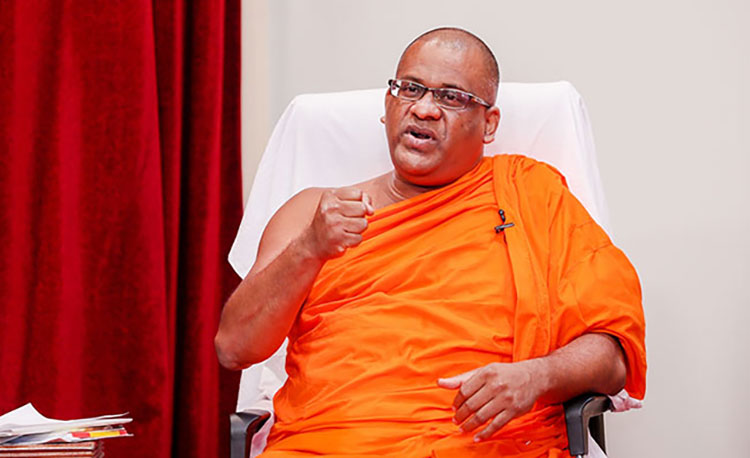
The Mahanayaka Theras of all Nikayas have protested against Bodu Bala Sena (BBS) General Secretary Ven. Galagodaaththe Gnanasara Thera, who is serving a prison sentence for contempt of court, being produced before court in civilian attire.
In a letter to the Commissioner General of Prisons, the Mahanayaka Theras have said they were surprised and concerned by the decision to remove the monk’s robes.
The letter has been signed by Most Ven. Thibbotuwawe Sri Siddhartha Sumangala Thera of the Malwatu Chapter, Most Ven. Warakagoda Sri Gnanarathana Thera of the Asgiri Chapter, Most Ven. Karagoda-Uyangoda Maithri Murthi Thera of the Amarapura Maha Nikaya and Most Ven. Makulawe Sri Wimala Thera of the Ramanna Maha Nikaya.
The Mahanayaka Theras have said they respect the Constitution and the judicial process, but maintained that removing a monk’s robes or ending his status as a member of the Buddhist Order is a matter that should be decided by the Maha Sangha.
They have said the relevant Sangha Council has not determined that Ven. Gnanasara Thera committed a Parajika offence or any other offence warranting his removal from the Buddhist Order.
The Mahanayaka Theras have also referred to Regulation 550 of the Prison Standing Orders, which they say stipulates that convicted prisoners should not be taken to court in prison uniform and should be allowed to wear the type of clothing they normally wore before their conviction. In the case of a Buddhist monk, they have said, this means his monastic robes.
They also referred to the United Nations Standard Minimum Rules for the Treatment of Prisoners, which provide for prisoners taken outside prison to be allowed to wear their own clothing or other unobtrusive clothing.
The Mahanayaka Theras have requested the Commissioner General of Prisons to allow Ven. Gnanasara Thera to wear his robes when appearing in court and to maintain his status as a monk while he remains in prison.
Prisons authorities have said that the clothing decision was made under prison regulations, and the Prisons Department has stated that prisoners serving sentences of more than three years are required to wear prison-issued clothing when produced before court.

Tsunami warnings across Latin America after 7.7 magnitude earthquake hits

Farhan, Sadaqat help Pakistan ace 183 chase to go 1-0 up

Afghanistan fast bowlers hit back after Bangladesh’s strong start

Sri Lanka chose to bat first in Rawalpindi

Sutherland and Litchfield lead Australia to quick and convincing win in ODI series opener

USS Tulsa departs Colombo

‘Dates have the highest sugar content to fight Coronavirus’

Sunday Island 27 December – Headlines

#SundayIsland 17th December – Headlines

Sunday Island – 28th March

Sunday Island Headlines – 21 March

Sunday Island – 21st February – Headlines
-

 Features6 days ago
The first woman in the foreign service or Ceylon Overseas Service it was then called
-

 News5 days ago
Geneva takes up Sallay’s case and govt. ignores opportunity to answer accusations
-

 Editorial7 days ago
Fuelling discontent and protest
-

 Foreign News6 days ago
Ten injured after car crashes into rugby supporters in Australia
-

 News6 days ago
Nearly 20 Iranian tankers stranded off Lanka amid US sanctions
-

 Latest News7 days ago
Tharindu Rathnayake, bowlers secure Asian Games Bronze for Sri Lanka
-

 Features4 days ago
Preventing grievances from becoming communal
-

 Features5 days ago
Sri Lanka Cricket Bill: Governance reform is not yet a cricket strategy