


Connect with us

News

Johnston predicts SJB split, promises fertiliser

Published

on

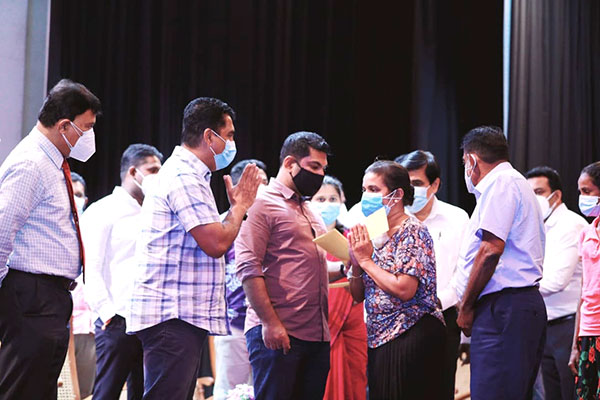
The SJB would suffer several splits soon, Minister Fernando said on Saturday during a ceremony held at the Provincial Council auditorium in Kurunegala to launch aqua farming entrepreneurs in the district.

Responding to questions by journalists who asked the minister to comment on recent statement by SJB MP Diana Gamage that the party would split into several groups, the Minister said the Opposition party’s leader Sajith Premadasa had lost twice and party followers had no hope that he would be able to steer that party to victory.

Asked to comment on prevailing shortages in the market, the Chief Government Whip said that the shortages had resulted from lockdowns and the situation would improve with the passage of time. “Farmers have complained of a fertilizer shortage and I am asking them to resume cultivation because fertilizer would be there on time. I ask them to have faith in this government. We will eradicate the fertilizer shortage in a few weeks’ time. Even if their crops fail, we will compensate them. These shortages of milk powder, gas and some other items are temporary and they have been caused by forex shortage and the pandemic. We as a government have been able to save the lives of people from the pandemic. The worst part of the pandemic is over. We have removed price controls and in the coming days shortages will be replenished soon.”

Asked to comment on the possibility of holding provincial council elections soon the Minister said: ‘Elections should be held on time. Holding elections shows the prevailing of democracy. All those shouting by the opposition will come to an end when an election is announced. The opposition is afraid of elections because it knows that it cannot win. Even last time they went before courts to delay the elections.”

Asked to comment on reports that some MPs would resign to contest for chief minister posts and monies had been allocated for electorates last week the minister said that funds had been allocated not for elections but for improving infrastructure facilities in the rural areas and developing economies of farming communities. “We are ready for an election any time. We do not need to allocate funds and make preparations for elections to win them like other parties. We have made impressive achievements such as restoring national security, winning against the pandemic and marching from strength to strength. People want a government that protects them. We are the only party that could save them and bring victories to them,” the minister said.


Continue Reading
Advertisement
Click to comment

Leave a Reply

Your email address will not be published. Required fields are marked *

News

Current El Niño Status in Sri Lanka

Published

on

By

At present, El Niño conditions have developed and are classified as being at a weak level. Forecasts indicate a 63% probability of a very strong El Niño event developing during the period from November 2026 to January 2027. According to the National Oceanic and Atmospheric Administration (NOAA), there is approximately a one-third probability that El Niño will remain below a very strong intensity.

Typical Climatic Conditions Associated with El Niño
Based on analyses of past El Niño events that occurred between 1950 and 2025:
• Rainfall during July and August may be below normal, particularly in the dry zone areas.
• From October onward, rainfall is generally expected to be above normal.
• If a positive Indian Ocean Dipole (IOD) develops, enhanced rainfall conditions may continue until December.

Sectors Requiring Attention
• Appropriate measures should be taken for water resource management during July and August.
• Increased rainfall expected from October onward may lead to floods and landslides, requiring preparedness and close monitoring. The forecasts are important for sectors such as, Agriculture /Water management /Livestock /Health /Energy /Other climate-sensitive sectors
• Attention should be paid to official information issued by the Department of Meteorology.

Actions by the Department of Meteorology
The Department of Meteorology continuously monitors the evolving situation and issues:
• Weekly and monthly seasonal forecasts and Monthly analyses of rainfall data to monitor meteorological drought conditions.
As weather conditions are influenced not only by El Niño but also by other climatic factors, updated forecasts and advisories are regularly shared with relevant stakeholder organizations (Irrigation/ Water Management Committee /Department of Agriculture/National Building Research Institute/Disaster Management Centre (DMC)/Ministry of Health /Sri Lanka Land Development Corporation…etc). The Department also provides technical support to the committee established through a Cabinet decision to address climate-related impacts. The Department’s monthly rainfall outlook for July to September 2026 is attached

Monthly Rainfall Forecasts for July, August and September 2026
Month Rainfall forecast
July 2026

During July 2026, there is a higher probability of having near normal rainfall across most parts of the Western and Southern Provinces. The remainder of the country is expected to experience below normal rainfall.

August 2026

There is a higher probability of having below normal rainfall across most parts of the country during month of August 2026.

September 2026

There is a possibility of above-normal rainfall across most parts of the Western and Southern Provinces, while near-normal rainfall is expected in the Sabaragamuwa Province. Below-normal rainfall is likely in the remaining areas during September 2026.

Note: These long-range forecasts may change due to strong day-to-day atmospheric variability associated with the movement of weather systems such as atmospheric disturbances, low-pressure areas, and depressions, as well as intra-seasonal oscillations such as the Madden–Julian Oscillation (MJO). Therefore, in addition to the weekly and monthly forecasts, it is important to pay attention to the Department’s official announcements, weather advisories and warnings, as well as the daily weather forecasts issued by the Department of Meteorology.

Continue Reading

News

Govt. move to extend retirement ages of top judges: Opp. complains to UN

Published

on

Prof. Peiris addresses the media outside the UN compound in Colombo on Thursday on the controversial government move to extend the retirement ages of Superior Court judges, while former MPs Thalatha Atukorale, Dr Suren Raghavan and Premanath C. Dolawatta look on.

Former External Affairs Minister Prof. G. L. Peiris yesterday (15) briefed the UN Resident Coordinator in Colombo, Marc-André Franche, on President Anura Kumara Dissanayake’s move to extend the retirement ages of the superior court judges and the delay in filling the vacancies in the Supreme Court and the Court of Appeal.

Prof. Peiris, the convenor of the People’s Joint Opposition, led the delegation that included UNP General Secretary and former Minister Thalatha Atukorale, former UPFA National List parliamentarian Suren Raghavan and ex- SLPP MP Premnath C. Dolawatta.

Having met the top official here, Prof. Peiris briefed the media on their decision to bring the developing situation to the notice of the UN.

Referring to the opposition of the legal fraternity to the NPP government’s plan, Prof. Peiris emphasised that the civil society, too, had opposed the politically motivated initiative.

Prof. Peiris said that instead of addressing the burning issues affecting the public, the government was creating new problems.

Continue Reading

News

Dengue surge pushes hospitals to the brink as cases near 70,000

Published

on

A week-long crackdown to begin in 11 districts

Hospitals are coming under mounting pressure as the country’s dengue epidemic gathers pace, with nearly 70,000 infections and 48 deaths reported so far this year, prompting health authorities to launch an intensive week-long mosquito control campaign in 11 districts.

The National Dengue Control Unit (NDCU) said 69,951 dengue cases had been reported by July 13, with 14,572 new infections recorded during the first 13 days of July alone. June saw the highest monthly caseload of the year, underlining the rapid spread of the mosquito-borne disease during the southwest monsoon.

Acting Director of the NDCU, Dr. Kapila Kannangara, warned that the hospital system was facing severe congestion due to the unprecedented influx of dengue patients.

“We are seeing an alarming increase in admissions. Hospitals are under tremendous pressure, and public cooperation is essential to bring the outbreak under control,” he said, announcing that a special one-week dengue control programme would be implemented across 11 high-risk districts.

Health authorities have identified 175 Medical Officer of Health (MOH) divisions as high-risk dengue zones. Public Health Inspectors will conduct inspections, eliminate mosquito breeding sites and initiate legal action against those maintaining mosquito-infested premises.

The Western Province continues to account for the largest share of infections, with Gampaha and Colombo among the worst-affected districts. Several hospitals are already operating beyond capacity as the number of admissions continues to climb.

Health officials attributed the surge to intermittent rains, poor waste disposal, stagnant water collections and inadequate community participation in vector control programmes.

The Ministry of Health has appealed to local authorities, schools, workplaces, religious institutions and households to inspect their premises regularly, clear blocked drains and roof gutters, cover water storage containers and remove discarded tyres, cans, bottles and other containers capable of collecting rainwater.

Medical experts urged the public not to ignore symptoms such as persistent fever, severe headache, pain behind the eyes, vomiting, abdominal pain and bleeding manifestations, stressing that early medical treatment is critical in preventing severe dengue and deaths.

Officials emphasised that eliminating mosquito breeding sites remains the single most effective way of controlling dengue, warning that unless communities actively participate, the outbreak could worsen during the ongoing rainy season.

With daily case numbers continuing to rise and hospitals struggling to cope, health authorities said the coming weeks would be crucial in determining whether the country can curb one of its worst dengue outbreaks in recent years.

By Ifham Nizam

Continue Reading

Trending