
Latest News
Joe Root notches record 34th Test hundred as England close in

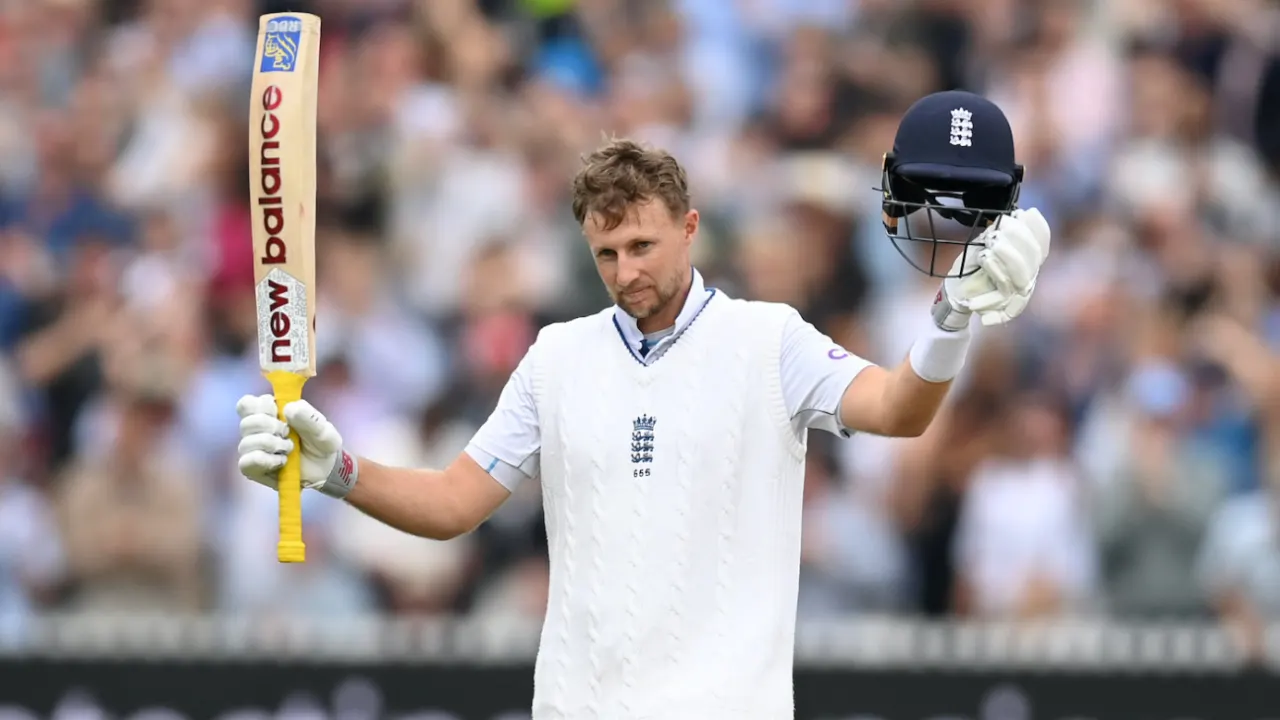
For the second time in three days at Lord’s, it was all about Joe Root. England’s batting bellwether continued a bumper Test match by producing twin tons for the first time in his storied career, his 34th century in the format setting new records for his country – and setting his team on their way towards what would be a series-sealing win.
England began the day in a position of comfort, 256 runs ahead with nine wickets standing, and Root allowed an expectant crowd to drink in the experience of a Lord’s Saturday. If there was data on champagne corks popped, Root would probably set have another benchmark. As it was, his innings of 103 was garlanded by several entries in the record books: his seventh Test hundred the most by an individual at Lord’s, as he surpassed Graham Gooch as the leading run-scorer on the ground. Cook’s overall England run-scoring records is now less than 100 runs away.
This effort, coming from 111 balls, was also his fastest in the format. He reached the mark, in the company of the No. 10, Olly Stone, by swatting Lahiru Kumara’s bouncer in front of deep point, amid a rising crescendo of “Roooooooot!” rolling around the ground. The next-highest score by one of his team-mates was Harry Brook’s 37 off 36 balls.
With Sri Lanka asked to chase a target of 483, Root was at it again in the field – his two catches at first slip to remove Nishan Madushka and Pathum Nissanka making him the fourth man to take 200 in Tests. Rahul Dravid, the record-holder with 210, is very much in his sights.
That Sri Lanka finished the day only two down was in part due to an early finish brought about by bad light. A world-record target looked a long way off for a team short on batting confidence, though Dimuth Karunaratne survived being given out lbw to his third ball – a poor decision from Paul Reiffel overturned – to negotiate 90 minutes in the gloom after tea. He walked off in the company of “lightwatcher” Prabath Jayasuriya after England had been instructed to bowl their spinners for a second time, with Ollie Pope preferring to preserve the condition of the ball for Sunday.
Madushka was the first wicket to fall, edging Gus Atkinson to slip to continue a difficult first tour of England – having been replaced behind the stumps by Dinesh Chandimal on the third morning, he also dropped two catches in the field (although one still resulted in the dismissal of Ben Duckett, as Angelo Mathews snaffled the rebound). Nissanka survived on 2 when the faintest of under-edges to leg slip off Shoaib Bashir went undetected, only to be dismissed by a snorter in Olly Stone’s first over as the light briefly improved enough to allow a return to pace.
Joe Root passes by as Joel Wilson puts the light meter to work, England vs Sri Lanka, 2nd Test, Lord’s, 3rd day, August 31, 2024
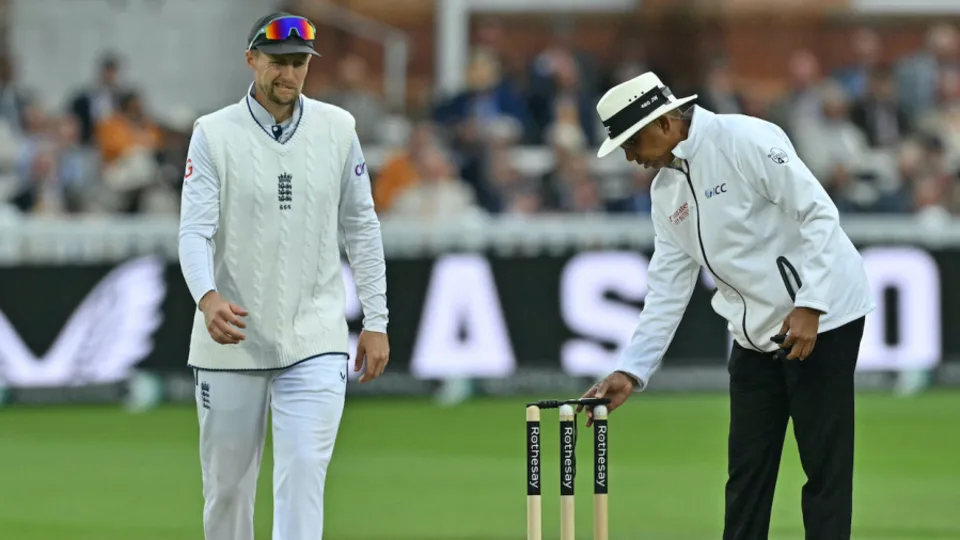
Bad light forced an early finish on day 3[Cricinfo]
England left the field at just after 5pm, content that there is plenty of time left for them to take the eight wickets required for a 2-0 lead in the series. Kamindu Mendis had held out the hope on the second evening that Sri Lanka could find a way back into the game if they could get England out for “under 150-175” – they gamely chipped out five wickets by that stage but couldn’t prevent a Root march carrying the hosts to 251 and a seemingly impregnable position.
Root’s reliability had allowed England to negotiate the morning session with few alarms, and the game continued to revolve around him after the interval. A nudge down the ground off Jayasuriya took him to fifty from 65 balls, and he began to push the tempo with three fours – two hauled through wide long-on, one delicately reverse-swept – in four balls.
Sri Lanka kept at it, Jayasuriya removing Jamie Smith lbw despite a review from the batter, before Chris Woakes flat-batted Milan Rathnayake to cover. Atkinson’s dismissal, meanwhile, came in complete contrast to the elegant simplicity that characterised his maiden hundred in the first innings: caught behind the keeper at long-stop when top-edging a reverse-pull at Asitha Fernando. Potts then gloved the same bowler behind but Stone hung in to get Root to his milestone.

Stone was caught at fine leg in the same over, and although England’s approach had seemed to have a declaration in mind, they batted on. Root eventually gave Kumara a third wicket, top-edging a tired heave to deep-backward square leg, with tea taken early at the close of the innings.
England’s batting effort was uneven, Root aside, reflective of their strong grip on the game. Three wickets went down during the morning session, including that of Pope, England’s stand-in captain, who made his highest score while deputising for Ben Stokes but again fell in perplexing fashion, slashing an Asitha bouncer straight to deep backward point for 17, shortly after Sri Lanka had put four men back for the ploy.
The hosts resumed on 25 for 1, after Dan Lawrence’s dismissal on the second evening, and Ben Duckett was the first to depart, thanks to accidental piece of choreography between slip and gully. Rathnayake pitched the ball up from round the wicket, tempting the drive – and while Madushka could not hold on diving to his right, he managed to scoop the chance back towards Mathews for a regulation catch.
At the other end, Pope was looking to quell some of the noise around his batting. He moved into double-figures for the first time in the series with a clip off his legs, then survived a review for lbw against Rathnayake, with ball-tracking showing the ball would have cleared the stumps. But he did not last much longer, as Asitha targeted him from round the wicket.
The first of Root’s four boundaries was a thick outside edge between slip and gully, but he was otherwise serene in progressing towards a third consecutive 50-plus score. Jayasuriya was picked off on the sweep and twice down the ground, though Root was initially happy to tick along at a strike rate in the 70s, allowing Brook and then Smith to play the aggressor.
Brook’s intent during a half-century stand seemed to suggest that England were already thinking about the declaration. Brook was badly dropped on 9, Madushka making a mess of a skied slog-sweep at midwicket, then launched Jayasuriya’s next delivery into the Tavern Stand to rub in the pain. Sri Lanka’s spinner bore the brunt of the attack, but he had the satisfaction of removing Brook when another attempt to haul him leg side was safely held by Madushka in front of the rope.
Brief scores:
Sri Lanka 196 and 53 for 2 in 20 overs (Dimuth Karunaratne 23; Olly Stone 1-1, Gus Atkinson 1-15)need a further 430 runs to beat England 427 and 251 (Joe Root 103; Asitha Fernando 3-52, Lahiru Kumara 3-53)
[Cricinfo]

Six American soldiers were killed in an Iranian strike against a military facility in Kuwait on Sunday, the US has confirmed.
US Central Command originally said three soldiers died in the incident but officials confirmed on Monday that the death toll had doubled, after one person succumbed to their injuries and two more bodies were found in the rubble.
Defence Secretary Pete Hegseth confirmed a US bunker in Kuwait was hit after a missile was launched during Iran’s original retaliation evaded air defences.
The six deaths are the only fatalities confirmed by the US military since it launched a new war against Iran with Israel.
Hegseth said a “powerful weapon” struck a “tactical operations centre that was fortified”, without providing further details about the site’s location.
Three US military officials with direct knowledge of Iran’s attack told the BBC’s US partner CBS News that the service members were in a makeshift office space in Kuwait.
They questioned whether the building had been adequately fortified, telling CBS News a trailer was being used as an office, with 12ft (3.7m) steel-reinforced concrete barriers to shield it.
The US has a long-standing defence relationship with Kuwait, and more than 13,000 American soldiers are stationed in the Gulf nation.
Iran has responded to attacks against it by launching missiles at Gulf countries allied with the US. Bahrain, UAE, Saudi Arabia, Oman and Qatar have all also seen strikes.
Separately in Kuwait, the US confirmed three fighter jets were downed after what it described as an incident of “friendly fire” on Monday.
Footage showed the jets spiraling to the ground. The pilots involved all managed to eject and survived the incident.
Iran state media claimed the Iranian military had shot down the jets, without providing evidence.
Latest News
Israel attacks presidential office in Tehran as reported death toll in Iran rises to 787
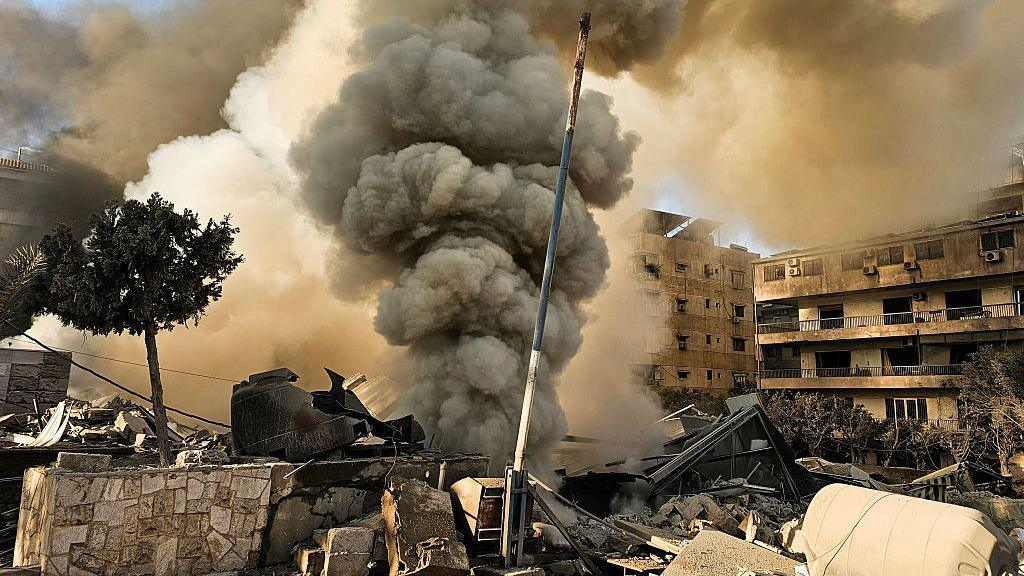
Israel says it has carried out new attacks on Iran’s “leadership compound” in Tehran, including the presidential office
One reporter inside Iran says ‘every part” of Teheran has been hit since Saturday, while new pictures show explosions in the east of the city.
The number of people killed since US-Israeli attacks began has reached 787, the Red Crescent says.
Elsewhere, Israel says ground troops will ‘advance and seize aditional strategic areas in Lebanon in order to stop attacks on Israel
The US embassy in Riyadh, Saudi Arabia, has been hit by two drones, seemingly from Iran
And the gas price on international markets has risen again – up 30% at one point o Tuesday morning, after 50% increases on Monday
Meanwhile, US President Donald Trump has again criticised Keir Starmer for initially denying access to British bases.
The US and Israel struck Iran on Saturday, killing Supreme Leader Ayatollah Ali Khamenei. Iran has retaliated with a wave of attacks across the region. On Monday, the US told Americans across the Middle East to “depart now”.
[BBC]
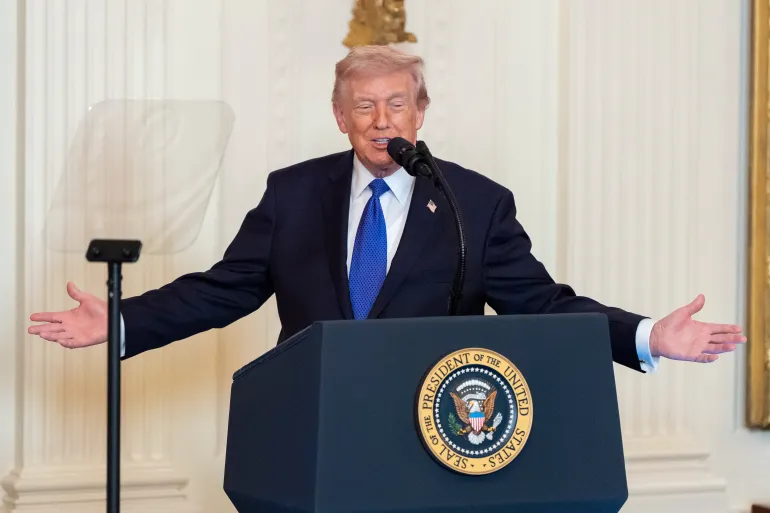
United States President Donald Trump has said the plan for the Iran war initially “projected four to five weeks”, adding the US military has the “capability to go far longer than that”.
Speaking on Monday from the White House, Trump outlined his administration’s justification for going to war against Iran alongside Israel, saying that Iran posed “grave threats” to the US, even as he again claimed that US strikes on Iran in June of last year led to the “obliteration of Iran’s nuclear programme”.
Trump also said that Iran’s ballistic missile programme was “growing rapidly and dramatically, and this posed a very clear, colossal threat to America and our forces stationed overseas”.
“The regime already had missiles capable of hitting Europe and our bases, both local and overseas, and would soon have had missiles capable of reaching our beautiful America,” Trump said, repeating a claim his administration has repeatedly made in the run-up to Saturday’s attack, for which US government officials have not provided any evidence.
The statements were significant, with Trump appearing to pivot from claims that Iran posed an immediate threat to the US. Instead, he characterised the Iranian government as potentially posing a longer-term threat.
“The purpose of this fast-growing missile programme was to shield their nuclear weapon development and make it extraordinarily difficult for anyone to stop them from making these – highly forbidden by us – nuclear weapons,” Trump said.
“An Iranian regime armed with long-range missiles and nuclear weapons would be an intolerable threat to the Middle East, but also to the American people,” Trump said.
“Our country itself would be under threat, and it was very nearly under threat,” Trump said.
Under both US domestic law and international law, attacks on a foreign country must be in response to an immediate threat. Under the US Constitution, only Congress can declare war, while the president can act unilaterally in response to an imminent threat.
Trump has released two video speeches since the US and Israel began their attacks, including saying in a recorded message released yesterday that Iran had waged a “war against civilisation”.
He also predicted there would likely be more US military personnel deaths after the Pentagon confirmed the first three members of the military killed in the Middle East on Sunday.
To date, at least 555 people have been killed in Iran, 13 have been killed in Lebanon, 10 killed in Israel, three killed in the United Arab Emirates, and two killed in Iraq, with Oman, Bahrain and Kuwait each reporting one death amid Iranian retaliations in the region.
On Monday, shortly after the Pentagon confirmed a fourth member of the US military had died, Trump did not give a clear timeline for the operations.
He said “Right from the beginning, we projected four to five weeks, but we have capability to go far longer than that.”
Trump added that the military had originally projected four weeks to “terminate the military leadership” of Iran.
To date, Iran’s Supreme Leader Ali Khamenei and several other top officials, including the head of Iran’s Islamic Revolutionary Guard Corps (IRGC), have been confirmed killed in US-Israeli strikes.
“We’re ahead of schedule there by a lot,” Trump said.
Trump spoke shortly after Pentagon chief Pete Hegseth took questions from reporters for the first time since the attacks began.
Hegseth appeared to respond to concerns from Trump’s own “Make America Great Again” (MAGA) movement about entering into a prolonged war.
Trump had vowed to end US interventionism during his presidential campaign, promising to focus on domestic needs over adventurism abroad.
“This is not Iraq. This is not endless,” Hegseth said.
“This operation is a clear, devastating, decisive mission. Destroy the missile threat, destroy the navy, no nukes,” he said.
“Israel has clear missions as well, for which we are grateful, capable partners,” he said, without defining Israel’s mission.
Israeli Prime Minister Benjamin Netanyahu has long called for the toppling of Iran’s government
Hegseth further vowed to fight the war “all on our terms, with maximum authorities, no stupid rules of engagement, no nation-building quagmire, no democracy building exercise, no politically correct wars”.
[Aljazeera]
Six US soldiers killed in Iranian strike on Kuwait base

Israel attacks presidential office in Tehran as reported death toll in Iran rises to 787

Attorney At Law S K Sangakkara pasess away

SriLankan Airlines Update on Middle East Operations

Trump says Iran war projected to last 4 to 5 weeks, could go ‘far longer’

Qatar downs two Iranian fighter jets as conflict widens

‘Dates have the highest sugar content to fight Coronavirus’

Sunday Island 27 December – Headlines

#SundayIsland 17th December – Headlines

Sunday Island – 28th March

Sunday Island Headlines – 21 March

Sunday Island – 21st February – Headlines
-

 Opinion5 days ago
Jamming and re-setting the world: What is the role of Donald Trump?
-
 Features5 days ago
An innocent bystander or a passive onlooker?
-
 Features6 days ago
Ratmalana Airport: The Truth, The Whole Truth, And Nothing But The Truth
-

 Business7 days ago
Dialog partners with Xiaomi to introduce Redmi Note 15 5G Series in Sri Lanka
-

 Features7 days ago
Building on Sand: The Indian market trap
-
 Opinion7 days ago
Future must be won
-

 Features2 days ago
Brilliant Navy officer no more
-

 Business6 days ago
IRCSL transforms Sri Lanka’s insurance industry with first-ever Centralized Insurance Data Repository