
News
JICA continues to strengthen medical care in Base Hospitals in Lanka

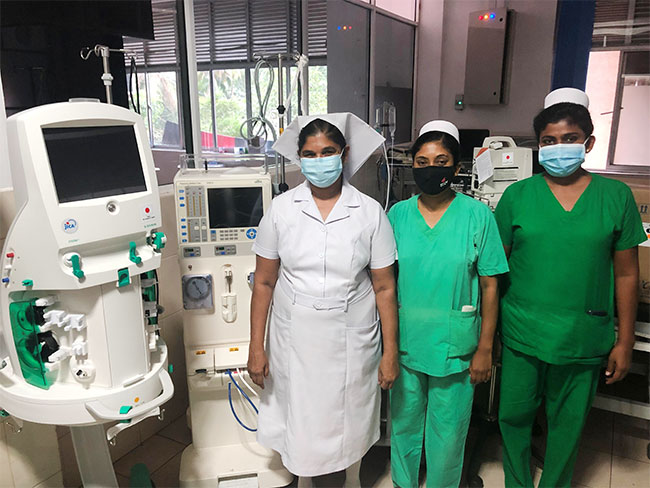
Japan International Cooperation Agency (JICA), together with the Ministry of Health, held the handover ceremony of medical equipment, at the District General Hospital, in Nawalapitiya, and the Base Hospital, in Karawanella, on 20th August 2022, with the presence of Dr. Sunil de Alwis, Additional Secretary of the Ministry of Health, and Tetsuya Yamada, Chief Representative of JICA Sri Lanka office.
During the ceremony, Yamada said,” JICA has been one of the biggest development partners and Japan and Sri Lanka are celebrating the 70th anniversary of bilateral relationship, this year, and this is thanks to the strong human history, which is the base for the long lasting friendship.
Dr. Alwis appreciated the government of Japan and JICA’s cooperation when Sri Lanka is facing a hard time. He said that true friendship between the two countries has further strengthened as Japan did not leave us at this difficult moment. And it is reassuring to know that JICA will continue with other such projects in the future.”
Since May 2021, JICA, together with the Ministry of Health, has been implementing a technical cooperation project to strengthen capacities in the preparedness and development for diagnostics and treatment services to combat infectious diseases, including COVID-19, and the equipment and online training opportunities have been provided to the targeted hospitals. Through this project, Rs. 300 mn worth of essential equipment are distributed to the Base Hospitals in Teldeniya, Warakapola, Walikanda, Pimbura, Nawalapitiya, Hingurakgoda, Karawanella, and Avissavella (mainly for treatment) and District General Hospital Hambantota (particularly for PCR tests).
In the year 2022, which marks the 70th Anniversary of the establishment of diplomatic relations between Japan and Sri Lanka, most of the essential equipment delivered, installed, and handed over to the targeted hospitals, are already in use. The equipment contributed to improving the quality of medical services, not only relating to COVID-19 but also relating to other diseases, as well. The local people are now able to access the upgraded medical services. The remaining equipment will be installed soon, within this year.

Latest News
Landslide RED warnings issued to the Divisional Secretaries Divisions of Ududumbara, Nildadndahinna and Walapane


The landslide early warning center of the National Building Research Organisation [NBRO] has issued RED warnings to the districts of Kandy and Nuwara Eliya for the next 24 hours effective from 0900 hrs today [09th January].
Accordingly,
LEVEL III RED landslide early warnings have been issued to the Divisional Secretaries Divisions and surrounding areas of Ududumbara in the Kandy district, and Nildandahinna and Walapane in the Nuwara Eliya district.
LEVEL II AMBER landslide early warnings have been issued to the Divisional Secretaries Divisions and surrounding areas of Wilgamuwa in the Matale district, and Mathurata and Hanguranketha in the Nuwara Eliya district.
LEVEL I YELLOW landslide early warnings have been issued to the Divisional Secretaries Divisions and surrounding areas of Uva Paranagama, Welimada, Kandaketiya, Badulla, Meegahakiwula, Hali_Ela, Passara and Lunugala in the Badulla district, Minipe in the Kandy district, Ambanganga Korale, Ukuwela, Rattota, Naula and Laggala_Pallegama in the Matale district, and Nuwara Eliya in the Nuwara Eliya district.
Latest News
A Policy is being formulated to ensure Child Protection in the use of Technology — Prime Minister

Prime Minister Dr. Harini Amarasuriya stated that a policy is currently being formulated to ensure child protection in the use of technology.
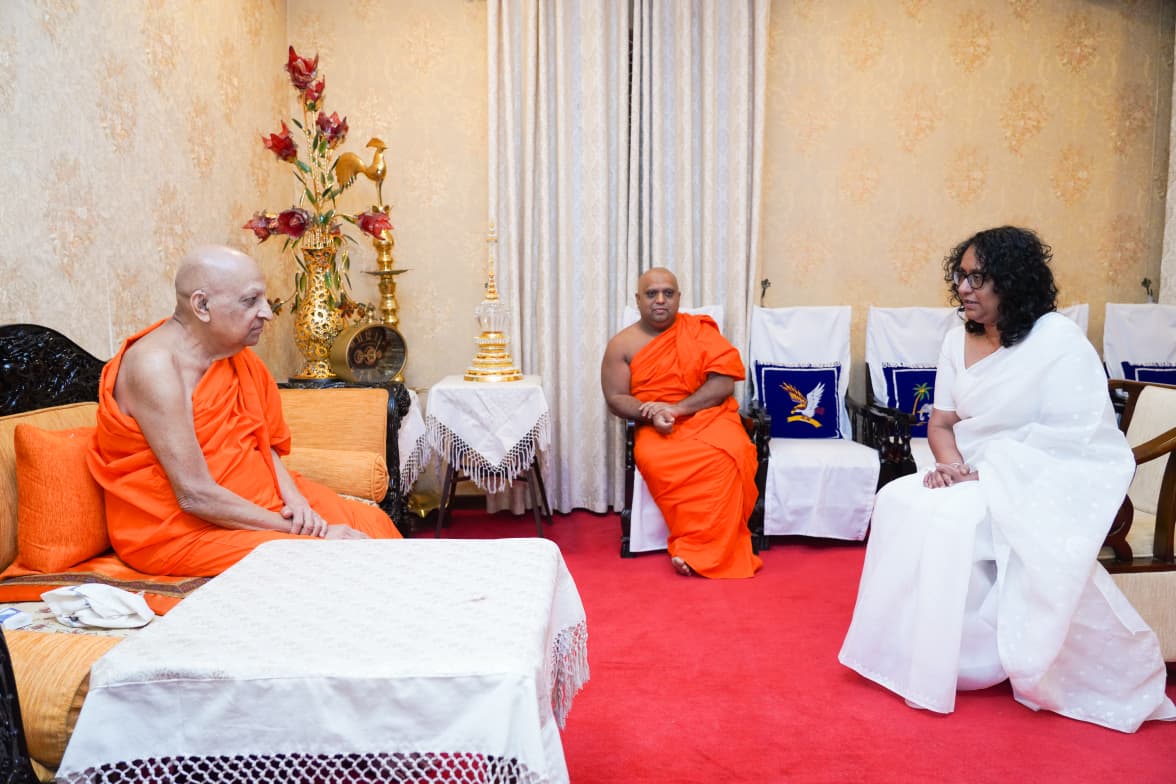
The Prime Minister made this statement on Thursday (08) in Kandy while briefing the Most Venerable Mahanayake Theros of the Asgiriya and Malwathu Chapters on the issue that has arisen regarding the Grade 6 English module. Thereafter, printed copies of all modules were presented to the Mahanayake Theros.
Earlier on Thursday (08), the Prime Minister visited the Malwathu Viharaya in Kandy and met the Most Venerable Thibbatuwawe Sri Siddhartha Sumangala Nayaka Thero, the Mahanayake of the Malwathu Chapter, where she explained the error that had occurred in the first print run of the English module for Grade 6 .
The Mahanayake Theros emphasized that education is a sensitive subject and that such matters should be handled with greater sensitivity and proper oversight. They further advised that a formal investigation should be conducted and that education reforms should be carried forward in a systematic manner.
Subsequently, the Prime Minister visited the Asgiriya Maha Viharaya and met the Most Venerable Warakagoda Sri Gnanarathana Mahanayaka Thero of the Asgiriya Chapter, where she clarified the error related to the English module.
The Mahanayake Thero noted that education reforms are a timely necessity and should be implemented with due oversight and careful review and also pointed out that there are broader issues in Sri Lanka regarding the use of technology, which are evident in the manner in which modern tools such as AI technologies are being used on social media.
Clarifying the issue Prime Minister Dr. Harini Amarasuriya further stated,
“We have appointed a committee to look into this issue, and based on the recommendations of the National Institute of Education (NIE), steps were taken to remove the relevant lesson. In addition, all printed copies of the relevant module have been stamped, and no module has been distributed to schoolchildren. A formal investigation into this matter has been initiated by the Ministry, and a complaint has also been lodged with the Criminal Investigation Department.
At the same time, we are in the process of formulating a policy on child protection in the use of technology”.
Thereafter, addressing the media and responding to the’ questions raised by journalists, the Prime Minister stated:
“The Opposition is attempting to use this national task for their own political advantage. However, many in society have expressed their views on the issues that have arisen in a positive manner, with the objective of identifying and correcting mistakes. The government has decided to move forward with education reforms by recognizing the error that have occurred and rectifying them. We will take the no-confidence motion brought by the Opposition as an opportunity to further advance dialogue on education reforms”
The occasion was graced by the Most Venerable Anunayaka Thero of the Asgiriya Chapter, Venerable Narampanawe Ananda Nayaka Thero; Deputy Registrar of the Asgiriya Chapter, Venerable Muruddeniye Dhammarakkhita Thero; Deputy Registrar of the Malwathu Chapter, Venerable Mahawela Rathanapala Thero; Members of Parliament Thushari Jayasinghe and Thanura Dissanayake; Mayor of Kandy Chandrasiri Wijenayake; Secretary to the Ministry of Education Nalaka Kaluwewa; and Secretary to the Ceylon Teachers’ Union in Central Province D. D. Wimalaweera.
[Prime Minister’s Media Division]
Latest News
The deep depression to the South-east of Sri Lanka is likely to intensify in to a cyclonic storm during the next 24 hours

A RED warning for a deep depression to the South-east of Sri Lanka has been issued at 01.00 a.m. on 09 January 2026 for the period until 01.00 a.m. 10 January 2026 by the Natural Hazards Early Warning Centre, of the Department of Meteorology.
The deep depression in the Bay of Bengal to the southeast of Sri Lanka (At 01:00 a.m. on Jan 9th, 2026 located about 200 km East of Pottuvil) is very likely to intensify further and move west-northwestwards towards the coast of Sri Lanka between Pottuvil and Trincomalee in the evening today (9th January 2026.) The system is likely to intensify in to a cyclonic storm
during the next 24 hours.
Hence, showery, and windy condition over the island, particularly in the Northern, North-Central, Eastern, Uva and Central provinces is expected to enhance.

Colombia sees ‘real threat’ of US military action, president tells BBC

Landslide RED warnings issued to the Divisional Secretaries Divisions of Ududumbara, Nildadndahinna and Walapane

Harmanpreet, Mandhana return to DY Patil, on opposite sides this time

Huge anti-government protests in Tehran and other Iranian cities, videos show

Clinical Pakistan look to keep momentum going and wrap up series

Astronaut’s ‘serious medical condition’ forces Nasa to end space station mission early

‘Dates have the highest sugar content to fight Coronavirus’

Sunday Island 27 December – Headlines

#SundayIsland 17th December – Headlines

Sunday Island – 28th March

Sunday Island Headlines – 21 March

Sunday Island – 21st February – Headlines
-

 News3 days ago
Interception of SL fishing craft by Seychelles: Trawler owners demand international investigation
-
 News3 days ago
Broad support emerges for Faiszer’s sweeping proposals on long- delayed divorce and personal law reforms
-

 News4 days ago
Private airline crew member nabbed with contraband gold
-

 Opinion12 hours ago
The minstrel monk and Rafiki, the old mandrill in The Lion King – II
-

 News2 days ago
Prez seeks Harsha’s help to address CC’s concerns over appointment of AG
-

 Features12 hours ago
The Venezuela Model:The new ugly and dangerous world order
-

 Latest News1 day ago
Warning for deep depression over South-east Bay of Bengal Sea area
-

 News2 days ago
Govt. exploring possibility of converting EPF benefits into private sector pensions