
Latest News
Jansen, Markram hand South Africa statement win

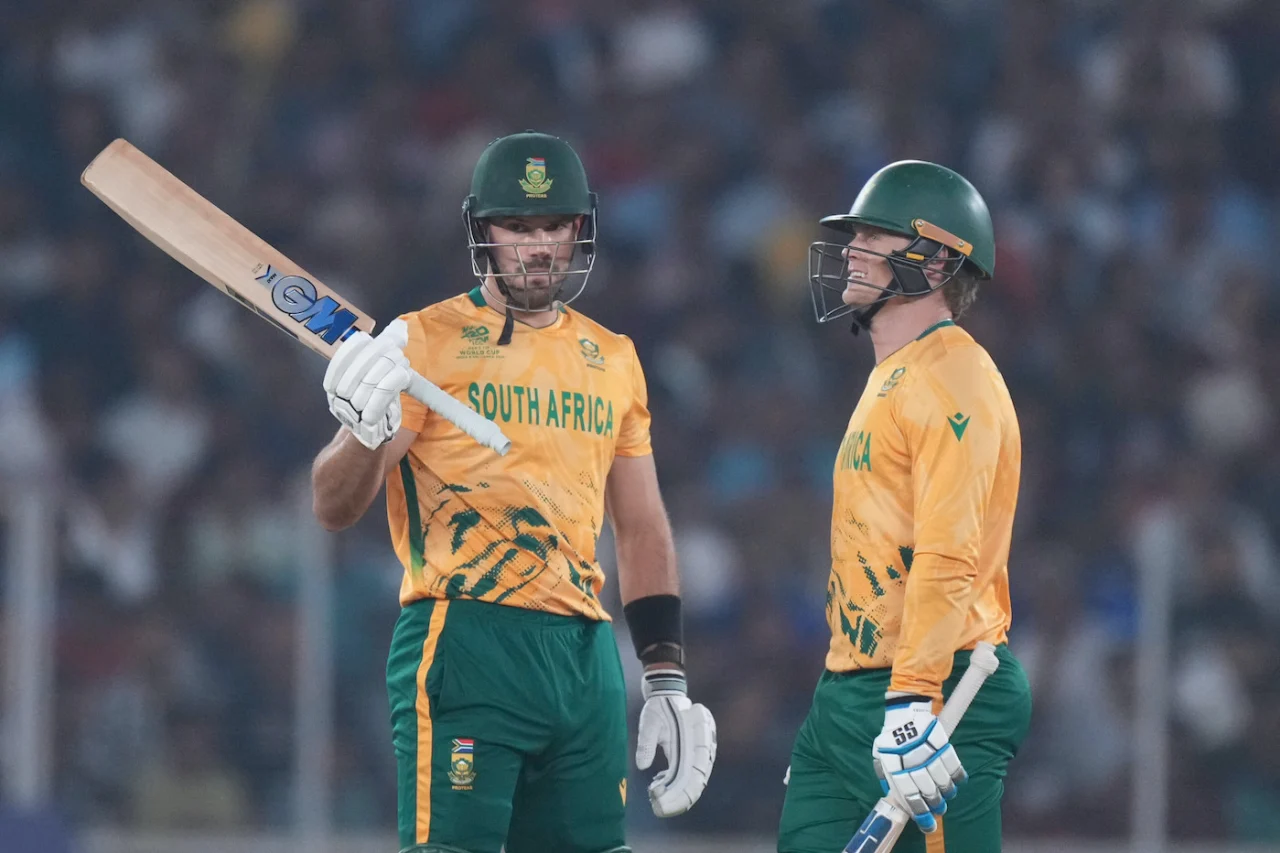
Marco Jansen’s first four-wicket haul in T20Is broke the back of two New Zealand assaults to give South Africa an easy win and a likely top spot in Group D. Not that the finish matters as the teams’ games in Super Eights are pre-decided as long as they make it out of the first group.
This was the first successful chase in a night game of this World Cup, but this was also arguably the first night match between evenly matched sides. Having survived Afghanistan in this group of death, both sides played with freedom. New Zealand kept coming at South Africa, reaching 33 for 0 in 3.1 overs, 57 for 1 in 5.1 and then 138 for 4 in 13.5.
However, Jansen pegged New Zealand back every time, the final strike resulting in a practical shutdown: only 37 came off the last 37 balls as New Zealand ran out of batting. In response, Aiden Markram’s personal best of 86 off 44 ended the game with 17 balls to spare, making it 5-0 for them against New Zealand in T20 World Cups.
Lungi Ngidi and Kagiso Rabada kept the dangerous duo of Tim Seifert and Finn Allen quiet for two overs, but the eventual onslaught arrived on a pitch where the ball came onto bat beautifully. Allen started off with three fours and a six in the third over, bowled by Ngidi. The powerplay hitting involved no innovation or cuteness, just timing and power.
Jansen’s first ball of the night was dismissed disdainfully for a six over mid-on by Siefert. Jansen immediately went to Plan B. Mid-on went back, leaving no boundary riders on the off side. Siefert looked to exploit that field but Jansen bowled an accurate short ball to take an edge through to the keeper.
Allen didn’t slow down, but then Jansen came back for the last over of the powerplay to take out Rachin Ravindra and Allen. While Ravindra got a thick edge to short third, Allen got too close to a slower offcutter and couldn’t find the elevation to clear mid-off.
Mark Chapman still kept coming, but when Keshav Maharaj bowled Glenn Phillips to make it 64 for 4 in seventh over, New Zealand finally had to go into recovery mode.
To be absolutely accurate, only Mitchell was in recovery mode. Chapman looked in fine touch, and pulled Maharaj for a six two balls after Phillips’ fall. Ngidi managed to bowl the 10th over without a boundary, but in the 11th and 12th the duo took 29. Corbin Bosch was hit for a four by each batter, and Markram a six each. At 131 for 4 in 13, New Zealand were back on track for 200, which looked like the bare minimum to stay competitive.
Jansen had got one wicket with a slower ball already, but on his return he unveiled a knuckle ball, which completely bewitched Chapman, who was 48 off 25 at that point. When Ngidi had Mitchell caught at long-on – for a change, with an on-pace delivery that hit the inner half of the bat – New Zealand had lost six wickets with more than four overs left. Only James Neesham could do some damage in the end but 175 looked paltry with dew already apparent.
It almost looked like a footnote that he brought up the fastest half-century for South Africa in T20 World Cups in 19 balls and took South Africa to their joint-highest powerplay score in t20 World Cups, 83. Quinton de Kock and Ryan Rickelton didn’t do badly either, scoring 20 off 14 and 21 off 11, but it wasn’t possible to take your eye off Markram’s driving.
Brief scores:
New Zealand 175/7 in 20 overs (Tim Siefert 13, Finn Allen 31, Rachin Ravindra 13, Mark Chapman 48, Daryl Mitchell 32, James Neesham 23*;Lungi Ngindi 1-34, Marco Jansen 4-40, Keshav Maharaj 1-24, Corbin Bosch 1-34) lost to South Africa 178/3 in 17.1 overs (Aiden Markram 86*, Quinton de Kock 20, Ryan Rickelton 21, Dewald Brevis 21, David Miller 24*; Lockie Ferguson 1-33, James Neesham 1-15, Rachin Ravindra 1-09) by seven wickets
[Cricinfo]







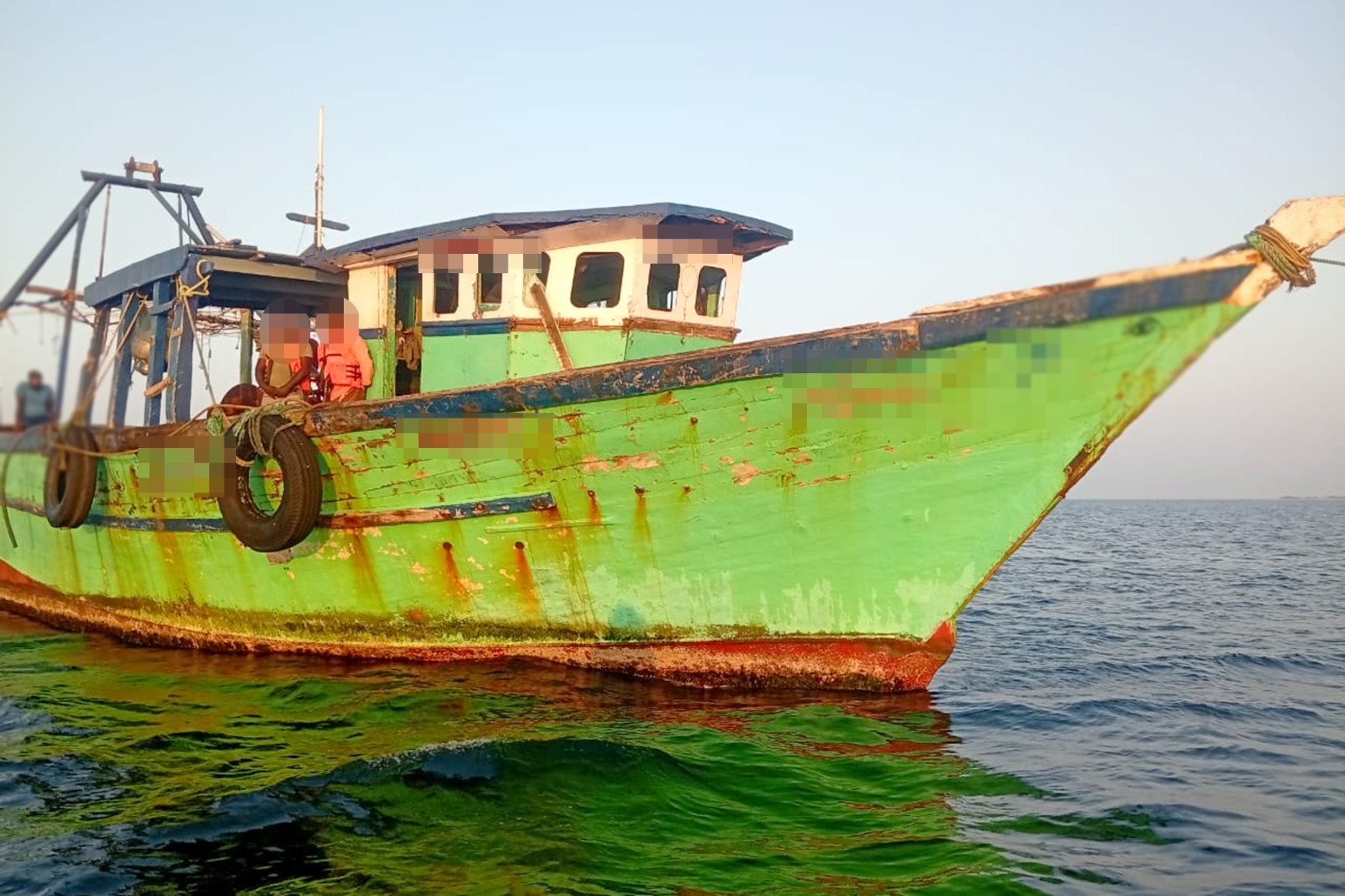
During an operation conducted in the dark hours of 11 Mar 26, the Sri Lanka Navy seized an Indian fishing boat and apprehended 02 Indian fishermen while they were poaching in Sri Lankan waters, in the sea area North of Mannar.
The North Central Naval Command spotted a group of Indian fishing boats engaging in illegal fishing, trespassing into Sri Lankan waters. In response, naval craft of the North Central Naval Command were deployed to drive away those Indian fishing boats from island waters off Mannar.
The seized boat (01) and Indian fishermen (02) were handed over to the Fisheries Inspector of Kilinochchi for onward legal proceedings.

The bodies of 84 Iranian sailors killed in a torpedo attack by a US submarine last week in the Indian Ocean are due to be flown home on Friday, Sri Lanka’s defence ministry has said.
The seamen were among 130 thought to be aboard the Iranian warship, the Iris Dena, when it was sunk on 4 March about 40km (25 miles) from Sri Lanka’s southern coastline.
A police escort transferred bodies to Mattala Rajapaksa International Airport on Friday morning for the repatriation to Iran, after they were stored in two freezers at Galle National Hospital.
Sri Lanka said 32 sailors rescued by its navy after the torpedo attack “will remain in Sri Lanka”, according to news agency AFP.
A magistrate in the Sri Lankan city of Galle ordered that the 84 bodies should be released to the Iranian embassy.
US Defense Secretary Pete Hegseth said shortly after the sinking that the Iranian warship had died a “quiet death”.
Iran’s Foreign Minister Abbas Araghchi said the US had “perpetrated an atrocity at sea, 2,000 miles away from Iran’s shores”, adding that “the US will come to bitterly regret precedent it has set”.
Video released by the US Department of Defense after the incident showed a ship being struck, causing the stern to rise up before exploding.
The Iris Dena had been returning from a military exercise hosted by India when it was attacked.
Its sinking in international waters came during the current US-Israeli war with Iran and marked a dramatic widening of the conflict.
Iran has since launched retaliatory strikes across the Middle East – targeting Gulf countries allied with the US.

Four of six members of a US military refueling aircraft’s crew have been confirmed dead after it crashed in western Iraq, US Central Command (Centcom) says.
Rescue efforts continue after the loss of the KC-135, it said, having earlier said neither hostile nor friendly fire were involved in the downing of the aircraft.
The tanker had been involved in ongoing US operations against Iran and was one of two aircraft involved in the incident. The second landed safely.
The Boeing-manufactured aircraft are capable of refueling planes midair and typically play a major role in US military operations. They were used extensively in the first Gulf War to extend the range of fighter jets and bombers.
Centcom said the incident occurred around 14:00 ET (19:00 GMT) on Thursday and that the circumstances of the crash were now under investigation.
The US military command unit added that the identities of the personnel who had been killed were being withheld for 24 hours so their next of kin could be notified.
The KC-135 usually has a crew of at least a pilot, a co-pilot and a boom operator responsible for controlling the refuelling arm of the aircraft.
Centcom earlier described the crash as happening over friendly airspace – but this is a region of Iraq where pro-Iranian militias operate. Iran’s military claimed on state TV that an allied group had targeted the plane with a missile.
Thursday’s crash brings the official US military death toll in the US-Israel war with Iran, which began a fortnight ago, to 11.
The US military has now lost at least four aircraft during the current war.
Earlier this month, three F15s were shot down in “an apparent friendly fire incident” over Kuwait, officials said. All six crew members were able to safely eject.
Boeing manufactured the KC-135 Stratotanker for the US military in the 1950s and early 1960s.
It has been a backbone to the US military’s air refuelling fleet, and allow combat aircraft to carry out longer missions without needing to land.

[BBC]

Navy seizes an Indian fishing boat poaching in Mannar seas

Bodies of 84 Iranian sailors killed in US torpedo strike to be repatriated

Four crew members killed after US refuelling plane crashes in Iraq

Safeguarding linguistic heritage is not only a cultural responsibility, but also a shared commitment to preserving the diversity of our world – PM

This is not an ordinary scholarship programme. It defines the future vision of our country – PM

West Indies name unchanged squad for home T20Is against Australia

‘Dates have the highest sugar content to fight Coronavirus’

Sunday Island 27 December – Headlines

#SundayIsland 17th December – Headlines

Sunday Island – 28th March

Sunday Island Headlines – 21 March

Sunday Island – 21st February – Headlines
-

 News7 days ago
Peradeniya Uni issues alert over leopards in its premises
-
 News5 days ago
Repatriation of Iranian naval personnel Sri Lanka’s call: Washington
-

 News7 days ago
Wife raises alarm over Sallay’s detention under PTA
-

 Features5 days ago
Winds of Change:Geopolitics at the crossroads of South and Southeast Asia
-

 News4 days ago
Prof. Dunusinghe warns Lanka at serious risk due to ME war
-

 Sports3 days ago
Royal start favourites in historic Battle of the Blues
-

 Latest News7 days ago
Heat Index at ‘Caution Level’ in the Sabaragamuwa province and, Colombo, Gampaha, Kurunegala, Anuradhapura, Vavuniya, Hambanthota and Monaragala districts
-

 Features7 days ago
The final voyage of the Iranian warship sunk by the US