
Life style
‘Its not like chicken farming’: why manta rays are being chopped up in Sri Lanka


by Zinara Rathnayake
The gill plates of the extremely intelligent fish – many species of which are already categorized as endangered – are sold across east Asia as remedies said to have ‘no basis in medical science’
Every morning, starting at 3am, Lakshan hacks up manta rays. A wholesale buyer who plies his trade at Sri Lanka’s largest fish market, in the city of Negombo, just north of Colombo, he jostles with fishers offloading their catches. His business is primarily to find fresh tuna but he also buys 700kg (1,540lb) of manta and devil rays every day.
He doesn’t want the ray’s meat, which most Sri Lankans don’t eat. Instead, he’s after the gill plates: cartilage that helps manta and devil rays filter out microorganisms in ocean waters.
In a courtyard across from the market, Lakshan dries the gill plates on a corrugated iron board. Then he sells them to another trader for as much as $130 (#104) per kilo. It seems a high price, but Lakshan (who gave only his first name out of concern for his trade) needs 5kg of fresh gill plates for every kilo of dried ones. He has only a vague idea what happens to them afterwards. “We heard they sell it to the Chinese because they eat them,” he says.
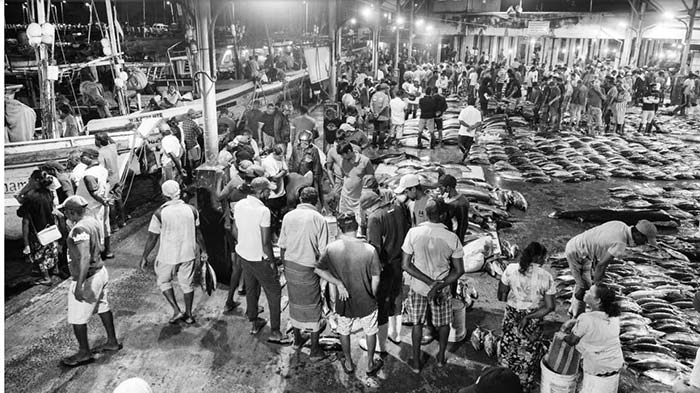
Buyers and sellers inspect the wares at the night market, where tuna and sailfish remain the most prized offerings
Dried gill plates are indeed often sold in medicine and dried seafood markets across east Asia, but are not used in traditional Chinese medicine. The growing demand for ray gill plates stems from market vendors using them to make soup that they tout a remedy for various health issues. The conservation charity Manta Trust calls these gill-plate concoctions “a pseudo-remedy” that has “no basis in medical science”.
The demand for gill plates has generated a sprawling cottage industry. Small-scale fisheries across Sri Lanka kill manta and devil rays (collectively known as mobulids), including endangered and vulnerable species, just to export their gill plates. A recent study showed that more mobulid rays are caught in Sri Lanka alone than the annual global catch across large industrial purse seine fisheries (huge operations that use curtain-like nets to scoop up marine life by the tonne). Their sizes are also declining, the study says.
Most mobulid species are classed as endangered, which means – according to the International Union for Conservation of Nature’s criteria – their populations has reduced by between 50% and 70% in the past decade. Meanwhile, the number of mobulids being caught continues to grow, with India, Indonesia and China the biggest culprits, feeding a thriving trade centred in Guangzhou, China, and Hong Kong.
Sri Lanka fishers don’t specifically target mobulids. Instead, the rays get entangled in gillnets used to catch yellowfin tuna, billfish and sailfish. Most Sri Lankans don’t eat them, though some add dried ray meat to curry; there’s little to no demand for the fresh meat.
This meant fishers used to release manta and devil rays back to the sea, but the lucrative gill plate trade has changed that. “Sometimes fishers used to cut off their heads and toss them out in the seas, because they thought that buyers wanted the meat,” says Daniel Fernando, the co-founder of the Blue Resources Trust, a non-profit marine research institution. “But traders didn’t want the meat. They wanted gill plates, which are in the head.”
The trade in plates provides much-needed additional income. Last year, Sri Lanka’s economy crashed, dragging many families into poverty. In its worst economic crisis since independence, the country ran out of basics such as food, cooking gas and fuel. Many people are still struggling to put meals on the table, and the World Food Program reported in February that 32% of households remained food-insecure. For fishery workers like Lakshan, gill plates bring much-needed income.
Manta rays are one of the most intelligent species of fish, with a brain up to 10 times larger than that of a whale shark and more highly developed areas for learning, problem solving and communicating. They are playful, curious and are thought to be able to recognize themselves in mirrors, a sign of self-awareness usually limited to the great apes, cetaceans and elephants.
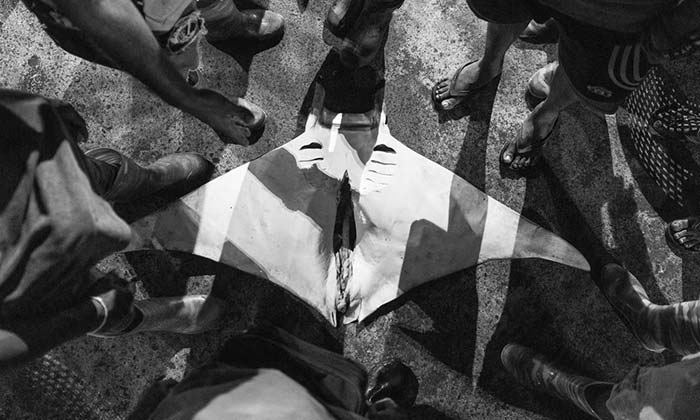
The tail of this species (madu-valgey) is used as a whip.
Trading rays is not illegal, although in 2014 the Convention on International Trade in Endangered Species of Wild Fauna and Flora (CITIES) brought in stronger protection for manta rays, and the international trade in their meat, gills and fins is supposed to be accompanied by permits and certificates confirming that they have been harvested sustainably and legally.
However, the UN’s Bonn Convention stipulates that the animals should not be captured for commercial purposes. Sri Lanka is also signed up to the Indian Ocean Tuna Commission, which requires that its members not retain any mobulid catch.
Sri Lanka itself has no legal framework to protect manta and devil rays. It has stopped issuing export permits but there are no national protections, Fernando said. Periodically, customs agents will stop shipments of gill plates being illegally exported, but the trade is persistent: in 2020, authorities at Hong Kong airport seized 300kg of manta ray gill plates worth $116,000, coming from Sri Lanka.
As fishing boats proliferate across the Indian Ocean, mobulids are under pressure. They’re particularly vulnerable biologically to overfishing: they have slow reproduction cycles, with young female mantas taking 10-15 years to mature sexually, and giving birth to just one pup every two or three years. “Their population can collapse in a very short time,” Fernando says. “Things will appear to be fine for a few years, and then, suddenly, they can pretty much get wiped out.”
He emphasizes that the problem is not limited to Sri Lanka. “These rays don’t respect political boundaries – they go in and out of Sri Lankan waters. It’s a regional issue, if not global. Action of one country is not sufficient.”
The organization is calling for governments to join in declaring protected areas for rays and their habitats to reduce by-catch, and to educate fishers about safely releasing juveniles back into the ocean to improve their chance of survival.
Replacing the use of gillnets – vertical walls of netting used to trap fish – with properly managed sustainable fishing methods such as longlines (miles-long lines with baited hooks) would also help, but the transition could take a long time as gillnets are the main method used by small fisheries.
Rays don’t have that time, Fernando says: their stocks are falling fast. He acknowledges that locals rely on them for income but points out: “We are not putting fish in the ocean and harvesting them. It’s not like chicken farming.
“Ideally, we should’ve looked into protecting them about four decades ago, to ensure they are caught sustainably, but we’ve waited so long that they now face imminent collapse,” he says. “We are going to have to make some very difficult decisions.” (Guardian)


 At Colombo Fashion Week,held recently at Cinnamon Grand,designer Aslam Hussein delivered a collection that spoke the language of quiet confidence and refined glamour, positioning him firmly as a Fashion Edit, favourite this season.
‘His collection unfolded like a carefully composed symphony – each piece moving with a rhythm of elegance and poise. Aslam Hussein’s runaway was more than a presentation – it was a story of refined luxury, individuality and timeless beauty where couture met emotion and each garment became a living expression of artistry.
Colombo Fashion Week was held this November at Cinnamon Grand ,namely Couture + Trousseau . The event was part of the luxury edit focused on high fashion,bridal wear and destination wedding,celebrating CFW’’s 22 rd anniversary Aslam Hussein opened the runway and his collection balanced sharp tailoring with fluid silhouettes, creating looks that felt both modern and enduring. Clean lines, thoughtful construction and an understated palette allowed craftsmanship to take centre stage. The colour palette was muted yet rich, allowing texture and craftsmanship to speak. Luxurious fabrics caught the light with every step, revealing subtle interplay between movement and form. Each silhouette told a story of – timeless, modern and effortless elegance

Aslam Hussein redefines elegance at CFW
Fluid silhouettes, muted palettes and clean tailoring defined his collection.
On the ramp,models moved with understated confidence, their hairstyles were created by. Ramani Fernando salons,the soft luminous makeup complemented the collection’s quiet sophistication. Each silhouette reflected Aslam’s commitment to craftsmanship, versatility and timeless style. Since establishing his label, he has been a staple on Sri Lanka’s fashion calendar, consistently presenting at Colombo Fashion Weeks and earning recognition for his designs.
His collection this year re-affirmed his mastery of understated elegance and contemporary luxury. Neutral tones were punctioned with occasion, deep shades, allowing fabric, cut and texture to take centre stage. Models carried the collection with measured poise. Make up was luminous yet natural, letting the silhouettes and individual model presence shine. Through his designs, Aslam Huseein has cultivated a following among modern cosmopolitan clientele who appreciate understated glamour, versatility and the quiet power of elegance.
His contributions have solidified his reputation as a designer who bridges Sri Lanka’s rich fashion heritage with an international sensibility.
Colombo Fashion Week is Sri Lanka’s premier event, showcasing the country’s top designers alongside emerging talent and is one of the glamorous events in the fashion landscape. The visionary is Ajay Vir Singh, founder of Colombo Fashion Week, whose leadership continues to elevate Sri Lanka’s premier fashion platform to international level.




Ramani Fernando salons is a name that has taken men and women’s grooming to new heights since its inception at Mount Lavinia. The salon has made its mark on the locals and celebrities alike. Over the years, Ramani Fernando Salons has not just set a benchmark for luxury grooming services but has also redefined how men perceive self-care, hair styling, and professional grooming. This salon at Mount Lavinia under its Manager Kappitiya Godage, namely Niroshan known by clients has become a favourite destination for those who sought more than just a haircut. The salon introduces a range of services—from precision styling and beard grooming to men’s makeup for photoshoots. The manager at Mount Lavinia is Niroshan Suresh. His philosophy emphasized that grooming is not just about appearance but also about confidence and self-expression and most importantly – self-care. He says make-up and grooming are not just limited to the opposite gender!
What makes Ramani Fernando Salon at Mount stand out. It is its innovative style and technique to men and women’s grooming. This branch prides itself on using cutting-edge tools and premium products that ensure every client leaves with a polished, customized look. The salon focus is on continuous learning and staying ahead of trends has earned it the loyalty of a discerning clientele.
Working at Ramani salons, Niroshan has spent many years perfecting the craft of styling, cutting and grooming men’s and woman’s hair, blending technical skill with a keen understanding of contemporary fashion trends. With years of experience, he guides clients on hairstyles and on the selection and proper use of styling products. His presence at Ramani Fernando salon at Mount Lavinia reinforce the brand’s reputation for excellence but also highlights the vital role of a skilled male stylist in shaping men and women’s grooming culture in Sri Lanka.
In the evolving world of men’s grooming, where style isn’t just about guiding a haircut but crafting a confident identity Niroshan at Mount Lavinia represent more than just a stylist or a place to cut hair. With Niroshan at the helm, this salon has become a place where style, innovation and meticulous grooming are curated for any client who walks in.
He is part of Ramani Fernando salons creative team, and brings creativity and precision to every look reflecting the high standards of Ramani Fernando’s renowned beauty collection
Niroshan has been with Ramani Fernando for several years and he is popular among his clients for those seeking sharp, modern and personalised hairstyles. With many years of experience, he has combined technical expertise with an eye for current trends ensuring each client leaves the salon looking confident and polished, Niroshan begins with a consultation, he carefully considers face shape, hair texture and personal style before recommending a look: He tailors each style to suit individual preferences, while ensuring easy to maintenance.
Beyond haircuts and grooming, his services include beard shaping, scalp and hair treatments and guidance on styling products. He makes each client of his leave the salon not just with a haircut but walk with confidence. He enjoys seeing his clients happy and self-assured. His experience, professionalism and knowledge make him a standard stylist in Colombo’s competitive grooming scene. He is very grateful to his senior and dynamic hairdresser Kamal for his guidance and expertise and who has been instrumental in shaping his approach to styling and artistry
by Zanita Careem ✍️

The Kingsbury, Colombo, welcomes the festive season with a spirit of warmth, elegance and celebration. This year’s Christmas and New Year offerings have been curated to bring guests together through moments of comfort, connection and shared joy across the hotel.
Harbour Court sets the tone for the season with its Christmas Eve Dinner Buffet, Christmas Day Brunch and Christmas Dinner on 24th and 25th December, followed by the New Year’s Eve Dinner Buffet on 31st December and the New Year’s Day Lunch and Dinner Buffets on 1st January. Kings Steakbar brings festive fine dining to Colombo with its Sunday Gourmet Carvery every Sunday in December, the Christmas Gourmet Carvery on 24th and 25th December, an á la carte Christmas Dinner on Christmas Day and a Seven-course Gourmet Dinner on New Year’s Eve.
Yue Chuan offers authentic Chinese cuisine with its signature Peking Duck Experience throughout December, daily Dim Sum and a special All You Can Eat menu on 24th, 25th and 31st December. At Tenk?, guests can enjoy elegant Japanese cuisine with the daily Teppanyaki Show, festive á la carte menus on 24th and 25th December and a New Year’s Eve Tasting Menu. Ocean highlights the best of coastal cuisine with festive á la carte menus on 24th, 25th and 31st December. Bringing Sri Lankan authenticity to the season, Tavern presents an Arrack Tasting Experience throughout December.
Festive cheer continues outdoors at Honey Beach Club with live music from 19th to 23rd December, poolside Festive party packages, and the signature New Year’s Eve celebration “Dancing Into 2026,” featuring Infinity and DJ E2. At Sky Lounge, guests can enjoy elevated festivities with Corporate Celebration packages, festive set menus, seasonal cocktails and the New Year’s Eve event “Party in the Sky,” featuring The Kingdom. Seas
For those celebrating at home, The Kingsbury offers Seasonal Roasts and festive hampers, available both ready-made and customisable, while Indulgence provides five-star delivery throughout the season. Families can also enjoy special offers, with children below six dining free and children aged six to ten receiving 50% off buffet dining. Seasonal cocktails, wine menus and bottle deals are available across all outlets.
This year, The Kingsbury, Colombo, invites guests to embrace the season with kindness, hope and cherished moments. Whether dining out, gathering with loved ones or gifting thoughtfully, we are honoured to share a season of splendour with you.

Showers may occur in the Northern, Eastern and Uva provinces and in Polonnaruwa, Matale and Nuwara-Eliya districts

Lankan aircrew fly daring UN Medevac in hostile conditions in Africa

Lanka to observe National Safety Day today

Street vendors banned from Kandy City

Police fully armed with breathalyser test kits during season of cheer

Hunt on for cops aiding and abetting heroin trafficking network in Moratuwa, Lunawa, Angulana and Ratmalana

‘Dates have the highest sugar content to fight Coronavirus’

Sunday Island 27 December – Headlines

#SundayIsland 17th December – Headlines

Sunday Island – 28th March

Sunday Island Headlines – 21 March

Sunday Island – 21st February – Headlines
-

 News3 days ago
Members of Lankan Community in Washington D.C. donates to ‘Rebuilding Sri Lanka’ Flood Relief Fund
-

 Latest News6 days ago
Landslide early warnings issued to the districts of Badulla, Kandy, Kurunegala, Matale and Nuwara-Eliya extended till 8AM on Sunday (21)
-

 News4 days ago
Air quality deteriorating in Sri Lanka
-
 Business5 days ago
Browns Investments sells luxury Maldivian resort for USD 57.5 mn.
-

 Editorial6 days ago
Cops as whipping boys?
-
 Features5 days ago
Another Christmas, Another Disaster, Another Recovery Mountain to Climb
-

 News4 days ago
Cardinal urges govt. not to weaken key socio-cultural institutions
-
 Features5 days ago
Hatton Plantations and WNPS PLANT Launch 24 km Riparian Forest Corridor