
Foreign News
Investigators find cockpit voice recorder from crashed Air India flight


Investigators have recovered the cockpit voice recorder (CVR) from the crashed Air India flight, a key step in uncovering what caused last week’s deadly accident.
The London-bound Air India aircraft, a Boeing 787-8 Dreamliner, crashed soon after taking off on Thursday from the western Indian city of Ahmedabad. At least 270 people have been killed, most of them passengers.
The CVR captures audio from the cockpit, including pilot conversations, alarms and ambient sounds.
The flight data recorder (FDR), which logs crucial flight parameters like altitude, speed and engine performance, had been recovered from the debris on Friday.
Both the CVR and FDR collectively form what is commonly known as the “black box” of a plane. It is a vital tool in air crash investigations, helping experts reconstruct the flight’s final moments and determine the cause of the incident.
The black box, unlike the name suggests, is actually two bright orange devices – one for the CVR and the other for the FDR – painted with reflective strips for easier recovery after a crash. Both these devices are designed to survive a crash.
India’s Aircraft Accident Investigation Bureau (AAIB) is leading the inquiry into the cause of the crash, helped by teams from the US and the UK.
On Sunday, officials from the US National Transportation Safety Board (NTSB) surveyed the site of the plane crash.
“The AAIB has launched a detailed investigation, and the US National Transportation Safety Board (NTSB) is conducting a parallel probe under international protocols, since the aircraft is American-made,” a statement released on Sunday said.
Indian media outlets have reported, citing sources, that officials from Boeing and the Federal Aviation Administration (FAA) – the US aviation safety agency – also visited the site.
Separately, a high-level committee set up by the Indian government to examine the reasons behind the crash is expected to hold its first meeting on Monday.
The committee will submit a preliminary report within three months, the Air India radio said, and will propose new standard operating procedures (SOPs) to help prevent similar incidents in future.
As the investigation continues, families on the ground are still grappling with disbelief and trauma.
Less than a minute after taking off from Ahmedabad’s Sardar Vallabhbhai Patel International Airport, the AI171 flight crashed into a doctors’ accommodation building at the BJ Medical College and Civil Hospital.
All but one of the 242 passengers and crew members were killed. Officials have also been trying to establish how many people were killed on the ground and continuing the slow process of matching DNA samples to confirm the victims’ identities.
Over the weekend, doctors said 270 bodies had been recovered from the site of the crash.
More than 90 victims have been identified through DNA matching, Dr Rajnish Patel of Ahmedabad’s Civil Hospital said on Monday. He added that 47 of the identified bodies have been sent to their families.
Among the identified victims is Vijay Rupani, the former chief minister of Gujarat, whose funeral will be held on Monday. Rupani, whose political career spanned more than 50 years, will be laid to rest with full state honours in Rajkot city.
For many other families, the agonising wait continues.
Officials told the BBC that the identification process has been slow and painstaking, as many of the bodies were badly burned in the crash and are being processed in small batches.
Mistry Jignesh, waiting outside the hospital for updates on his niece, told the BBC on Saturday that officials told him that it might take longer for them to hand over his niece’s remains as the search for bodies is still ongoing. He had earlier been told that the body would be handed over by Sunday, after the 72 hours it normally takes to complete DNA matching.
“When people are still missing, how can they complete the DNA process by tomorrow? What if my niece’s remains haven’t even been found? The wait is killing us,” he said.
(BBC)


Thousands of prisoners in Myanmar have been granted amnesty or had their sentences reduced. The pardon order by Min Aung Hlaing is one of his first official acts since the coup leader became president this month.
The move comes as the lawyer for jailed former leader Aung San Suu Kyi told the Reuters news agency that her sentence has been reduced. Former president Win Myint, detained since the 2021 coup, was also pardoned of his convictions, a statement from the presidency said.
Min Aung Hlaing approved an amnesty for 4,335 prisoners, Myanmar’s state television MRTV reported.
A communique on behalf of Min Aung Hlaing said “those serving death sentences shall have their sentences commuted to life imprisonment”, without naming specific prisoners.
“The President has pardoned Win Myint,” said another statement from Min Aung Hlaing’s office. Win Myint was “granted a pardon and the reduction of his remaining sentences under specified conditions”, MRTV said.
Suu Kyi, 80, is serving a 27-year sentence on charges her allies describe as politically motivated. Her sentence was cut by one-sixth, her lawyer told Reuters, but it remains unclear whether the Nobel Peace Prize winner will be allowed to serve the rest of her sentence under house arrest. Min Aung Hlaing placed Suu Kyi under arrest after the coup.
Amnesties typically happen as Myanmar marks Independence Day in January and its New Year in April.
Among those to be released are 179 foreign nationals, who will be deported. The amnesty also includes the commutation of all death sentences to life imprisonment, life sentences reduced to 40 years, and a one-sixth reduction in term lengths for all other prisoners.
[Aljazeera]

Several armed men robbed a bank in broad daylight in Naples, holding 25 people hostage before making their escape via a tunnel.
Police surrounded a branch of Crédit Agricole in the southern Italian city shortly after the robbery began around midday local time (10:00 GMT).
Local outlets reported that they negotiated with the robbers before the hostages could be released, about two hours into the robbery.
Firemen could be seen smashing in a window with battering rams and helping people climb out from inside in videos shared on social media.
Some hostages simply shook off the shards of glass and walked on.
But others looked visibly shaken, crying and hugging their relatives. Six people, who were in a state of shock, were offered medical assistance.
One man later told local news site Fanpage.it that the robbers had locked them into a room and that, while they were armed, “they did not use violence”.
Nobody was seriously injured. “Thanks to the swift response… all the hostages were freed shortly after 13:30 without serious injuries,” regional official Michele di Bari said in a statement.
A large crowd of bystanders, local residents and firefighters gathered in the square waiting for developments, while ten of thousands of people tuned into a livestream from the scene of the crime.
Members of the special forces of the carabinieri armed police were urgently flown in from Tuscany.
It was not until several hours later that they stormed the bank by breaking a window.
Several shots and the loud noises of stun grenades could be heard on the live feed shortly after.
But by then, the robbers had reportedly escaped through a tunnel, local media reported. It was thought they could have vanished into the sewer system.
The video feed later showed a number of carabinieri and firefighters peering into a manhole nearby as a crowd continued to mill about the square.
Fanpage.it reported that it was not yet possibly to quantify the value of the loot taken because the robbers had seized personal safety deposit boxes rather than cash.
(BBC)
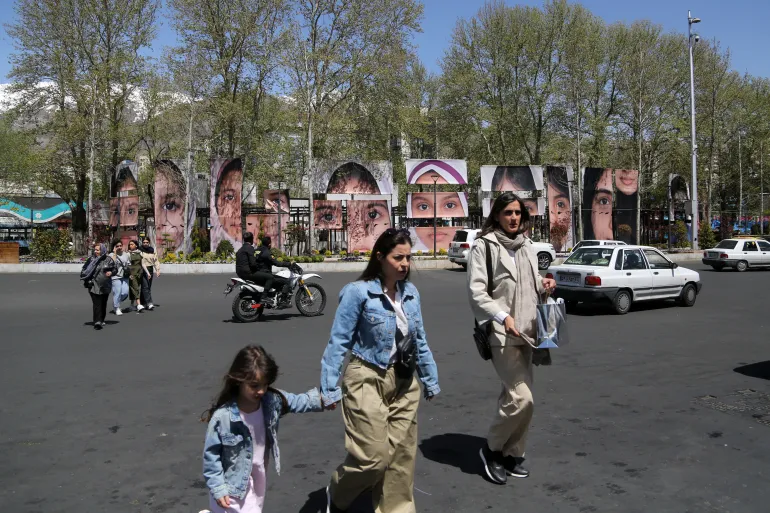
Iran has demanded that it receive compensation for the destruction caused by the United States and Israel’s attacks, as the country remains defiant and regional powers continue their attempts to mediate an end to the conflict.
Tehran’s envoy to the United Nations said on Tuesday that five regional countries must pay compensation, based on his accusation that their territories were used for launching attacks on Iran.
Iran has also raised the idea of compensation for damages to come through a Strait of Hormuz protocol, which would include a tax on ships passing through the waterway.
An early estimate indicates that Iran has suffered about $270bn in direct and indirect damages since the start of the US-Israel war on February 28, Iranian government spokeswoman Fatemeh Mohajerani said during an interview with Russia’s RIA Novosti news agency, published on Tuesday.
She did not provide further information, such as a breakdown of the damages, but said the issue of compensation was discussed in last week’s negotiations between Tehran and Washington in Pakistan, and will be raised in any potential future talks with the US and mediators.
The government has said it is still assessing the extensive damage dealt to Iran’s critical infrastructure, after oil and gas facilities, petrochemical companies, steel plants, and aluminium factories were repeatedly targeted, in addition to military complexes. These will take years to fully rebuild.
Bridges, ports and railway networks, universities and research centres, and several power plants and water desalination plants were also directly hit, while a large number of hospitals, schools and civilian homes were damaged or destroyed.
(Aljazeera)

Bodies of 50 infants dumped at Trinidad graveyard

Indonesian Navy Sailing Ship KRI BIMA SUCI – 945 concludes official goodwill visit to Sri Lanka

Malinga, Reddy sink Chennai Super Kings chase to defend under-par 194 in Hyderabad

Stubbs, Miller win Delhi Capitals a thriller against Royal Challengers Bengaluru

Showers predicted in the Western, Central, Sabaragamuwa, Uva, North-western, North-central and Southern provinces after 1.00 pm.

After dark in Sri Lanka: Tiny wild cats step into the spotlight

‘Dates have the highest sugar content to fight Coronavirus’

Sunday Island 27 December – Headlines

#SundayIsland 17th December – Headlines

Sunday Island – 28th March

Sunday Island Headlines – 21 March

Sunday Island – 21st February – Headlines
-

 Latest News7 days ago
PNS TAIMUR & ASLAT arrive in Colombo
-

 Latest News7 days ago
Prasidh, Buttler set up comfortable win for Gujarat Titans
-

 News4 days ago
PNS TAIMUR & ASLAT set sail from Colombo
-

 Latest News6 days ago
“I extend my heartfelt wishes to all Sri Lankans for a peaceful and joyous Sinhala and Tamil New Year!” – President
-

 Business2 days ago
Harnessing nature’s wisdom: Experts highlight “Resist–Align” path to resilience
-
 Latest News7 days ago
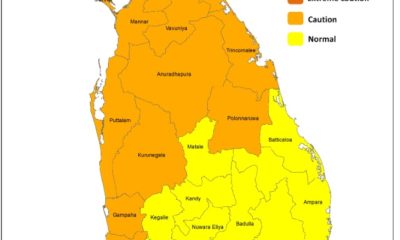
Heat Index at Caution level’ in the Northern, North-central, North-western, Western and Southern provinces and in Trincomalee district.
-

 News2 days ago
Gratiaen Trust announces longlist for the 33rd Annual Gratiaen Prize
-
 News2 days ago
Heroin haul transported on 50-million-rupee contract