
News
International experts due next month to examine Victoria dam

By Ifham Nizam
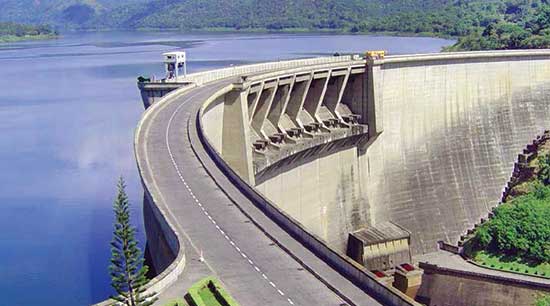
A team of international experts would be here next month to examine the Victoria dam built with a British grant in the 1980s and the government would go all out to maintain the dam according to international standards, said Mahaweli Zones Canals and Settlements Infrastructure Development State Minister, Siripala Gamlath.
The Minister told the media yesterday that all arrangements had been made for the foreign team to visit the country.
Engineers and the technical officers attached to the Sri Lanka Mahaweli Authority had been using modern equipment to monitor the stability of the dam round the clock due to the recent tremors in the vicinity, Gamlath said.
Gamlath said he had inspected all the monitoring machines installed there to obtain information about the functions and the stability of the dam and the seismometers.
Quoting engineers in charge of the dam, the Minister said that the stability of the Victoria Dam was 100% , and no damages had been caused due to the recent earth tremors felt in the region.
The team of experts would also visit Randenigala, Kotmale and Senanayake Samudraya dams, Gamlath said.
The 210 MW Victoria Hydro power Project Dam was declared open by then British Prime Minister Margret Thatcher. It was built by the internationally reputed British builders Balfour Beatty Nuttall. The scheme also irrigates the farmlands in the Mahaweli B and C Zones.
Mahaweli Zones Canals and Settlements Infrastructure Development State Ministry, Secretary Wasantha Palugaswewa said the expert team would evaluate reports next year and thereafter that expert team would issue a 30-year guarantee for the stability of the Victoria Dam as such a certificate was mandatory for all main reservoirs.
Sri Lanka Mahaweli Authority Director General Sunil S Perera said that a discussion was held with the Geological and Civil Engineering Faculty of the University of Peradeniya. It sent a team of experts for a field visit of the Victoria dam complex later and the team had made recommendations for the future cause of action to be taken, he said.
He said a 3D movable robot had been installed to check 74 spots of the dam and issue data daily and, accordingly, the safety of the Dam could be assured 100%.
He also said although there were lime deposits in the surrounding areas of the dam had been built on a stable site. The soil samples collected 40 years ago before the dam was constructed on the site were still available for testing if necessary, he said.
Deputy Director General (Technical Services) P.G. Gunapala, Director Main Dams and Reservoirs Rohana Aruppala, Engineer in Charge of the Victoria Reservoir Wasantha Ehalapitiya were also present at the media briefing.


The government, under heavy Opposition fire over inclusion of a sex website in the Grade 6 English module, as well as overall education reforms, has decided to put on hold reforms in respect of Grade 6.
Cabinet Spokesman and Media and Health Minister Dr. Nalinda Jayatissa announced the government decision yesterday (13) at the post-Cabinet media briefing at the Information Department.
According to him, the decision had been taken at the previous day’s Cabinet meeting, chaired by President Anura Kumara Dissanayake. Dr. Jayatissa said that education reforms pertaining to Garde 6 had been put on hold until 2027.
The Minister said that other proposed education reforms would be implemented as planned. The Minister said that action would be taken against those responsible for the inclusion of a link to a sex website following investigations conducted by the Criminal Investigation Department and the National Education Institute.
The SJB and several other political parties, as well as civil society groups, have accused the government of promoting an LGBTQ agenda, through the proposed education reforms.
The Opposition grouping Mahajana Handa, on Monday, made representations to the Mahanayake Thera of the Malwatta Chapter regarding the controversial reforms, while urging their intervention to halt the project.
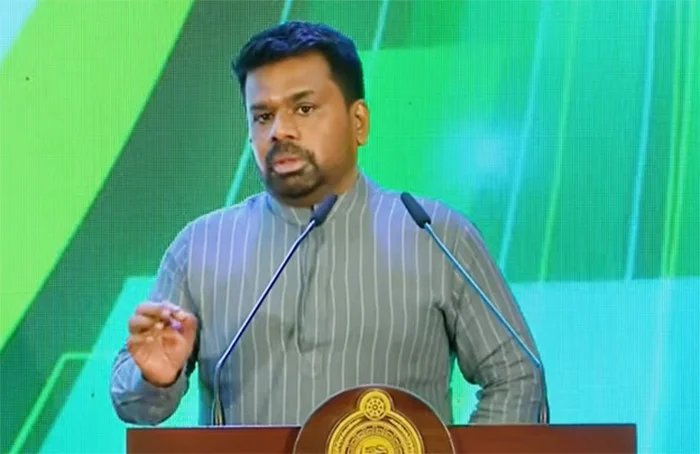
President Anura Kumara Dissanayake yesterday (13) vowed to go ahead with his government’s agenda, regardless of the destruction caused by Cyclone Ditwah.
Emphasising the responsibility on the part of all to contribute to the post-Ditwah recovery efforts, President Dissanayake said that he would have complete faith in the public service.
The President said so at the launch of the re-building Sri Lanka project at the BMICH yesterday.
The JVP and NPP leader said that he wouldn’t take advantage of the death and destruction caused by the cyclone or use the situation as an excuse to reverse their agenda or weaken it.
President Dissanayake said that in spite of many calling for amending the then Budget, in view of the cyclone, the government presented the proposals that were agreed before the disaster struck.

The United States has announced that it will provide the Sri Lanka Air Force with 10 US Navy TH-57 helicopters free of charge.
The announcement was made by outgoing US Ambassador Julie Chung, who stated, on social media, that the helicopters would be transferred under the United States’ Excess Defence Articles programme. The aircraft are Bell 206 Sea Ranger helicopters previously operated by the US Navy.
US sources said that the transfer was intended to strengthen Sri Lanka’s disaster response capabilities, following the devastating cyclone that struck the island at the end of 2025 and killed more than 600 people. US officials have framed the move as a humanitarian measure aimed at improving aerial rescue and relief operations.

Showery condition over the island is expected to reduce from tomorrow (15th)

USA’s Ali Khan claims having been ‘denied’ India visa ahead of T20 World Cup

At least 28 dead as crane collapses onto train in Thailand

Fair weather will prevail except for a few showers in the Uva, Eastern, Western and Central provinces and in Galle, Matara and Rathnapura districts

Trump cancels US-Iran meetings, urges protesters to take over institutions

Govt. bows to pressure, shelves Grade 6 reforms

‘Dates have the highest sugar content to fight Coronavirus’

Sunday Island 27 December – Headlines

#SundayIsland 17th December – Headlines

Sunday Island – 28th March

Sunday Island Headlines – 21 March

Sunday Island – 21st February – Headlines
-

 Business4 days ago
Dialog and UnionPay International Join Forces to Elevate Sri Lanka’s Digital Payment Landscape
-
 News4 days ago
Sajith: Ashoka Chakra replaces Dharmachakra in Buddhism textbook
-

 Features4 days ago
The Paradox of Trump Power: Contested Authoritarian at Home, Uncontested Bully Abroad
-

 Features4 days ago
Subject:Whatever happened to (my) three million dollars?
-

 News3 days ago
Level I landslide early warnings issued to the Districts of Badulla, Kandy, Matale and Nuwara-Eliya extended
-

 News4 days ago
65 withdrawn cases re-filed by Govt, PM tells Parliament
-

 News3 days ago
National Communication Programme for Child Health Promotion (SBCC) has been launched. – PM
-

 Opinion6 days ago
The minstrel monk and Rafiki, the old mandrill in The Lion King – II