
Latest News
Injury-hit New Zealand eye revenge as Afghanistan look to run it back

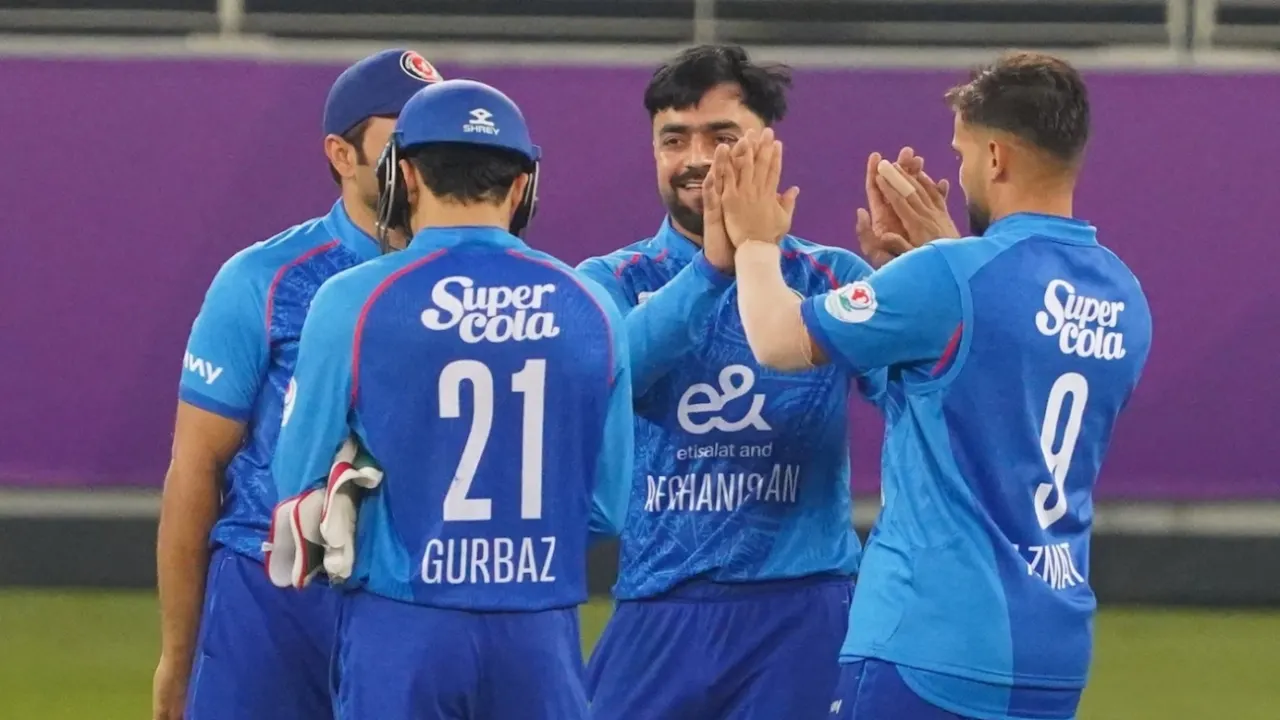
Afghanistan vs New Zealand in the early stages of a T20 World Cup. Sounds familiar? The memories of their clash in 2024 will be very pleasant or downright horrific depending on who you support. It proved a pivotal result with the teams going in vastly opposite directions after Afghanistan’s stunning 84-run hammering in Guyana.
It kick-started Afghanistan’s fairytale semi-final run, fuelling an outpouring of revelry in the streets back home. For New Zealand, it was effectively the beginning of the end as they flamed out in a rare early exit at a global tournament.
The teams have not played in any format since, creating even more anticipation for a rematch with big stakes. Group D is considered the ‘group of death’ with South Africa also in its ranks, amplifying the importance of this match for teams considered dark horses in the tournament.
New Zealand will be keen to banish the demons, but enter with plenty of question marks following a 4-1 series pummelling to India ahead of the World Cup. Of most concern, injury and illness have swept the squad and a strong start to the tournament could prove difficult.
But New Zealand should be at least familiar with the conditions, with some players having been in India for about a month. They should be match-hardened, and there will be confidence that the team can build through the tournament if they can weather this early storm.
They will need to muster one of their famed backs against the wall efforts, although there is no shortage of talent with New Zealand boasting a powerful batting order and several speedsters threatening to do damage if conditions are conducive.
Given the uncertainties over New Zealand, Afghanistan might just enter the match as favourites as they eye a strong start to a campaign they hope will go even further than their 2024 breakout.
Afghanistan will arrive confident having won six straight matches in the format before a 15-run defeat to West Indies in their series finale in Dubai last month.
They will unleash a formidable spin-heavy attack that should relish favourable conditions. While other Asian countries are hogging the spotlight, for various reasons, Afghanistan will go in under the radar but internally there should be optimism that they can inflict damage on high-profile opponents.
New Zealand Cricket has taken a pragmatic approach to the proliferation of T20 leagues by allowing players to take up casual agreements to have flexibility with their international commitments. Finn Allen has been one to take up the offer and it meant he missed most of the white-ball tour against India due to the BBL. But he has stated a strong desire to keep playing international cricket, music to the ears of New Zealand’s hierarchy. He clubbed 80 off 38 balls in his return in the fifth T20I in his first international match in 10 months. After a long layoff last year due to a foot injury, Allen ignited title-winners Perth Scorchers and he rewrote the six-hitting records during his destructive rampage. Such is the brutality, he even sometimes made opening partner Mitchell Marsh look relatively sedate by comparison. If he continues his heater – there is some doubt over his fitness for the opener – then New Zealand will get off to flyers.
Rashid Khan, obviously, is Afghanistan’s talisman and looms large over their campaign. There isn’t much more that can be said about the leggie who has taken the most wickets in T20I history with an economy of just six. The burden on his shoulders is even greater these days with the captaincy responsibilities but he should absolutely relish the likely drier surfaces. Rashid, of course, was at the heart of Afghanistan’s famous victory over New Zealand at the last T20 World Cup with a mesmerising 4 for17 from four overs and he’ll fancy something similar here.
New Zealand enter the tournament in disarray as they battle injury and illness. Batters Rachin Ravindra and Devon Conway have been struck down with illness, while Allen is nursing a shoulder injury he sustained against India. Allrounder Michael Bracewell and fast bowler Lockie Ferguson have been dealing with calf issues. There is optimism from the New Zealand camp that they will have a near full-strength squad to choose from although Ravindra appears unlikely to recover in time.
New Zealand XI (Probable): Finn Allen, Tim Seifert (wk), Rachin Ravindra/Devon Conway, Glenn Phillips, Daryl Mitchell, Mark Chapman, Michael Bracewell, Mitchell Santner (capt), Lockie Ferguson, Matt Henry Ish Sodhi
Unlike New Zealand, Afghanistan have few concerns and should field a full-strength line-up which includes their favoured spin-heavy attack.
Afghanistan XI (Probable): Rahmanullah Gurbaz (wk), Ibrahim Zadran, Sediqullah Atal, Darwish Rasooli, Mohammad Nabi, Gulbadin Naib, Azmatullah Omarzai, Rashid Khan (capt), Mujeeb Ur Rahman, Fazalhaq Farooqi, Noor Ahmad
[Cricinfo]

Latest News
Heat Index at Caution Level at some places in the Western, Sabaragamuwa, Southern, North-central and North-western provinces and in Monaragala, Mannar and Vavuniya districts
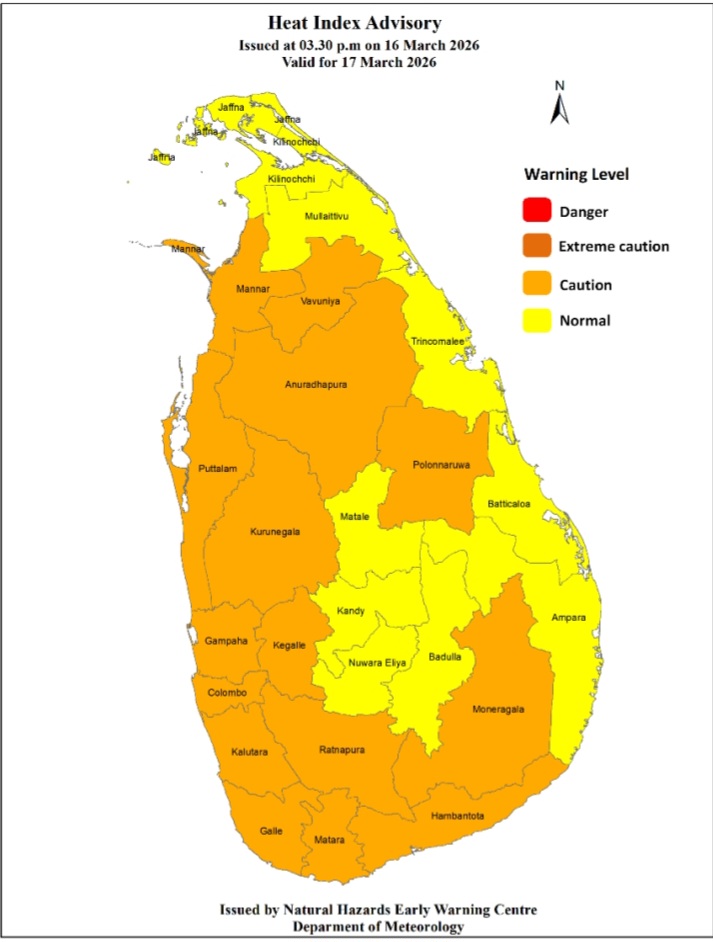
Warm Weather Advisory Issued by the Natural Hazards Early Warning Centre of the Department of Meteorology at 3.30 p.m. on 16 March 2026, valid for 17 March 2026
The general public are warned that the Heat index, the temperature felt on human body is likely to increase up to ‘Caution level’ at some places in the Western, Sabaragamuwa, Southern, North-central and North-western provinces and in Monaragala, Mannar and Vavuniya districts.
The Heat Index Forecast is calculated by using relative humidity and maximum temperature and this is the condition that is felt on your body. This is not the forecast of maximum temperature. It is generated by the Department of Meteorology for the next day period and prepared by using global numerical weather prediction model data.
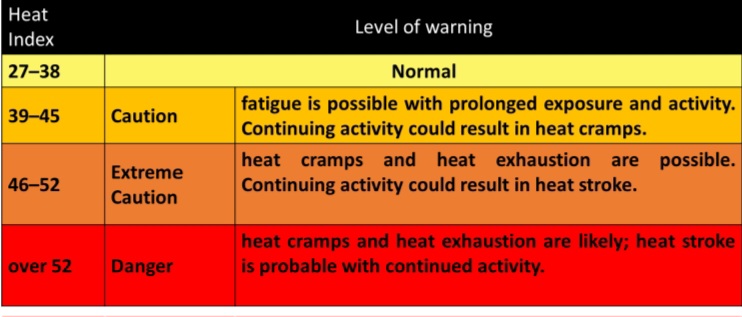
Effect of the heat index on human body is mentioned in the above table and it is prepared on the advice of the Ministry of Health and Indigenous Medical Services.
ACTION REQUIRED
Job sites: Stay hydrated and takes breaks in the shade as often as possible.
Indoors: Check up on the elderly and the sick.
Vehicles: Never leave children unattended.
Outdoors: Limit strenuous outdoor activities, find shade and stay hydrated.
Dress: Wear lightweight and white or light-colored clothing.
Note:
In addition, please refer to advisories issued by the Disaster Preparedness & Response Division, Ministry of Health in this regard as well. For further clarifications please contact 011-7446491.

The Ecuadorean government has deployed more than 75,000 police officers and soldiers to four of the country’s most violence-wracked provinces, the interior minister says.
The authorities have also declared a night-time curfew in these areas as part of a “new phase” in their “war” on criminal gangs.
Since coming to office in November 2023, President Daniel Noboa has tried to quell drug-related violence but nevertheless Ecuador registered a record murder rate in 2025.
Noboa has also joined a US-led alliance of 17 countries aimed at fighting criminal cartels in the Western Hemisphere.
“We’re at war,” Ecuadorean Interior Minister John Reimberg told residents of the provinces of El Oro, Guayas, Los Ríos and Santo Domingo de los Tsáchilas.
“Don’t take any risks, don’t go out, stay at home,” he added.
Ecuador’s geographical location – sandwiched between Colombia and Peru, the world’s largest producers of cocaine – has turned it into a key transit country for the illicit drug.
Around 70% of the cocaine produced in Colombia and Peru is estimated to be shipped through Ecuador.
Noboa’s government has been working with the administration of US President Donald Trump to quell the flow of cocaine from Ecuador to the US.
Last week, the FBI opened its first office in the Andean country, a move which came shortly after the two countries launched joint counter-narcotic operations.
Noboa was one of the Latin American leaders to attend an international meeting hosted by Trump in Mar-a-Lago, which the US authorities dubbed the “Shield of the Americas” summit.
At the summit, Trump likened criminal gangs to a “cancer” and urged his Latin American counterparts to use military force to root them out.
“We don’t want it spreading,” Trump added.
Following the meeting, Noboa posted a photo on social media of himself standing next to Trump with the words: “For too long, the mafias thought that America was their territory. That they could cross borders, move drugs, guns and [spread] violence without consequences. Their time has run out.”
Since coming to office, Noboa has tried to combat criminal organisations in his country with an iron fist and has declared several states of emergency but nevertheless the murder rate rose by over 30% between 2024 and 2025.
[BBC]

The Commissioner General of Essential Services, Prabath Chandrakeerthi has announced that, after taking into consideration the current fuel situation in Sri Lanka, the Government has decided to declare Wednesdays of every week as a holiday for government sector employees, all government schools, universities, and courts with effect from March 18, 2026, until further notice
The holiday will not apply to essential service sectors including Healthcare, Ports, Water Supply and Customs.

Pakistan lodge official complaint about Bangladesh’s review at end of chase

Showers or thundershowers will occur at several places in the Central, Sabaragamuwa, Southern and Uva provinces after 2.00 pm.

Government’s objective is to ensure the continuous functioning of the country’s economic activities and essential services through effective energy management – President

UN resolution on Iran ‘unbalanced’: FM Herath

Japan provides grant for reinforcement of Cyclone Ditwah damaged bridge

Australian HC debunks misleading travel risk claims for Sri Lanka

‘Dates have the highest sugar content to fight Coronavirus’

Sunday Island 27 December – Headlines

#SundayIsland 17th December – Headlines

Sunday Island – 28th March

Sunday Island Headlines – 21 March

Sunday Island – 21st February – Headlines
-

 Business6 days ago
BOI launches ‘Invest in Sri Lanka’ forum
-

 News5 days ago
Historic address by BASL President at the Supreme Court of India
-

 Sports5 days ago
The 147th Royal–Thomian and 175 Years of the School by the Sea
-

 Sports6 days ago
Royal start favourites in historic Battle of the Blues
-

 News6 days ago
CEBEU warns of operational disruptions amid uncertainty over CEB restructuring
-
 Features6 days ago
Indian Ocean zone of peace torpedoed!
-
 News5 days ago
Power sector reforms jolted by 40% pay hike demand
-

 News3 days ago
Crypto loopholes funnel Lankan funds abroad