
News
Indigenous Lankans demand their rights be protected


Mechanisms are needed to prevent them from losing their identity, lands, resources and equality, they say
(UCAN) Leaders, representing indigenous people in Sri Lanka, have called on the government to formulate a special law to protect their rights and provide proper access to courts in case these rights are violated.
Five indigenous leaders, dressed in traditional attire, made the call at a press conference in the capital Colombo on 22 Jan., before handing a letter outlining their demands to Prime Minister Harini Amarasuriya.
One of the leaders, Uruwarige Wannilaaththo, said the government should pass an indigenous rights law to address important issues concerning ethnic minority groups and give equal treatment under the law.
“Tribal people face numerous challenges due to forest depletion and government administrative activities, with verbal solutions offered in the past, but no government has implemented permanent solutions to address ongoing issues faced by indigenous communities,” said Wannilaaththo.
He said that they expect a formal resolution to these issues, adding that they even travelled to Geneva to the U.N. to fight for their rights and live freely in the jungle.
Indigenous peoples, known as the Vedda community, make up less than one percent of Sri Lanka’s estimated 22 million people. They are mostly concentrated in 62 villages in rural, forested parts of the island nation.
Wannilaaththo said that the destruction of forests for various development projects threatens the existence of indigenous people, many of whom are facing lawsuits for allegedly trespassing in forest reserves.
“Our life isn’t just hunting, we go to the forest for medicine, potatoes, nuts, and firewood. Yet, for these actions, our people are being sued,” he said.
Sri Lanka’s indigenous people are considered one of the most marginalized communities in the country due to poverty and a lack of education and social development.
The country does not have a special law ensuring recognition of indigenous people’s rights in line with the 2007 U.N. Declaration on the Rights of Indigenous Peoples.
The declaration calls on member states to implement effective mechanisms to prevent actions that deprive indigenous peoples of their identity, lands, resources, and equality.
Indigenous community leaders say the establishment of national parks has devastated their ancestral lands, forcing them to abandon age-old traditions and a self-sufficient lifestyle. Forced relocation and being restricted from entering their forests have left them grappling with serious challenges and a loss of heritage.
Sunimalee Somaweera, a rights activist from Colombo, said that due to their displacement, they can no longer return to the self-sufficient lifestyle they had enjoyed for generations. It has disrupted their way of life and their connection to traditional knowledge and practices, she added.
“The loss of their homeland has also forced them to abandon their unique medical practices, which combined plant and animal substances, ritual treatments, and witchcraft, all passed down orally through generations as vital aspects of their culture,” Somaweera told UCA News.
Sri Lanka’s indigenous people deserve the protection of their fundamental rights in the constitution that guarantees “the right to equality, freedom of occupation, and freedom of movement” for everyone, she noted.
She said the issues faced by the Vedda community have been discussed for more than 50 years, yet no practical solution has been provided to address them.
Various governments have made efforts to pass a law to protect the rights of indigenous peoples but have consequently failed to do so.

Latest News
Landslide Early Warnings issued to the districts of Kalutara, Nuwara Eliya and Ratnapura


The Landslide Early Warning Centre of the National Building Research Organisation (NBRO) has issued early warnings to the Districts of Kalutara, Nuwara Eliya and Ratnapura from 1600hrs on 13th June 2026 till 1600hrs on 14th June 2026.
Accordingly,
LEVEL I (YELLOW) landslide early warnings have been issued to the Divisional Secretaries Divisions and surounding areas of Palindanuwara and Agalawatta in the Kalutara district, Ambagamuwa in the Nuwara Eliya and Ayagama, Pelmadulla,
Godakawela, Elapatha, Kalawana, Ratnapura and Nivithigala in the Ratnapura district.

The Indian Naval Ship (INS) ‘Sharda’ departed the island today (13 Jun 26), concluding her replenishment purposes.
On departure the vessel was accorded a traditional naval farewell by the Sri Lanka Navy at the Port of Colombo.
The visit also paved the way for vibrant personnel interactions, fostering camaraderie and goodwill. The crew of INS Sharda and personnel from the Sri Lanka Navy participated in a
friendly volleyball match and a joint yoga session. A
dditionally, Sri Lanka Navy personnel had the opportunity to visit the Indian naval vessel, while the visiting crew took time to explore several culturally significant landmarks across the island.
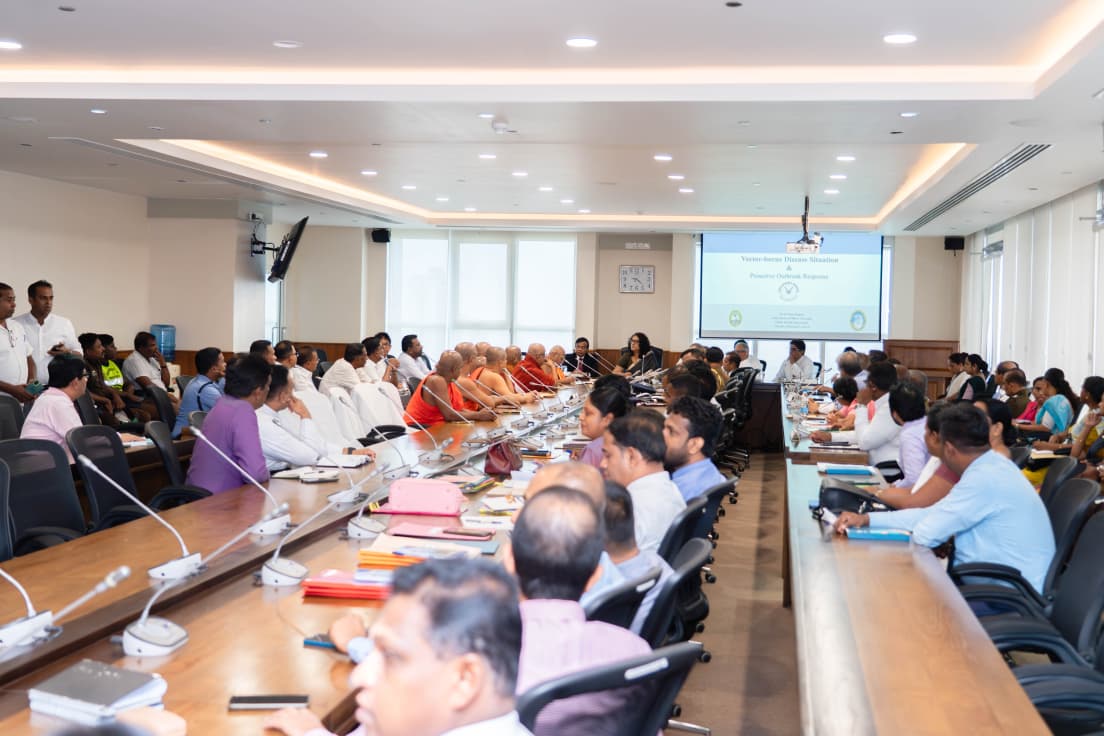
A decision has been taken to declare a Special Dengue Prevention Week from 15 to 21 of June by the Colombo District Dengue Control Committee to curb the spread of the disease in the Colombo District.
This decision was taken at the meeting of the Colombo District Dengue Control Committee held on Friday (12) at the Colombo District Secretariat under the patronage of Prime Minister Dr. Harini Amarasuriya.
Compared to last year, the number of dengue cases reported this year has increased significantly. According to the National Dengue Control Unit, approximately 39,100 dengue cases have been reported island wide to date, of which 25.8% have been recorded in the Colombo District. Following this situation, the Colombo District has been identified as a high-risk district.
Health authorities informed that the increasing spread of the disease has been influenced not only by the nature of circulating virus but also to the lack of sufficient immunity among the population. They further noted that the recent period of heavy rainfall has aggravated the spread of Dengue.
It was also identified that the current outbreak is being reported more frequently from public places such as government institutions, private establishments, schools, and religious venues rather than from residential premises. Observations have identified improperly managed solid waste and drainage systems in offices and other public locations as major breeding grounds for mosquitoes.
Accordingly, during the Dengue Prevention Week from 15 to 21 June, a series of measures will be implemented, including, organising community clean-up campaigns in government and private institutions, schools, residential areas, and other public spaces; Conducting inspections of high-risk premises by Divisional Secretariats and taking legal action, where necessary, followed by awareness programmes; Distributing informational leaflets, displaying banners, and carrying out public awareness campaigns through the media. Health authorities also requested school administrations not to involve students below Grade 10 in school cleaning programmes and to immediately notify the relevant Medical Officer of Health (MOH) office if a student is diagnosed with dengue.
The programme is expected to receive the active support and participation of the district’s political leadership, religious leaders of all faiths, public officials, local government institutions, the tri-forces, the police, and the general public.
The event was attended by the Chairperson of the District Coordination Committee, Members of Parliament, representatives of local government authorities, government secretaries, police officers, and officials representing the education and health sectors, among others.
[Prime Minister’s Media Division]

Mismatch in batting firepower could dictate the outcome again

Landslide Early Warnings issued to the districts of Kalutara, Nuwara Eliya and Ratnapura

INS Sharda departs Colombo concluding replenishment visit

Special Dengue Prevention Week declared in Colombo District from June 15 to 21

The leader of the indigenous Vedda community Uru Warige Wannila Aththo Meets Prime Minister Dr. Harini Amarasuriya

SpaceX IPO debuts in US markets, Musk becomes world’s first trillionaire

‘Dates have the highest sugar content to fight Coronavirus’

Sunday Island 27 December – Headlines

#SundayIsland 17th December – Headlines

Sunday Island – 28th March

Sunday Island Headlines – 21 March

Sunday Island – 21st February – Headlines
-

 News7 days ago
Women’s T20 World Cup 2026 warm-up: Chamari Athapaththu’s 94 helps Sri Lanka beat Pakistan
-

 News7 days ago
Lankan-Canadian inducted to Toronto Sports Hall of Fame
-

 Editorial6 days ago
Probe Sallay’s complaint
-
 News4 days ago
Local firms move millions of dollars overseas for phantom imports: Govt.
-
 News2 days ago
CIABOC summons Yoshitha over his participation in British Navy training programme
-

 Editorial7 days ago
Prez in the dock
-

 Features7 days ago
Entering MIT for my Ph.D program, coping with harsh Boston winter and breasting the tape
-
 Midweek Review4 days ago
July 09: An inexcusable overall security failure and exceptional contingency plan