
Latest News
India’s Gandhis charged in money laundering case amid opposition outcry

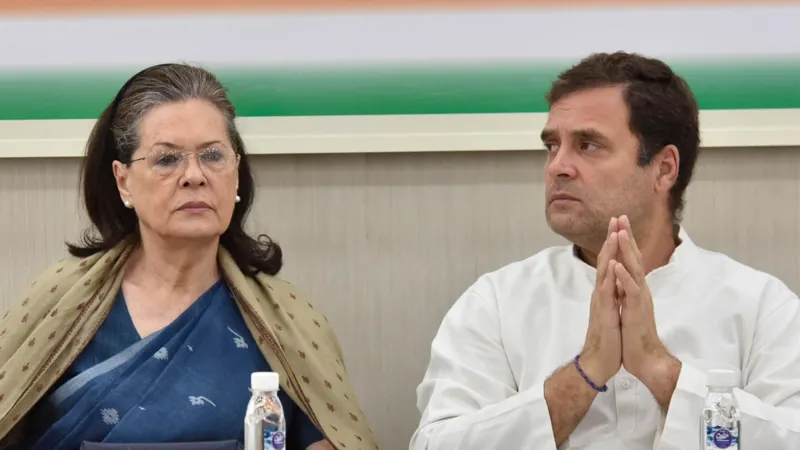
India’s opposition Congress party has said it will organise nationwide protests on Wednesday after the country’s financial crimes agency charged senior leaders Sonia and Rahul Gandhi and others with money laundering.
The Enforcement Directorate (ED) presented its findings in a Delhi court on Tuesday, accusing the Gandhis of forming a shell company to illegally acquire assets of the National Herald newspaper worth more than 20bn rupees ($233mn; £176mn).
Congress spokesperson Jairam Ramesh called the charges “politics of vendetta and intimidation” by the government.
The Gandhis who have previously denied any wrongdoing have not commented on the charges.
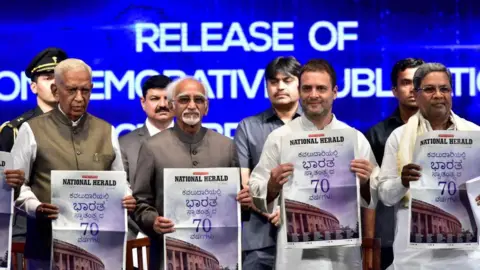
The investigation also names other members of the Congress party, including its overseas chief Sam Pitroda, according to news agency ANI.
The Enforcement Directorate (ED) began investigating the case in 2021 after a private complaint filed by Subramanian Swamy, a member of the governing Bharatiya Janata Party (BJP).
Swamy alleged that the Gandhis used party funds to take over Associated Journals Limited (AJL), which published the now-defunct National Herald newspaper, and illegally acquired properties worth millions through AJL.
The Congress maintains that it bailed out the publisher due to its historical legacy and had lent more than 900m rupees to AJL over the years.
In 2010, AJL became debt-free by swapping its debt for equity and assigning the shares to a newly created company called Young Indian, which the party says is a “not-for-profit company” with no dividends paid to its shareholders and directors.
Sonia and Rahul Gandhi are among Young Indian’s directors and they each own 38% of the company. The remaining 24% is owned by Congress leaders, including Motilal Vora and Sam Pitroda.
Last week, the Enforcement Directorate said Young Indian had acquired AJL properties worth 20bn rupees for just 5m, significantly undervaluing their worth.
It also served several notices to seize assets worth 6.6bn rupees across several Indian cities – including Delhi and Mumbai – which are connected to Young Indian.
The case is scheduled to come up for hearing on 25 April.
In recent years, the opposition has repeatedly accused the Narendra Modi government of weaponising the Enforcement Directorate against its political opponents.
According to data compiled by Reuters in 2024, the agency has summoned, questioned or raided around 150 opposition politicians since Modi came to power in 2014.
Last year, the ED arrested former Delhi chief minister Arvind Kejriwal in connection with an alleged liquor scam just a month before key general elections. He spent five months in jail before being freed on bail.
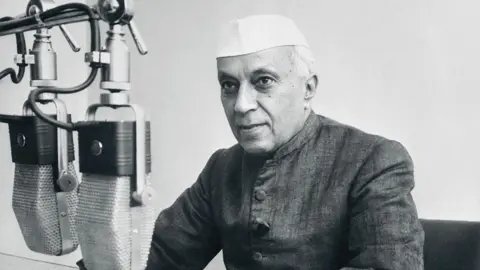
What is the National Herald?
The National Herald newspaper was founded in 1938 by Jawaharlal Nehru, India’s first prime minister and Rahul Gandhi’s great-grandfather.
It ceased publication in 2008 after running into financial troubles but was later acquired by the Congress in 2010 and relaunched as a digital news outlet in 2017.
It was published by Associated Journals Limited (AJL), which was established in 1937 with 5,000 freedom fighters as shareholders. AJL also published Qaumi Awaz in Urdu and Navjeevan in Hindi.
The National Herald became known for its association with India’s freedom struggle and its nationalist stance.
Nehru often wrote strong-worded columns, which led to the British government banning the paper in 1942. It reopened three years later.
After India gained independence in 1947, Nehru resigned as chairman of the newspaper to become prime minister.
But the Congress continued to play a huge role in shaping the newspaper’s ideology.
In a message to the National Herald on its silver jubilee in 1963, Nehru spoke about the paper “generally favouring Congress policy” while maintaining “an independent outlook”.
Over the years, the National Herald grew to be a leading English daily, supported by the Congress party, until it shut down in 2008 after years of financial troubles.
[BBC]

Latest News
Heat Index at Caution Level in the Northern, North-central, North-western, Western, Sabaragamuwa, Eastern and Southern provinces and in Monaragala district

Warm Weather Advisory
Issued by the Natural Hazards Early Warning Centre
Issued at 3.30 p.m. on 15 April 2026, valid for 16 April 2026.
The Heat index, the temperature felt on human body is likely to increase up to ‘Caution level’ at some places in the Northern, North-central, North-western, Western, Sabaragamuwa, Eastern
and Southern provinces and in Monaragala district.
The Heat Index Forecast is calculated by using relative humidity and maximum temperature and this is the condition that is felt on your body. This is not the forecast of maximum temperature. It is generated by the Department of Meteorology for the next day period and prepared by using global numerical weather prediction model data.
Effect of the heat index on human body is mentioned in the above table and it is prepared on the advice of the Ministry of Health and Indigenous Medical Services.
ACTION REQUIRED
Job sites: Stay hydrated and takes breaks in the shade as often as possible.
Indoors: Check up on the elderly and the sick.
Vehicles: Never leave children unattended.
Outdoors: Limit strenuous outdoor activities, find shade and stay hydrated.
Dress: Wear lightweight and white or light-colored clothing.
Note:
In addition, please refer to advisories issued by the Disaster Preparedness & Response Division, Ministry of Health in this regard as well. For further clarifications please contact 011-7446491

Pakistan’s army chief, Field Marshal Asim Munir, has landed in Iran as part of a delegation to hold high-level talks on the resumption of talks between Iran and the US.
Iran’s army has warned it will block trade through the Red Sea along with the Gulf and Sea of Oman if the US naval blockade on Iranian ports continues.
The US military says it has “completely halted economic trade going into and out of Iran by sea” as its blockade in the Strait of Hormuz continues for a second day.
US President Donald Trump says the war is “close to over” after hinting at a second round of face-to-face talks with Iran in Pakistan in the coming days.
(Aljazeera)

More than 200 Iranian sailors left stranded in Sri Lanka after a US torpedo attack are returning home after being stuck in the country for more than a month.
On Wednesday, Sri Lanka’s Deputy Defence Minister, Aruna Jayasekara, confirmed 32 sailors rescued from the Iris Dena and 206 from Irins Bushehr, had left the country.
The Iranian warship, Iris Dena, sank on 4 March about 40km (25 miles) from Sri Lanka’s southern coastline after it was hit by a torpedo from a US submarine, killing 104 sailors.
On March 5, Sri Lanka took control of the Iranian naval vessel, Irins Bushehr, after it had requested to dock at one of country’s ports after one of its engines malfunctioned.
Speaking to Reuters, Jayasekara confirmed the crew of both ships were flown out on Tuesday night.
The stranded sailors were granted 30-day entry visas by the Sri Lankan government and were housed in navy and air force camps.
The Iris Dena had been returning from a military exercise hosted by India when it was attacked.
Video released by the US Department of Defense after the incident showed a ship being struck, causing the stern to rise up before exploding.
The bodies of 84 Iranian sailors killed in the attack were recovered and later repatriated in a chartered plane arranged by Iran.
Its sinking in international waters came just a few days into the current US-Israeli war with Iran and marked a dramatic widening of the conflict.
Iran has since launched retaliatory strikes across the Middle East – targeting Gulf countries allied with the US.
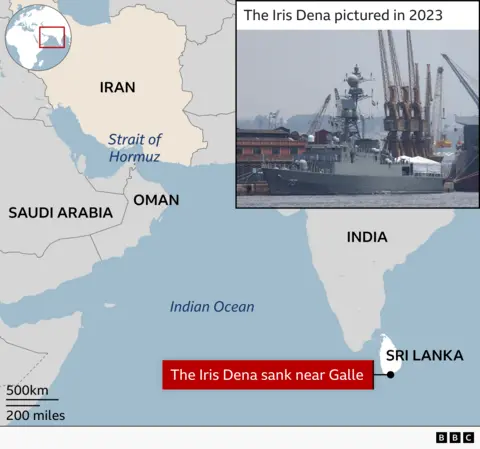
About 15 Iranian sailors will remain in Sri Lanka to operate the Irins Bushehr, which is anchored off Trincomalee in the northeast of the island.
Sri Lankq had allowed the Iranian vessel to dock at a north-eastern port on 5 March after hours of discussion, with its president saying they would “never hesitate to protect humanity”.
“Our position has been to safeguard our neutrality while demonstrating our humanitarian values,” President Anura Kumara Dissanayake said in a statement at the time.
“[Sri Lanka] intervened in a way that demonstrated our commitment to international conventions, protecting the reputation and dignity of our country, and protecting human lives,” he said.
Sri Lanka has maintained a long-standing policy of non-alignment since it became independent in 1948.
It has strong economic and diplomatic ties with both Iran and the US.
(BBC)

Heat Index at Caution Level in the Northern, North-central, North-western, Western, Sabaragamuwa, Eastern and Southern provinces and in Monaragala district

Pakistani army chief in Tehran amid bid to restart US talks

Sri Lanka repatriates 238 Iranian sailors stranded after US torpedo attack

Indonesian Navy Sailing Ship KRI BIMA SUCI – 945 makes port call in Colombo

PM initiates children into learning at the auspicious time while observing New Year traditional customs and rituals

Navy seize an Indian fishing boat poaching in seas north of Mannar

‘Dates have the highest sugar content to fight Coronavirus’

Sunday Island 27 December – Headlines

#SundayIsland 17th December – Headlines

Sunday Island – 28th March

Sunday Island Headlines – 21 March

Sunday Island – 21st February – Headlines
-

 News4 days ago
CEB orders temporary shutdown of large rooftop solar systems
-
 Features4 days ago
From Royal College Platoon to National Cadet Corps: 145 years of discipline, leadership, and modern challenges
-

 Business6 days ago
Israeli attack on Lebanon triggers local stock market volatility
-

 Business6 days ago
HNB Assurance marks 25 years with strategic transformation to ‘HNB Life’
-
 Latest News3 days ago
PNS TAIMUR & ASLAT arrive in Colombo
-

 News5 days ago
Anura Solomons passes away
-

 Features4 days ago
CIA’s hidden weapon in Iran
-
 Latest News3 days ago
Prasidh, Buttler set up comfortable win for Gujarat Titans