
News
India begins trial run for trans-shipment of goods to its NorthEast via Bangladesh port

BY S VENKAT NARAYAN
Our Special Correspondent
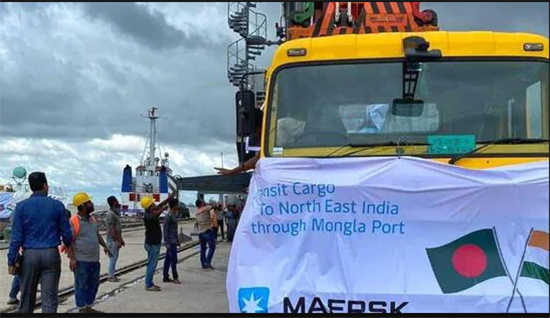
NEW DELHI, August 9: India on Tuesday began trial runs for the trans-shipment of goods to its own states in the NorthEast using two key ports in Bangladesh, with a vessel arriving at Mongla port with two containers of transit cargo.
The land route between Kolkata and key cities in the northeastern states is more than 1,200km. The use of Chattogram (Chittagong) and Mongla ports in neighbouring Bangladesh for trans-shipment will cut the distance and cost to almost half. The trans-shipment arrangement will facilitate the movement of heavier cargo at a lower cost.
The trial runs were initially scheduled for July, but were pushed to August in order to enable Bangladeshi authorities to complete certain arrangements, including customs procedures.The development comes ahead of a planned visit to India by Bangladesh Prime Minister Sheikh Hasina in the first week of September.
Announcing the start of trial runs for operationalising a bilateral agreement signed in October 2018 for the transit of goods from India via Chattogram and Mongla ports in Bangladesh, the Indian high commission in Dhaka said the vessel carrying two Indian transit containers had arrived at Mongla port on Monday.The vessel MV Rishad Raihan with cargo bound for the northeastern states was subsequently flagged off by Mongla Port Authority Chairman Mohammed Musa, and India’s assistant high commissioner in Khulna, Inderjit Sagar.
The trial runs are being undertaken by Maersk India Ltd, and will be done on two routes – Mongla-Tamabil-Dawki and Mongla-Bibir Bazar-Srimantapur. After being transported by riverine routes in Bangladesh, the goods will enter India through border checkpoints at Dawki in Meghalaya and Srimantapur in West Bengal. These two routes are among eight approved routes for transit of goods under the 2018 agreement.
India had earlier carried out a trial trans-shipment of goods from Kolkata to Tripura via Chattogram port in southeastern Bangladesh in July 2020. The onset of the Covid-19 pandemic delayed plans for further trial runs.
The Indian high commission in Dhaka said the transit and trans-shipment of goods under the 2018 agreement will reduce both time and cost for transporting cargo to the northeastern states. It will also create economic gains for the logistics and services industry of Bangladesh as only Bangladeshi trucks will be used for moving freight.
The trial runs will help iron out any rough spots and align the immigration and customs set-ups in both countries, people familiar with the matter said. The two sides are looking at several land routes leading to the northeastern states of Meghalaya and Tripura for movement of goods, they said.Prime Minister Sheikh Hasina had reiterated her country’s offer to use Chattogram port for trans-shipment of goods to India’s northeastern states and to increase connectivity at a meeting with External Affairs Minister Dr Subrahmanyam Jaishankar in Dhaka on April 28.

Latest News
Landslide early warnings issued to the Districts of Badulla, Kandy, Matale and Nuwara Eliya


The Landslide Early Warning Center of the National Building Research Organisation [NBRO] has issued landslide early warnings to the districts of Badulla, Kandy, Matale and Nuwara Eliya for the next 24 hours commencing at 1200hrs today [08]
Accordingly
LEVEL II AMBER landslide early warnings have been issued to the Divisional Secretaries Divisions and surrounding areas of Ududumbara in the Kandy District, Wilgamuwa in the Matale District, and Nildandahinna and Walapane in the Nuwara Eliya District.
LEVEL I YELLOW landslide early warnings have been issued to the Divisional Secretaries Divisions and surrounding areas of Meegahakiwula, Welimada, Kandaketiya, Lunugala, Badulla, Passara, Uva Paranagama and Hali_Ela in the Badulla District, Ambanganga Korale in the Matale District, and Mathurata and Hanguranketha in the Nuwara Eliya District.
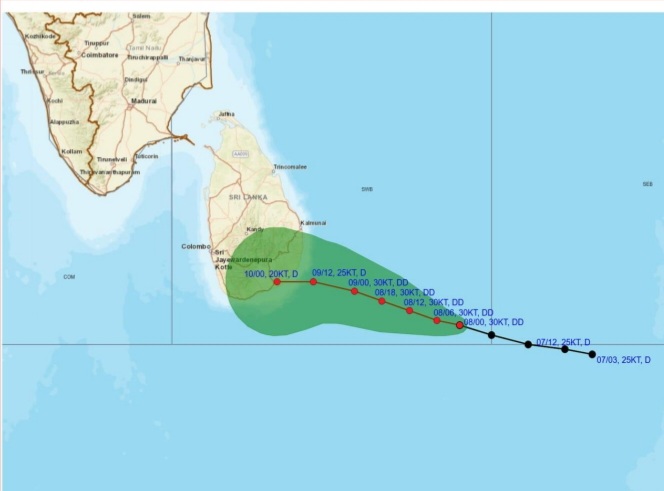
Warning for deep depression over South-east Bay of Bengal Sea area.
Issued by the Natural Hazards Early Warning Centre, Department of Meteorology at 10.30 a.m. on 08 January 2026 for the period until 10.30 a.m. 09 January 2026
The depression in the Bay of Bengal to the southeast of Sri Lanka has intensified into a deep depression and is centered near latitude 5.4°N and longitude 85.3°E, about 420 km southeast of Pottuvil at 05.30 a.m. today (08th). The above system is currently (10:00 a.m.) located about 300 km southeast of Pottuvil.
It is very likely to move west-northwestwards across the southwest Bay of Bengal and cross the Sri Lanka coast between Hambantota and Kalmunai between 5.30 p.m. to 11.30 p.m. on Friday [9th January 2026].
Hence, showery, and windy condition over the island, particularly in the Northern, NorthCentral, Eastern, Uva and Central provinces is expected to enhance from today (08th).
For the Land area:
DAMAGE EXPECTED:
• Damage to huts, temporary shelters and light structures
• Destroy the roof tops/ sheets etc.
• Damage to power and communication lines.
• Breaking of tree branches and uprooting of large avenue trees.
• Damage to paddy crops, banana, papaya trees and orchards.
• Damage to harbor yachts
• Flash flood
• Sea water inundation in low lying areas in the near coast.
Action suggested for the Land area:
• Coastal hutment dwellers are advised to move to safer places. Other people in the affected areas to remain indoors.
• People living in hilly areas (particularly landslide prone areas) and low lying areas in river basins are requested to be vigilant.
• Drivers and people using roads in the hilly areas are requested to be vigilant.
• Beware of fallen trees and power lines.
• Avoid using wired telephones and connected electric appliances during thunderstorms.
• General public is requested to be vigilant regarding impending extreme weather situation.
• For emergency assistance contact the local disaster management authorities.
• Requested to be attentive about future advisories issued by the Department of Meteorology in this regard.


Latest News
Showers above 100 mm are likely at some places in the Eastern and Uva provinces and showers about 50-75 mm in other areas

WEATHER FORECAST FOR 08 JANUARY 2026
Issued at 05.30 a.m. on 08 January 2026 by the Department of Meteorology
The depression over the Bay of Bengal, located to the southeast of Sri Lanka, was centered near latitude 5.3°N and longitude 86.0°E, about 490 km southeast of Pottuvil, at 11:30 p.m. yesterday (07). It is expected to move west-northwestwards and towards the eastern coast of the island during next 24 hours. This system is likely to intensify further into a deep depression during the next 12 hours.
Cloudy skies can be expected over most parts of the island.
Showers or thundershowers will occur at times in the Northern, North-central, Eastern, Uva, Central and Southern provinces. Showers or thundershowers may occur at several places elsewhere in the Island after 1.00 p.m. Heavy showers above 100 mm are likely at some places in the Eastern and Uva provinces. Fairly Heavy showers about (50 – 75) mm are likely at some places in the other areas of the island.
Strong winds about (50-60) kmph can be expected at times over the Eastern slopes of the central hills, the Northern, North-central, North-western and Eastern provinces and in Hambantota, Gampaha, Colombo and Monaragala districts.
The general public is kindly requested to take adequate precautions to minimize damages caused by temporary localized strong winds and lightning during thundershowers.

Greenland allies vow action if Trump moves to seize world’s largest island

Landslide early warnings issued to the Districts of Badulla, Kandy, Matale and Nuwara Eliya

Coe commits World Athletics support to Jamaica

Rare mountain gorilla twins born in Africa’s oldest national park

ECB launch ‘thorough review’ in wake of 4-1 Ashes defeat

Warning for deep depression over South-east Bay of Bengal Sea area

‘Dates have the highest sugar content to fight Coronavirus’

Sunday Island 27 December – Headlines

#SundayIsland 17th December – Headlines

Sunday Island – 28th March

Sunday Island Headlines – 21 March

Sunday Island – 21st February – Headlines
-

 News3 days ago
Interception of SL fishing craft by Seychelles: Trawler owners demand international investigation
-

 News3 days ago
Broad support emerges for Faiszer’s sweeping proposals on long- delayed divorce and personal law reforms
-

 News4 days ago
Private airline crew member nabbed with contraband gold
-

 News2 days ago
Prez seeks Harsha’s help to address CC’s concerns over appointment of AG
-

 News2 days ago
Govt. exploring possibility of converting EPF benefits into private sector pensions
-

 Features3 days ago
Educational reforms under the NPP government
-

 News6 days ago
Health Minister sends letter of demand for one billion rupees in damages
-

 Features4 days ago
Pharmaceuticals, deaths, and work ethics