
Foreign News
In a Haitian city ruled by gangs, young rape survivor raises baby she was told to abort


Warning: This story contains accounts of rape and other violence that readers may find distressing.
Helene was 17 years old when a gang attacked her neighbourhood in the Haitian capital, Port-au-Prince.
She strokes her baby daughter, asleep in her lap, while describing how armed men abducted her as she tried to flee, and held her for over two months.
“They raped me and beat me every single day. Several different men. I didn’t even know their names, they were masked,” says the young woman, whose name we have changed to protect her identity. “Some of the things they did to me are too painful to share with you.”
“I fell pregnant, they kept telling me I must abort the pregnancy and I said ‘no’. This baby could be the only one I ever have.”
She managed to escape while the gang was caught up in fighting to maintain territory. Now 19, she has spent the past year raising her daughter in a safe house in a suburb of the city.
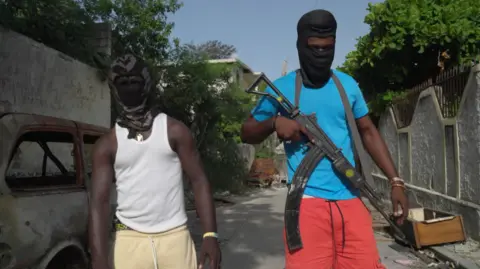
The safe house is home to at least 30 girls and young women who sleep in bunk beds in colourfully painted rooms.
Helene is the oldest rape survivor here. The youngest is just 12. Playing and dancing on the balcony in a blue polka dot dress, she looks much younger than her age, having suffered from malnutrition in the past. Staff tell us she has been raped multiple times.
Rape and other sexual violence is surging in Haiti as armed gangs expand their control across Port-au-Prince and beyond.
The Caribbean island nation has been engulfed in a wave of gang violence since the assassination in 2021 of the then-president, Jovenel Moïse.
It is hard to measure the scale of sexual violence. Medical charity Medecins Sans Frontieres (MSF) runs a clinic in central Port-au-Prince for women who have experienced sexual abuse. Data it has shared exclusively with the BBC shows patient numbers have nearly tripled since 2021.
The gangs are known for sweeping into neighbourhoods and killing dozens of people. MSF says multiple gang rapes of women and girls are often part of these large-scale attacks. From survivors’ accounts, it is clear that gangs have been using rape to terrorise and subjugate entire communities.
The BBC has challenged gang leaders about accounts of killings and rapes. One previously told us they do not control the actions of their members and believe they have a “duty” to fight the state. Another said “when we are fighting we are possessed – we are no longer human”.
“Patients have started to share very, very difficult stories since 2021,” says Diana Manilla Arroyo, MSF’s head of mission in Haiti.
“Survivors talk about two or four or seven, or up to 20 aggressors,” she says, adding that more women now say they have been threatened with weapons or knocked unconscious.
Women are also reporting more frequently that their assailants are under 18, she adds.
In a drop-in centre in another part of the city, four women – ranging in age from late 20s to 70 – describe being attacked in front of their children and husbands.
“Our neighbourhood was attacked, I went back home only to find my mum, my dad, my sister, all were murdered. They killed them and then burnt the house down, with them inside it,” one woman says.
After surveying her devastated home, she was about to leave the neighbourhood when she encountered gang members. “They raped me – I had my six-year-old with me. They raped her too,” she continues. “Then they killed my younger brother in front of us.”
“Whenever my daughter looks at me, she’s sad and crying.”
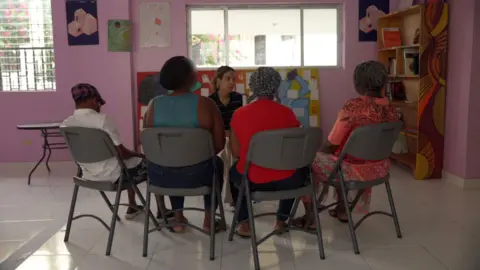
The other women recount attacks that follow a similar pattern – murder, rape and arson.
Sexual violence is just one element of the crisis that has engulfed Haiti. UN agencies say more than a tenth of the population – 1.3 million people – have fled their homes, and half the population faces acute hunger.
Haiti has had no elected leadership since the assassination of Moïse. A Transitional Presidential Council and a series of prime ministers it has appointed are tasked with running the country and organising elections.
Rival gangs have formed an alliance, turning their weapons on the Haitian state rather than each other.
Since we last visited in December, the situation has deteriorated. Hundreds of thousands more people have been displaced. More than 4,000 people have been killed in the first half of 2025, compared to 5,400 in the whole of 2024, according to the UN.
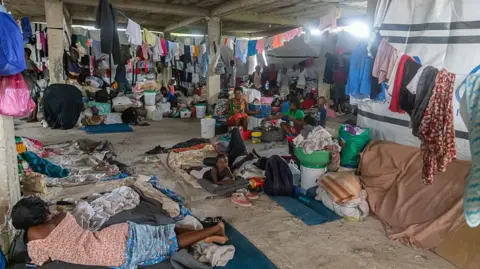
The gangs are estimated to have increased their control from 85% to 90% of the capital, seizing key neighbourhoods, trade routes and public infrastructure, despite efforts by a Kenyan-led, UN-backed security force.
We join the international force as they patrol a gang-controlled area, but within minutes, one of the tyres on their armoured vehicle is shot out and the operation ends.
Members of the force rarely leave their armoured vehicles. Experts say the gangs continue to acquire powerful weapons and maintain the upper hand.
In recent months, the Haitian authorities have contracted mercenaries to help wrest back control.
A source within the Haitian security forces told the BBC that private military companies, including one from the US, are operating on the ground, and using drones to attack gang leaders.
He showed us drone footage he says is of one gang leader, Ti Lapli, being targeted in an explosion. He says Ti Lapli was left in a critical condition, though the BBC has not been able to confirm this.
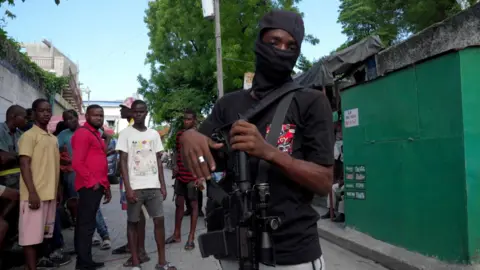
But around the city, the fear of the gangs remains. In many neighbourhoods, vigilante groups are taking security into their own hands, further increasing the numbers of young men with weapons on the streets.
“We’re not going to let them [the gangs] come here and kill us – steal everything we have, burn cars, burn houses, kill kids,” says a man using the name “Mike”.
He says he operates with a group in Croix-des-Prés, a bustling market area close to gang-controlled territory.
As gunfire rings out in the distance, no-one flinches. People here are used to it.
He says the gangs pay young boys to join, and set up checkpoints where they demand money from residents passing through.
“Of course everyone is afraid,” he tells us. “We feel alone trying to protect the women and children. As the gangs keep spreading, we know our area could be next.”
Humanitarian agencies say the situation is deteriorating and women are among the hardest hit, with many of them facing the double trauma of sexual violence and displacement.
Lola Castro, the regional director of the UN’s World Food Programme, says Port-au-Prince “is the worst place in the world to be a woman”.
Women here are also likely to feel the impact of cuts to humanitarian aid programmes, she adds.
Haiti has long been one of the largest recipients of funding from the US Agency for International Development (USAID), which President Donald Trump has slashed, dubbing it “wasteful”.
When we visited in June, Ms Castro said the WFP was distributing its last stocks of US-funded food aid.
Food provision protects women, she explained, because it saves them from having to be out in the streets begging or looking for food.
Humanitarian workers here also fear that cuts may soon affect support for victims of violence in places like the safe house where Helene lives.
And Ms Manilla Arroyo from MSF says funding for contraception has also been reduced: “Many of our patients already have children. Many of them are under the age of 18 with children. The risk of pregnancy represents many, many new challenges for them.”
Helene and other women in the safe house often sit and chat together on a balcony that looks out across Port-au-Prince, but many of them are too afraid to leave the security of its walls.
She does not know how she will support her young daughter as she grows up.
“I always dreamt of going to school, to learn and to make something of myself,” she says. “I always knew I’d have children, just not this young.”
[BBC]


About 550,000 accounts were blocked by Meta during the first days of Australia’s landmark social media ban for kids.
In December, a new law began requiring that the world’s most popular social media sites – including Instagram and Facebook – stop Australians aged under 16 from having accounts on their platforms.
The ban, which is being watched closely around the world, was justified by campaigners and the government as necessary to protect children from harmful content and algorithms.
Companies including Meta have said they agree more is needed to keep young people safe online. However they continue to argue for other measures, with some experts raising similar concerns.
“We call on the Australian government to engage with industry constructively to find a better way forward, such as incentivising all of industry to raise the standard in providing safe, privacy-preserving, age appropriate experiences online, instead of blanket bans,” Meta said in a blog update.
The company said it blocked 330,639 accounts on Instagram, 173,497 on Facebook, and 39,916 on Threads during it’s first week of compliance with the new law.
They again put the argument that age verification should happen at an app store level – something they suggested lowers the burden of compliance on both regulators and the apps themselves – and that exemptions for parental approval should be created.
“This is the only way to guarantee consistent, industry-wide protections for young people, no matter which apps they use, and to avoid the whack-a-mole effect of catching up with new apps that teens will migrate to in order to circumvent the social media ban law.”
Various governments, from the US state of Florida to the European Union, have been experimenting with limiting children’s use of social media. But, along with a higher age limit of 16, Australia is the first jurisdiction to deny an exemption for parental approval in a policy like this – making its laws the world’s strictest.
The policy is wildly popular with parents and envied by world leader, with the Tories this week pledging to follow suit if they win power at the next election, due before 2029.
However some experts have raised concerns that Australian kids can circumvent the ban with relative ease – either by tricking the technology that’s performing the age checks, or by finding other, potentially less safe, places on the net to gather.
And backed by some mental health advocates, many children have argued it robs young people of connection – particularly those from LGBTQ+, neurodivergent or rural communities – and will leave them less equipped to tackle the realities of life on the web.
(BBC)
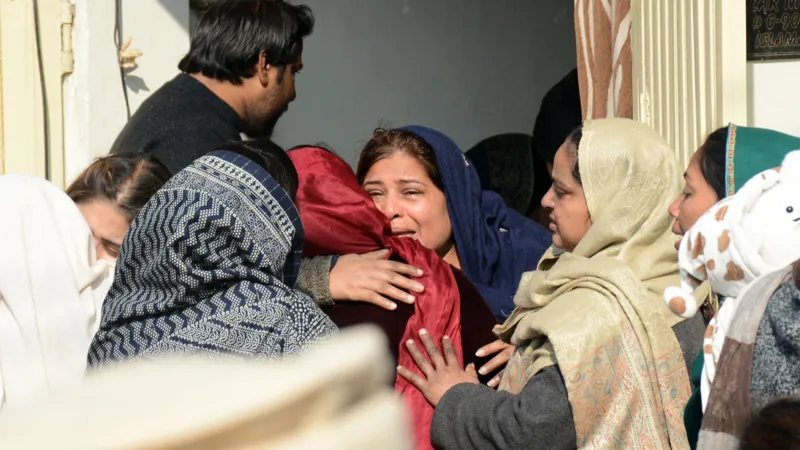
A newly married couple were killed when a gas cylinder exploded at a house in Islamabad where they were sleeping after their wedding party, police have said.
A further six people – including wedding guests and family members – who were staying there also died in the blast. More than a dozen people were injured.
The explosion took place at 07:00 local time (02:00 GMT) on Sunday, causing the roof to collapse.
Parts of the walls were blown away, leaving piles of bricks, large concrete slabs and furniture strewn across the floor. Injured people were trapped under the rubble and had to be carried out on stretchers by rescue workers.
(BBC)

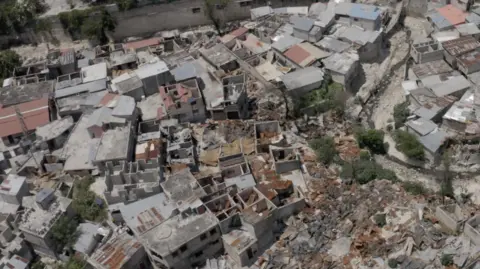
Rescue workers are racing to find dozens of people still missing following a landslide at a landfill site in the central Philippines that occurred earlier this week, an official has said.
Mayor Nestor Archival said on Saturday that signs of life had been detected at the site in Cebu City, two days after the incident.
Four people have been confirmed dead so far, Archival said, while 12 others have been taken to hospital.
Conditions for emergency services working at the site were challenging, the mayor added, with unstable debris posing a hazard and crew waiting for better equipment to arrive.
The privately-owned Binaliw landfill collapsed on Thursday while 110 workers were on site, officials said.
Archival said in a Facebook post on Saturday morning: “Authorities confirmed the presence of detected signs of life in specific areas, requiring continued careful excavation and the deployment of a more advanced 50-ton crane.”
Relatives of those missing have been waiting anxiously for any news of their whereabouts. More than 30 people, all workers at the landfill, are thought to be missing.
“We are just hoping that we can get someone alive… We are racing against time, that’s why our deployment is 24/7,” Cebu City councillor Dave Tumulak, chairman of the city’s disaster council, told news agency AFP.
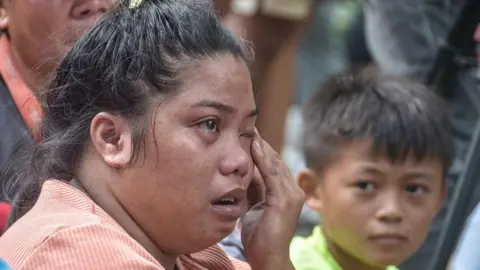
Jerahmey Espinoza, whose husband is missing, told news agency Reuters at the site on Saturday: “They haven’t seen him or located him ever since the disaster happened. We’re still hopeful that he’s alive.”
The cause of the collapse remains unclear, but Cebu City councillor Joel Garganera previously said it was likely the result of poor waste management practices.
Operators had been cutting into the mountain, digging the soil out and then piling garbage to form another mountain of waste, Garganera told local newspaper The Freeman on Friday.
The Binaliw landfill covers an area of about 15 hectares (37 acres).
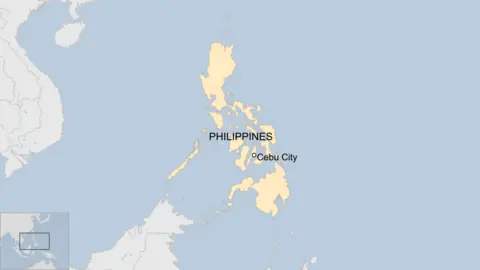
Landfills are common in major Philippine cities like Cebu, which is the trading centre and transportation gateway of the Visayas, the archipelago nation’s central islands.
[BBC]

Showery condition over the island is expected to reduce from tomorrow (15th)

USA’s Ali Khan claims having been ‘denied’ India visa ahead of T20 World Cup

At least 28 dead as crane collapses onto train in Thailand

Fair weather will prevail except for a few showers in the Uva, Eastern, Western and Central provinces and in Galle, Matara and Rathnapura districts

Trump cancels US-Iran meetings, urges protesters to take over institutions

Govt. bows to pressure, shelves Grade 6 reforms

‘Dates have the highest sugar content to fight Coronavirus’

Sunday Island 27 December – Headlines

#SundayIsland 17th December – Headlines

Sunday Island – 28th March

Sunday Island Headlines – 21 March

Sunday Island – 21st February – Headlines
-

 Business4 days ago
Dialog and UnionPay International Join Forces to Elevate Sri Lanka’s Digital Payment Landscape
-

 News4 days ago
Sajith: Ashoka Chakra replaces Dharmachakra in Buddhism textbook
-

 Features4 days ago
The Paradox of Trump Power: Contested Authoritarian at Home, Uncontested Bully Abroad
-

 Features4 days ago
Subject:Whatever happened to (my) three million dollars?
-

 News4 days ago
Level I landslide early warnings issued to the Districts of Badulla, Kandy, Matale and Nuwara-Eliya extended
-

 Business21 hours ago
New policy framework for stock market deposits seen as a boon for companies
-

 Opinion6 days ago
The minstrel monk and Rafiki, the old mandrill in The Lion King – II
-

 News4 days ago
65 withdrawn cases re-filed by Govt, PM tells Parliament