
Foreign News
In a Haitian city ruled by gangs, young rape survivor raises baby she was told to abort


Warning: This story contains accounts of rape and other violence that readers may find distressing.
Helene was 17 years old when a gang attacked her neighbourhood in the Haitian capital, Port-au-Prince.
She strokes her baby daughter, asleep in her lap, while describing how armed men abducted her as she tried to flee, and held her for over two months.
“They raped me and beat me every single day. Several different men. I didn’t even know their names, they were masked,” says the young woman, whose name we have changed to protect her identity. “Some of the things they did to me are too painful to share with you.”
“I fell pregnant, they kept telling me I must abort the pregnancy and I said ‘no’. This baby could be the only one I ever have.”
She managed to escape while the gang was caught up in fighting to maintain territory. Now 19, she has spent the past year raising her daughter in a safe house in a suburb of the city.
The safe house is home to at least 30 girls and young women who sleep in bunk beds in colourfully painted rooms.
Helene is the oldest rape survivor here. The youngest is just 12. Playing and dancing on the balcony in a blue polka dot dress, she looks much younger than her age, having suffered from malnutrition in the past. Staff tell us she has been raped multiple times.
Rape and other sexual violence is surging in Haiti as armed gangs expand their control across Port-au-Prince and beyond.
The Caribbean island nation has been engulfed in a wave of gang violence since the assassination in 2021 of the then-president, Jovenel Moïse.
It is hard to measure the scale of sexual violence. Medical charity Medecins Sans Frontieres (MSF) runs a clinic in central Port-au-Prince for women who have experienced sexual abuse. Data it has shared exclusively with the BBC shows patient numbers have nearly tripled since 2021.
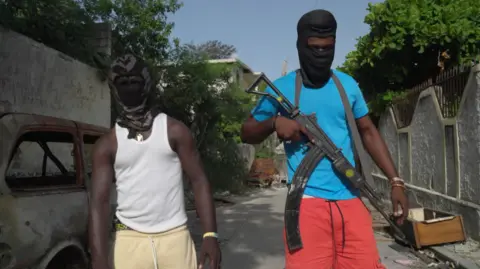
The gangs are known for sweeping into neighbourhoods and killing dozens of people. MSF says multiple gang rapes of women and girls are often part of these large-scale attacks. From survivors’ accounts, it is clear that gangs have been using rape to terrorise and subjugate entire communities.
The BBC has challenged gang leaders about accounts of killings and rapes. One previously told us they do not control the actions of their members and believe they have a “duty” to fight the state. Another said “when we are fighting we are possessed – we are no longer human”.
“Patients have started to share very, very difficult stories since 2021,” says Diana Manilla Arroyo, MSF’s head of mission in Haiti.
“Survivors talk about two or four or seven, or up to 20 aggressors,” she says, adding that more women now say they have been threatened with weapons or knocked unconscious.
Women are also reporting more frequently that their assailants are under 18, she adds.
In a drop-in centre in another part of the city, four women – ranging in age from late 20s to 70 – describe being attacked in front of their children and husbands.
“Our neighbourhood was attacked, I went back home only to find my mum, my dad, my sister, all were murdered. They killed them and then burnt the house down, with them inside it,” one woman says.
After surveying her devastated home, she was about to leave the neighbourhood when she encountered gang members. “They raped me – I had my six-year-old with me. They raped her too,” she continues. “Then they killed my younger brother in front of us.”
“Whenever my daughter looks at me, she’s sad and crying.”
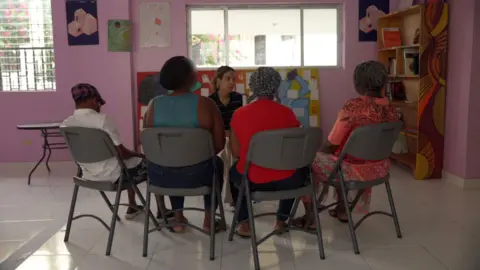
The other women recount attacks that follow a similar pattern – murder, rape and arson.
Sexual violence is just one element of the crisis that has engulfed Haiti. UN agencies say more than a tenth of the population – 1.3 million people – have fled their homes, and half the population faces acute hunger.
Haiti has had no elected leadership since the assassination of Moïse. A Transitional Presidential Council and a series of prime ministers it has appointed are tasked with running the country and organising elections.
Rival gangs have formed an alliance, turning their weapons on the Haitian state rather than each other.
Since we last visited in December, the situation has deteriorated. Hundreds of thousands more people have been displaced. More than 4,000 people have been killed in the first half of 2025, compared to 5,400 in the whole of 2024, according to the UN.
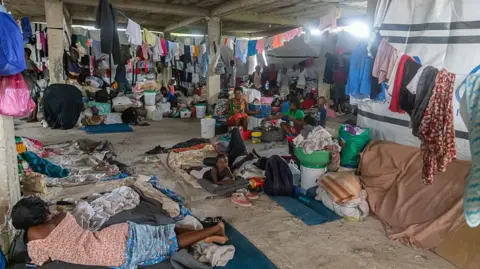
The gangs are estimated to have increased their control from 85% to 90% of the capital, seizing key neighbourhoods, trade routes and public infrastructure, despite efforts by a Kenyan-led, UN-backed security force.
We join the international force as they patrol a gang-controlled area, but within minutes, one of the tyres on their armoured vehicle is shot out and the operation ends.
Members of the force rarely leave their armoured vehicles. Experts say the gangs continue to acquire powerful weapons and maintain the upper hand.
In recent months, the Haitian authorities have contracted mercenaries to help wrest back control.
A source within the Haitian security forces told the BBC that private military companies, including one from the US, are operating on the ground, and using drones to attack gang leaders.
He showed us drone footage he says is of one gang leader, Ti Lapli, being targeted in an explosion. He says Ti Lapli was left in a critical condition, though the BBC has not been able to confirm this.
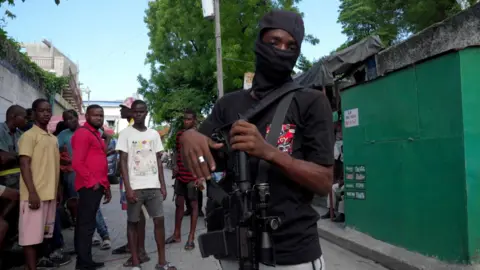
But around the city, the fear of the gangs remains. In many neighbourhoods, vigilante groups are taking security into their own hands, further increasing the numbers of young men with weapons on the streets.
“We’re not going to let them [the gangs] come here and kill us – steal everything we have, burn cars, burn houses, kill kids,” says a man using the name “Mike”.
He says he operates with a group in Croix-des-Prés, a bustling market area close to gang-controlled territory.
As gunfire rings out in the distance, no-one flinches. People here are used to it.
He says the gangs pay young boys to join, and set up checkpoints where they demand money from residents passing through.
“Of course everyone is afraid,” he tells us. “We feel alone trying to protect the women and children. As the gangs keep spreading, we know our area could be next.”
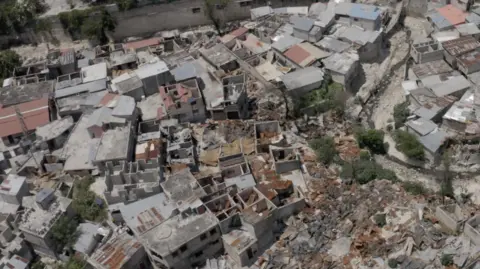
Humanitarian agencies say the situation is deteriorating and women are among the hardest hit, with many of them facing the double trauma of sexual violence and displacement.
Lola Castro, the regional director of the UN’s World Food Programme, says Port-au-Prince “is the worst place in the world to be a woman”.
Women here are also likely to feel the impact of cuts to humanitarian aid programmes, she adds.
Haiti has long been one of the largest recipients of funding from the US Agency for International Development (USAID), which President Donald Trump has slashed, dubbing it “wasteful”.
When we visited in June, Ms Castro said the WFP was distributing its last stocks of US-funded food aid.
Food provision protects women, she explained, because it saves them from having to be out in the streets begging or looking for food.
Humanitarian workers here also fear that cuts may soon affect support for victims of violence in places like the safe house where Helene lives.
And Ms Manilla Arroyo from MSF says funding for contraception has also been reduced: “Many of our patients already have children. Many of them are under the age of 18 with children. The risk of pregnancy represents many, many new challenges for them.”
Helene and other women in the safe house often sit and chat together on a balcony that looks out across Port-au-Prince, but many of them are too afraid to leave the security of its walls.
She does not know how she will support her young daughter as she grows up.
“I always dreamt of going to school, to learn and to make something of myself,” she says. “I always knew I’d have children, just not this young.”
[BBC]

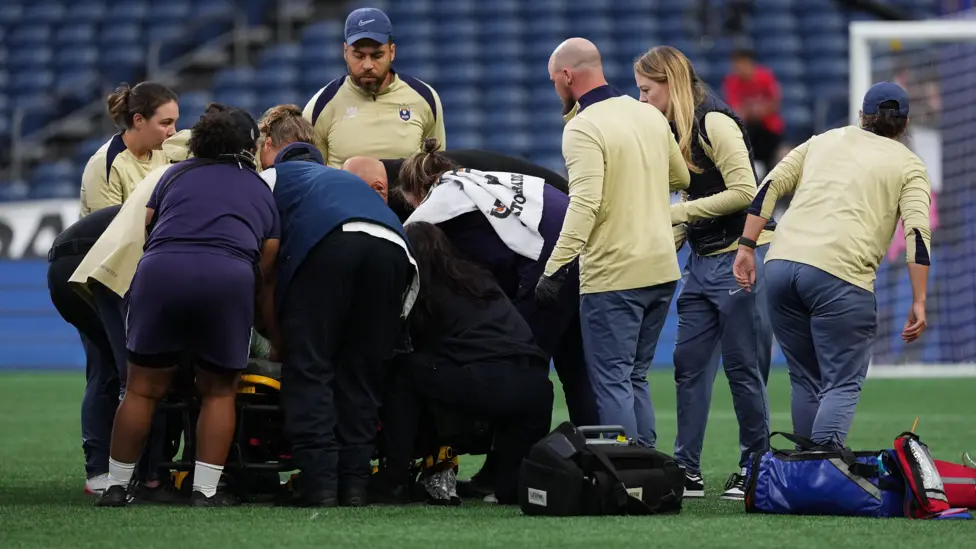
United States women’s national team player Savannah DeMelo is suing a hospital and two doctors after she suffered a cardiac arrest on the pitch last year.
Midfielder DeMelo, who has seven senior caps for the USA, has filed a lawsuit against University of Louisville Health (UofL Health) for negligence.
The 28-year-old, who plays for Racing Louisville, collapsed in the first half of a National Women’s Soccer League (NWSL) match on 14 September 2025.
According to documents seen by BBC Sport, the case was filed on Tuesday morning with Jefferson Circuit Court in Kentucky, where her club is based – a year and a day after her on-field collapse.
DeMelo’s filing claims UofL Health and two doctors, Dr Sarabjeet Suri and Dr Jennifer Daily, “failed to act as a reasonably prudent and competent medical practice, and such negligence was a substantial factor in causing DeMelo to suffer severe physical injuries, including, but not limited to, her cardiac arrest”.
Dr Daily, according to her online UofL biography, is Racing Louisville’s chief medical officer. The lawsuit states DeMelo was under the care of Dr Daily from January 2024 to July 2026.
It states that in March 2025, Dr Daily referred DeMelo to Dr Suri for “evaluation and treatment” after she had been complaining of chest pain, dizziness and shortness of air; Dr Suri obtained a history, performed a physical examination and ordered diagnostic tests.
Nearly six months later, DeMelo suffered the cardiac arrest.
“She was subsequently diagnosed and treated for ventricular tachycardia [an abnormal heart rhythm],” the suit states.
DeMelo, who has spent her entire professional career with Racing Louisville, has not played since her collapse.
In a post to her instagram page on Tuesday, De Melo – who was picked in the USA squad for the 2023 Women’s World Cup and started their first two games – marked the anniversary of the incident.
“A year ago today, while playing soccer, I collapsed due to an undiagnosed cardiac arrhythmia, that caused me to go into cardiac arrest,” she wrote.
“I respect and appreciate the privacy everyone has met me with while going through everything I have this year. I’ll never be able to fully put into words how emotionally hard this year has been. There has been a lot of uncertainty and emotions intertwined with it all.”
[BBC]

The Philippine Coast Guard says it has recovered 41 bodies from the wreckage of a ferry that caught fire this week, bringing the total death toll to 76.
More than 130 people were on board the MV June Aster when the blaze erupted on Wednesday as it neared its destination at the tourist hotspot of Coron, after departing from Manila.
The coast guard said on Saturday the number of survivors remained 43, with many receiving treatment in hospital, but 13 people remain unaccounted for.
Recovery of bodies had been hampered due to toxic fumes and lingering heat, which meant authorities were unable to board until Friday.
Geronimo Tuvilla, an official for the Philippine Coast Guard, said the priority was identifying victims and determining the cause of the blaze.
Kristine Ablana, a tourism official in Coron, said relatives were being asked to help identify family members through personal items and DNA testing.
“Once someone is able to verify that this photo or these belongings are indeed those of their relative, they will be asked to provide a DNA sample,” she said.
Coast Guard spokesperson Commodore Noemie Cayabyab said the fire began in a cargo hold before spreading.
She said survivors had described hearing a loud explosion, “the appearance of smoke and then fire. It spread very quickly”. She added that those who had made it off the ship did not have time to put on lifejackets.
A survivor who was hauled to safety on a rescue boat told the BBC he had heard frantic cries onboard when the fire erupted, and was trampled by panicked people as he tried to escape.
The ferry, built in 2002, held valid safety certificates and passed an enforcement inspection in March, but investigators are looking into potential manifest discrepancies, cargo loading integrity, and crew emergency response protocols, the Palawan Daily reported.
The vessel was carrying 117 passengers and 17 crew members.
Atienza Interisland Ferries, the vessel’s operator, has pledged full co-operation with the inquiry.
[BBC]

A dress worn by Princess Diana to a party in London hours after a documentary was televised in which the then-Prince Charles admitted to committing adultery during their marriage is going up for auction.
Her dramatic arrival at the Serpentine Gallery in 1994 in a custom-made black silk evening dress by designer Christina Stambolian became an iconic pop-culture moment.
The media dubbed her outfit the “revenge dress”.
Auction house Sotheby’s expects the dress to sell for up to £220,000 ($300,000) when it goes under the hammer on 9 December.
A press release from Sotheby’s said it is the first time the dress has been offered at auction since 1997, when the late princess sold 79 of her dresses to raise money for charities.
Morgane Halimi, Sotheby’s Global Head of Handbags and Fashion, said in a statement that Princess Diana “understood instinctively” that fashion can be a language in its own right.
“On her own terms, Princess Diana turned the dress into one of the most powerful messages she ever made, during one of the most scrutinised and emotionally charged episodes of her life,” Halimi said.
“She walked into a moment in which so much of her story was being told for her and, through what she chose to wear, reclaimed the narrative for herself.”

According to Sotheby’s, Anna Harvey, her stylist at the time, said Diana “wanted to look a million dollars”.
The princess made a last-minute wardrobe change for the fundraising dinner and chose the strapless evening dress by the Greek designer Christina Stambolian – which she accessorised with a royal jewel, a black clutch and black heels.
The vintage Jaguar XJ40 car that Diana arrived in at the event was sold at auction earlier this year for £66,250.
The revenge dress is expected to fetch a considerably higher price.
If it does, it will not be the first time an item from the princess’s wardrobe has sold for a significant sum.
Princess Diana’s sweater featuring a black sheep among rows of white ones was sold for £920,000 at an auction by Sotheby’s in New York in 2023.
[BBC]

Flood warning issued to the Divisional Secretariat Divisions of Ganga Ihala Korale, Udapalatha, Doluwa, Udunuwara, Yatinuwara, Gangawata Korale, Harispattuwa, and Pathadumbara

Landslide Red Alerts issued to the districts of Kandy, Kegalle and Nuwara Eliya

Shafali dazzles with 49-ball unbeaten 100 and India march into Asian Games final

Development projects can deliver results to the people more quickly when the political authority and the public service work together towards a common goal – PM

Landslide Early Warnings issued to the Districts of Colombo, Galle, Kalutara, Kandy, Kegalle, Matara, Nuwara Eliya and Ratnapura

Chamari Athapaththu’s unbeaten 83 leads Sri Lanka into final

‘Dates have the highest sugar content to fight Coronavirus’

Sunday Island 27 December – Headlines

#SundayIsland 17th December – Headlines

Sunday Island – 28th March

Sunday Island Headlines – 21 March

Sunday Island – 21st February – Headlines
-

 Opinion7 days ago
From Galkissa (Mount Lavinia) to Tambuttegama
-

 News4 days ago
US embassy won’t comment on IGP’s probe into joint drug raid
-

 Features6 days ago
The emptying university: why are academics leaving?
-

 Features7 days ago
Sri Lanka’s university crisis: Brain drain and union action demand urgent reform
-

 News3 days ago
Bid for Basil’s extradition nears final stage: Police
-

 Business4 days ago
All-new Bolero MaXX unveiled in Sri Lanka
-

 Opinion7 days ago
Ashraff: From the SLMC towards the National Unity Alliance
-

 Editorial7 days ago
Muscle flexing, astroturfing and dog-and-pony shows