
Opinion
Import substitution in Covid-infested Neoliberal World


Covid-19, which has taught many a lesson to the rich and the mighty, is causing unparalleled turmoil in the neoliberal economies of the world. It has made governments and economists think of alternatives to the market driven dependent economies that most poor countries practice or are forced to practice. Sri Lanka too is trying its hand with options like export control, import substitution, taxation, protective tariffs, etc. Most countries are forced into it due to the disruption of several aspects of the system, such as foreign exchange earning capacity, international transport, and local export oriented industry. Sri Lanka is faced with considerable decline in its main sources of foreign exchange, such as foreign employment, tourism and garments. The foreign exchange thus earned are, in the main, spent to import food items, textile, medicines, fertilizer, etc., that could be locally produced. Is there any logic in advocating the continuation of this policy – Covid or no Covid?
Yet there are people including parliamentary bigwigs, who criticize the present government policy of controlling imports and attempting import substitution. They say such policy would antagonize Western countries who buy our products, like tea and rubber. Yes, it would make them angry but then that is how they pursue and perpetuate the practice of neoliberalism and exploitation of our resources. They say Western countries would stop extending preferential treatment and favourable terms to us in trade. Yes, they may do that but we must know that these are only tools they use to trap us into their system of neocolonialist exploitation. These people who talk like this in parliament must be tools of the neocolonialists.
It may be worthwhile to look at other countries which had adopted import substitution, in the past as well as recently and see how they have fared in their effort. This concept and policy could be traced back to the 18th Century German economist Friedrich List who proposed a “National System” of political economy where tariffs were to be imposed on imported goods while free trade would operate for local products. Later in the 1950s and 60s the Global South, particularly Latin America, adopted this policy and came to be known as Import Substitution Industrialization (ISI). ISI is based on the premise that a country should attempt to reduce its foreign dependency through local production. It envisaged industrialization of production for greater efficiency and mass production. Most of the Latin American countries, like Brazil, Mexico, Argentina, Ecuador, Honduras employed this system, the larger countries with big populations were benefited to a greater degree than smaller countries.
African Socialism, which started about the same time with leaders like Kwome Nkrumah of Ghana and Julius Nyerere of Tanzania giving it leadership, took up ISI as its economic policy. These movements were socialist and nationalist and naturally anti-west and the Western powers did not view these developments kindly. In the 1980s with the fall of the Soviet Union, and the IMF and the World Bank gaining immense ground, the Global South abandoned ISI policy and turned to the West and again became the servant of neoliberalism.
However, there is a country which recently adopted these ISI measures with great success. Russia has managed to save several billions of Dollars by vigorously following ISI policies in the industrial sector, mostly in the areas of agriculture, automotive, chemical, pharmaceutical, aviation, etc. In 1914, their cost of food imports was 60 billion dollars, it was brought down to 20 Bn by 2018, in 2012 the pharmaceutical industry was negligible and by 2017 it has developed into a 50 Bn industry. These achievements were mainly due to subsidization of vital industries, import restriction by heavy taxation and other protective trade policies.
There may be lessons for Sri Lanka from what has taken place in the above mentioned countries. First and foremost the essential food items that could be produced here should not be imported and everything required for this endevour such as land, water, seeds, fertilizer, machinery should be made available. Every effort should be made to manufacture locally these things necessary to achieve self-sufficiency in food. If we are self sufficient in food, medicine, clothes and housing we need not be afraid of economic warfare that imperialists resort to when they want us to do their bidding. We must get assistance from friendly countries like China and Russia to achieve self-sufficiency in essential items and not for mammoth projects that politicians think would enhance their image.
As mentioned above, ISI policies employed for heavy industrial development had succeeded in large countries like Brazil, Mexico and Argentina but in smaller countries like Ecuador and Honduras such attempts at industrialization had failed. This was the experience in Africa too. Development of one industry at the expense of others or one crop like tea for instance could also lead to failure.
Therefore Sri Lanka must not go for heavy industries. First it must achieve self sufficiency in food and other essentials. Later it could start small machinery like power looms, electrical and electronic items. Industrialization should be at the manageable level of agriculture, clothes and such items and perhaps not heavy industries like automobiles, etc. The threat posed by Covid-19 must be converted into an opportunity and made full use of to make the country’s economy and politics independent of external factors.
N. A. de S. Amaratunga


Here is what you can do!
Comedy and the ability to have a good laugh are what keep us sane. The good news to announce is that there are many British and American comedy shows posted up and available on the internet.
They will bring a few hours of welcome relief from our present doldrums.
Firstly, and in a class of its own, are the many Benny Hill shows. Benny is a British comedian who comes from a circus family, and was brought up in an atmosphere of circus clowning. Each show is carefully polished and rehearsed to get the comedy across and understood successfully. These clips have the most beautiful stage props and settings with suitable, amusing costumes. This is really good comedy for the mature, older viewer.
Benny Hill has produced shows that are “Master-Class” in quality adult entertainment. All his shows are good.
Then comes the “Not the Nine o’clock news” with Rowan Atkinson and his comedy team producing good entertainment suitable for all.
And then comes the “Two Ronnies” – Ronnie Barker and Ronnie Corbett, with their dry sense of humour and wit. Search and you will find other uplifting shows such as Dave Allen, with his monologues and humour.
All these shows have been broadcast in Britain over the last 50 years and are well worth viewing on the Internet.
Similarly, in The USA of America. There are some really great entertainment shows. And never forget Fats Waller in the film “Stormy Weather,” where he was the pianist in the unforgettable, epic, comedy song “Ain’t Misbehavin”. And then there is “Bewitched” with young and glamorous Samantha Stevens and her mother, Endora who can perform magic. It is amazing entertainment! This show, although from the 1970s was a milestone in US light entertainment, along with many more.
And do not overlook Charlie Chaplin and Laurel and Hardy, and all the Disney films. Donald Duck gives us a great wealth of simple comedy.
The US offers you a mountain of comedy and good humour on Youtube. All these shows await you, just by accessing the Internet! The internet channel, ‘You tube’ itself, comes from America! The Americans reach out to you with good, happy things right into your own living room!
Those few people with the ability to understand English have the key to a great- great storehouse of uplifting humour and entertainment. They are rich indeed!
Priyantha Hettige

After the recent disaster, a great deal of information has been circulating on WhatsApp and YouTube regarding our reservoirs, highways, etc.
In many of these discussions, people have analysed what went wrong and how the damage could have been prevented. My question is this: why do all these knowledgeable voices emerge only after disaster strikes? One simple reason may be that our self-proclaimed, all-knowing governing messiahs refuse to listen to anyone outside their circles. It is never too late to learn, but has any government decision-maker read or listened to these suggestions?
When the whole world is offering help to overcome this tragedy, has the government even considered seeking modern forecasting equipment and the essential resources currently not available to our armed forces, police, and disaster-management centres?
B Perera
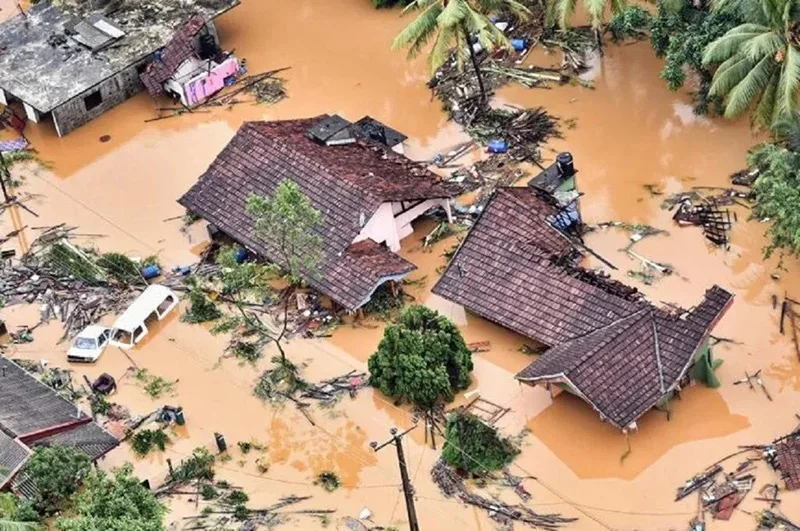
A great deal has been said about Cyclone Ditwah and its impact. To my mind one important aspect of it has not been addressed.
During the 1,400 odd landslides, it washed off a vast volume of soil which entered the various water bodies like tanks, lakes, rivers and streams etc. This process has raised their water levels reducing the water holding capacities (water holding capacity has a different meaning in soil science). What it means is that they cannot hold the same amount of water as before without spilling. Therefore, a precipitation which would not have been significant then can cause spilling of tanks leading to floods now. Hence there is a possibility of experiencing more floods in the future. Due to silting the tanks will carry less water than before, thus reducing the irrigable areas under their command. They will not be able to irrigate the same extents of paddy, thus affecting production.
How do we rectify this situation? It is desilting which can be very expensive.
It is good if these are considered in future planning.
Gamini Peiris
Panadura
Experienced agriculturist

Trump files $5bn defamation lawsuit against BBC over Panorama speech edit

UK and South Korea strike trade deal

Rob Reiner’s son Nick arrested for murder after director and wife found dead

70,297 persons still in safety centers

Showers will occur at times in the Northern, North-Central, Eastern, Uva and Central provinces

MEPA to crack down on marine polluters

‘Dates have the highest sugar content to fight Coronavirus’

Sunday Island 27 December – Headlines

#SundayIsland 17th December – Headlines

Sunday Island – 28th March

Sunday Island Headlines – 21 March

Sunday Island – 21st February – Headlines
-

 Features6 days ago
Finally, Mahinda Yapa sets the record straight
-
 Features6 days ago
Handunnetti and Colonial Shackles of English in Sri Lanka
-
 Business5 days ago
Cabinet approves establishment of two 50 MW wind power stations in Mullikulum, Mannar region
-

 News5 days ago
Gota ordered to give court evidence of life threats
-

 Features5 days ago
Cliff and Hank recreate golden era of ‘The Young Ones’
-
 Features5 days ago
Sri Lanka and Global Climate Emergency: Lessons of Cyclone Ditwah
-
 Opinion6 days ago
A national post-cyclone reflection period?
-

 Latest News6 days ago
Sri Lanka squad named for ACC Men’s U19 Asia Cup