
News
How tax revision that caused revenue loss of Rs 500-600 bn triggered collapse …

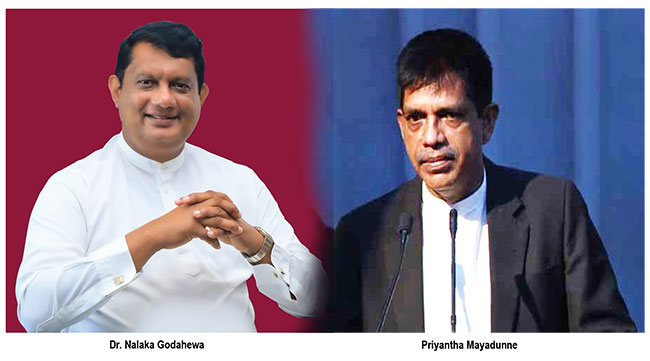
Dr. Godahewa dealt with anatomy of developing crisis
By Shamindra Ferdinando
SLPP lawmaker Dr. Nalaka Godahewa has alleged that those who managed the economy during Gotabaya Rajapaksa’s tenure as the president conveniently failed to take remedial measures though alleged faults were pointed out.
Dr. Godahewa, a key member of the dissident group that voted against the emergency said the then President Gotabaya Rajapaksa could have averted the disastrous consequences if corrective measures were taken. However, the decision makers remained committed to previously taken decisions regardless of the consequences, one-time Viyathmaga activist alleged.
Addressing a group of supporters at Gampaha recently, Dr. Godahewa cited the much disputed tax restructuring that had been introduced soon after Gotabaya Rajapaksa’s overwhelming victory at the 2019 presidential election. Pointing out that tax revisions deprived the government Rs 500-600 bn annually, the Gampaha District MP questioned the failure on the part of the decision makers to take remedial measures. Action could have been taken in 2020 or 2021, but the powers that be chose to ignore criticism pertaining to the tax revisions, Dr. Godahewa said.
The government abolished a range of taxes, including PAYE (Pay As You Earn), NBT (Nation Building Tax), Withholding tax, Capital Gain tax imposed on the Colombo Stock Exchange, Bank Debit tax and unprecedented reduction of VAT (Value Added Tax). In addition to those revisions 15% VAT and the 2% NBT which amounted to 17% imposed on all goods and services were unified and reduced to 8%, effective from Dec 01, 2019. Controversial decision in this regard has been taken at the first cabinet meeting of the Gotabaya Rajapaksa government held on Nov 27, 2019.
Total income dropped to Rs 1,373 in 2020, though total revenues for 2018 and 2019 had been Rs 1,950 bn and Rs 1,900 bn, respectively.
Shouldn’t those decision makers be held responsible for a much bigger budget deficit and continuously printing of money to meet a shortfall of Rs 2,000 bn annually? he asked.
Though Easter attacks, the pandemic and the resultant body blow to the vital tourism sector and steep drop in migrant worker remittances aggravated the situation, the first time entrant to parliament primarily faulted President Gotabaya Rajapaksa for the current crisis. Dr. Godahewa said that having repeatedly assured the electorate he wouldn’t allow family rule, President Rajapaksa placed the economy in the hands of those who mismanaged the economy over the past several decades. Dr. Godahewa pointed out that following the general election in August 2020, those who had been rejected in 2015 received cabinet portfolios. In the wake of the country being declared bankrupt, those who had been overwhelmingly rejected in 2019 received an opportunity to regain power.
The former media minister was referring to UNP leader securing parliamentary approval to complete the remainder of Gotabaya Rajapaksa’s mandate.
Dr. Godahewa asked whether longstanding issues at hand could be addressed by the above-mentioned two groups swapping political power from time to time and in some instances working together. The outspoken politician quoted Fitch Ratings as having recently stated that far reaching changes couldn’t be expected under President Ranil Wickremesinghe’e leadership as those who had been rejected by the people were behind him.
Dr. Godahewa was referring to the SLPP engineering Wickremesinghe victory at the July 20 presidential contest. Dr. Godahewa backed Dullas Alahapperuma, who obtained 82 votes whereas Wickremesinghe polled 134. The group that voted for Wickremesinghe largely backed the imposition of emergency with 120 voting for and 63 against in the 225 member parliament.
MP Godahewa said that the country could overcome the daunting economic challenges. The MP said that he was not sure whether the incumbent Cabinet-of-Ministers had the capacity and the commitment to implement what was agreed during consultations among political parties in the run-up to Wickremesinghe election as the President. Whatever the developments, now that Wickremesinghe has been installed as the President, the new administration should be given the time and the space to address the issues, he said.
Lawmaker Godahewa strongly censured the electorate for habitually electing the same corrupt lot though they always demanded what he called a system change. The MP warned the electorate that there was absolutely no point in demanding ‘a system change’ if they exercised their franchise for those who ruined the country.
Declaring that there could be fresh protests similar to the massive public eruption on July 09 in Colombo, Dr. Godahewa urged the electorate to correctly identify those responsible.
Former Finance Minister Ali Sabry, PC, appearing on Swarnavahini in early June named the then President’s economic advisor (Dr. PBJ), Governors of the Central Bank (Prof. W.D. Lakshman and Ajith Nivard Cabraal) and the Treasury Secretary (S.R. Attygalle) as the culprits.
Dr. Godahewa said that the government required as much as USD 5-6 bn annually to settle loans amounting to USD 24.7 bn taken between 2004 and 2019. The MP emphasized the urgent need to examine the utilization of these funds, particularly unproductive investments made over the years. The former private sector top executive questioned whether a part of foreign loans obtained at exorbitant rates had been robbed.
The lawmaker said today the public had forgotten the Treasury bond scams that had been perpetrated in Feb 2015 and March 2016, finalization of 99-year- leasing of the Hambantota port to China in 2017 at terms utterly disadvantageous to Sri Lanka, sharp drop in economic development from 5.5% to 2.1% and depreciation of the Rupee by 40 percent during yahapalana administration. At the time, Gotabaya Rajapaksa won the presidency in late Nov 2019, the country had USD 7.6 bn in reserves sufficient to meet the import bill for a couple months, Dr. Godahewa said.
Referring to a recent controversial public declaration made by Public Administration Secretary Priyantha Mayadunne, Dr. Godahewa said that those who had recklessly expanded the public sector at the expense of the overall financial stability, too, should accept the responsibility for the current crisis.
The MP pointed out that there had been approximately 500,000 public sector employees in 2004 but over the years the total increased to a staggering 1,402,000. Dr. Godahewa cited the 2021 figures to highlight the crisis. Of Rs 1,238 bn tax revenue, Rs 1,115 bn or 90 percent of the total had been spent on public sector salaries and pensions.
Stressing the extreme difficulty in raising USD 500 mn required for fuel imports, particularly for power generation, Dr. Godahewa alleged that those who deliberately delayed power generation projects, too, should accept the blame for Sri Lanka’s current predicament.
Dr. Godahewa queried how the sudden introduction of mandatory use of carbonic fertilizer without a proper study ruined the agriculture sector. Those who decided on the agriculture policy as well as proponents of that move, too, should be held responsible for the overwhelming crisis.
Much touted projects to send trained personnel abroad and expansion of the information technology sector couldn’t achieve desired results as those entrusted with the said tasks failed, the former minister said.


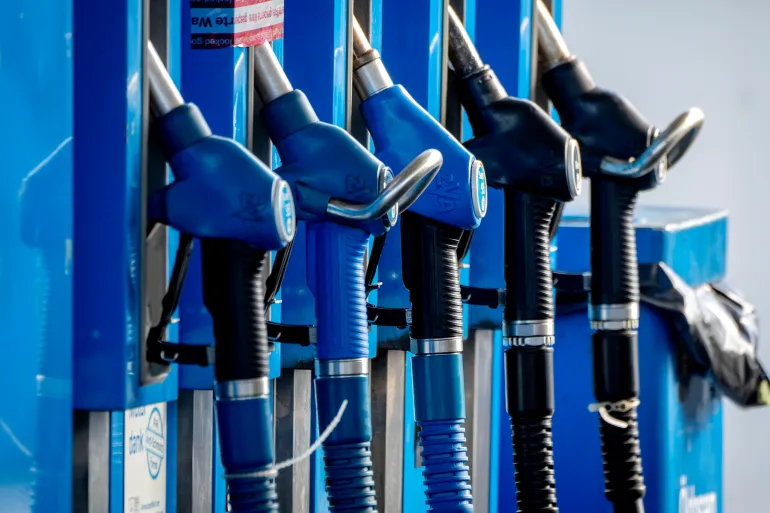
The Ceylon Petroleum Corporation (Ceypetco) has announced a revision of fuel prices, effective from midnight today (21).
Accordingly,
Auto Diesel – Rs. 382 (increased by Rs. 79)
Super Diesel – Rs. 443 (increased by Rs. 90)
Petrol 92 Octane – Rs. 398 (increased by Rs. 81)
Kerosene – Rs. 255. (increased by Rs. 60)
Petrol 95 Octane – Rs. 455 (increased by Rs. 90)

Latest News
Advisory for Severe Lightning issued for Galle, Matara, Kaluthara and Rathnapura districts

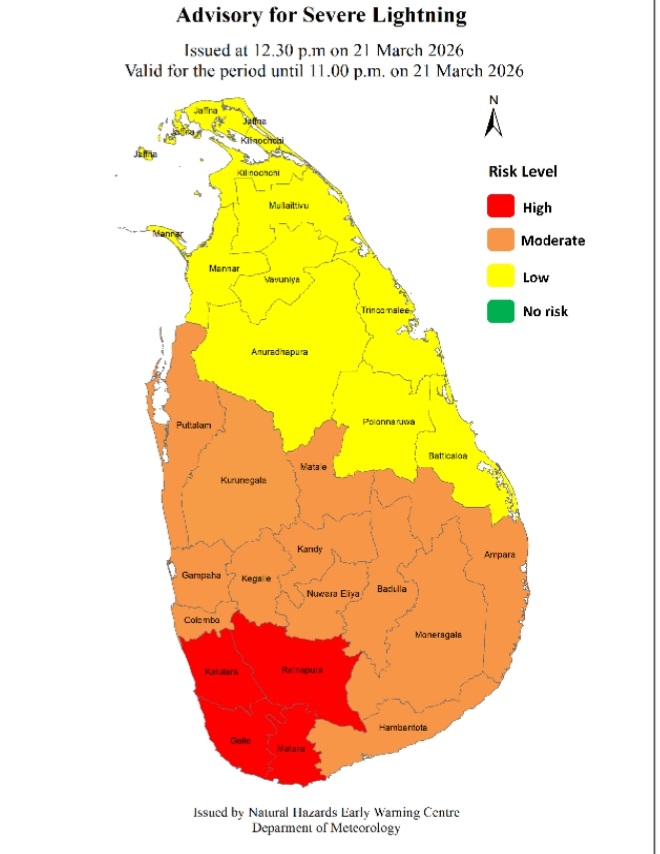
Advisory for Severe Lightning Issued by the Natural Hazards Early Warning Centre Issued at 12.30 p.m. 21 March 2026, valid for the period until 11.00 p.m. 21 March 2026
Thundershowers accompanied with severe lightning are likely to occur at some places in the Galle, Matara, Kaluthara and Rathnapura districts after 1.00 p.m.
There may be temporary localized strong winds during thundershowers. General public is kindly requested to take adequate precautions to minimize damages caused by lightning activity.
ACTION REQUIRED:
The Department of Meteorology advises that people should:
Seek shelter, preferably indoors and never under trees.
Avoid open areas such as paddy fields, tea plantations and open water bodies during thunderstorms.
Avoid using wired telephones and connected electric appliances during thunderstorms.
Avoid using open vehicles, such as bicycles, tractors and boats etc.
Beware of fallen trees and power lines.
For emergency assistance contact the local disaster management authorities.
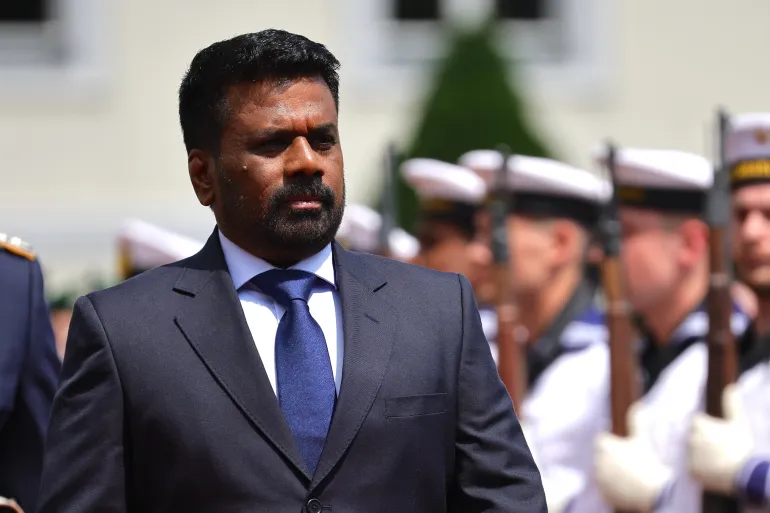
Sri Lanka’s president says his government turned down a request from the United States to land two US combat aircraft at a civilian airport earlier this month.
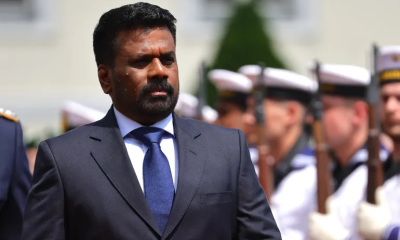
President Anura Kumara Dissanayake told Sri Lanka’s parliament on Friday that Washington had requested permission for the aircraft to land at Mattala Rajapaksa International Airport in southern Sri Lanka from March 4 to 8.
The request was made on February 26, two days before the US and Israel launched their military offensive against Iran.
“They wanted to bring two warplanes armed with eight antiship missiles from a base in Djibouti”, Dissanayake told lawmakers. “We turned down the request to maintain Sri Lanka’s neutrality”, he added to applause.
The US-Israeli war on Iran has sparked widespread concern globally, as Iranian missile and drone attacks across the wider Middle East have sent energy prices soaring and fuelled fears of a widening conflict.
US President Donald Trump has also been pressuring Washington’s allies to show more support for the war, slamming NATO countries as “cowards” for refusing to help secure the Strait of Hormuz.
Iran has essentially shuttered the critical Gulf waterway amid the war, forcing leaders around the world to scramble to try to offset the effects on their economies and energy supplies.
Amid the turmoil, many countries have refused to get directly involved in the war while calling for urgent de-escalation.
On Friday, Switzerland announced that it would halt any weapons exports to the US that could be used in military operations against Iran, citing its longstanding policy of neutrality.
“The export of war materiel to countries involved in the international armed conflict with Iran cannot be authorised for the duration of the conflict”, the Swiss government said.
Sri Lanka’s president also cited his country’s neutrality in the decision to deny the US request to land the two aircraft at Matalla airport earlier this month.
Dissanayake said he had received another request that same day, on February 26, from Iran to seek permission for three naval vessels to make a goodwill visit to Sri Lanka.
“With two requests before us, the decision was clear,” he said, noting that the government denied both to avoid taking sides as signs of escalating conflict emerged.
“Had we said ‘yes’ to Iran, we would have had to say ‘yes’ to the US, as well”, Dissanayake added.
In early March, Sri Lanka’s navy rescued 32 Iranian crew off IRIS Dena after it was torpedoed by a US submarine off the country’s coast, killing at least 84 people.
Days later, Sri Lanka evacuated more than 200 crew members from a second Iranian vessel, IRIS Bushehr, after the ship requested assistance from Colombo.
[Aljazeera]

CEYPETCO Fuel prices increased from midnight today (21)

Advisory for Severe Lightning issued for Galle, Matara, Kaluthara and Rathnapura districts

Sri Lanka says it denied US request to land two aircraft at Mattala airport

Eid celebrations dimmed by war and displacement across Middle East

Showers may occur at several places in the Western, Sabaragamuwa, Northwestern and Uva provinces and in Galle, Matara, Kandy and Nuwara-Eliya districts after 1.00 pm.

Iranian strikes on bases used by US caused $800m in damage, new analysis shows

‘Dates have the highest sugar content to fight Coronavirus’

Sunday Island 27 December – Headlines

#SundayIsland 17th December – Headlines

Sunday Island – 28th March

Sunday Island Headlines – 21 March

Sunday Island – 21st February – Headlines
-

 Business6 days ago
Browns EV launches fast-charging BAW E7 Pro at Rs. 5.8 million
-

 Life style7 days ago
From culture to empowerment: Indonesia’s vision for Sri Lanka
-

 News4 days ago
CIABOC questions Ex-President GR on house for CJ’s maid
-

 Life style7 days ago
Ranjith Fernando celebrates cricketing journey with Hob Nails to Spikes
-

 News5 days ago
Sri Lankan marine scientist Asha de Vos honoured at UNGA opening
-

 Features6 days ago
Achievements of the Hunduwa!
-

 Latest News7 days ago
QR code system will be implemented for fuel with effect from 06.00 a.m. today (15th)
-

 News5 days ago
Australian HC debunks misleading travel risk claims for Sri Lanka