
Midweek Review
How former CID Chief Shani ended up in Geneva agenda and clampdown on Ranjan’s tapes

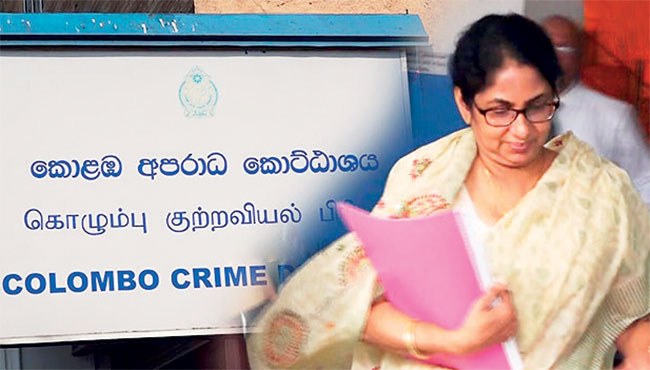
By Shamindra Ferdinando
Many eyebrows were raised when the Geneva-based UK Mission to the WTO, UN and other International Organizations recently referred to one-time Director of the Criminal Investigation Department (CID) Gnendra Shani Abeysekara.
In a brief statement, dated June 22, 2021, that dealt with Sri Lanka, the UK, on behalf of the literally self-appointed Sri Lanka Core Group (whether we like it or not), comprising Canada, Germany, North Macedonia, Malawi, Montenegro and the UK, demanded the safety of Abeysekara. The grouping told the world: “We call for former CID director Shani Abeysekara’s safety to be ensured.”
The Geneva statement was made ahead of Abeysekara’s retirement. At the time Abeysekara retired on June 30, 2021, he was on bail having been arrested, in July 2020, in connection with the alleged fabrication of evidence against former DIG Vass Gunawardena and several others. The latter group had been arrested over the alleged abduction and killing of Mohammed Shyam, on May 22, 2013. Along with Abeysekara, the Appeal Court bench consisting of Justices Nissanka Bandula Karunaratne and R. Gurusinghe on June 16, 2021 also granted bail to former Sub Inspector of CID Sugath Mendis. Both were subjected to strict bail conditions.
Attorney-at-Law K.W. Janaranjana, the editor of Annidda, has meticulously dealt with the killing of Mohammed Shyam, investigations conducted by Abeysekara, the 2019 change of government, the probe taking a new turn, Abeysekara’s arrest and, finally, the Court of Appeal granting the former CID Director and SI Sugath Mendis bail. The full page article authored by the civil society activist, formerly with Ravaya, carried on its June 27, 2021 edition, is a must read.
The UK-led Core Group addressed the Abeysekara’s arrest, pertaining to the alleged fabrication of evidence. Yahapalana Justice Minister Thalatha Atukorale, too, called for an end to what she called persecution of Abeysekara. The Sri Lanka Core Group wouldn’t have taken up Abeysekara’s case in Geneva without being pushed by the Colombo-based civil society group. There had never been such a Western intervention on behalf of a law enforcement officer here, though there were intrusions by individual countries. Switzerland accommodating Abeysekara acolyte Chief Inspector Nishantha Silva and his family in its asylum programme is a case in point. CI Silva, accompanied by his family, left the country just over a week after the 2019 presidential election. Their departure to Switzerland paved the way for those who had been involved in the conspiracy to accuse newly elected President Gotabaya Rajapaksa’s government of abducting local Swiss Embassy employee, Francis Garnier, formerly Sriyalatha Perera.
The London headquartered Amnesty International, in late Nov 2020, expressed concerns over Abeysekara’s safety, in prison, after he was tested Covid-19 positive. According to the AI, the police officer who had been interdicted over alleged fabrication of evidence, in respect of Mohammed Shyam’s case, earned the wrath of the second Rajapaksa government for exposing human rights abuses implicating top politicians.
SC endorses HC ruling
One of the high profile cases, handled by Abeysekara, was the killing of four persons, including former lawmaker Bharatha Lakshman Premachandra, who had been assigned to handle the UPFA trade union activity. The then Attorney General filed 17 indictments against 13 defendants for the murders of Bharatha Lakshman Premachandra, Damitha Darshana Jayathilake, Jalaldeen Mohamed Azeem and Manuel Kumaraswamy, on October 8, 2011, the day of the Local Government Elections, at Himbutana, Angoda. Following an extensive trial, High Court judges Padmini M. Ranawaka and M.T.B.S. Moraes (believed to be in Fiji as a judge) sentenced the defendants to death on Dec 8, 2016. However, the President of the trial-at-bar, Judge Shiran Gooneratne (now in the Supreme Court) disagreed. He acquitted 13 defendants from all charges filed against them whereas Judge Padmini Ranawaka, with Judge M.T.B.S. Moraes, agreeing, acquitted 08 of the 13 defendants from all charges.
At the time of the Himbutana incident, Duminda Silva had been Colombo District lawmaker and Monitoring MP for the Defence Ministry. The other Monitoring MP in that Rajapaksa administration was Sajin Vass Gunawardena, assigned to the Foreign Ministry.
The Supreme Court, on Oct 11, 2018, dismissed an appeal filed by Duminda Silva and the three others. The SC bench comprised five judges. Duminda Silva and the three other accuseds, filed an appeal against the death penalty imposed by the High Court on Dec 8, 2016. At the SC proceedings, the 01st accused, Police Constable Anura Thushara de Mel was acquitted of all charges by the bench consisting of the then Chief Justice Priyasath Dep, Justices Buwaneka Aluvihare, Nalin Perera, Priyantha Jayawardena and Vijith Malalgoda. Thereby the SC reaffirmed the death penalty imposed on Duminda Silva, Srinayake Pathiranage, Chaminda Ravi Jayanath alias Dematagoda Chaminda and Dissanayake Mudiyanselage Sarath Bandara.
However, the releasing of audio tapes of conversations among Abeysekara (he hadn’t been appointed Director CID then), Deputy Minister of Social Empowerment Ranjan Ramanayake, the then High Court judge Mrs. Padmini Ranawaka and President Maithripala Sirisena, in the wake of the 2019 Presidential Election, sent shock waves through political parties, the judiciary, the police and the civil society. Controversy still surrounds the circumstances under which the police received the recordings, secretly made by Ramanayake. Selected tapes were released to both the print and electronic media. Social media prevented efforts to hush up the shocking revelations, pertaining to the Himbutana killings, and the subsequent judgment.
Those in authority conveniently refrained from conducting a proper investigation into the scandalous interventions made by Ramanayake, as well as the conduct of HC judge Mrs. Ranawaka, and Abeysekara, though the police recorded some statements, including that of Mrs. Ranawaka. Parliament, through a statement issued by its Director Department of Communication, Shan Wijetunga, explained its position. That statement dated Feb 7, 2021, based on the decisions taken by the Committee on Parliamentary Business, as regards Ramanayake’s tapes, is reproduced here: “The CDs containing the recorded telephone conversations which were handed over to the Hansard Department of Parliament by MP Ranjan Ramanayake was taken into a lengthy discussion during the Committee on Parliamentary Business held today (Feb. 07, 2021).
Accordingly, the Committee Members directed Parliament officials to submit the alleged CDs to the Speaker of Parliament, Karu Jayasuriya, to examine matters concerning national prejudice, insults directed at elite persons and words which are inconsistent with Parliament.
The Committee then decided that the Speaker should examine it further and take appropriate action. The decision to table the CDs and give access to the MPs was deferred for later consideration.”
Parliament never released the CDs. Karu Jayasuriya’s recent call to grant presidential pardon to Ramanayake should be examined against the backdrop of how Parliament responded to the disturbing revelations and the suppression of CDs.
Meeting press outside Temple Trees
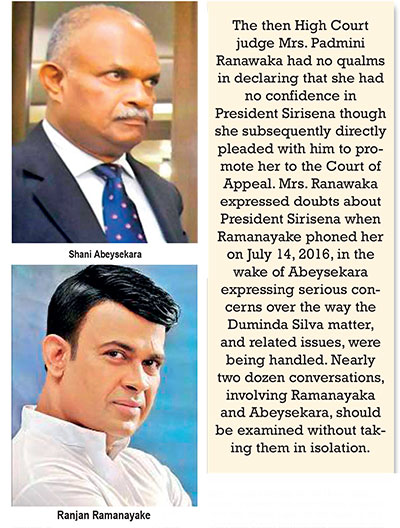 Ramanayake got into trouble for a statement he made outside Temple Trees, on August 21, 2017, following a parliamentary group meeting of the then ruling party. A simmering controversy erupted over the leaked tapes in the wake of the Supreme Court sentencing Ramanayake on January 12, 2021. A three-judge bench, comprising Justices Sisira de Abrew, Vijith Malalgoda and Preethi Padman Surasena, sentenced Ramanayake to four years rigorous imprisonment after convicting him of contempt of court. The Attorney General filed the case following a complaint filed in the Supreme Court by Ranawaka Sunil Perera of 43/11, Walawwatta Road, Gangodawila, Nugegoda. The case has been in terms of Article 105(3) of the Constitution.
Ranawaka Sunil Perera moved the Supreme Court on the day after Ramanayake accused lawyers and judges of being corrupt.
Rasika Dissanayake, with Sandun Senadhipathi, appeared for the petitioner, on the instructions of Sanath Wijewardena, whereas Tamil National Alliance lawmaker M.A. Sumanthiran, PC, with Viran Corea and J.C. Thambiah, appeared for the respondent on the instructions of D. Vithanapathirana. Sarath Jayamanne PC ASG, with Suharshi Herath SSC, represented the Attorney-General.
But, interventions made by Ramanayake, throughout 2016, in respect of judgment in the Himbutana killings, had never been properly investigated, though Parliament, and the police, received the tapes well over a year ago. The bottom line is that the appalling disclosures in audio tapes had never been subjected to judicial proceedings.
Now Karu Jayasuriya, in his new capacity as the Chairperson of the NMSJ (National Movement for Social Justice), pioneered by the late Ven Maduluwawe Sobitha wants President Gotabaya Rajapaksa to pardon Ranjan Ramanayake, the way he freed Duminda Silva. Following the last parliamentary election, in August 2020, Prof Sarath Wijesuriya gave up the NMSJ leadership for Jayasuriya’s entry. Those who are genuinely interested in good governance and accountability should listen to those tapes and take tangible measures to conduct a thorough investigation into the whole affair. The conversations involving Abeysekara and Ramanayake, President Sirisena, Ramanayake and Judge Mrs. Ranawaka depict a pathetic situation.
Before the writer dealt with the leaked conversations, it would be pertinent to mention that Abeysekara received promotion to the rank of SSP on August 8, 2016, and appointed as Director, CID, in the first week of Sept 2017. Abeysekara served as CID Director till he received a transfer, on Nov 21, 2019, as Personal Assistant to DIG, Galle.
Did Ramanayake speak to High Court Judge Mrs. Ranawaka to influence the murder conviction against Duminda Silva, sans permission from the party leadership? Did the then top UNP leadership ask him to approach judges in respect of various cases? Ramanayaka is also on record phoning High Court judge Gihan Pilapitiya and Magistrate Dhammika Hemapala. Following the disclosure of a fraction of the tapes secretly recorded by Ramanayake, the police compiled statements from Mrs. Ranawaka (retired), Pilapitiya and Hemapala. Let me focus on the conversations involving Mrs. Ranawaka, Ramanayake, Abeysekara and President Sirisena (now SLPP Polonnaruwa district MP. Sirisena remains the SLFP leader).
How Prez’s intervention
sought for promotion
Mrs. Ranawaka had no qualms in declaring that she had no confidence in President Sirisena though she subsequently directly pleaded with him to promote her to the Court of Appeal. Mrs. Ranawaka expressed doubts about President Sirisena when Ramanayake phoned her on July 14, 2016, in the wake of Abeysekara expressing serious concerns over the way the Duminda Silva matter, and related issues, were being handled. Nearly two dozen conversations, involving Ramanayaka and Abeysekara, should be examined without taking them in isolation. According to conversations now in public domain, Mrs Ranawaka asked Ramanayaka to intervene on her behalf when the latter pressed her on the pending judgment on the Himbutana killings. The judge also made reference to the then lawmaker and Attorney-at-Law Ajith P. Perera during her conversation, initiated by Ramanayake. The way the conversation continued, clearly indicated that the call taken by Ramanayake, on July 14, 2016, couldn’t have been the first and they knew each other very well. Mrs. Ranawaka, obviously exploited Ramanayake’s intervention to explore the possibility of moving up the ladder with unbridled political patronage.
Let me stress that Ramanayake didn’t mince his words when he repeatedly sought assurances from Mrs Ranawaka and Abeysekara, in separate conversations, whether they were sure of a guilty verdict in respect of the Himbutana killings. Abeysekara repeatedly assured Ramanayake he was convinced of a guilty verdict. At one point, Abeysekara declared all three judges would take a common stand. Abeysekara had been so confident of the impending ruling, at one point he assured Ramanayake that he was 10,000 percent sure of the verdict. Abeysekara warned Ramanayake of dire consequences if he made any further direct interventions, particularly with Mrs. Ranawaka.
Abeysekara, however, pointed out to Ramanayake that calling Mrs Ranawaka was nothing but a mistake but he cut a sorry figure by pleading with the UNP Deputy Minister not to discuss the issue at hand with anyone, including President Sirisena. Ramanayake ignored Abeysekara’s advice.
After the three-member bench delivered judgment on the Himbutana killings, Ramanayake, on Sept 12, 2017, arranged for President Sirisena to talk with Mrs. Ranawaka. She unashamedly sought President Sirisena’s intervention to secure a promotion to the Court of Appeal. Having repeatedly assured good governance and accountability, the yahapalana grandees caused unprecedented turmoil. In the absence of a proper inquiry at any level, Ramanayake’s interventions in judicial matters were never dealt with.
In spite of Ramanayake’s deplorable conduct, the Samagi Jana Balavegaya (SJB), the breakaway faction of the UNP, had no misgivings in accommodating him on its Gampaha District list at the August 2020 General Election. The SJB cannot absolve itself of the UNP’s culpabilities, ranging from Treasury bond scams, perpetrated in Feb 2015 and March 2016, to failure to prevent the 2019 Easter Sunday attacks, despite being forewarned with precise intelligence.
Former Speaker Karunaratne Jayasuriya, despite always being clad in immaculate lily white national attire, like most shrewd politicians, however failed to inquire into Ramanayake’s sordid vigilante type justice. What we should understand is that he is foremost a politician. Jayasuriya, one-time UNP Deputy Leader and a member of the 2015 UNP parliamentary group, was named the Speaker, therefore his actions/failures can be explained. However, the pathetic failure on the part of the SLPP to initiate an inquiry into the Ramanayake affair, nearly a year after the last general election, is an indication of the utterly irresponsible Parliament, where many a backroom deal is made.
All parties represented in Parliament, particularly the SLPP, and the SJB, with nearly 200 lawmakers in Parliament should take a clear stand on political interventions in judgments. Whatever the shortcomings, those drafting a new Constitution, at a great cost to the taxpayer, should do away with constitutional provisions in respect of presidential pardons and formulate a mechanism for judicial review of previous rulings in case of the emergence of fresh evidence. Presidential pardon shouldn’t be a ‘tool’ available for the executive, under any circumstances. Political parties should reach a consensus on the need to abolish the presidential pardon, as such powers make a mockery of democracy.
But, in the so-called greatest democracy, the USA, even if we leave aside the erratic and unscrupulous behaviour of President Trump and take for example the actions of President Obama, one of the darlings of the liberal media there, he pardoned nearly 2000 felons before he left office At least in the local instance of Duminda Silva, the presidential pardon managed to undo a grave injustice to a man, who was shot first in the head. So the President overturning his murder conviction for the other killings that took place after he was incapacitated, amidst shenanigans involving Ranjan Ramanayake, Shani Abeysekara and Judge Padmini Ranawaka, was the right thing to do.
The government should go for a thorough inquiry into Ramanayake’s tapes. Let us hope Parliament, without further delay, makes all tapes available to its members and takes tangible measures to facilitate no holds barred investigations. The way Abeysekara used Ramanayake to target Brigadier Suresh Salley of the Directorate of Military Intelligence (DMI) is evidence how all stakeholders exploited various situations to their advantage. Abeysekara wanted Ramanayake to set the stage for Salley’s removal. Whatever the circumstances, the then Premier Wickremesinghe unceremoniously removed Salley.
Perhaps, the Foreign Ministry should make available certified translations of all available telephone conversations among former High Court judge Padmini Ranawaka, retired SSP Shani Abeysekara, former lawmaker Ranjan Ramanayake and former President Maithripala Sirisena to members of Sri Lanka Core Group. The Foreign Ministry should seriously consider briefing the Core Group members, particularly the UK, Canada and Germany, to prevent them from further exploiting Abeysekara’s case.

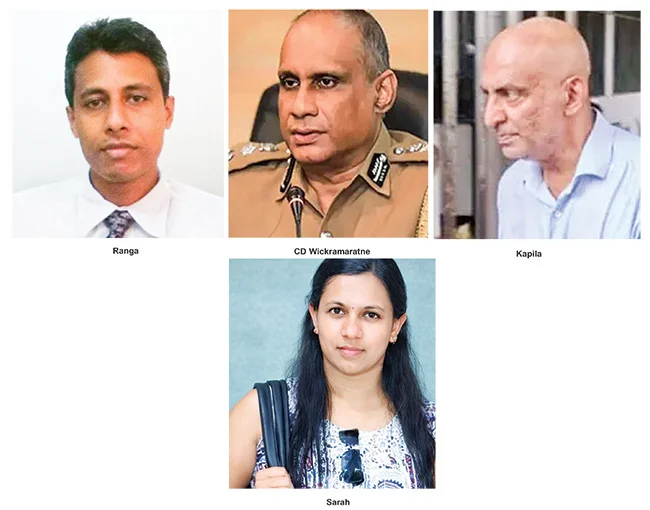
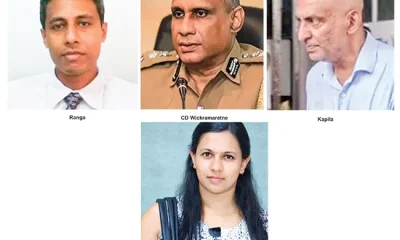
Former IGP Chandana Deepal Wickramaratne, 63, succumbed to gunshot injury he received at his residence at Parakrama Mawatha, in Thalahena, Malabe, on 17 July. Wickramaratne, the 35th IGP (25 November, 2020, to 23th November, 2025), was pronounced dead at the Mulleriyawa Hospital.
The incident triggered speculation regarding the circumstances leading to the ex-IGP’s death. Some declared that Wickramaratne shot himself with a weapon issued to his bodyguard. Others alleged that Wickramaratne had been deeply depressed over divorce proceedings, involving his son and daughter-in-law, and accusations directed at his son over domestic violence. They claimed that the situation may have had unexpected bearing on Wickramaratne.
There are also lingering concerns regarding the impact of the ongoing investigations into the 2019 Easter Sunday carnage, on Wickramaratne’s demise, the third such incident after the last presidential elections held in September, 2024.
Assistant Director of the External Resources Department of the Ministry of Finance, Ranga Nishantha Rajapaksa, 50, was found dead in the garden of his Kuliyapitiya home on 30 April, 2026. At the time of Rajapaksa’s alleged suicide, blamed on injuries he supposedly inflicted on himself using a knife, while he was under suspension over the USD 2.5 mn heist from the Treasury. He was the official who lodged a complaint with the CID regarding the unprecedented theft.
Former Chief Executive Officer (CEO) of SriLankan Airlines, Kapila Chandrasena, 61, was found dead at No. 38, Pedris Road, Kollupitiya, on 8 May, 2026. Authorities declared Chandrasena died by hanging. Chandrasena was the prime suspect in the SriLankan Airlines bribery case, exposed by the UK Serious Fraud Office (SFO), in a joint investigation carried out with US and French authorities. At the time of his death, he was out on bail but faced re-arrest over alleged violations of bail conditions.
The Finance Ministry official and ex-IGP died as a result of ‘incidents’ at their respective homes, while Chandrasena allegedly took his own life at the posh residence of his brother-in-law Aravinda de Silva. Their deaths are mired in controversy for obvious reasons. One of the major issues at hand is whether their deaths impacted the ongoing politically sensitive cases.
The USD 2.5 mn theft sent shockwaves through the National People’s Power (NPP) government, struggling to cope up with a spate of other sensitive developments, such as the massive coal scam that led to the resignation of Energy Minister Kumara Jayakody, and the controversial release of 323 red flagged containers from the Colombo port, without any checks, in addition to two containers carrying narcotics.
The police faced the challenging task of conducting transparent investigations into the deaths of Ranga Nishantha Rajapaksa, Kapila Chandrasena and C.D. Wickramaratne.
Although the Finance Ministry official’s death was caused by cardiorespiratory failure due to heavy loss of blood, many questioned how he inflicted grievous cut wounds on his legs and on his left wrist. The judicial post mortem report that was made available within 24 hours after the alleged suicide raised concerns. The Opposition expressed suspicions. A section of the media, too, weren’t satisfied with the way the government handled the case. The truth is in spite of a post mortem examination conducted by a four-member expert panel, suspicions remain regarding the Finance Ministry official’s death.
It would be pertinent to mention that The Sunday Leader Editor Lasantha Wickrematunga was stabbed to death though police and all others concerned initially claimed firearms attack caused his death. The Attorney-at-Law was killed inside his car that he was driving on the Attidiiya Road, Ratmalana, on 8 January, 2009. Over 17 years after the still unresolved killing of the one-time The Island staffer, the vast majority of people still believe Wickrematunga was shot dead. Wickrematunga’s case is just among several high profile investigations hampered by deliberate falsification of relevant autopsy reports.
Sarah Jasmine factor
Among those who paid their last respects to Wickremaratne at a funeral parlour in Colombo was former President Ranil Wickremesinghe. Former Minister Sagala Ratnayake accompanied the UNP leader.
One of the issues that received public and media attention, following Wickremaratne’s demise, was the controversial third DNA test conducted in spite of two previous DNA tests confirming that Pulastini Rajendran, alias Sarah Jasmine, was not among the dead caused by a series of explosions at Sainthamaruthu, in the East, a week after the 2019 Easter Sunday carnage.
She was married to Achchi Muhammadu Mohammadu Hasthun, the National Thowheeth Jaamath (NTJ) operative who carried out the suicide blast in St. Sebastian Church, Katuwapitiya.
The CID questioned Wickremaratne as he served as the IGP at the time of the third DNA test. Controversy surrounds the decision to call for a third DNA test and, in addition to Wickremaratne, the CID questioned former Deputy IGP of the CID Prasad Ranasinghe in the second week of December last year. Public Security and Parliamentary Affairs Minister Ananda Wiejapala commented on the issue at hand in Parliament in early June, 2025.
There had been contradictory claims on Sarah, a Batticaloa Tamil convert to Islam, who lived with the extremist group. In spite of investigations, controversy still surrounds her fate, though both Sri Lanka and Indian intelligence services investigated the circumstances of her ‘disappearance.’
There had been claims that she was taken out of the country by Indian intelligence. Let me remind you what the DSJB lawmaker Mujibur Rahuman said in Parliament on 10 November, 2022, during Ranil Wickremesinghe’s presidency. Declaring that Sarah had taken refuge in India, the outspoken parliamentarian alleged that the Wickremesinghe-Rajapaksa government was struggling to prove she died in the Sainthamaruthu blasts, on the night of 26 April, 2019.
Rajarathnam Kavitha, mother of Sarah, is on record as having told the Presidential Commission of Inquiry (PCoI) that her daughter had been with Zharan Hashim’s wife, Fatima, from early February, 2019, to 26 April, 2019, the day remnants of the NTJ group triggered the Sainthamaruthu blasts.
Sarah’s mysterious status remains a key factor in the overall investigation, with retired Major General Suresh Sallay named a suspect in the high profile case. Sallay served as the Director of State Intelligence Service (SIS) from November, 2019, to October, 2024. The CID arrested the one-time head of the Directorate of Military Intelligence (DMI/ 2012 to 2016) in late February 2026, under the Prevention of Terrorism Act (PTA).
Archbishop of Colombo, Malcolm Cardinal Ranjith, recently filed an intervening petition before the Court of Appeal in respect of the petition filed by Sallay challenging his arrest and detention under the PTA. Cardinal Ranjith sought permission to make submissions regarding Sallay’s petition while requesting the court to dismiss the latter’s petition.
The Church intervened after several prominent Buddhist monks, religious and civil society organisations filed intervenient petitions seeking leave to intervene in Sallay’s writ application, filed by the retired top intelligence officer, challenging the legality of his arrest and detention.
They highlighted the following points:
• The Supreme Court and the PCoI identified Zahran Hashim and the ISIS-inspired NTJ as the perpetrators of the 2019 Easter Sunday carnage while attributing responsibility to State officials for failing to act on prior intelligence.
• None of the official investigations or judicial findings implicated Sallay in planning or facilitating the Easter Sunday attacks.
• The PCoI recorded that Major General Sallay had warned authorities about the rise of Islamist extremism before the attacks.
• The intervening petitions expressed concerns that unsubstantiated allegations have created a public narrative suggesting a wider conspiracy involving Sinhala Buddhist military and intelligence officers, contrary to the findings of the Supreme Court and the PCoI.
• The petitions argued that such unsupported narratives risk undermining public confidence, damaging communal harmony, and unfairly tarnishing the reputation of individuals and institutions without credible evidentiary foundation.
Ex-IGP’s statement
In his statement to the CID, Wickremaratne explained that he directed the senior police officer, in charge of Ampara, to secure the military and STF backing for the Sainthamaruthu operation that led to the death of some inner remnants of Zahran’s group. The Ampara-based officer, identified as Samantha Wijesekera, had got in touch with the Department’s number two officer, as IGP Jayasundera couldn’t be contacted over the phone. That statement dealt with the measures taken by them to ascertain Sarah’s status and the final assertion on the basis of the Government Analyst’s findings (third DNA test) that she was among those who perished in the Sainthamaruthu suicide blast.
The then Police Spokesman DIG, Nihal Thalduwa, has been directed by Wickremaratne to issue a press release confirming Sarah’s death. In his statement to the CID, Wickremaratne explained the deep interest shown by the head of the Indian Intelligence, based in Colombo, regarding Sarah’s status, underscoring their requirement to know whether she was dead or alive. The Indian official has repeatedly emphasised the pivotal importance of establishing Sarah’s status and, according to Wickremaratne, never tried to hide their interest in knowing her fate.
Did India accept the findings of the third DNA test? The possibility of Sarah being an Indian informant cannot be ruled out as India was able to alert Sri Lanka of the impending attacks. SJB Colombo District MP Rahuman has often commented on this possibility. Or, perhaps, India knew of Sarah’s status but raised the issue with Wickremaratne in a bid to indicate they, too, weren’t aware. Perhaps, we’ll never know the truth.
Sri Lanka received three specific warnings on 4, 20 and 21 April regarding impending dastardly NTJ operation. The last warning was received several hours before the NTJ struck hotels and Churches in Colombo, Katana and Batticaloa. The blasts killed 270 persons and wounded about 500.
At the time of the NTJ operation, the DMI was headed by Brigadier Chula Kodituwakku, who appeared alongside President Maithripala Sirisena when he met the media at the Janadhipathi Mandiraya, several days after the attacks. Now retired, Kodituwakku, in his testimony in courts, declared that the SIS refrained from sharing foreign intelligence with the DMI. In fact, Army Commander Lt. Gen. Mahesh Senanayake, who also addressed the media, explained the difficulties experienced by the Army due to refusal on the part of the SIS to cooperate with the DMI.
According to an appeal filed against an order of the High Court-at-Bar, in terms of the Section 451 (3) of the Code of Criminal Procedure Act No. 15 of 1979, as amended, read with Article 128 of the Constitution, in the Supreme Court, India issued the following warning: “As per an input, Sri Lanka based Zahran Hashim of National Thowheeth Jamath and his associates are planning to carry out suicide terror attack in Sri Lanka shortly. They are planning to target some important churches. It is further learnt that they have conducted reconnaissance of the Indian High Commission in Sri Lanka and it is one of the targets for the planned attack.”
No holds barred investigation is required to establish the truth. The Opposition has repeatedly questioned the handing over of the investigation to retired Shani Abeysekera, who had been the Director, CID, at the time of the 2019 Easter Sunday carnage, and accommodating Senior DIG Ravi Seneviratne as the Secretary Public Security Ministry. They had been accused of failing to act on specific intelligence received from the SIS.
Both Abeysekera and Seneviratne, as members of the Retired Police Collective, backed the NPP campaigns in the run-up to the presidential and parliamentary polls, in 2024. Abeysekera, who retired on 30 June, 2021, was recalled and officially reappointed as the Director of the Criminal Investigation Department (CID), on a contract basis, by the NPP.
Political factors
There had never been a case as politicised as the 2019 Easter Sunday carnage. Immediately after the massive security lapse, and negligence on the part of the Sirisena-Wickremesinghe government, facilitated the NTJ operation, the Church threw its weight behind Gotabaya Rajapaksa’s 2019 presidential bid.
The Church backing made a significant difference on the ground. That prompted SJB’s Harin Fernando to directly accuse Malcolm Cardinal Ranjith of ensuring Gotabaya Rajapaksa’s victory at the expense of Sajith Premadasa. Since the SJB’s highly publicised June, 2020, accusations, there had been contradictory statements regarding the Easter Sunday attacks.
In February, 2021, on behalf of the JVP/NPP, Dr. Nalinda Jayatissa (current Health and Media Minister) declared that India masterminded the Easter Sunday attacks.
This accusation was made just a few weeks after the PCoI handed over its report to President Gotabaya Rajapaksa, who, for some strange reason, appointed a six-member committee, consisting of SLPP lawmakers, headed by his elder brother Chamal, than requesting the Attorney General Dappula de Livera, PC, to act on the recommendations.
In May, 2021, Dappula, after having failed to convince President Rajapaksa to extend his term by one year, alleged that the Easter Sunday attack was a grand conspiracy. In spite of growing doubts regarding the delay in implementing the PCoI recommendations, the Church tried to convince the President to act on them. In July 2021, the Church wrote to President Rajapaksa. Against the backdrop of the SLPP’s continuing indifference, by the end of that year, the Church reached a consensus with those opposed to the government.
The Church openly backed the protest campaign, against President Rajapaksa, and remained committed to the operation until the very end.
Two sons of wealthy spice merchant and JVP National List MP, at the 2015 general election Mohamed Yusuf Ibrahim’s sons Ilham Ahamed and Imsath Ibrahim, carrying out suicide attacks, on behalf of the NTJ, made no difference. Ibrahim was later released on bail, in May, 2022, during Wickremesinghe’s tenure as the President. Ilham Ahamed’s heavily pregnant wife detonated an explosive vest, inside their Dematagoda mansion, when the police surrounded the place, soon after the attacks. Did the spice trader know about the despicable NTJ strategy? Zaharan Hashim’s wife Abdul Cader Fathima, who survived the Sainthamaruthu blast too was granted bail in March, 2023, during Wickremesinghe’s presidency.
The Church, at one point, demanded that the Deputy Defence Minister Maj. Gen. Aruna Jayasekera be removed pending conclusion of the investigations. The Church claimed that as Jayasekera served as the Eastern Commander at the time of the Sainthamaruthu blasts, he should give up the Defence portfolio for the time being. The government ignored that demand.
By Shamindra Ferdinando

Exposing Complexities of the Human Condition in Man’s Quest for Power
Shakespeare believed that drama could illuminate truths about human nature more effectively than argument or philosophy. The famous line, “The play’s the thing, wherein I’ll catch the conscience of the king,” expresses not merely Hamlet’s strategy but Shakespeare’s own artistic philosophy – that theatre exposes hidden moral realities and awakens the human conscience.
Shakespeare and the Human Condition
Shakespeare displayed an extraordinary understanding of the human mind, long before psychology emerged as a formal discipline. He possessed an unparalleled gift for revealing human experience through vividly drawn characters and situations they create. He drew from Renaissance historical material as they provided a rich source of dramatic material, and chose themes that reflected musings of the Elizabethan era he lived in, taking his audiences with him.
Complexities of the human condition, regardless of culture, nationality or historical period have endured. As his fellow playwright, Ben Jonson famously proclaimed over four hundred years ago: “He [Shakespeare] is not of an age, but for all time”. He continues to alert our senses and raise our conscience about humanity with all its strengths and weaknesses by way of dramatic expression. Shakespeare is our contemporary.
I have endeavoured to examine the great playwright’s work in relation to the treatment of psychological and moral complexities surrounding humanity’s pursuit for power, in order to demonstrate how these works continue to speak with remarkable urgency to our own time. The enduring relevance of this idea becomes apparent in the following three Shakespeare’s plays: Henry V, Macbeth and The Tragedy of Julius Caesar, I have chosen to illustrate my argument.
Henry V: Leadership and the Cost of Glory
It is a reflection on Shakespeare’s stature that he portrays triumphalism of leadership and the anguish of those who pay with their lives in war, in equal measure. In his Historical play, Henry V. King Henry of England makes a claim to the French throne, egged on by church leaders who wish to distract him from domestic issues. Feeling mocked by the French response, Henry declares war. He invades France displaying strong leadership despite hardship and heavy loss of life. On the eve of the pivotal battle of Agincourt, on St. Crispin’s day, he delivers an inspiring speech to his outnumbered troops. The long and poetic speech, which came to be known as the St. Crispin’s day speech – one of the best known in all Shakespeare – strengthened his powerful status in the play.
“…This story shall the good man teach his son;
And Crispin Crispian shall ne’er go by,
From this day to the ending of the world,
But we in it shall be remember’d.
We few, we happy few, we band of brothers;
For he to-day that sheds his blood with me
Shall be my brother; be he ne’er so vile,
This day shall gentle his condition …”
Against the odds, the English defeat the French at Agincourt. The play ends with a note of political and personal triumph, as Henry woos and marries Princess Catherine of France, securing peace between the two nations, at an immense cost to human life.
Macbeth: Ambition and Moral Corruption
In the reign of King Duncan of Scotland, General Macbeth who commands respect as a valiant soldier, returning home with his colleague Banquo following a victorious military expedition, is confronted by three witches who predict cryptically that he is destined to become King of Scotland. Macbeth is urged on by his wife, who, in an ‘’unquenchable desire to become queen’’, attempts to persuade her husband with ‘a humane disposition’ to assassinate the king while he is asleep as a royal guest in their home, and frame the two intoxicated royal aides. Malcolm and Donalbain, King Duncan’s two sons who accompanied him, fled to England.
Macbeth, the play, portrays the tale of a man in pursuit of power destroying anyone on his way, bringing about a collapse in moral order, providing insights into everything inhumane about humankind. The character of Macbeth is first acknowledged as a ‘hero’; his innate desire for power is activated by the prophecy of the witches. But bound by his loyalty to his king, his ‘conscience’ would not allow him the thought of regicide: “If chance will have me king, why, chance may crown me/ without my stir”. Weighed down by fear and guilt, he drags his feet, but the valiant soldier succumbs to the “valour of his wife’s tongue”: “Your hand, your tongue look like th’ innocent flower/ But be the serpent under’t”. She herself did not have the courage to murder her royal guest with her own hand, but was persuasive: morality yields to the pressure of evil desire. Macbeth completes the task, and they feign their lament at the king’s death which they themselves brought about.
Power did not bring in peace, but inner turmoil: “In the affliction of these terrible dreams/ That shake us nightly; better be with the dead/ Whom we, to gain our peace, have sent to peace/ Than on the torture of the mind to lie/ In restless ecstasy”. Fear, guilt and repentance grip the usurper but pride would not allow their expression.
Fear and insecurity bred paranoia in Macbeth. The usurpers became preoccupied with protecting the throne and handing over sovereignty to their progeny which they were yet to produce. With the advice of the witches he arranges the murder of all they suspect would take over rule after him. First they get Banquo, his colleague, ambushed and killed; Fleance, who accompanied his father, escapes. He then learns that Macduff, the feudal lord of Fife, has fled to England to join Malcolm, the son of the slain King Duncan, and, together they are mobilising an army to attack Scotland with the intent of displacing him from the throne. An outraged Macbeth orders the slaughter of Macduff’s wife and children who remained in Scotland, and anyone related to the defector.
Malcolm and Macduff invade Scotland with a powerful army. Lady Macbeth, afflicted with intense guilt, took her own life. Macbeth was slain after a fierce battle and his severed head was presented to the newly crowned king, Malcolm, who proclaimed …”I should/ Pour the sweet milk of concord, into hell? Uproar the universal peace, confound/ All unity on earth”.
In Macbeth, Shakespeare places on stage a disturbing portrayal of humanity with all its base characteristics that compels us to see ourselves in.
Julius Caesar: Political Power, Hypocrisy and Betrayal
The theme of humans competing with each other for power, exercised inappropriately, provides a fertile ground for Shakespeare to explore the complexities of the human condition. Drawing from history, he gives dramatic expression to such a scenario in his popular play, ‘The Tragedy of Julius Caesar’, displaying the patterns of behaviour of the main characters, the focus for interpretation. The propensity to manipulate the truth in political machinations takes centre stage in the play. “Men may examine things after their fashion/ Clean from the purpose of things themselves” [Cicero: Act 1]
Julius Caesar, the Roman military expansionist, emerged as a formidable leader of the territories, following his successful campaigns in Europe. The play begins with Caesar’s triumphant return to Rome after one of his military expeditions, accompanied by generals and political figures – Cassius, Brutus and Antony. They were welcomed by scores of cheering Romans for bringing ‘‘many captives home… whose ransoms, did the general coffers fill’’. The contention for leadership of the territories, in its entirety, between Caesar and Pompey resulted in a bitter civil war with Caesar emerging victorious.
Cassius and Brutus who too had leadership ambitions fought with Pompey against Caesar. Caesar in his magnanimity, while being merciful towards his defeated opponents, remained cautious about Cassius. There was growing concern amongst the common folk [plebeians] regarding their newly emerged leader “soar[ing] above the view of men”, and using his supreme power to establish a new monarchy. They were averse to the extravagant lifestyle and corrupt practices of their former monarchical rulers and feared that Caesar may override their desire to form a republican form of governance with greater representation by commoners.
Cassius, envious of Caesar’s might, instigates a plot to remove him from power. He hatches a plot to draw Brutus into the conspiracy to lend respectability to the project as Brutus is held in high regard by the populace. Brutus is faced with having to balance his personal friendship with Caesar against the “general good of the Republic”. He finally overcomes his ambivalence and joins the conspirators in a plot to assassinate Caesar. “Let not our looks put on our purposes/ But bear it as our Roman actors do/ With untir’d spirits and formal constancy”…. “Let’s kill him boldly, but not wrathfully/Let’s carve him as a dish for the Gods”. [Brutus: Act 2. Scene1]. Caesar is stabbed to death by the conspirators, one after the other, on the ‘ides of March’ – the first full moon of the New Year for festivities and sacrifice. Turning to his friend Brutus, Caesar uttered his last words: “et tu Brute?” [Even you Brutus?”].
In a funeral oration that followed, Brutus pacified an agitated crowd by stating that despite his love for Caesar, he loved Rome more, and that Caesar posed a danger to the liberty of the nation. The masses perceived his act of murdering Caesar as a deed of heroism! But, Mark Antony, a loyalist of Caesar, after skilfully negotiating with Brutus, delivers a stirring oration with the starting captivating lines, which lives on: “Friends, Romans, Countrymen” [Act 3, Scene 2]. In his speech replete with irony, while referring to Brutus as “an honourable man”, refuted the claim by Brutus that Caesar acted in ambition and self-interest. An enraged crowd drove away Cassius and Brutus.
The two exiled assassins, Cassius and Brutus, raise an army to combat a newly formed alliance of Antony, Lepidus and Octavius [adopted son of Caesar]. Undeterred by the suicide of his wife, in his absence, Brutus marched on to combat the enemy at Philippi. “There is a tide in the affairs of men/ Which take at the flood, leads on to fortune;/ Omitted on the voyage of their life,/ Is bound in shallows, and I miseries……[Act 4, Scene 2].
Following the poor performance at the Battle of Philippi, and facing defeat, Cassius gets one of his men to kill him with his own sword. Brutus learning about the death of Cassius, commits suicide by running through a sword held by a colleague. The power sharing alliance between Octavius, Antony and Lepidus ended following a struggle for supremacy.
Shakespeare and the Modern World
Shakespeare presents man’s quest for power as a lens through which the complexities of the human condition are revealed. Portraying such a pursuit as a powerful but destructive force, he reveals the tension between honour and ambition, rhetoric and reality, leadership and moral conflict and glory and human suffering – characteristics that are universal and timeless.
Shakespeare, like other great literary artists, does not lecture to us, nor does he offer solutions, but helps us broaden our sense in recognising the humanity we share with the good and the bad, and our desires that lead us into animosity.
We live in a volatile and unpredictable world marked by geopolitical tensions, economic competition, social discontent and armed conflict resulting in global instability. Contemporary societies are currently experiencing a sense of uncertainty, desperate to find answers to establishing world order and peace.
Alongside technological advancement, humankind has developed increasingly lethal weapons with which to wage war to gain power over one another. Warfare has transformed the battlefield from land to the skies, most recently through airborne long-range missiles targeted with the use of AI; and across the oceans both on the surface and beneath it through submarines, transforming the nature of combat at immense cost to human life and property. The loss of innocent civilians, including children, caught in these conflicts has given rise to the troubling yet widely invoked phrase ‘collateral damage’, a term that seeks to justify what remains profoundly deplorable. Powerful nations frequently evade meaningful accountability, despite widespread international condemnation. And, spirituality appears to have done little to awaken human conscience and humans continue to wage conflict over religious ideology.
Although art and literature do not intend to maintain order in the way the military, the laws and institutions do, their influence is subtle yet foundational in shaping how individuals and societies, and especially their leaders envisage justice, empathy and coexistence, and in lifting us out of the moral darkness we are in. Art, including dramatic art, has a transformative influence on humanity.
Conclusion
Human beings possess an enduring duality: they are capable of reason and irrationality, compassion and cruelty, cooperation and conflict, creation and destruction. These fundamental characteristics have remained remarkably constant across history, even as cultures and technologies have changed. Great literature – particularly Shakespeare’s plays – explores this universal human condition, revealing how love, ambition, fear, grief, honour, jealousy, and the desire for power continue to shape individual actions and the course of history.
by DR. Siri Galhenage, Psychiatrist [Retd.]
[sirigalhenage@gmail.com]
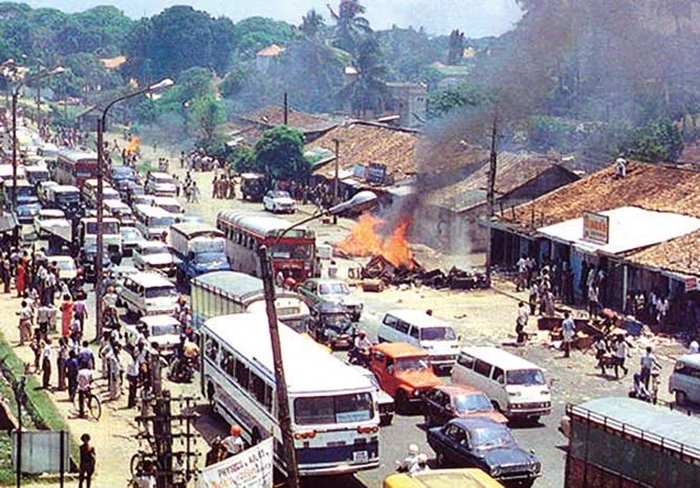
Forty three years and counting,
Big posers remain unanswered –
For instance, couldn’t the state,
See the bloodletting coming,
When restive young hands of the North,
Opted for the gun and not the ballot?
Couldn’t it be seen that counter-violence,
Would only lead to a wasting conflict,
Wherein ordinary folk of both halves,
Would be cruelly cut down in the cross fire,
And dumped in graves still being opened?
That hands of good will and friendship,
Extended warmly in statesman like fashion,
Over the divide that was seen as enduring,
Would have laid the basis for reconciliation?
Will only ‘the peace of the graveyard’,
Be made to reign in the pauperized Isle?
By Lynn Ockersz

Dambulla Sixers hand Galle Gallants first defeat in LPL 2026

Jaffna Kings beat Colombo Kaps by five runs

Showers will occur in the Western and North-western provinces and Galle, Batticaloa, Ampara and Monaragala districts

United Opposition moves to halt interference with judicial independence

PM labels seven Presidential Houses white elephants ; govt. to make them commercially viable

Gen. Sallay’s writ application against arrest: PC questions validity of Moulana’s statement

‘Dates have the highest sugar content to fight Coronavirus’

Sunday Island 27 December – Headlines

#SundayIsland 17th December – Headlines

Sunday Island – 28th March

Sunday Island Headlines – 21 March

Sunday Island – 21st February – Headlines
-
 Features4 days ago
Two memorable excerpts from a former SLAF commander’s memoir
-

 Business4 days ago
‘Giving up was never an option’: The fisherman who fought back after losing millions in SL
-
 Latest News5 days ago
Davis cup Asia/Oceania Group IV 2026 to be held in Colombo from 20th to 25th July
-
 Features4 days ago
Erdoğan’s New Republic
-
 Life style4 days ago
Taste of the Swiss Alps comes to Colombo
-
 News5 days ago
Evidence recorded in money laundering case against Yoshitha Rajapaksa
-
 News5 days ago
Dengue outbreak gallops ahead: Infections surpasses 73,455, leaving 50 dead
-
 Midweek Review1 day ago
Three high-profile alleged suicides shaping key investigations