
Features
HOMES ON THURSTAN ROAD/ CAMBRIDGE PLACE 75 YEARS AGO


by Hugh Karunanayake
Seventy five years ago, the Thurstan Road/ Cambridge Place thoroughfare was one of the most picturesque in Colombo. It was lined on either side by gigantic specimens of flamboyant, or flame of the forest tree (poinciana regia), the saman tree (samanea saman) and the kaha mal or cassia fistula. The tree lined avenues provided a restful and shady canopy over the road. During the months of April and May when the avenues were in full bloom this stretch of road was most colourful and attractive, and indeed a magnificent spectacle – a remarkable living legacy from the spacious days of the city in the past.
Those were the days when Colombo was renowned the world over as the “garden city of the East.” The trees were planted around 1920, following a report by Professor Patrick Geddes, an Urban Planner, who was commissioned by the Government of the day, to recommend a Master Plan for the development of Colombo. He had a vision for Colombo in which trees, greenery, and open spaces played a significant role.Sometime in the nineteen forties, members of the Orchid Circle of Ceylon took the initiative of adding further colour and character to the tree lined environment, by planting varieties of epiphytic orchids on the branches of the larger trees. Specimens of cymbidium bicolor, vanda tesselata, and dendrobium superbiens could be seen albeit sporadically among the trees that survive along this once beautiful avenue.
The Thurstan Road/ Cambridge Place precinct was originally part of the Bagatelle Estate known later as Alfred House Estate, arguably the most expensive piece of real estate ever sub divided in the country. The folk who lived in the area were the crème-de la crème of Colombo’s society in th early 20th century. Thurstan Road (since renamed Munidasa Cumaranatunge Mawata, after the well known Sinhalese author and poet) commences at its intersection with Reid Avenue, and ends at the roundabout connecting Flower Road. Cambridge Place continues northwards from this point, and ends at its intersection with Edinburgh Crescent, now known as Sir Marcus Fernando Mawata. Thurstan Road was once the eastern boundary of the estate originally known as Bagatelle, and renamed later as Alfred House.The Fergusons Directory of 1871 lists Bagatelle as a cinnamon cum coconut estate of 125 acres. As the history of Alfred House has a significant bearing on the stately homes that exist on Thurstan Road to this day, a brief examination of its past would seem appropriate.
The property was first advertised for sale in the Ceylon Government Gazette of March 9, 1822 as “a thatched cottage with a tent roof, about two miles and half from the Fort of Colombo, to be disposed of by private contract.” The owner at the time was believed to be a prominent businessman in the Fort with the quaint name Daddy Parsee. Charles Edward Layard, the third son of the Dean of Bristol, arrived in Ceylon in 1803. He joined the Ceylon Civil Service in 1804 and served until 1839. It is not clear whether he owned Bagatelle Estate, but it is evident that he resided there, the thatched cottage having been replaced by a substantial two-storied bungalow at the time of his occupation.
Many of Layard’s children were born in Bagatelle House, and it is on record that the youngest of Layard’s 26 children, named Barbara, was born in Bagatelle in 1834.The Ceylon Almanacs of the 1840s lists Bagatelle Estate as a property owned by Arbuthnot and Co, who were agents for the Government of Ceylon in India, and who were the sole exporters of cinnamon from Ceylon, which was a government monopoly at the time. A plantation owner became the owner of Bagatelle Estate, which was thereafter called Bagatelle Walauwwa. His nephew Charles Henry de Soysa to whom the property passed on, demolished the old homestead and built a magnificent home comprising of around 100 rooms. This was the location of a historic dinner that was accorded by the De Soysas to the Duke of Edinburgh when he visited Ceylon in 1870.The house was named Alfred House with the permission of Prince Alfred, the Duke. C.H. de Soysa died in 1890, and his wife in 1914, leaving a large family of 14 sons and daughters to inherit an enormous estate which in addition to Alfred House included several thousand acres of coconut, tea and rubber lands spread around the island.
Over the years, the 125 acre Alfred House Estate underwent several sub divisions, some major changes being precipitated by the master plan for Colombo which foresaw many new roads across the estate. The earlier sub divisions were however made by the De Soysa family itself, which constructed several stately mansions within the property.
The ornate Lakshmigiri which was built in 1910 by A.J.R. de Soysa, the second son of C.H. de Soysa, is a classic example of extravagant building design of the time. This house with its extensive gardens and massive cast iron gates is at the southern end of Thurstan Road bordering Queens Road. It bears assessment No.102 Thurstan Road and is much the same fifty years ago, as it was when constructed almost half a century earlier. A few years after it was built, the house was mortgaged, and later foreclosed. It was then bought by the Adamjee Lukmanjee family and has remained in their ownership to date under the name Saifee Villa.
Seventy years ago there were no buildings between Saifee Villa and Queens Road. Adjoining Queens Road is the house originally named Regina Walauwwa by its owner T. H.A. de Soysa, the fourth son of C.H. de Soysa. It was named after his wife Regina, and was built in 1912. An imposing building with multiple roofs, turrets, and towers it was a palatial residence facing Thurstan Road. The owner was a keen turfite owning many horses, and with a penchant for heavy wagers. The story goes that whenever he won over Rs. 100, 000 at the races, he would hoist the family flag on the large flagstaff in front of the house to indicate to all and sundry that he had made a killing at the races. This ritual was locally referred to as “Lakseta kodiya” meaning “win a lakh of rupees and the flag goes up”. Fortunes do however fluctuate, and by 1920 he was in financial difficulties and the house sold to the newly emerging University College. It was then renamed College House. The flagstaff or ‘kodigaha’ remains on the property to this day.
On the opposite side of Thurstan Road was the University of Ceylon buildings constructed in 1913 as the home of Royal College. The school occupied the premises till 1923 when it was acquired by the Ceylon University College. Royal College later moved to the new premises on Racecourse Avenue, where it functions to this day.
Next to College House is a property extending to over three acres, purchased from the Dc Soysa family in 1926 by the Imperial Bank of India. It was earlier used as the dairy for Alfred House.
The Bank commissioned Walker and Sons to construct an impressive residence for its manager, and the house was named “Carlowrie”. In the mid 1950s it was acquired by the Government of India as the official residence for its High Commissioner, and has since been called “India House”. Many distinguished visitors have been entertained here, including Prime Minister Nehru, and later his daughter Indira Gandhi who have planted trees in commemoration of their visits, in its spacious gardens.
Adjoining India House were two bungalows belonging to Brooke Bonds Ceylon Ltd, the tea company. Hammerfaest was at No 80 Thurstan Road and was the residence of its Managing Director H. Broome.In the adjoining home lived his Deputy Roy Collins, and later S. E. Satarasinghe. At No. 76 was Chitrakala one time residence of Sepala Gunasena of M.D. Gunasena and Co. whose mortgage on the property was foreclosed by the bank.
Next to the University property was Thurstan College established in 1949 in the premises earlier used by the Government Training College, prior to its shift to Maharagama. Adjoining Thurstan College was Royal Primary School, whose Headmaster Major A.F. de Saa Bandaranayake resided in the official bungalow at No 13. Mr. J.C.A. Corea the Principal of Royal College occupied the adjoining bungalow. The buildings and grounds of Royal Primary School stood next.
Around 50 years ago the school was under the Headmastership of Mr.H.D. Sugathapala and Mr.H.P. Jayewardene under whose leadership the well facilitated school hall known as “Navarangahala” was built. It acquired a permanent place in the history of the island, when the constituent assembly convened to draft the 1972 Constitution, was held there. It was also the occasion for the change of name from Ceylon to Sri Lanka.
On the opposite side of Thurstan Road facing Thurstan College were the ends of Bagatelle Road and Alfred Place conjoining at the intersection with Thurstan Road. At this point along Thurstan Road were a few commercial buildings including a small restaurant known as “Villas” a haunt of generations of Royal College students who dropped in after school for a ‘cuppa’ often combined surreptitiously with a cigarette. Many were the abortive raids conducted by the college prefects in attempts to rein in the offending delinquents.
Next door was Thurstan Café run by Noel Perera. Further on towards Flower Road, near Pedris Road was the home of K.H.M. Fernando, who owned a successful motor spares shop in the Pettah.
Adjoining Pedris Road was the home of Mrs. A. Wijewardene. Her son, the entrepreneur Upali Wijewardene who disappeared tragically in his Learjet in 1982, built his house designed by Geoffrey Bawa in part of the land in the 1970s. Her sons-in-law Dr. Attygalle and Prof Stanley Wijesundera the latter killed during the JVP insurgency of 1989 also lived in houses within the same property. Adjoining was the entrance to 5th Lane, which was neighbouring the dental clinic of Dr. Ian de Silva.
Next-door was the home of the General Manager of the Shell Co, P.D. Finn. The house there was built on a property, which was earlier known as “the Monastery” The roundabout here links Thurstan Road on the south, Cambridge Place on the north, Racecourse Avenue on the East, and Flower Road on the west.
Racecourse Avenue in its entirety on one side provided boundaries to Royal College and Royal Primary School. At its western end was the Orient Club founded in 1894, and at one time an exclusive social club for the elites of Colombo. Its tennis courts border the southern end of Cambridge Place, near the roundabout. On the opposite side of Cambridge Place at No. 32 was the home of Sherman de Silva, the proprietor of a well-known produce company of the time.
Adjoining was the large home earlier called Cambridge House and later renamed Florence House when Sir Wilfred de Soysa, the sixth son of C.H. de Soysa, occupied it. Sir Wifred’s sons, Bishop Harold, Terrence, Cecil, Ryle, Anura, and Lalith, all grew up in this home, and were later to acquit themselves with great credit in adult life, whether it be business, sports, or in the “service of the Lord”. Ryle was for many years the opening batsman for the Ceylon Cricket team then known as “The All Ceylon Cricket Team”. As a schoolboy at Royal College he was a member of the unbeaten Royal team that toured Australia in 1938. Florence House stood on a large extent of land. It was demolished in the 1950s to give way to a cluster of large bungalows and a new roadway named Cambridge Terrace.

Adjoining Florence House was Mackinnon House the official home of the Managing Director of Mackinnon Mackenzie and Co. the well known shipping agents. H.W. Tatham lived in this house situated in a large garden enclosed by a high wall. In the late 1/950s Mr George Chitty the very successful criminal lawyer purchased this house and named it Goodwood. A humanist and a lover of people and company, he was a man of varied interests, and was an expert on cameras and photography, music, art, forensic medicine, woodwork, and motorcars. He led the successful prosecution in the Bandaranaike Assassination Case, at the invitation of the Crown.
As in all neighbourhoods, romance is always in the air, and it was no different in Thurstan Road. His son Ajit married Rapti, the daughter of Y.D. Gundevia the Indian High Commissioner who lived in India House on Thurstan Road, thus linking the two roads Thurstan and Cambridge by marriage! Two doors next to Goodwood was “St Catherine” the home of C.H.Z. Fernando whose father C.M. Fernando was a son in law of C.H. de Soysa of Alfred House. D.J. Wimalasurendra who pioneered hydroelectric schemes in Ceylon earlier owned St Catherine’s.
At the end of Cambridge Place fronting Edinburgh Crescent was “Lynwood” the home of Francis Amarasuriya a popular race horse owner of the time. His elder son Rukman ended his life tragically, at an early age, committing suicide in 1957 in Nuwara Eliya. Facing the Museum on the opposite side in Cambridge Place, in a house called “Brentham” lived Leslie de Saram the head of the legal firm F.J. and G de Saram. He sold the house to the Australian Government, which purchased it for its high commission. Leslie de Saram was a remarkable man known for his generosity and many acts of philanthropy.
He was educated at Royal College, and Clifton College in England, but gifted Gurutalawa Farm of 35 acres of cultivated land, and buildings, to S. Thomas’ College, which established a branch school there. He also gifted his unique collection of rare antiques to the University of Ceylon, when it established at Peradeniya, and was described as “the greatest benefactor and friend the Ceylon University ever had.”. After his retirement he settled all his affairs in Ceylon and migrated first to England and later to Australia where he lived in Canberra. Next to Brentham was “Oakleigh” the home of another legal luminary F.C. Rowan the senior Partner of Julius and Creasy. Rowan was the advisor and confidante to almost every leading mercantile firm in Colombo in the 1950s.
Further down Cambridge Place at “The Eyds” lived Stanley de Saram the brother of Leslie, and no less remarkable. He was also a partner of the family firm of de Saram’s but in 1946 relinquished it to take up a position as a Director of Leechman and Co, an Agency House, the first Ceylonese to be invited to the position. He later became the first Ceylonese Chairman of the firm. Stanley and his wife were well known personalities in the mercantile world of that era, and were renowned for their legendary hospitality. Stanley and his wife hosted Lady Churchill on a visit to Ceylon in 1953. Later, Sir Winston and Lady Churchill played host to the De Sarams when they were asked to dinner at their home in Chartwell. After Stanley’s death in the 1970s, “The Eyds’ was demolished and several new homes have come up on its grounds. Somewhere between “The Eyds” and Oakholme stood a house called Gresham, which has since been altered structurally.
At around this area in Cambridge Place, was the intersection with Edinburgh Crescent.Further on, adjoining the Orient Club was the Women’s International Club. The Thurstan Road /Cambridge Place belt still remains a salubrious area of Colombo, but its quiet and leafy environment may not be the same as it was 50 years ago,. The student population in the educational triangle, which it adjoins, has expanded dramatically, making the area a traffic controller’s nightmare during school hours. Mercifully, the commercial sprawl that is evident in most areas of Colombo has spared its blight here, and Thurstan Road and Cambridge Place together with its immediate environs, are still an absolutely charming area within Colombo.



THE GREAT DIGITAL RETHINK : PART III OF V
The Teenage Battleground
Secondary school has always been a battlefield of sorts, competing loyalties, volatile friendships, the daily theatre of adolescent identity. But in the past decade it acquired a new and uniquely modern dimension: the smartphone in the pocket, the social media feed refreshing every few minutes, the group chat that never sleeps.
The numbers, when they arrived, were not subtle. PISA 2022 data, drawn from students in over 80 countries, found that around 65 percent of students reported being distracted by their own digital devices in mathematics lessons, and 59 percent said a classmate’s device had pulled their attention away. Students who reported being distracted by peers’ phones scored, on average, 15 points lower in mathematics than those who said it never happened. Fifteen points is not a rounding error. It is a meaningful, measurable, recurring gap that appears consistently across countries with very different education systems.
Governments took notice of the situation. In a pattern that will be familiar to readers of this series, a number of them reached for the most visible, most politically satisfying tool available – the ban in Finland, Sweden, Australia, and France. The UK, in a characteristically chaotic way, involving years of guidance, and pilots, eventually legalised. One by one, secondary schools across the wealthy world have begun confiscating phones at the gate, storing them in pouches, locking them up in boxes, and discovering, somewhat to their own surprise, that this works.
When the Ban Actually Works
A 2025 survey of nearly a thousand principals in New South Wales found that 87 percent reported students were less distracted after the ban was introduced, and 81 percent said learning had improved. South Australia recorded a 63 percent decline in critical incidents involving social media and a 54 percent reduction in behavioural issues. These are striking figures, and they align with what common sense would predict: if you remove the distraction, concentration improves.
What is also emerging from Australian, Finnish and Swedish schools is something less expected and more interesting: the character of break times has changed. Teachers and principals report that when phones disappear from pockets, something older reappears in their place. Students talk to each other. They play. They argue, resolve disputes, make and lose friendships in the ancient, messy, face-to-face way that adolescence has always demanded but that the smartphone had been quietly crowding out. The playground, it turns out, was not broken. It was just occupied.
Sweden’s nationwide policy, coming into effect in autumn 2026, will require schools to collect phones for the full day, not just during lessons. This is the more ambitious intervention, and the one that addresses what the Australian experience has already demonstrated: that the damage done by constant connectivity is not confined to the classroom. It happens at lunch. It happens between periods. It happens in the 10 minutes before the bell when a group of 14-year-olds are supposedly in the building but are actually, in every meaningful sense, somewhere else entirely.
87% of Australian principals said students were less distracted after the ban. The other 13% presumably hadn’t tried it yet.
But Here Is What Nobody Wants to Talk About
Here is the part that the ministers’ press releases do not mention. While the smartphone, the device the student owns, controls and carries, has been banned from the secondary classroom, the institution’s own digital apparatus has been expanding at an impressive pace throughout the same period. Learning management systems now mediate most of secondary school life in high-income countries. Assignments are distributed digitally. Work is submitted digitally. Attendance is recorded digitally. Grades are published on portals that students, parents and administrators can access in real time. The school that bans your personal phone may simultaneously be recording precisely how long you spent on each page of the online reading assignment last Tuesday.
Learning analytics, the practice of harvesting data from student interactions with digital platforms to inform teaching and school management, has moved from a niche research curiosity to a mainstream tool. PISA 2022 data show that virtually all 15-year-olds in OECD countries attend schools with some form of digital infrastructure. Behind that infrastructure sits a layer of data collection that most students and many parents are only dimly aware of: log-in times, click patterns, quiz scores, time-on-task measures, platform engagement metrics. These are assembled into dashboards, fed into algorithms, and used, with genuinely good intentions, in most cases, to identify struggling students early.
The genuinely good intentions do not resolve the underlying problem. Research on learning analytics raises serious concerns about privacy, about the opacity of algorithmic decision-making, and about what happens when a teenager is quietly flagged as ‘at risk’ by a system they never knew was watching. The irony of secondary de-digitalisation is not lost on those paying attention: we have removed the device the student controls, while expanding the systems that observe and score them.
The AI Proctor in the Room
 During the pandemic, when exams moved online, a number of education authorities adopted software that monitored students through their webcams, flagging unusual eye movements, background sounds, or the presence of other people in the room as potential signs of cheating. The systems were sold as efficient, scalable and objective. They were, in practice, frequently absurd.
The software flagged students who looked away from the screen to think. It penalised students whose rooms were small, shared or noisy, disproportionately those from less privileged backgrounds. It struggled with students of colour, whose features were less well-represented in the training data. It was contested, appealed, gamed, and eventually abandoned by a significant number of institutions that had initially adopted it with enthusiasm. By 2024 and 2025, the rollback was visible. Universities and some school systems were returning, with minimal fanfare, to supervised in-person examinations, handwritten, on paper, in a room with a human invigilator, partly to solve the AI cheating problem, partly to solve the AI proctoring problem. The wheel had, somewhat dizzingly, turned full circle.
We banned the student’s phone. We kept the webcam that monitors their eye movements during exams. Progress.
The Equity Problem That Bans Cannot Solve
Beneath the headline politics of phone bans lies a more uncomfortable question about who, exactly, benefits from secondary school de-digitalisation, and who pays a cost that is rarely acknowledged. The argument for phone bans on equity grounds is real: unrestricted phone use in schools amplifies social hierarchies. The student with the latest device, the most followers, the most compelling social media presence occupies a different social universe from the student without. Removing phones during the school day levels that particular playing field.
But the equity argument runs the other way, too, once you look beyond school hours. Secondary schools in high-income systems have steadily increased their dependence on digital platforms for homework, assessment preparation and communication. If a school bans phones during the day and then sends students home to complete digitally-mediated assignments, the burden of that homework falls unequally.
There is also the growing phenomenon of what researchers are beginning to call ‘shadow digital education’: the private online tutoring platforms, AI-powered study tools and exam preparation services that affluent families use to supplement and extend what school provides. While secondary schools debate whether students should be allowed to use AI for essay drafts, some of those students’ wealthier peers are already using it, skillfully, privately and with considerable academic advantage. The phone ban, whatever its merits in the classroom, does not touch this market. It may even quietly accelerate it.
Two Worlds, Still Diverging
In Finland, Sweden and Australia, the policy conversation is about how to manage the excesses of a generation that grew up digitally saturated, how to restore concentration, how to protect wellbeing, how to ensure that institutional platforms serve learning rather than merely monitor it.
Elsewhere, across much of Southeast Asia, Sub-Saharan Africa, Latin America and parts of the Middle East, the secondary school conversation remains anchored to a different set of concerns: how to get enough devices into enough classrooms, how to train enough teachers to use them, how to ensure that the smartboard contract does not expire before the teachers learn to turn it on. Vendors are present, helpful and commercially motivated. Development banks are funding rollouts. Government ministers are visiting showrooms. The playbook being followed is the one that Finland and Sweden wrote in 2010 and are now revising.
SERIES ROADMAP:
Part I: From Ed-Tech Enthusiasm to De-Digitalisation | Part II: Phones, Pens & Early Literacy | Part III: Attention, Algorithms & Adolescents (this article) | Part IV: Universities, AI & the Handwritten Exam | Part V: A Critical Theory of Educational De-Digitalisation

Buddhism is renowned for its profound insights into ageing and decay, known as jara in Pali. Through its teachings and practices, Buddhism cultivates the wisdom and mental clarity necessary to accept and prepare for the inevitability of ageing. The formula jati paccayaā jaraāmaranaṃ translates to “dependent on birth arise ageing and death,” clearly illustrating that birth inevitably leads to ageing and death, accompanied by sorrow, lamentation, pain, grief, and despair. Without birth, there would be no ageing and death. Therefore, ageing is a fundamental aspect of suffering as outlined in the Four Noble Truths.
Buddhism encourages us to confront the realities of ageing, illness, and mortality head-on. Old age is recognised as an unavoidable aspect of dukkha (suffering). Old age is fundamentally and inextricably entwined with the concept of impermanence(annicca), serving as the most visible, undeniable evidence that all conditioned things are in a state of flux and decay. Ageing, illness and death create in us an awareness not only of dukkha but also impermanence. The Buddha taught, “I teach suffering and the way out of suffering.” Here, “suffering” encompasses not only physical pain but also the profound discomfort that arises when our attempts to escape or remedy pain stemming from old age are thwarted. Instead of fearing old age, Buddhists are encouraged to embrace it, release attachments to youth, and cultivate wisdom, gratitude, and inner peace.
Ageing is a complex process shaped by both genetic and environmental factors. From a Buddhist viewpoint, we should perceive the body realistically. Fundamentally, the human body can be seen as a vessel of impurities, subject to old age, disease, decay, and death. The natural process of ageing is gradual, irreversible, and inevitable. Every individual must ultimately come to terms with the reality of growing old, as change is an essential fact of life.
In Buddhism, impermanence (anicca) holds a central position. Everything that exists is unstable and transient; nothing endures forever—including our bodies and all conditioned phenomena. Thus, anicca, dukkha, and anattaā (non-self or selflessness) are the three characteristics common to all conditioned existence. The reality of impermanence can often evoke pain, yet a wise Buddhist fully understands and appreciates this simple yet profound truth.
The Greek philosopher Heraclitus encapsulated this notion when he stated, “No man ever steps in the same river twice, for it is not the same river, and he is not the same man.” Old age was one of the four sights that prompted Prince Siddhartha Gautama to seek enlightenment, alongside sickness, death, and the wandering ascetic. Coming to terms with these aspects of existence was pivotal in his transformation into the Buddha.
At Sāvatthi, King Pasenadi of Kosala once asked the Buddha, “Venerable sir, is there anyone who is born who is free from old age and death?” The Buddha replied, “Great King, no one who is born is free from ageing and death. Even those affluent khattiyas—rich in wealth and property, with abundant gold and silver—are not exempt from ageing and death simply because they have been born.” This interaction underscores the universal challenge of ageing, transcending societal divisions of wealth or status.
Ageing presents one of the greatest challenges in human experience. Physically, the body begins to deteriorate; socially, we may find ourselves marginalised or discounted, sometimes subtly and sometimes explicitly. Some may encounter dismissal or condescension. Ageism remains one of the most persistent forms of discrimination. The physical and social difficulties associated with ageism can undermine our self-image and sense of self-worth. Common perceptions often portray old age as a stage where the best years are behind us, reducing the remaining years to a form of “bonus years” frequently presented in sentimental or patronising ways.
The suffering associated with ageing can serve as a powerful motivation to engage in practices that directly address this suffering, allowing us to gradually transform it or, at the very least, make it more bearable and manageable. We must recognise that this principle applies equally to our own bodies. The human body undergoes countless subtle changes every moment from the time you are born, never remaining the same even for two consecutive moments, as it is subject to the universal law of impermanence.
Whatever your age. However young-looking you try to remain through external means, the truth is that you are getting older every minute. Every minute, every second, our lives are getting shorter and closer to death. Since you were conceived in your mother’s womb, your life is getting shorter. We see external things going by rapidly, but never reflect on our own lives. No matter what we do, we cannot fully control what happens in our lives or to our bodies. With time, we all develop lines and wrinkles. We become frail, and our skin becomes thinner and drier. We lose teeth. Our physical strength and sometimes our mental faculties decline. In old age, we are subject to multiple diseases.
Many people live under the illusion that the body remains constant and is inherently attractive and desirable. Modern society, in particular, has become increasingly obsessed with the quest for eternal youth and the reversal of the ageing process. Many women feel inadequate about their physical appearance and constantly think about how to look younger and more attractive. Enormous sums of money are spent on cosmetic procedures, skincare, and grooming products to remain presentable and desirable. The global beauty and cosmetics industries thrive on this ideal, often promoting unrealistic standards of beauty and youthfulness. But no amount of products available in the world can truly restore lost youth, as time inevitably leaves its mark.
Therefore, in Buddhism, mindful reflection on ageing and the human body is considered essential for overall well-being. This contemplation provides insight into impermanence as we navigate life. Reflecting on the nature of the body—its true condition and its delicate, changing state—is a fundamental aspect of the Buddha’s teachings. By understanding the body accurately, we support both wisdom and peace of mind.
Buddhism recognises forty subjects of meditation which can differ according to the temperaments of persons. Contemplation of the human body is one of them. Of all the subjects of meditation, reflection on the human body as a subject is not popular among certain people particularly in the western world as they think such contemplation would lead to a melancholic morbid and pessimistic outlook on life. They regard it as a subject that may be somewhat unpleasant and not conducive to human wellbeing. Normally, people who are infatuated and intoxicated with sensual pleasures develop an aversion towards this subject of meditation. In Buddhism this mode of contemplation is called asuba bhavana or mindfulness of the impurities of the body. It is all about our physiology and individual body parts and organs internal as well as external. This subject of meditation is unique to the Buddhist teachings.
To appreciate the body as it truly is, we must set aside preconceived notions and engage in a calm and honest inquiry: Is this body genuinely attractive or not? What is it composed of? Is it lasting or subject to decay?
In embracing the teachings of Buddhism, we find the wisdom to navigate the journey of ageing with grace, transforming our understanding of this natural process into an opportunity for growth and acceptance.
When our fears centre on ageing, decay, and disease, we cannot overcome them by pretending they do not exist. True relief comes only from facing these realities directly.
Reflecting on the body’s unattractive and impermanent nature can help us gain a realistic perspective. In an age when the mass media constantly bombards people with sensual images, stimulating lust, greed, and attachment, contemplation of the body’s true nature can bring calm and clarity.
All beings that are born must eventually die. Every creature on earth, regardless of status, shares this common fate. After death, the body undergoes a series of biological changes and decomposes, returning to the earth as organic matter. It is part of the earth and ultimately dissolves back into it.

Understanding this, we can meet ageing, decay, and death with greater wisdom, less fear, and a deeper sense of peace.
by Dr. Justice Chandradasa Nanayakkara
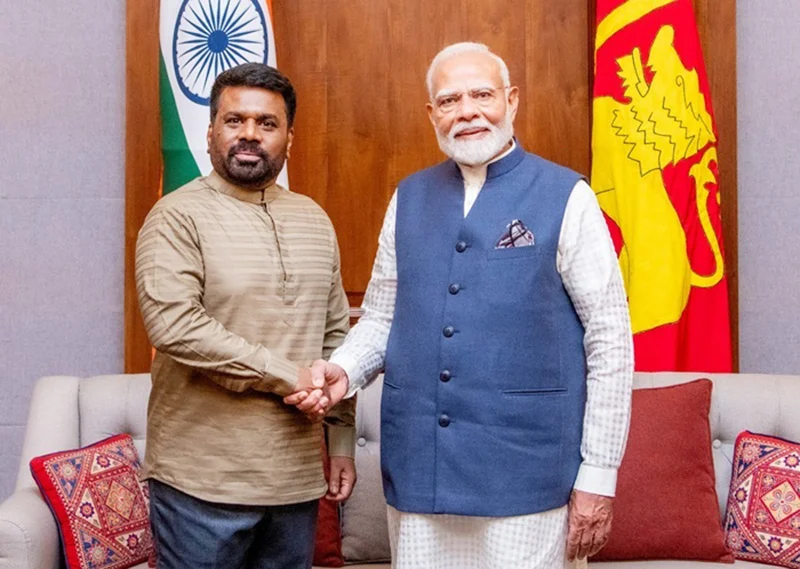
Indian Prime Minister Narendra Modi once again signaled the priority India places on Sri Lanka by swiftly dispatching a shipload of petrol following a telephone conversation with President Anura Kumara Dissanayake. The Indian Prime Minister’s gesture came at a cost to India, where there have been periodic supply constraints and regional imbalances in fuel distribution, even if not a countrywide shortage. Under Prime Minister Modi, India has demonstrated to Sri Lanka an abundance of goodwill, whether it be the USD 4 billion it extended in assistance to Sri Lanka when it faced international bankruptcy in 2022 or its support in the aftermath of the Ditwah cyclone disaster that affected large parts of the country four months ago. India’s assistance in 2022 was widely acknowledged as critical in stabilising Sri Lanka at a moment of acute crisis.
This record of assistance suggests that India sees Sri Lanka not merely as a neighbour but as a partner whose stability is in its own interest. In contrast to Sri Lanka’s roughly USD 90 billion economy, India’s USD 4,500 billion economy, growing at over 6 percent, underlines the vast asymmetry in economic scale and the importance of Sri Lanka engaging India. A study by the Germany-based Kiel Institute for the World Economy identifies Sri Lanka as the second most vulnerable country in the world to severe food price surges due to its heavy reliance on imported energy and fertilisers. Income per capita remains around the 2018 level after the economic collapse of 2022. The poverty level has risen sharply and includes a quarter of the population. These indicators underline the urgency of sustained economic recovery and the importance of external partnerships, including with India.
It is, however, important for Sri Lanka not to abdicate its own responsibilities for improving the lives of its people or become dependent and take this Indian assistance for granted. A long unresolved issue that Sri Lanka has been content to leave the burden to India concerns the approximately 90,000 Sri Lankan refugees who continue to live in India, many of them for over three decades. Only recently has a government leader, Minister Bimal Rathnayake, publicly acknowledged their existence and called on them to return. This is a reminder that even as Sri Lanka receives support, it must also take ownership of its own unfinished responsibilities.
Missing Investment
A missing factor in Sri Lanka’s economic development has long been the paucity of foreign investment. In the past this was due to political instability caused by internal conflict, weaknesses in the rule of law, and high levels of corruption. There are now significant improvements in this regard. There is now a window to attract investment from development partners, including India. In his discussions with President Dissanayake, Prime Minister Modi is reported to have referred to the British era oil storage tanks in Trincomalee. These were originally constructed to service the British naval fleet in the Indian Ocean. In 1987, under the Indo Lanka Peace Accord, Sri Lanka agreed to develop these tanks in partnership with India. A further agreement was signed in 2022 involving the Ceylon Petroleum Corporation and the Lanka Indian Oil Corporation to jointly develop the facility.
However, progress has been slow and the project remains only partially implemented. The value of these oil storage tanks has become clearer in the context of global energy uncertainty and tensions in the Middle East. Energy analysts have pointed out that strategic storage facilities can provide countries with greater resilience in times of supply disruption. The Trincomalee tanks could become a significant strategic asset not only for Sri Lanka but also for regional energy security. However, historical baggage continues to stand in the way of Sri Lanka’s deeper economic linkage with India. Both ancient and modern history shape perceptions on both sides.
The asymmetry in size and power between the two countries is a persistent concern within Sri Lanka. India is a regional power, while Sri Lanka is a small country. This imbalance creates both opportunities for partnership and anxieties about overdependence. The present government too has entered into economic and infrastructure agreements with India, but many of these have yet to move beyond initial stages. This has caused frustration to the Indian government, which sees its efforts to support Sri Lanka’s development as not being sufficiently appreciated or effectively utilised. From India’s perspective, delays and hesitation can appear as a lack of commitment. From Sri Lanka’s perspective, caution is often driven by domestic political sensitivities and concerns about sovereignty.
Power Imbalance
At the same time, global developments offer a cautionary lesson. The behaviour of major powers in the contemporary international system shows that states often act in their own interests, sometimes at the expense of smaller partners. What is being seen in the world today is that past friendships and commitments can be abandoned if a bigger and more powerful country can see an opportunity for itself. The plight of Denmark (Greenland) and Canada (51st state) give disturbing messages. Analysts in the field of International Relations frequently point out that power asymmetries shape outcomes in bilateral relations. As one widely cited observation by Lord Parlmeston, a 19th century prime minister of Great Britain is that “nations have no permanent friends or allies, they only have permanent interests.” While this may be an overly stark formulation, it captures an underlying reality that small states must navigate carefully.
For Sri Lanka, this means maintaining a balance. It needs to clearly acknowledge the partnership that India is offering in the area of economic development, as well as in education, connectivity, and technological advancement. India has extended scholarships, supported digital infrastructure, and promoted cross border links that can contribute to Sri Lanka’s long term growth. These are tangible benefits that should not be undervalued. At the same time, Sri Lanka needs to ensure that it does not become overly dependent on Indian largesse or drift into a position where it functions as an appendage of its much larger neighbour. Economic dependence can translate into political vulnerability if not carefully managed. The appropriate response is not to distance itself from India, but to broaden its partnerships. Engaging with a diverse range of countries and institutions can provide Sri Lanka with greater autonomy and resilience.
A hard headed assessment would recognise that India’s support is both genuine and interest driven. India has a clear stake in ensuring that Sri Lanka remains stable, prosperous, and aligned with its broader regional outlook. Sri Lanka needs to move forward with agreed projects such as the Trincomalee oil tanks, improve implementation capacity, and demonstrate reliability as a partner. This does not preclude it from actively seeking investment and cooperation from other partners in Asia and beyond. The path ahead is therefore one of balanced engagement. Sri Lanka can and should welcome India’s partnership while strengthening its own institutions, fulfilling its domestic responsibilities, and diversifying its external relations. This approach can transform a relationship shaped by asymmetry into one defined by mutual benefit and confidence.
by Jehan Perera

Punjab Kings fined for slow over-rate

Ice-cool Connolly leads nervy Punjab Kings home on IPL debut

Showers expected in the Western, Sabaragamuwa and Southern provinces in the evening or night

Heat Index at Caution Level in the Western, Sabaragamuwa, Southern, Eastern, North-western, Northern and North-central provinces and in Monaragala district

Urea shortage threatens Yala harvest: Experts

2025 property grab: Court orders JVP to hand back Yakkala office to FSP

‘Dates have the highest sugar content to fight Coronavirus’

Sunday Island 27 December – Headlines

#SundayIsland 17th December – Headlines

Sunday Island – 28th March

Sunday Island Headlines – 21 March

Sunday Island – 21st February – Headlines
-

 Features4 days ago
A World Order in Crisis: War, Power, and Resistance
-

 News5 days ago
Energy Minister indicted on corruption charges ahead of no-faith motion against him
-

 News6 days ago
US dodges question on AKD’s claim SL denied permission for military aircraft to land
-

 Business6 days ago
Dialog Unveils Dialog Play Mini with Netflix and Apple TV
-

 Sports5 days ago
SLC to hold EGM in April
-
 Latest News6 days ago
A strong Technical and Vocational Education and Training (TVET) system equips individuals with practical, relevant, and future-oriented skills helping to innovate responsibly towards a greener and sustainable future – PM
-

 Opinion5 days ago
When elephants fight, it is the grass that suffers
-

 Features5 days ago
Lest we forget