
Opinion
History of St. Sebastian’s National Shrine Kandana

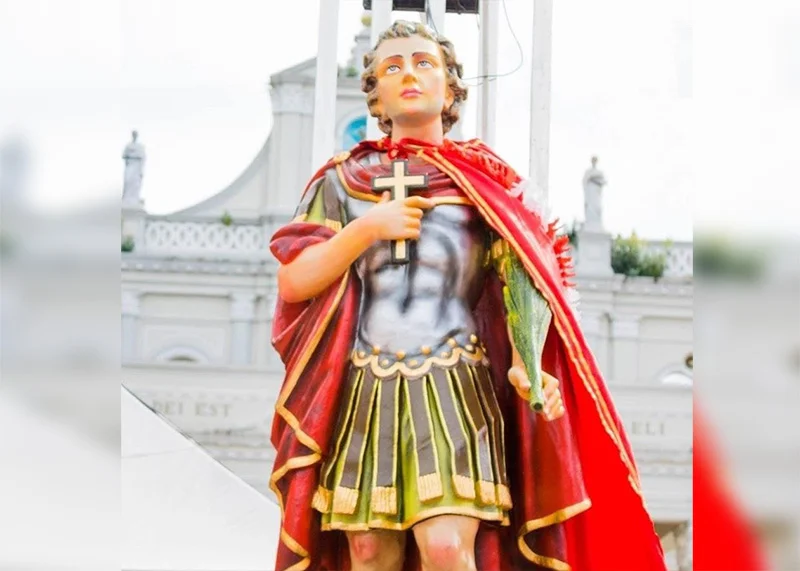
According to legend, St. Sebastian was born at Narbonne in Gaul. He became a soldier in Rome and encouraged Marcellian and Marcus, who were sentenced to death, to remain firm in their faith. St. Sebastian made several converts; among them were master of the rolls Nicostratus, who was in charge of prisoners, and his wife Zoe, a deaf mute whom he cured.
Sebastian was named captain in the Roman army by Emperor Diocletian, as by Emperor Maximian when Diocletian went to the east. Neither knew that Sebastian was a Christian. When it was discovered that Sebastian was indeed a Christian, he was ordered to be executed. He was shot with arrows and left to die but when the widow of St. Castulas went to recover his body, she found out that he was still alive and nursed him back to health. Soon after his recovery, St. Sebastian intercepted the Emperor; denounced him for his cruelty to Christians and was beaten to death on the Emperor’s order.
St. Sebastian was venerated in Milan as early as the time of St. Ambrose. St. Sebastian is the patron of archers, athletes, soldiers, the Saint of the youths and is appealed to protection against the plagues. St. Ambrose reveals that the parents that young Sebastian were living in Milan as a noble family. St. Ambrose further says that Sebastian, along with his three friends, Pankasi, Pulvius and Thorvinus, completed his education successfully with the blessing of his mother, Luciana. Rev. Fr. Dishnef guided him through his spiritual life. From his childhood Sebastian wanted to join the Roman army. With the help of King Karnus, young Sebastian became a soldier and within a short span of time he was appointed as the Commander of the army of King Karnus. The Emperor Diocletian declared Christians the enemy of the Roman Empire and instructed judges to punish Christians who have embraced the Catholic Church. Young Sebastian, as one of the servants of Christ, converted thousands of other believers into Christians. When Emperor Diocletian revealed that Sebastian had become a Catholic, the angry Emperor ordered for Sebastian to be shot to death with arrows. After being shot by arrows, one of Sebastian supporters, Irane, treated him and cured him. When Sebastian was cured he went to Emperor Diocletian and professed his faith for the second time disclosing that he is a servant of Christ. Astounded by the fact that Sebastian is a Christian, Emperor Diocletian ordered the Roman army to kill Sebastian with club blows.
In the liturgical calendar of the Church, the feast of the St. Sebastian is celebrated on the 20th of January. This day is indeed a mini Christmas to the people of Kandana, irrespective of their religion. The feast commenced with the hoisting of the flag staff on the 11th of January at 4 p.m. at the Kandana junction, along the Colombo-Negombo road. There is a long history attached to the flag staff. The first flag staff, which was an areca nut tree, 25 feet tall, was hoisted by the Aththidiya family of Kandana, and today their descendants continue hoisting of the flag staff as a tradition. This year’s flag staff, too, was hoisted by the Raymond Aththidiya family. Several processions, originating from different directions, carrying flags, meet at this flag staff junction. The pouring of milk on the flag staff has been a tradition in existence for a long time. The Nagasalan band was introduced by a well-known Jaffna businessman that had engaged in business in Kandana in the 1950s. The famous Kandaiyan Pille’s Nagasalan group takes the lead, even today, in the procession. Kiribath Dane in the Kandana town had been a tradition from time immemorial.
According to available history from the Catholic archives and volume III of the Catholic Church in Sri Lanka, the British period of vicariates of Colombo, written by Rev. Ft. Vito Perniola SJ, in 1806, states that the British government granted the freedom of conscious and religion to the Catholics in Ceylon and abolished all the anti-Catholic legislation enacted by the Dutch.
The proclamation was declared and issued on the 3rd of August 1796 by Colonel James Stuart, the officer commanding the British forces of Ceylon stated “freedom granted to Catholics” (Sri Lanka national archives 20/5).
Before the Europeans, the missioners were all Goans from South India. In the year 1834, on the 3rd of December, XVI Gregory the Pope, issued a document Ex Muwere pastoralis ministeric, after which the Ceylon Catholic Church was made under the South Indian Cochin diocese. Very Rev. Fr. Vincent Rosario, the Apostolic Vicar General, was appointed along with 18 Goan priests (The Oratorion Mission in Sri Lanka being a history of the Catholic Chruch 1796-1874 by Arthur C Dep Chapter 11 pg 12). Rev Fr. Joachim Alberto arrived in Sri Lanka as missionary on the 6th of March 1830 when he was 31 years old and he was appointed to look after the Catholics in Aluthkuru Korale, consisting Kandana, Mabole, Nagodaa and Ragama. There have been one Church built in 1810 in Wewala about three miles away from Kandana. The Wewala Chruch was situated bordering Muthurajawela which rose to fame for its granary. History reveals that the entire area was under paddy cultivation and most of them were either farmers or toddy tappers. History further reveals that there has been an old canal built by King Weera Parakrama Bahu. Later it was built to flow through the Kelani River, and Muthurajawela, up to Negombo, which was named as the Dutch Canal (RL Brohier historian). During the British time this canal was named as Hamilton Canal and was used to transport toddy, spices, paddy and tree planks of which tree planks were stored in Kandana. Therefore, the name Kandana derives from “Kandan Aana”.
Rev. Fr. Joachim Alberto purchased a small piece of land, called Haamuduruwange watte, at Nadurupititya, in Kandana, and put up a small cadjan chapel and placed a picture of St. Sebastian for the benefit of his small congregation. In 1837, with the help of the devotees, he dug a small well where the water was used for drinking and bathing and today this well is still operative. He bought several acres of land, including the present cemetery premises. Moreover, he had put up the Church at Kalaeliya in honour of his patron St. Joachim where his body has been laid to rest according to his wish of the Last Will attested by Weerasinghe Arachchige Brasianu Thilakaratne. Notary Public, dated 19th July 1855. The present Church was built on the property bought on the 13th of August 1875 on deed no. 146 attested by Graciano Fernando. Notary Public of the land Gorakagahawatta Aluthkuru Korale Ragam Pattu in Kandana within the extend ¼ acre from and out of the 16 acres. According to the old plan number 374 made by P.A. H. Philipia, Licensed surveyor on the 31st of January 195, 9 acres and 25 perches belonged to St. Sebastian Church. However, today only 3 acres, 3 roods and 16.5 perches are left according to plan number 397 surveyed by the same surveyor, while the rest had been sold to the villagers. According to the survey conducted by Orithorian priest on the 12th of February 1844 there were only 18 school-going Catholic students in AluthKuru Korale and only one Antonio was the teacher for all classes. In 1844 there was no school at Kandana (APF SCG India Volume 9829).
According to Sri Lanka National Archives (The Ceylon Almanac page 185) in the year 1852 there were 982 Catholics Male 265, female 290, children 365, with a total of 922. According to the census reports in 2014, prepared by Rev. Ft. Sumeda Dissanayake TOR, the Director Franciscan Preaching group, Kadirana Negombo a survey revealed that there are 13,498 Catholics in Kandana.
According to the appointment of the Missionaries in the year 1866-1867 by Bishop Hillarien Sillani, Rev. Fr. Clement Pagnani OSB was sent to look after the missions in Negoda, Ragama, Batagama, Thudella, Kandana, Kala Eliya and Mabole. On the 18th of April 1866, the building of the new Church commenced with a written agreement by and between Rec. Fr. Clement Pagnani and the then leaders of Kandana Catholic Village Committee. This committee consisted of Kanugalawattage Savial Perera Samarasinghe Welwidane, Amarathunga Arachchige Issak Perera Appuhamy, Jayasuriya Arachchige Don Isthewan Appuhamy, Jayasuriya Appuhamylage Elaris Perera Muhuppu, Padukkage Andiris Perera Opisara, Kanugalawattage Peduru Perera Annavi and Mallawa Arachchige Don Peduru Appujamy. The said agreement stated that they will give written undertaking that their labour and money will be utilised to build the new Church of St. Sebastian and if they failed to do so they were ready to bear any punishment which will be imposed by the Catholic Church.
Rev. Fr. Bede Bercatta’s book “A History of the Vicariate of Colombo page 359” says that Rev. Fr. Stanislaus Tabarani had problems of finding rock stones to lay the foundation. He was greatly worried over this and placed his due trust in divine providence. He prayed for days to St. Sebastian for his intercession. One morning after mass, he was informed by some people that they had seen a small patch of granite at a place in Rilaulla, close to the Church premises, although such stones were never seen there earlier, and requested him to inspect the place. The parish priest visited the location and was greatly delighted as his prayers has been answered. This small granite rock amount provided enough granite
blocks for the full foundation of the present church. This place still known as “Rilaulla galwala”. The work on the building proceeded under successive parish priests but Rev. Fr. Stouter was responsible for much of it. The façade of the Church was built so high that it crashed on the 2nd of April of 1893. The present façade was then built and completed in the year 1905. The statue of St. Sebastian, which is behind the altar, had been carved off a “Madan tree”. It was done by a Paravara man, named Costa Mama, who was staying with a resident named Miguel Baas a Ridualle, Kandana. This statue was made at the request of Pavistina Perera Amaratunge, mother of former Member of Parliament gatemuadliyer D. Panthi Jayasuirya. The Church was completed during the time of Rev. Fr. Keegar and was blessed by then Archbishop of Colombo Dr. Anthony Courdert OMI on the 20th of January 1912. In 1926, Rev. Fr. Romauld Fernando was appointed as the parish priest to the Kandana Church. He was an educationalist and a social worker. Without any hesitation he can be called as the father of education to Kandana. He was the pioneer to build three schools in Kandana: Kandana St. Sebastian Boys School, Kandana St. Sebastian English Girls School and, the Mazenod College Kandana. Later he was appointed as the Principal of the St. Sebastian Boys English School. He bought a property at Kandana, close to Ganemulla Road, and started De Mazenod College. Later, it was given officially to the Christian Brothers of Sri Lanka, by then Archbishop of Colombo, Peter Mark. In 1931, there were 300 students (history of De Lasalle brothers by Rev. Fr. Bro Michael Robert). Today, there are over 3,500 students and is one of the leading Catholic schools in Sri Lanka. In 1924, one Karolis Jayasuriya Widanage donated two acres to build De Mazenod College for its extension.
The frist priest from Kandana to be ordained was Rev. Fr. William Perera in 1904. With the help of Rev. Fr. Marcelline Jayakody, he composed the famous hymn “the Vikshopa Geethaya”, the hymn of our Lady of Sorrow.
The Life story of St. Sebastian was portrayed through a stage play called “Wasappauwa” and the world famous German passion play Obar Amargavewchi whichwas a sensation was initiated by Rev. Fr. Nicholas Perera. Legend reveals that in the year 1845 a South Indian Catholic, on his way to meet his relatives in Colombo, had brought down a wooden statue of St. Sebastian, one and half feet tail, to be sold in Sri Lanka. When he reached Kalpitiya he had unexpectedly contracted malaria. He had made a vow at St. Anne’s Church, Thalawila, expecting a full recovery. En route to Colombo, he had come to know about the Church in Kandana and dedicated to St. Sebastian. In the absence of the then parish Priest Rev. Fr. Joachim Alberto, the Muhuppu of the Church, with the help of the others, had agreed to by the statue for 75 pathagas (one pahtaga was 75 cent). Even though the seller had left the money in the hands of the “Muhuppu” to be collected later, he never returned.
On the 19th of January 2006, Archbishop Oswald Gomis declared St. Sebastian Church as “St. Sebastian Shrine” by way of a special notification and handed over the declaration to Rev. Fr. Susith Perera, the Parish Priest of Kandana.
On the 12th of January 2014, Catholics in Sri Lanka celebrated the reception of a reliquary containing a fragment of the arm of St. Sebastian. The reliquary was gifted from the administrator of the Basilica of St. Anthony of Padua and was brought to Sri Lanka by Monsignor Neville Perera. His Eminence Malcolm Cardinal Ranjit, Archbishop of Colombo, accompanied by priests and a large gathering, received the relic at the Katunayake International Airport, and brought it to Kandana, led by a procession, and was enthroned at the St. Sebastian Shrine.
Rev. Fr. Srinath Manoj Perera, the present administrator of the shrine, and assistant Priest Rev. Fr. Asela Mario, have finalised all arrangements to conduct the feast of St. Sebastian in a grand scale.
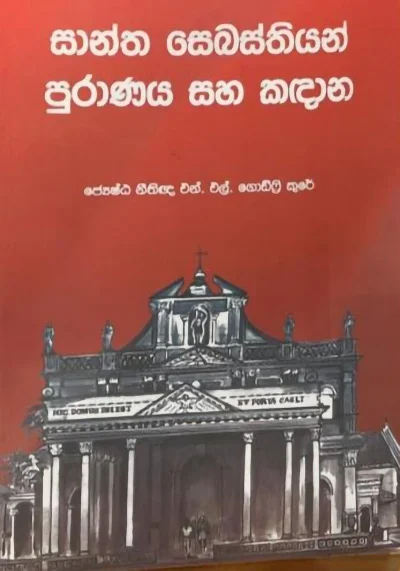
The latest book, written by Senior Lawyer Godfrey Cooray, named “Santha Sebastian Puranaya Saha Kandana” (The history of St. Sebastian and Kandana), was launched at De La Salle Auditorium, De Mazenod College, Kandana.
The Archbishop of Colombo His Eminence Most rev. Dr. Malcolm Cardinal Ranjith was the Chief Guests at the event.
The book discusses about the buried history of Muthurajawela and Aluth Kuru Korale civilisation, the history of Kandana and St. Sebastian. The author discusses the historical and archaeological values and culture.
158th Annual Feast of St. Sebastian’s National Shrine, Kandana, will be held on 20th of January 2026. On the 19th of January, Monday, Solemn Vespers were presided by His Lordship most Rev. Dr. Maxwell Silva Auxiliary Bishop of Colombo.
Festive High Mass will be presided by His Lordship Most Rev. Dr. J. D. Anthony, The Auxiliary Bishop of Colombo, on the 20th of January at 8pm.
By Godfrey Cooray
Senior Attorney -at -Law,
Former Ambassador to Norway and Finland
President, National Catholic Writers’ Association


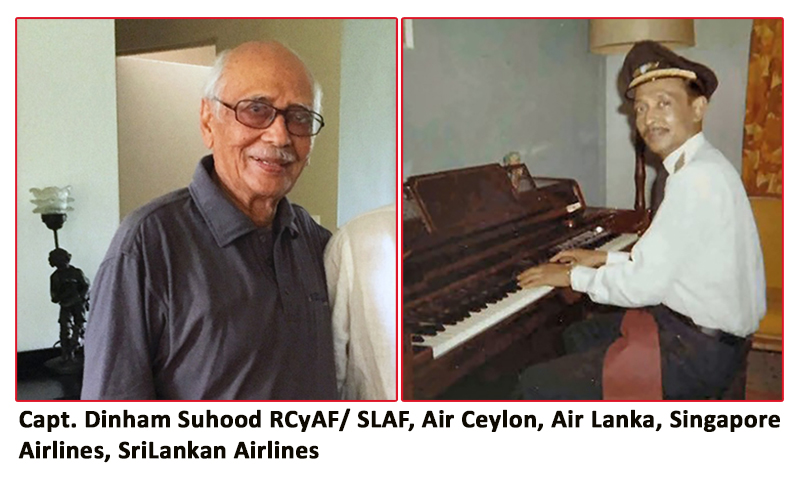
A few days ago, we heard the sad news of the passing on of Capt. Dinham Suhood. Born in 1929, he was the last surviving Air Ceylon Captain from the ‘old guard’.
He studied at St Joseph’s College, Colombo 10. He had his flying training in 1949 in Sydney, Australia and then joined Air Ceylon in late 1957. There he flew the DC3 (Dakota), HS748 (Avro), Nord 262 and the HS 121 (Trident).
I remember how he lent his large collection of ‘Airfix’ plastic aircraft models built to scale at S. Thomas’ College, exhibitions. That really inspired us schoolboys.
In 1971 he flew for a Singaporean Millionaire, a BAC One-Eleven and then later joined Air Siam where he flew Boeing B707 and the B747 before retiring and migrating to Australia in 1975.
Some of my captains had flown with him as First Officers. He was reputed to have been a true professional and always helpful to his colleagues.
He was an accomplished pianist and good dancer.
He passed on a few days short of his 97th birthday, after a brief illness.
May his soul rest in peace!
To fly west my friend is a test we must all take for a final check
Capt. Gihan A Fernando
RCyAF/ SLAF, Air Ceylon, Air Lanka, Singapore Airlines, SriLankan Airlines

The cause of global warming, they claim, is due to ever increasing levels of CO2. This is a by-product of burning fossil fuels like oil and gas, and of course coal. Environmentalists and other ‘green’ activists are worried about rising world atmospheric levels of CO2. Now they want to stop the whole world from burning fossil fuels, especially people who use cars powered by petrol and diesel oil, because burning petrol and oil are a major source of CO2 pollution. They are bringing forward the fateful day when oil and gas are scarce and can no longer be found and we have no choice but to travel by electricity-driven cars – or go by foot. They say we must save energy now, by walking and save the planet’s atmosphere.
THE DEMON COAL
But it is coal, above all, that is hated most by the ‘green’ lobby. It is coal that is first on their list for targeting above all the other fossil fuels. The eminently logical reason is that coal is the dirtiest polluter of all. In addition to adding CO2 to the atmosphere, it pollutes the air we breathe with fine particles of ash and poisonous chemicals which also make us ill. And some claim that coal-fired power stations produce more harmful radiation than an atomic reactor.
STOP THE COAL!
Halting the use of coal for generating electricity is a priority for them. It is an action high on the Green party list.
However, no-one talks of what we can use to fill the energy gap left by coal. Some experts publicly claim that unfortunately, energy from wind or solar panels, will not be enough and cannot satisfy our demand for instant power at all times of the day or night at a reasonable price.
THE ALTERNATIVES
It seems to be a taboo to talk about energy from nuclear power, but this is misguided. Going nuclear offers tried and tested alternatives to coal. The West has got generating energy from uranium down to a fine art, but it does involve some potentially dangerous problems, which are overcome by powerful engineering designs which then must be operated safely. But an additional factor when using URANIUM is that it produces long term radioactive waste. Relocating and storage of this waste is expensive and is a big problem.
Russia in November 2020, very kindly offered to help us with this continuous generating problem by offering standard Uranium modules for generating power. They offered to handle all aspects of the fuel cycle and its disposal. In hindsight this would have been an unbelievable bargain. It can be assumed that we could have also used Russian expertise in solving the power distribution flows throughout the grid.
THORIUM
But thankfully we are blessed with a second nuclear choice – that of the mildly radioactive THORIUM, a much cheaper and safer solution to our energy needs.
News last month (January 2026) told us of how China has built a container ship that can run on Thorium for ten years without refuelling. They must have solved the corrosion problem of the main fluoride mixing container walls. China has rare earths and can use AI computers to solve their metallurgical problems – fast!
Nevertheless, Russia can equally offer Sri Lanka Thorium- powered generating stations. Here the benefits are even more obviously evident. Thorium can be a quite cheap source of energy using locally mined material plus, so importantly, the radioactive waste remains dangerous for only a few hundred years, unlike uranium waste.
Because they are relatively small, only the size of a semi-detached house, such thorium generating stations can be located near the point of use, reducing the need for UNSIGHTLY towers and power grid distribution lines.
The design and supply of standard Thorium reactor machines may be more expensive but can be obtained from Russia itself, or China – our friends in our time of need.
Priyantha Hettige
The Island has recently published various articles on AI, and they are thought-provoking. This article is based on a paper I presented at a London University seminar, 22 years ago.
Will computers ever be intelligent? This question is controversial and crucial and, above all, difficult to answer. As a scientist and student of philosophy, how am I going to answer this question is a problem. In my opinion this cannot be purely a philosophical question. It involves science, especially the new branch of science called “The Artificial Intelligence”. I shall endeavour to answer this question cautiously.
Philosophers do not collect empirical evidence unlike scientists. They only use their own minds and try to figure out the way the world is. Empirical scientists collect data, repeat and predict the behaviour of matter and analyse them.
We can see that the question—”Will computers ever be intelligent?”—comes under the branch of philosophy known as Philosophy of Mind. Although philosophy of mind is a broad area, I am concentrating here mainly on the question of consciousness. Without consciousness there is no intelligence. While they often coincide in humans and animals, they can exist independently, especially in AI, which can be highly intelligent without being conscious.
AI and philosophers
It appears that Artificial Intelligence holds a special attraction for philosophers. I am not surprised about this as Al involves using computers to solve problems that seem to require human reasoning. Apart from solving complicated mathematical problems it can understand natural language. Computers do not “understand” human language in the human sense of comprehension; rather, they use Natural Language Processing (NLP) and machine learning to analyse patterns in data. Artificial Intelligence experts claim certain programmes can have the possibility of not only thinking like humans but also understanding concepts and becoming conscious.
The study of the possible intelligence of logical machines makes a wonderful test case for the debate between mind and brain. This debate has been going on for the last two and a half centuries. If material things, made up entirely of logical processes, can do exactly what the brain can, the question is whether the mind is material or immaterial.
Although the common belief is that philosophers think for the sake of thinking, it is not necessarily so. Early part of the 20th century brought about advances in logic and analytical philosophy in Britain. It was a philosopher (Ludwig Wittgenstein) who invented the truth table. This was a simple analytic tool useful in his early work. But this was absolutely essential to the conceptual basis of early computer science. Computer science and brain science have developed together and that is why the challenge of the thinking machine is so important for the philosophy of mind. My argument so far has been to justify how and why AI is important to philosophers and vice versa.
Looking at computers now, we can see that the more sophisticated the computer, the more it is able to emulate rather than stimulate our thought processes. Every time the neuroscientists discover the workings of the brain, they try to mimic brain activity with machines.
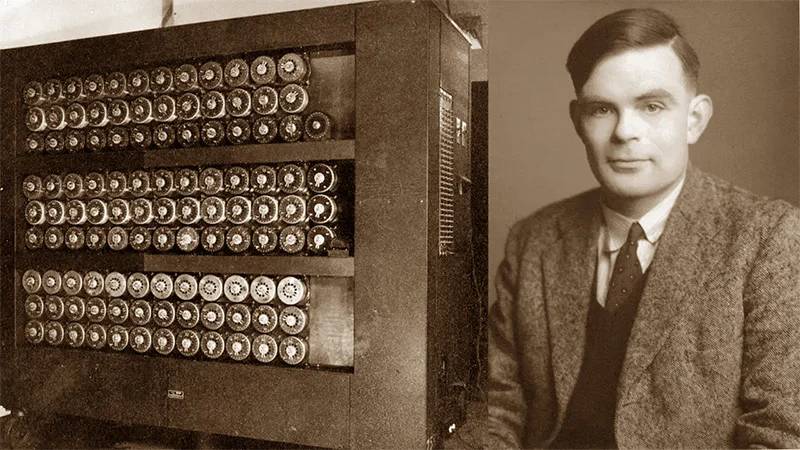
How can one tell if a computer is intelligent? We can ask it some questions or set a test and study its response and satisfy ourselves that there is some form of intelligence inside this box. Let us look at the famous Alan Turing Test. Imagine a person sitting at a terminal (A) typing questions. This terminal is connected to two other machines, (B) and (C). At terminal (B) sits another person (B) typing responses to the questions from person (A). (C) is not a human being, but a computer programmed to respond to the questions. If person (A) cannot tell the difference between person (B) and computer(C), then we can deduce that computer is as intelligent as person (B). Critics of this test think that there is nothing brilliant about it. As this is a pragmatic exercise and one need not have to define intelligence here. This must have amused the scientists and the philosophers in the early days of the computers. Nowadays, computers can do much more sophisticated work.
Chinese Room experiment
The other famous experiment is John Sealer’s Chinese room experiment. *He uses this experiment to debunk the idea that computers could be intelligent. For Searle, the mind and the brain are the same. But he warns us that we should not get carried away with the emulative success of the machines as mind contains an irreducible subjective quality. He claims that consciousness is a biological process. It is found in humans as well as in certain animals. It is interesting to note that he believes that the mind is entirely contained in the brain. And the empirical discovery of neural processes cannot be applied to outside the brain. He discards mind-body dualism and thinks that we cannot build a brain outside the body. More commonly, we believe the mind is totally in the brain, and all firing together and between, and what we call ‘thought’ comes from their multifarious collaboration.
Patricia and Paul Churchland are keen on neuroscientific methods rather than conventional psychology. They argue that the brain is really a processing machine in action. It is an amazing organ with a delicately organic structure. It is an example of a computer from the future and that at present we can only dream of approaching its processing speed. I think this is not something to be surprised about. The speed of the computer doubles every year and a half and in the distant future there will be machines computing faster than human beings. Further, the Churchlands’, strongly believe that through science one day we will replicate the human brain. To argue against this, I am putting forward the following true story.
I remember watching an Open University (London) education programme some years ago. A team of professors did an experiment on pavement hawkers in Bogota, Colombia. They were fruit sellers. The team bought a large number of miscellaneous items from these street vendors. This was repeated on a number of occasions. Within a few seconds, these vendors did mental calculations and came out with the amounts to be paid and the change was handed over equally fast. It was a success and repeatable and predictable. The team then took the sample population into a classroom situation and taught them basic arithmetic skills. After a few months of training they were given simple sums to do on selling fruit. Every one of them failed. These people had the brain structure that of ordinary human beings. They were skilled at their own jobs. But they could not be programmed to learn a set of rules. This poses the question whether we can create a perfect machine that will learn all the human transferable skills.
Computers and human brains excel at different tasks. For instance, a computer can remember things for an infinite amount of time. This is true as long as we don’t delete the computer files. Also, solving equations can be done in milliseconds. In my own experience when I was an undergraduate, I solved partial differential equations and it took me hours and a lot of paper. The present-day students have marvellous computer programmes for this. Let alone a mere student of mathematics, even a mathematical genius couldn’t rival computers in the above tasks. When it comes to languages, we can utter sentences of a completely foreign language after hearing it for the first time. Accents and slang can be decoded in our minds. Such algorithms, which we take for granted, will be very difficult for a computer.
I always maintain that there is more to intelligence than just being brilliant at quick thinking. A balanced human being to my mind is an intelligent person. An eccentric professor of Quantum Mechanics without feelings for life or people, cannot be considered an intelligent person. To people who may disagree with me, I shall give the benefit of the doubt and say most of the peoples’ intelligence is departmentalised. Intelligence is a total process.
Other limitations to AI
There are other limitations to artificial intelligence. The problems that existing computer programmes can handle are well-defined. There is a clear-cut way to decide whether a proposed solution is indeed the right one. In an algebraic equation, for example, the computer can check whether the variables and constants balance on both sides. But in contrast, many of the problems people face are ill-defined. As of yet, computer programmes do not define their own problems. It is not clear that computers will ever be able to do so in the way people do. Another crucial difference between humans and computers concerns “common sense”. An understanding of what is relevant and what is not. We possess it and computers don’t. The enormous amount of knowledge and experience about the world and its relevance to various problems computers are unlikely to have.
In this essay, I have attempted to discuss the merits and limitations of artificial intelligence, and by extension, computers. The evolution of the human brain has occurred over millennia, and creating a machine that truly matches human intelligence and is balanced in terms of emotions may be impossible or could take centuries
*The Chinese Room experiment, proposed by philosopher John Searle, challenges the idea that computers can truly “understand” language. Imagine a person locked in a room who does not know Chinese. They receive Chinese symbols through a slot and use an instruction manual to match them with other symbols to produce correct replies. To outsiders, it appears the person understands Chinese, but in reality, they are only following rules. Searle argues that similarly, a computer may process language convincingly without genuine understanding or consciousness.
by Sampath Anson Fernando

Teacher recruitment examinations will be conducted in accordance with the relevant court decisions – PM

Low-pressure area is likely to form over the southeastern Bay of Bengal around 15th February

Kolkata the stage as England, Scotland resume auld rivalry

Showers will occur at times in the Central, Uva, Eastern, Northern and North-central provinces and in Hambantota district

Sajith points to irregularities in coal procurement deals

Lankan Embassy in Washington welcomes ‘Walk for Peace’ Buddhist monks

‘Dates have the highest sugar content to fight Coronavirus’

Sunday Island 27 December – Headlines

#SundayIsland 17th December – Headlines

Sunday Island – 28th March

Sunday Island Headlines – 21 March

Sunday Island – 21st February – Headlines
-
 Features6 days ago
My experience in turning around the Merchant Bank of Sri Lanka (MBSL) – Episode 3
-
 Business6 days ago
Remotely conducted Business Forum in Paris attracts reputed French companies
-
 Business6 days ago
Four runs, a thousand dreams: How a small-town school bowled its way into the record books
-
 Business6 days ago
ComBank and Hayleys Mobility redefine sustainable mobility with flexible leasing solutions
-

 Business3 days ago
Autodoc 360 relocates to reinforce commitment to premium auto care
-
 Midweek Review3 days ago
A question of national pride
-
 Opinion2 days ago
Will computers ever be intelligent?
-
 Midweek Review3 days ago
Theatre and Anthropocentrism in the age of Climate Emergency