
News
Health Ministry launches Food-Based Dietary Guidelines with FAO support

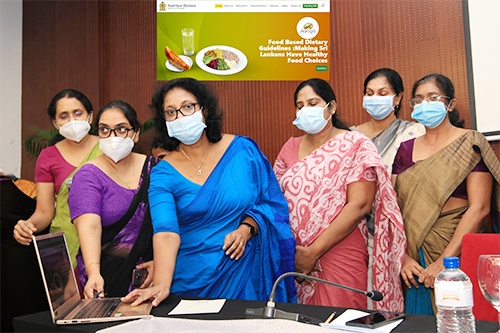
Ministry of Health Additional Secretary (Public Health Services) Dr. Lakshmi Somatunga launching a website. Deputy Director General (Public Health Services) Dr. H. S. R. Perera, Nutrition Division Actg. Director Dr. Lakmini Magodaratne, Dr. Yasoma Weerasekere, and Dr. Anoma Basnayake look on
The Ministry of Health, Nutrition and Indigenous Medicine with support from the Food and Agriculture Organization of the United Nations (FAO) launched the Sri Lanka Food-Based Dietary Guidelines (FBDGs) at an event held in Colombo.
FAO in a press release said: Country specific FBDGs are one of the FAO/WHO recommended tools to improve healthy eating habits and lifestyles of individuals and populations. Sri Lanka was one of the countries to endorse the FBDGs in the Framework for Action agreed at the Second International Conference on Nutrition.
The Food-Based Dietary Guidelines (also known as dietary guidelines) are intended to establish a basis for public food and nutrition, health and agricultural policies and nutrition education programs to foster healthy eating habits and lifestyles. The guidelines provide advice on foods, food groups and dietary patterns to provide the required nutrients to the general public to promote overall health and prevent chronic diseases.
Sri Lanka first published food-based dietary guidelines in 2002. A revised version was launched in 2011.
“A quick reference guide with the most relevant facts for better nutrition is a public need,” said Ministry of Health Deputy Director General Public Health Services Dr. Susie Perera. “A lot of hard work in the form of extensive research and stakeholder consultations went into the development of this guideline. A wide circulation to empower people with these facts is needed. Therefore, the next steps of implementation and dissemination of the dietary guidelines are equally important.”
The guidelines were developed by the Nutrition Division of the Ministry of Health, in consultation with various government ministries, universities, nutrition associations and institutes, consumer and non-governmental organizations. Technical and financial support was extended by FAO. The guidelines are adapted to the country’s nutrition situation, food availability, culinary cultures and eating habits.
“FAO assists member countries to develop, revise and implement food-based dietary guidelines and food guides in line with current scientific evidence,” said FAO Representative for Sri Lanka and the Maldives Dr. Xuebing Sun. “Sri Lanka is a country that is facing a triple-burden of malnutrition from staggering rates of stunting and wasting among children, micronutrient deficiencies, and overweight and obesity especially among women of reproductive age. The causes of malnutrition are complex and multilayered, yet diet is one of the single most important contributors to malnutrition. These food-based dietary guidelines can favorably impact diets and the food systems in Sri Lanka, from production to consumption,” Dr. Sun noted.
The revised Sri Lanka Food – Based Dietary Guidelines will be published and made available to the public on the website of the Nutrition Division of the Ministry of Health.
Food-Based Dietary Guidelines Key Messages are
• Add variety to your daily meals balancing the correct amounts.
• Eat whole grains including rice and their products which are parboiled or less polished instead of refined grains and products.
• Limit sugary drinks, biscuits, cakes, sweets, and sweeteners.
• Add fish or egg or lean meat with pulses in each meal.
• Eat at least two vegetables, one green leafy vegetable, and two fruits daily.
• Eat a handful of nuts or oily seeds daily.
• Have fresh milk or its fermented products.
• Limit salty foods and adding salt to foods.
• Water is the healthiest drink: drink 8 to 10 glasses (1.5 – 2.0l) throughout the day.
• Be active: engage in exercises at least for 20 minutes every day.
• Sleep 7 – 8 hours continuously every day.
• Eat clean and safe food.
• Eat fresh and home-cooked food: limit processed and ultra-processed food.
• Always read labels of packaged foods.

Latest News
Heat Index at Caution Level in the Northern, North-central, North-western, Western, Sabaragamuwa, Eastern and Southern provinces and in Monaragala district


Warm Weather Advisory
Issued by the Natural Hazards Early Warning Centre
Issued at 3.30 p.m. on 15 April 2026, valid for 16 April 2026.
The Heat index, the temperature felt on human body is likely to increase up to ‘Caution level’ at some places in the Northern, North-central, North-western, Western, Sabaragamuwa, Eastern
and Southern provinces and in Monaragala district.
The Heat Index Forecast is calculated by using relative humidity and maximum temperature and this is the condition that is felt on your body. This is not the forecast of maximum temperature. It is generated by the Department of Meteorology for the next day period and prepared by using global numerical weather prediction model data.
Effect of the heat index on human body is mentioned in the above table and it is prepared on the advice of the Ministry of Health and Indigenous Medical Services.
ACTION REQUIRED
Job sites: Stay hydrated and takes breaks in the shade as often as possible.
Indoors: Check up on the elderly and the sick.
Vehicles: Never leave children unattended.
Outdoors: Limit strenuous outdoor activities, find shade and stay hydrated.
Dress: Wear lightweight and white or light-colored clothing.
Note:
In addition, please refer to advisories issued by the Disaster Preparedness & Response Division, Ministry of Health in this regard as well. For further clarifications please contact 011-7446491

The Indonesian Navy Sailing Ship KRI BIMA SUCI – 945 arrived at the Port of Colombo on a goodwill visit on 15 Apr 2026 and was welcomed by the Sri Lanka Navy (SLN) in compliance with time-honoured naval traditions.
The vessel’s arrival is a key highlight of the ASEAN Plus Cadet Sail (APCS) – 2026 programme , accompanying a diverse contingent of Navy cadets from 26 different nations alongside their Indonesian counterparts.
The ship is commanded by Commander SUGENG HARIYANTO. Meanwhile, Officer Under-trainees of the Sri Lanka Navy are expected to participate in various programmes aboard the
ship and naval personnel observe its operational functions during its stay in the island.
Furthermore, the ship’s crew is scheduled to take part in programmes organized by the Sri Lanka Navy to enhance camaraderie between the two navies, as well as visit several tourist attractions in the country.
News
PM initiates children into learning at the auspicious time while observing New Year traditional customs and rituals

The Sinhala and Tamil New Year cultural festival, organized by the Ministry of Buddha Sasana, Religious and Cultural Affairs, was held on Tuesday (14) in Gampaha under the patronage of Prime Minister Dr. Harini Amarasuriya, with the performance of traditional auspicious customs and rituals.
In accordance with tradition, during the Punya Kalaya (inauspicious time), the Prime Minister visited the Medagama Sri Sunandarama Viharaya in Gampaha and participated in religious observances and received blessings from Venerable Thunmodara Samitha Thero, a member of the Karaka Sangha Sabha of the Sri Lanka Ramanna Maha Nikaya and the Chief Incumbent of the Medagama Sri Sunandarama Dharmaduta Piriven Viharaya.
The traditional observances of the Sinhala and Tamil New Year cultural festival were held at the residence of Darshana Weerasinghe in Gampaha. Marking the auspicious time for commencing work, and upon the invitation of the host family, the Prime Minister planted a sapling within the premises. Concurrently, Minister of Buddha Sasana, Religious and Cultural Affairs, Dr. Hiniduma Sunil Senevi, and Minister of Foreign Affairs and Tourism, Vijitha Herath, joined the PM.
Subsequently, the Prime Minister joined children in engaging in traditional folk games.
At the auspicious time for engaging work and educational activities, the PM participated with children in reading and writing, guiding them and symbolically marking the commitment to advancing the educational development of the nation’s children.
Thereafter, the Prime Minister and other distinguished guests observed the traditional customs of exchanging greetings, transactions and gifts with the host family, and joined them to partake in the customary New Year meal.
Extending New Year greetings to all citizens, the Prime Minister expressed her gratitude to all Sri Lankans, both at home and abroad, for their contributions in overcoming and effectively managing the various challenges faced by the country.
Speaking at the occasion, Minister Dr. Hiniduma Sunil Senevi stated that the Sinhala and Tamil New Year festival symbolizes renewal and purity, and reflects the energy of the sun. He also conveyed his wishes for a peaceful and prosperous New Year for all.
The occasion was attended by the Deputy Minister of Finance and Planning and Minister of Labour, Dr. Anil Jayantha; Deputy Minister of Labour, Mahinda Jayasinghe; Member of Parliament for the Gampaha District, Ruwan Mapalagama; along with the Gampaha District Secretary, Mayor, Divisional Secretaries, and a large number of government officials.
(Prime Minister’s Media Division)

Heat Index at Caution Level in the Northern, North-central, North-western, Western, Sabaragamuwa, Eastern and Southern provinces and in Monaragala district

Pakistani army chief in Tehran amid bid to restart US talks

Sri Lanka repatriates 238 Iranian sailors stranded after US torpedo attack

Indonesian Navy Sailing Ship KRI BIMA SUCI – 945 makes port call in Colombo

PM initiates children into learning at the auspicious time while observing New Year traditional customs and rituals

Navy seize an Indian fishing boat poaching in seas north of Mannar

‘Dates have the highest sugar content to fight Coronavirus’

Sunday Island 27 December – Headlines

#SundayIsland 17th December – Headlines

Sunday Island – 28th March

Sunday Island Headlines – 21 March

Sunday Island – 21st February – Headlines
-

 News4 days ago
CEB orders temporary shutdown of large rooftop solar systems
-
 Features4 days ago
From Royal College Platoon to National Cadet Corps: 145 years of discipline, leadership, and modern challenges
-

 Business6 days ago
Israeli attack on Lebanon triggers local stock market volatility
-

 Business6 days ago
HNB Assurance marks 25 years with strategic transformation to ‘HNB Life’
-

 Latest News3 days ago
PNS TAIMUR & ASLAT arrive in Colombo
-

 News5 days ago
Anura Solomons passes away
-

 Features4 days ago
CIA’s hidden weapon in Iran
-

 Latest News3 days ago
Prasidh, Buttler set up comfortable win for Gujarat Titans