
News
Harvesting ‘true cinnamon’: The story of the Ceylon spice

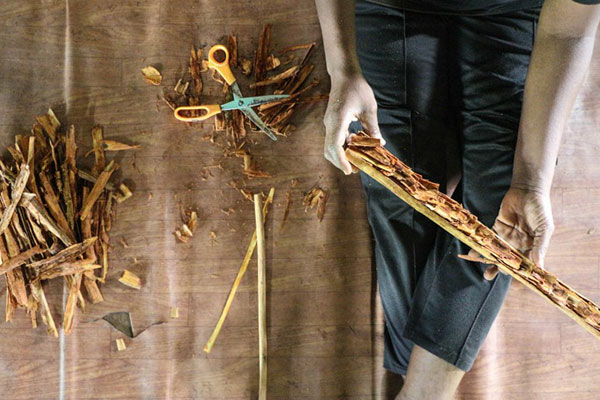
Considered the world’s best cinnamon, Ceylon cinnamon has been grown and produced in Sri Lanka for generations. But experienced peelers are now rare, says a report by Al Jazeera.
It said: It is 9am in the Carlton estate in Thihagoda, a small town about 160km (100 miles) south of Sri Lanka’s capital Colombo, and the July sun hides behind inky clouds. The air is thick and hot. Two men walk to the main estate building carrying piles of cinnamon branches. Inside, a group of women sit on the cement floor, chatting as they peel cinnamon.
Since 2000, workers here have planted, harvested and peeled cinnamon, sending batches of the fragrant sticks to a factory in Kamburupitiya, a 15-minute drive away, where they are cut, packed and loaded onto shipping containers for export.
Cinnamon harvesting usually takes place from June to December when the monsoon skies burst into downpours. But here at Rathna Producers Cinnamon Exports, it is produced throughout the year on the 42-acre (17 hectares) estate. “When we are done harvesting one acre, the next acre is ready,” says Chamara Lakshith, 28, the estate’s visiting officer, whose job involves coordinating between the estate and the main office in Kamburupitiya. “But sometimes for a few weeks, the bark is so hard that you can’t peel cinnamon. We know it by looking at the trees; young leaves turn striking red.”
The family business that began in 1985 is run by Ravindu Runage, whose late father started in the cinnamon trade with 7,000 Sri Lankan rupees ($35) to buy cinnamon from small farmers and sell it to bigger traders.
Now, Runage says the company is one of the largest cinnamon producers in Sri Lanka, exporting cinnamon and other spices like nutmeg and black pepper to 56 countries. Apart from growing organic cinnamon, the company also sources it from 8,000 individual and small-scale farmers and exports more than 30 containers of cinnamon a month.
“We grew up with cinnamon,” says 36-year-old Runage, at his office in Kamburupitiya, surrounded by several industry awards his family has won over the years. “We lived in a two-bedroom house. We slept in one room. In the other room, my thaththa [father] stored cinnamon.”
Once they were in the business, the Runage family learned that Mexico is one of the biggest cinnamon consumers. “So thaththa learned English and visited Mexico in 1998 to find a buyer,” says Runage. “But they spoke Spanish. So thaththa sent his business cards to companies he found in a telephone book.”
“Five months later, we sold our first container of cinnamon to Mexico.”
There are two types of cinnamon in the Western market: Ceylon cinnamon (named after the title British colonisers gave to Sri Lanka) and cassia. Ceylon cinnamon is native to Sri Lanka; it has a lush, inviting scent and a sweet taste, and its quills are soft and light brown in colour. Cassia comes from other Asian countries like China, Indonesia and Vietnam; its bark is sturdy with a rough texture, it is dark brown in colour and is stronger and hotter in taste. Cassia is considered lower quality, while Ceylon often triumphs as the pure, “true cinnamon”.
The process of producing this cinnamon includes several laborious, time-consuming steps. This is also why Ceylon cinnamon is expensive in the market while cassia is cheap, Runage says.
At the estate, seeds are planted in grow bags. After one year, saplings are cultivated. Harvesting begins four years later.
For harvesting, farmers cut down the branches of cinnamon trees at an angle, which allows cinnamon bushes to regrow, Lakshith says. Young and tender twigs are thrown away. Once branches are soaked in water and are moist enough, peelers remove the outermost layer of the cinnamon bark. To produce thin cinnamon quills, they spend hours stripping off the inner bark of the cinnamon branch in sheets.
Once produced, Ceylon cinnamon quills are graded based on their width; the thinner the quills, the higher they are in value. Alba is the highest form of cinnamon, with a diameter of 6mm. H1 is a lower grade of cinnamon, with a diameter of 22mm. In the export market, Alba costs twice as much as H1.
With a hearty smile, Suduhakuru Piyathilake holds a large batch of cinnamon quills. Piyathilake and his wife have been living in an old, dilapidated house next to the estate’s main building for 10 years now.
At 5am every day, Piyathilake heads off to the plantation. After collecting branches from about 15 trees, he plods back to the water tank in the main building, drops them off for soaking and returns to the plantation. He must make several trips back and forth before he begins peeling.
“When it’s moist, it’s easy to peel,” says the 55-year-old. “That’s why we cut them early in the morning and soak them.”
When the clock hits 10am, Piyathilake comes back with the last batch. After five hours, he has collected the branches of 200 trees. Sweat trickles down his forehead. A resident kitten swats at his feet, but Piyathilake ignores it and rushes in for a shower.
After a two-hour break, he sharpens his knife by scraping the outer bark of the branch and then he gets to work. “This is what my father and his father did,” he says. “Now my sons are cinnamon peelers.”
Piyathilake has been peeling cinnamon for the last 43 years. He learned the craft from his father in their village in Elpitiya, 70km north of the Runage family estate, where his children live with his mother. At home, cinnamon trees adorn their back yard, Piyathilake says. “But it’s a small garden so we can’t harvest cinnamon every day of the year. We don’t make much money there. So I work here with my wife. We only see our children once in every four months.”
Piyathilake is so adept at work that he can masterfully strip off extremely thin barks of the cinnamon branch by merely measuring them next to his index finger. After peeling the outer bark, he makes two cuts on two opposite sides before peeling off the inner bark. A half a length cut of your smallest bone is for Alba, Piyathilake says. For “rough” or H1 cinnamon quills, Piyathilake uses the length of two bones of his index finger.



During an operation conducted in the dark hours of 27 Dec 25, the Sri Lanka Navy seized an Indian fishing boat and apprehended 03 Indian fishermen while they were poaching in Sri Lankan waters, south of the Delft Island in Jaffna.
The seized boat and Indian fishermen (03) were brought to the Kreinagar Jetty and were handed over to the Fisheries Inspector of Jaffna for onward legal proceedings.

Admiral of the Fleet Wasantha Karannagoda said that he is still waiting for the government’s response to the UK sanctions imposed on three ex-military officers, including him, and a former member of the LTTE.
The former Navy Chief said so in response to The Island query whether he was aware of the position taken by a three-member ministerial committee, consisting of Foreign Minister Vijitha Herath, Justice and National Integration Minister Harshana Nanayakkara and Deputy Defence Minister Maj. Gen (retd) Aruna Jayasekera.
The government named the committee in the wake of the UK declaration of travel bans and asset freezes in respect of Karannagoda, General Shavendra Silva, General Jagath Jayasuriya and Vinayagamoorthy Muralitharan, also known as Karuna. Maj. Gen. Jayasekera said that they inquired into the issue at hand.
Karannnagoda said that he would like to know the government’s recommendations if the ministerial committee briefed the Cabinet as per a decision taken by the Cabinet of Ministers. Karannagoda said that the issue should have been taken at the highest level as various interested parties continue to humiliate the war-winning military by targeting selected individuals.
Other sources, familiar with the issues at hand, told The Island that the government was yet to announce its stand.
Sources pointed out that the Opposition has been silent on what they called a matter of utmost national importance.
Cabinet spokesman Dr. Nalinda Jayathissa is on record as having described the UK move as a unilateral move and that committee was formed to examine the developments and recommend appropriate measures to the Cabinet.
Foreign Minister Herath told The Island the government was not successful in getting the British to withdraw sanctions. Describing the UK decision as unilateral, the Miniser said that the government conveyed its concerns but the UK didn’t change its stand.
The Island raised the issue with Minister Herath and Admiral Karannagoda in the wake of British MP of Sri Lankan origin, Uma Kumaran requesting the UK Foreign Secretary Yvette Cooper to expand on the government’s sanctions imposed on the four above-mentioned persons.
During a Foreign Affairs Committee meeting on 16 December, the MP for Stratford and Bow highlighted the lack of accountability and political will from the current Sri Lankan government to address war crimes and mass atrocities committed in Sri Lanka.
Sources said that David Lammy, who served as Secretary of State for Foreign, Commonwealth and Development Affairs at the time of the declaration of sanctions, had no qualms in declaring that the action taken against four Sri Lankans was in line with a commitment he made during the election campaign to ensure those responsible wouldn’t be allowed impunity. The UK government statement quoted Lammy as having said that this decision ensured that those responsible for past human rights violations and abuses were held accountable.
By Shamindra Ferdinando
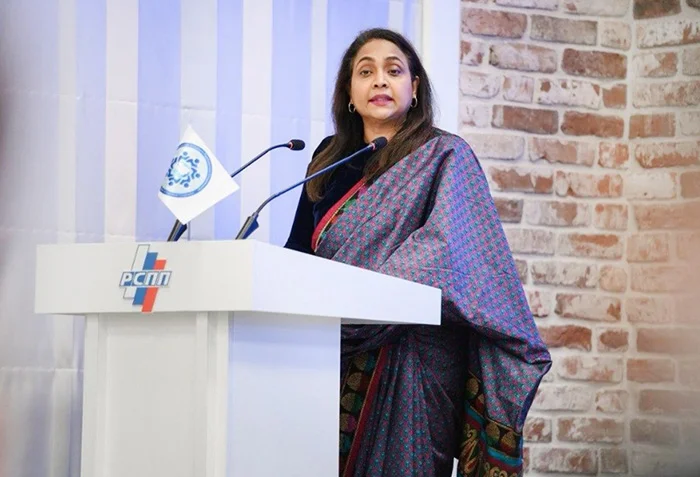
Sri Lankan Ambassador to the Russian Federation, Shobini Gunasekera recently presented a conceptual framework of seven key vectors that defined contemporary international relations and facilitated dialogue among States. She made the presentation at XI Moscow International Financial and Economic Forum held under the theme “Building Bridges: Partnership without Borders”.
In her address, the Ambassador emphasised that these vectors represent the channels through which ideas circulate, trade expands, and peace is strengthened, serving as guiding principles for cooperation amid global uncertainties. The seven key vectors highlighted were economic ties as a foundation for long-term stability; political choice and diplomacy through dialogue and multilateral engagement; security cooperation to address cross-border threats; cultural linkages through education, tourism, and professional exchanges; technological advancement, particularly in digital systems and artificial intelligence; environmental stewardship through collective action on renewable energy and climate change; and humanitarian obligations, including disaster relief and development cooperation.
Drawing on Sri Lanka’s experience, the Ambassador illustrated the practical application of these principles by highlighting the country’s strategic location in the Indian Ocean, its role as a trade and logistics hub, and its active engagement in regional groupings such as BIMSTEC and the Indian Ocean Rim Association, where the Russian Federation serves as a Dialogue Partner.
The potential for enhanced Sri Lanka–Russia bilateral cooperation was underscored, particularly through complementarities between Russia’s technological and energy expertise and Sri Lanka’s logistical capabilities and maritime infrastructure. She noted that such synergies could support joint initiatives in trade, innovation, tourism, and logistics, while cultural and scientific exchanges would further strengthen mutual understanding between the two countries.
Concluding her remarks, the Ambassador stated that sustained progress requires dialogue, mutual respect, and forward-looking partnerships capable of shaping a shared and stable future.

Navy seizes an Indian fishing boat poaching in northern waters

Mandhana, Shafali and Ghosh help India edge run-fest to go 4-0 up

Showers predicted in several provinces today (29th December)

Delay in govt. response to UK sanctions on ex-military chiefs, and others causes concern

Sri Lanka outlines seven key vectors of international cooperation at Moscow forum

Sri Lanka third most preferred destination for Indians

‘Dates have the highest sugar content to fight Coronavirus’

Sunday Island 27 December – Headlines

#SundayIsland 17th December – Headlines

Sunday Island – 28th March

Sunday Island Headlines – 21 March

Sunday Island – 21st February – Headlines
-

 News7 days ago
Members of Lankan Community in Washington D.C. donates to ‘Rebuilding Sri Lanka’ Flood Relief Fund
-

 News5 days ago
British MP calls on Foreign Secretary to expand sanction package against ‘Sri Lankan war criminals’
-

 Features7 days ago
General education reforms: What about language and ethnicity?
-
 News7 days ago
Suspension of Indian drug part of cover-up by NMRA: Academy of Health Professionals
-
 Sports5 days ago
Chief selector’s remarks disappointing says Mickey Arthur
-
 News4 days ago
Street vendors banned from Kandy City
-

 Editorial7 days ago
A very sad day for the rule of law
-

 News7 days ago
US Ambassador to Sri Lanka among 29 career diplomats recalled