
News
Harvesting ‘true cinnamon’: The story of the Ceylon spice

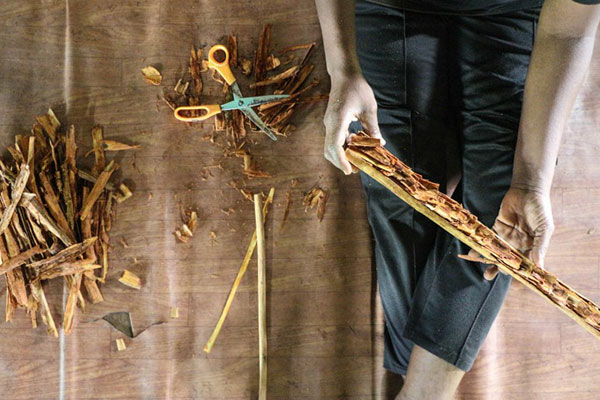
Considered the world’s best cinnamon, Ceylon cinnamon has been grown and produced in Sri Lanka for generations. But experienced peelers are now rare, says a report by Al Jazeera.
It said: It is 9am in the Carlton estate in Thihagoda, a small town about 160km (100 miles) south of Sri Lanka’s capital Colombo, and the July sun hides behind inky clouds. The air is thick and hot. Two men walk to the main estate building carrying piles of cinnamon branches. Inside, a group of women sit on the cement floor, chatting as they peel cinnamon.
Since 2000, workers here have planted, harvested and peeled cinnamon, sending batches of the fragrant sticks to a factory in Kamburupitiya, a 15-minute drive away, where they are cut, packed and loaded onto shipping containers for export.
Cinnamon harvesting usually takes place from June to December when the monsoon skies burst into downpours. But here at Rathna Producers Cinnamon Exports, it is produced throughout the year on the 42-acre (17 hectares) estate. “When we are done harvesting one acre, the next acre is ready,” says Chamara Lakshith, 28, the estate’s visiting officer, whose job involves coordinating between the estate and the main office in Kamburupitiya. “But sometimes for a few weeks, the bark is so hard that you can’t peel cinnamon. We know it by looking at the trees; young leaves turn striking red.”
The family business that began in 1985 is run by Ravindu Runage, whose late father started in the cinnamon trade with 7,000 Sri Lankan rupees ($35) to buy cinnamon from small farmers and sell it to bigger traders.
Now, Runage says the company is one of the largest cinnamon producers in Sri Lanka, exporting cinnamon and other spices like nutmeg and black pepper to 56 countries. Apart from growing organic cinnamon, the company also sources it from 8,000 individual and small-scale farmers and exports more than 30 containers of cinnamon a month.
“We grew up with cinnamon,” says 36-year-old Runage, at his office in Kamburupitiya, surrounded by several industry awards his family has won over the years. “We lived in a two-bedroom house. We slept in one room. In the other room, my thaththa [father] stored cinnamon.”
Once they were in the business, the Runage family learned that Mexico is one of the biggest cinnamon consumers. “So thaththa learned English and visited Mexico in 1998 to find a buyer,” says Runage. “But they spoke Spanish. So thaththa sent his business cards to companies he found in a telephone book.”
“Five months later, we sold our first container of cinnamon to Mexico.”
There are two types of cinnamon in the Western market: Ceylon cinnamon (named after the title British colonisers gave to Sri Lanka) and cassia. Ceylon cinnamon is native to Sri Lanka; it has a lush, inviting scent and a sweet taste, and its quills are soft and light brown in colour. Cassia comes from other Asian countries like China, Indonesia and Vietnam; its bark is sturdy with a rough texture, it is dark brown in colour and is stronger and hotter in taste. Cassia is considered lower quality, while Ceylon often triumphs as the pure, “true cinnamon”.
The process of producing this cinnamon includes several laborious, time-consuming steps. This is also why Ceylon cinnamon is expensive in the market while cassia is cheap, Runage says.
At the estate, seeds are planted in grow bags. After one year, saplings are cultivated. Harvesting begins four years later.
For harvesting, farmers cut down the branches of cinnamon trees at an angle, which allows cinnamon bushes to regrow, Lakshith says. Young and tender twigs are thrown away. Once branches are soaked in water and are moist enough, peelers remove the outermost layer of the cinnamon bark. To produce thin cinnamon quills, they spend hours stripping off the inner bark of the cinnamon branch in sheets.
Once produced, Ceylon cinnamon quills are graded based on their width; the thinner the quills, the higher they are in value. Alba is the highest form of cinnamon, with a diameter of 6mm. H1 is a lower grade of cinnamon, with a diameter of 22mm. In the export market, Alba costs twice as much as H1.
With a hearty smile, Suduhakuru Piyathilake holds a large batch of cinnamon quills. Piyathilake and his wife have been living in an old, dilapidated house next to the estate’s main building for 10 years now.
At 5am every day, Piyathilake heads off to the plantation. After collecting branches from about 15 trees, he plods back to the water tank in the main building, drops them off for soaking and returns to the plantation. He must make several trips back and forth before he begins peeling.
“When it’s moist, it’s easy to peel,” says the 55-year-old. “That’s why we cut them early in the morning and soak them.”
When the clock hits 10am, Piyathilake comes back with the last batch. After five hours, he has collected the branches of 200 trees. Sweat trickles down his forehead. A resident kitten swats at his feet, but Piyathilake ignores it and rushes in for a shower.
After a two-hour break, he sharpens his knife by scraping the outer bark of the branch and then he gets to work. “This is what my father and his father did,” he says. “Now my sons are cinnamon peelers.”
Piyathilake has been peeling cinnamon for the last 43 years. He learned the craft from his father in their village in Elpitiya, 70km north of the Runage family estate, where his children live with his mother. At home, cinnamon trees adorn their back yard, Piyathilake says. “But it’s a small garden so we can’t harvest cinnamon every day of the year. We don’t make much money there. So I work here with my wife. We only see our children once in every four months.”
Piyathilake is so adept at work that he can masterfully strip off extremely thin barks of the cinnamon branch by merely measuring them next to his index finger. After peeling the outer bark, he makes two cuts on two opposite sides before peeling off the inner bark. A half a length cut of your smallest bone is for Alba, Piyathilake says. For “rough” or H1 cinnamon quills, Piyathilake uses the length of two bones of his index finger.


The Sri Lanka Navy demonstrated its commitment to maritime safety by assisting to bring ashore an injured fisherman and rushing him for urgent medical attention on Thursday (28 May 2026)
The fisherman was aboard a local multiday fishing trawler off the south coast and the Maritime Rescue Coordination Centre (MRCC) Colombo coordinated the retrieval of the fisherman.
Reportedly, the multi-day fishing trawler had departed from the Kudawella Fisheries Harbour on 05th May with 06 fishermen. While engaged in fishing activities approximately 730 nautical miles off the south coast, one of the crew members suffered an injury.
Following a formal request for assistance, through MRCC Colombo, the Merchant Vessel ‘Dong Fang Wei Ye’ sailing in the nearby sea area had been informed to retrieve the patient. In a rapid response, the Navy dispatched a craft attached to the Southern Naval Command to the designated sea area where the Merchant Vessel was stationed to transfer the fisherman.
Upon transferring the injured fisherman from the Merchant Vessel, naval personnel provided essential first aid to the injured person before swiftly bringing him to the Galle Harbour And safely transferred him to the National Hospital, Galle.
News
Applications called to recruit 400 public officers as Digital Champions for the Public Impact Champions Network

As a key component of the Government’s Digital Economy Plan aimed at enhancing the quality and efficiency of the public sector system, an awareness programme for coordinating executive officers of public institutions was held on Wednesday (27) at the Information and Communication Technology Agency of Sri Lanka (ICTA). The programme marked the first step towards establishing the “Public Impact Champions Network” (PIC-NET), an institutional pilot network intended to drive the optimisation of public services through the digitalisation of public institutions.
During the programme, heads of institutions were informed to submit applications from officers currently serving in public institutions who possess the capability and capacity to represent the “Champions Corps” in spearheading digital transformation, in accordance with Circular PS/ADA/Circular/3/2026.
Chairman of the Information and Communication Technology Agency of Sri Lanka and Senior Adviser to the President on the Digital Economy, Dr. Hans Wijayasuriya, stated that the Government aims to increase Sri Lanka’s digitally empowered economy from its current level of 3% to 12% by 2030.
He further explained that the development of the digital economy is a process aimed at improving efficiency, quality and revenue generation through the use of communication technology in economic activities.
Pointing out how the digital economy has expanded in every developed state, Dr Hans Wijayasuriya noted that the slow growth of the digital economy remains a serious challenge faced by Third World countries. However, he stated that India is currently achieving remarkable progress in digital economic development and that elevating Sri Lanka’s digital economy to a prominent level alongside such developments is one of the Government’s principal objectives.
Dr Hans Wijayasuriya also pointed out that this digital economic growth must take place simultaneously across nearly all public institutions. Accordingly, within the next three years, the coordination and management of transactions among public institutions are expected to function in a fully networked manner similar to banking operations.
He further emphasised that the support of both public institutions and the country’s citizens as a whole would be crucial for the successful implementation of this extensive technological transformation across all public institutions over the next few years.
Ranil Peiris of the Department of Information Technology at the University of Sri Jayewardenepura briefed those present on the foundation of the PIC-NET programme and its future plans.
He explained that, in the future, citizens would be able to access services such as applying for passports and renewing licences entirely online from their homes. He further pointed out that this system would eliminate the need for citizens to repeatedly provide the same information.
Representatives of KPMG also presented the future action plan relating to the selection and training of officers.
Representing the Presidential Secretariat, Sameera Wickremasinghe further briefed participants on the mechanism for calling applications.
The necessary guidance and coordination support for this public sector digitalisation programme are being provided with the support of the Presidential Secretariat, the Ministry of Digital Economy, GovTech Sri Lanka and the Asian Development Bank.
(PMD)

India’s top anti-crime agency has arrested the mother-in-law of an Indian woman whose death has sparked conflicting claims of murder and suicide.
Twisha Sharma’s parents and siblings have alleged that she was tortured by her lawyer husband, Samarth Singh, and his mother – retired judge Giribala Singh – over dowry demands and that she was murdered, allegations they have denied.
The 33-year-old model and actor had been married for just five months when she was found dead in her matrimonial home in Madhya Pradesh state’s Bhopal city on 12 May.
On Thursday, the Central Bureau of Investigation (CBI) arrested Giribala Singh after questioning her for several hours.
The Madhya Pradesh High Court had earlier cancelled her anticipatory bail, finding that a trial court had ignored key evidence and witness testimony.
Following Twisha’s death, the police had registered a case of dowry death against the Singhs. Earlier this week, the investigation was taken over by the CBI.
Twisha’s death has made national headlines and has once against brought the issue of dowry deaths into the spotlight. Every year, thousands of women are murdered for bringing in insufficient dowries, even though the practice was banned in 1961.
The case has drawn significant attention because of the family’s prominence. Twisha was a former beauty pageant winner and actor, while her husband and mother-in-law were lawyers.
Twisha’s parents allege that dowry-related harassment began soon after her marriage to Singh. They also claim that when she became pregnant, Singh and his mother accused her of infidelity and forced her to terminate the pregnancy.
The Singhs deny the allegations, saying Twisha had mental health issues and took her own life. They also contend that the decision to terminate the pregnancy was hers.
Singh is currently in police custody. He had reportedly absconded after Twisha’s death and was arrested by police in Jabalpur on 22 May.
Twisha was cremated on Sunday after a second autopsy. Her family had alleged that the first post-mortem was flawed and accused the police of a cover-up, a charge the police denied.
[BBC]

Tickner five-for wraps up innings win for New Zealand

Ambidextrous spinner Shashini Gimhani in Sri Lanka’s T20 World Cup squad

Pakistan’s famous cheerleader ‘Chacha Cricket’ to retire this year

South Africa Women’s maiden tour to Zimbabwe to feature five T20Is

Navy renders assistance to bring injured fisherman ashore

Applications called to recruit 400 public officers as Digital Champions for the Public Impact Champions Network

‘Dates have the highest sugar content to fight Coronavirus’

Sunday Island 27 December – Headlines

#SundayIsland 17th December – Headlines

Sunday Island – 28th March

Sunday Island Headlines – 21 March

Sunday Island – 21st February – Headlines
-

 News6 days ago
All-New GRAVITE launches at LKR 6.99 Mn
-

 Features6 days ago
The NPP’s pivot to the past
-
 News5 days ago
Police probe underway to ascertain links between criminals deported from UAE and local politicians
-

 News4 days ago
Easter Sunday carnage: Court told Maulana’s statement cannot be accepted without cross-examination
-

 Features6 days ago
End of Peacekeeping
-
 Opinion4 days ago
Undermining the democratic political framework
-
 News4 days ago
UK passport holder hiding here wants to have deportation order rescinded to leave without blemish
-

 News5 days ago
Dickoya double murder suspect arrested