
News
Harsha welcomes SL’s credit upgrading

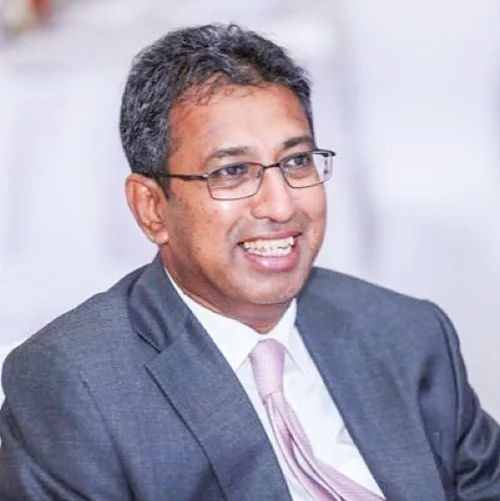
SJB MP Dr. Harsha de Silva on Tuesday (24), described the recent upgrade of Sri Lanka’s credit rating as a positive development, not only for the government but for the entire economy.
Addressing the media at the SJB headquarters Dr. de Silva highlighted its significance, “Sri Lanka has been removed from the list of countries at risk of debt default by leading credit rating agencies such as Moody’s and Fitch Ratings. This is a momentous development for the nation. The previous government’s mismanagement of debt placed immense pressure on private sector investors. For example, during negotiations between Sri Lanka and India’s Adani Group over electricity tariffs, Adani raised concerns about Sri Lanka’s poor creditworthiness. Similarly, the downgraded credit rating discouraged other investors from considering Sri Lanka as a viable destination. This upgrade, therefore, is a relief for both the government and the economy.”
Dr. de Silva, however, noted that Sri Lanka has not yet achieved the credit rating necessary to borrow from international markets.
“To reach that milestone, the economy must be further strengthened,” he emphasised. He attributed the recent credit rating improvement to measures initiated in 2023 during the country’s economic crisis. These included parliamentary-approved reforms and stabilisation efforts.
He observed that the credit rating upgrade was the result of adhering to the International Monetary Fund (IMF) agreement without deviating from its fundamentals. “Before the election, the National People’s Power (NPP) pledged to introduce an alternative Debt Sustainability Analysis (DSA) for debt restructuring. However, when the opportunity for restructuring arose, no alternative DSA was implemented. Instead, the existing agreement was followed, ultimately benefiting the country,” he explained.
Dr de Silva also discussed the government’s recent decision to extend the gazette notification for rice imports until 10 January. He stressed the importance of setting a guaranteed price for paddy before the next harvest to support farmers. “Farmers affiliated with the NPP have demanded a guaranteed price of Rs. 130 per kilogram of paddy. If the government agrees to this price, will it revise the rice import gazette accordingly? Will the price of rice remain at Rs. 230 per kilo? If not, large-scale rice mill owners will exploit the situation by purchasing paddy from farmers at reduced prices, leaving them vulnerable once again,” he warned.
As a sustainable solution to the rice price issue, Dr. de Silva proposed reviving the Shakthi Rice Enterprise, a cooperative initiative launched during the Good Governance administration to support small- and medium-scale rice millers. “The solution lies in restarting the Shakthi Rice Enterprise, which previously operated in eight districts. Neglecting this initiative would be a mistake,” he concluded, urging the government to take decisive action to stabilise the rice market and safeguard the livelihoods of farmers.


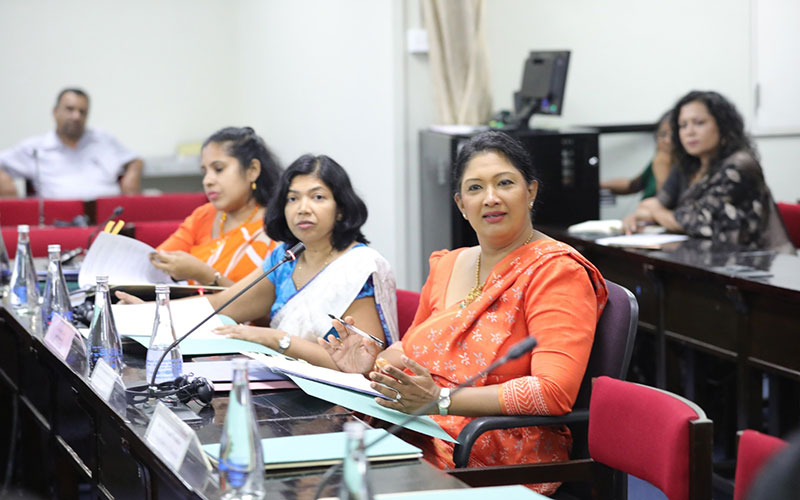
Proposals to amend the Prevention of Domestic Violence Act, No. 34 of 2005, to ensure its more effective implementation were considered at a meeting of the Parliamentary Women’s Caucus.
The matter was discussed at length when the caucus met recently in Parliament. As its Chairperson, Minister Saroja Savithri Paulraj, was absent, the meeting was chaired by Deputy Co-Chairs Chamindrani Kiriella and Samanmali Gunasinghe.
The primary objective of the Act is to prevent domestic violence and provide prompt legal remedies to those affected by it.
The Muslim Women’s Research and Action Forum (MWRAF) presented several proposals regarding a proposed new Bill to replace the existing legislation.
Among the proposals were expanding the range of persons and officials who could initiate legal action on behalf of adults and children subjected to violence, simplifying the application process, making interim protection orders more effective and strengthening follow-up mechanisms relating to protection orders.
It was also stressed that legal and institutional reforms should not be confined to legislation but should take into account the actual experiences of women facing domestic violence.
Meanwhile, Chrysalis Sri Lanka conducted an awareness programme on increasing women’s political participation and representation. Attention was drawn to the importance of expanding women’s participation in decision-making processes, including policymaking, beyond economic empowerment.
The participants agreed to continue considering measures to strengthen legal protection against domestic violence and increase women’s rights and participation in decision-making.
Members of the Parliamentary Women’s Caucus and other invitees attended the meeting.
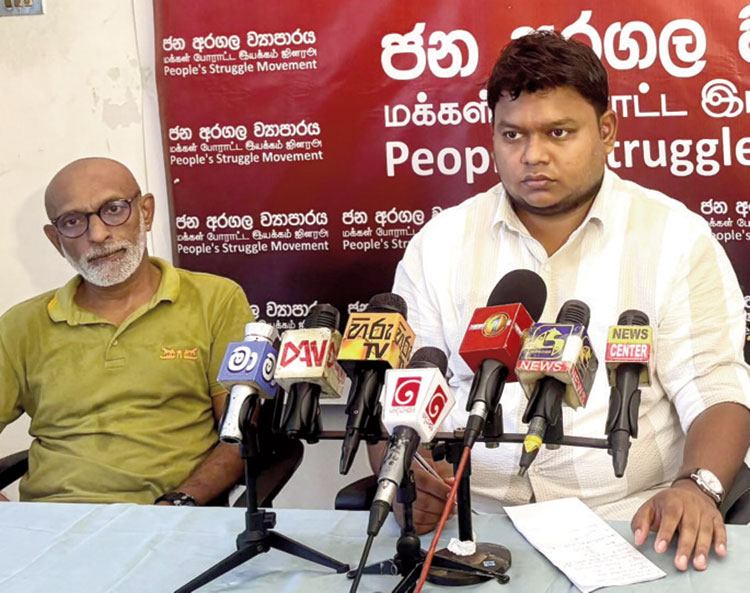
The Frontline Socialist Party-backed People’s Struggle Movement is set to stage a protest march in Colombo today (03) against what it describes as the growing tax burden on the public and the rising cost of living.
The organisers are due to commence the “Colombo March Against Unjust Taxes” at noon from Campbell Park, Borella. The FSP has also been mobilising support for the protest in Colombo and its suburbs in the run-up to the event.
People’s Struggle Movement National Executive Council member Wasantha Mudalige, speaking at a media briefing in Nugegoda yesterday (02), called on the public to join the protest, saying the movement intended to bring the tax burden faced by ordinary people to the forefront.
Mudalige alleged that successive tax measures had placed an excessive burden on households, particularly through taxes on food and educational items. He also criticised the Government over what he described as the high cost of basic food items and the difficulties faced by parents in meeting their children’s educational expenses.
He accused the Opposition of failing to adequately address the issue, claiming that opposition parties raised such concerns, mainly during election periods.
Mudalige also criticised the Government for what he described as a departure from promises made before the 2024 presidential election regarding taxes on educational equipment.
He questioned the tax burden on food items, citing figures of Rs. 100 per kilogramme on dried sprats, Rs. 310 per kilogramme on chicken and Rs. 11 per egg.
He further alleged that while ordinary people were bearing a heavy tax burden, wealthy groups were receiving tax concessions. He also criticised the Government’s economic programme and its implementation of measures associated with the International Monetary Fund (IMF).
The movement has framed today’s protest as part of a broader campaign over the cost of living and taxation. The People’s Struggle Alliance has separately announced that the Campbell Park demonstration will be the first in a series of public actions, with further protests planned in November.
Mudalige said the movement would continue to take the issue to the streets and urged the public to participate in today’s demonstration.
People’s Struggle Movement National Executive Council member Jayantha Amarasinghe also addressed the press.

The Colombo High Court yesterday postponed the trial in the case filed under the Prevention of Money Laundering Act against Yoshitha Rajapaksa, son of former President Mahinda Rajapaksa.
The case was taken up before Colombo High Court Judge Udesh Ranatunga, with Yoshitha Rajapaksa, who is currently out on bail, appearing in court.
The trial was postponed as the President’s Counsel appearing for the defence was indisposed.
The Attorney General has filed the case against Rajapaksa, alleging that he committed an offence under the Prevention of Money Laundering Act by purchasing five plots of land in Dehiwala and Ratmalana, worth more than Rs. 73 million.

Proposals considered to amend Prevention of Domestic Violence Act

IIHS expands global nursing pathways

Sampath Bank launches Sri Lanka’s first community-powered book discovery platform at Colombo International Book Fair

CEAT expands premium retail network with Kurunegala outlet

STC General launches three new products

Reliance Consumer Products CEO to Deliver Keynote at SLEIS 2026

‘Dates have the highest sugar content to fight Coronavirus’

Sunday Island 27 December – Headlines

#SundayIsland 17th December – Headlines

Sunday Island – 28th March

Sunday Island Headlines – 21 March

Sunday Island – 21st February – Headlines
-

 News6 days ago
Police remove Thileepan statue in Jaffna
-

 Features6 days ago
The 22nd Amendment, constitutional recovery and illiberal slippage
-

 Features6 days ago
Of foreigners as CEOs of Lankan ventures
-

 Latest News4 days ago
Gold winner Tharanga gets brand-new Honda Vezel from SLAAJ
-

 News6 days ago
Sajith rejects Jt. Opp. protest sabotage claim; SJB TU chief demands remedial action
-

 Features4 days ago
Why Sri Lanka needs an Inclusive Civic Nationalism – urgently
-

 Features5 days ago
Thailand’s biggest new global star …
-

 News3 days ago
US-assisted ‘Ice’ detection: NPC to examine IGP’s move to transfer drug-busting team