
Features
Harpo the irrepressible restaurateur turns 20


I first went to ‘The Commons Coffeehouse’ a few years now. I can’t remember the first day but I think I must have purchased a ‘Flat White.’ That’s what I’ve always got there. Today, if I stop at the counter, this is the question that is invariably put to me: ‘a flat white?’
They know, even though I don’t always buy something. I mostly sit in some corner writing something or playing online chess. They don’t mind. It’s my place. It’s everyone’s place. A common ground. You can come, stay and leave. As you please.
It took me a while to learn that Harpo Gunaratne owned the place. It took me even longer to learn that he’s been running the place for 20 years. Somewhere along the way, we became friends. I’ve written about him and his little restaurant that has more or less become my ‘day home’ on a few occasions, but I write now following an interview. Harpo turned 20. Sorry, Harpo the Restaurateur turned 20.
Harpo was a brand long before Harpo the Restaurateur emerged from a corporate world where his hands were full of all things related to food, hospitality and entertainment. Today, as he celebrates 20 years as a restaurateur, Harpo can be justifiably proud about what he has achieved, although this self-effacing man talks and acts as though it’s all an aggregate of day’s well-lived doing what makes him happy, i.e. putting smiles on other people’s faces.
Harpo has a name. Lalith Clarence Gooneratne. His family must have used it when he was a child, but he was re-christened, so to speak, as ‘Harpo’ by his father when he was but a toddler because he resembled Harpo Marx. That name stuck. It became a brand or rather; he turned it into a brand.
It all began when he and Gabo (Gamini Peiris) began Deejaying in the early 1980s, i.e. not too long after he left school. Young people in Colombo who loved music and dancing knew the duo. Harpo and Gabo made music.
Music was a natural option for him since nothing inspires greater passion in him than people. Obviously the hospitality industry was the other natural option. Harpo knew the two went together and soon developed himself into what could be called the perfect and complete package.
Having followed a three year course at the Claremont Hotel School, Harpo joined the Capri Club, in 1983. He hasn’t stopped since and therefore counts more than 40 years of experience in the industry. In that 40 years literally hundreds of thousands of patrons have enjoyed the hospitality and entertainment of places like the Ramada Renaissance Hotel now known as Cinnamon Lakeside and where the famed ‘Library Lounge and Music Room’ was born, Hilton Colombo, Hilton Dalian (China), Hilton Osaka (Japan) and other mixed-development projects in Sri Lanka such as the World Trade Centre, Crescat Boulevard, & Millennium Theme Park. Harpo either managed or was consulted by such high-end entities in the corporate sector. The industry knows Harpo. The clientele simply enjoyed the fruit of his labor and that is what pleases him most.
So I sat him down at ‘The Commons Coffeehouse,’ the quaint hangout-plus-food place on Ernest de Silva Mawatha frequented by people of all ages, some of whom become regulars to the point that it’s a ‘must stop’ in their daily routines. I’ve seen Harpo often, especially in the mornings when he drops by to check on things. We exchange greetings or just nod in acknowledgement and sometimes talk for a few minutes. This was different. I wanted to know the why and how of it all. He ordered coffee and asked me if I needed anything else. A Flat White, as always, was good enough.
I asked him why he moved away from what arguably was a comfortable gig, so to speak. Harpo has a simple response: ‘I was done working for others.’
And he explained:
‘I had already completed about 25 years in the corporate sector as an entertainer, hotelier, consultant etc., both local and foreign. My thing was to manage other people’s headaches. So I decided to do my own thing.’
That’s how Harpo Productions, now Harpo’s Cafes and Restaurants, came into being and how Harpo became a full-time restaurateur.
‘This was the first project. I simply managed and operated. About a year later the owner asked me, “Why don’t you consider acquiring the brand?” I knew the numbers. I knew the business. And I knew “The Commons.” I agreed.’
It was, as he said, a functional coffee shop. The menu, the concept, the look and feel, this was all Harpo’s thing. He laid it out. He tweaked it. He leveraged his best asset, the brand Harpo.
Harpo was already a household name. The Commons was a ‘family thing.’ An ideal match.
‘It was a first of a kind,’ Harpo explained.
‘The dining industry had expanded and got varied. But this was unique at the time. People come, they know what they want, the staff sooner or later figures out what the particular customer needs and delivers it. It was casual food, but good food.’
Harpo is right. While the kitchen staff is understandably invisible for the most part, those at the counter and those who serve, including the security personnel, seem to have become permanent fixtures but with a friendly, warm and human countenance. They are known and they know.
He acknowledged that the staff is a huge part of the brand’s success story. He explained the low staff turnover as a product of the way things are done.
‘It’s our culture: “look after your people and they look after you.”’
Just a year ago, a second outlet was opened in Pitakotte. But Harpo or rather Harpo’s Cafes and Restaurants is not just a ‘Commons’ thing.
-
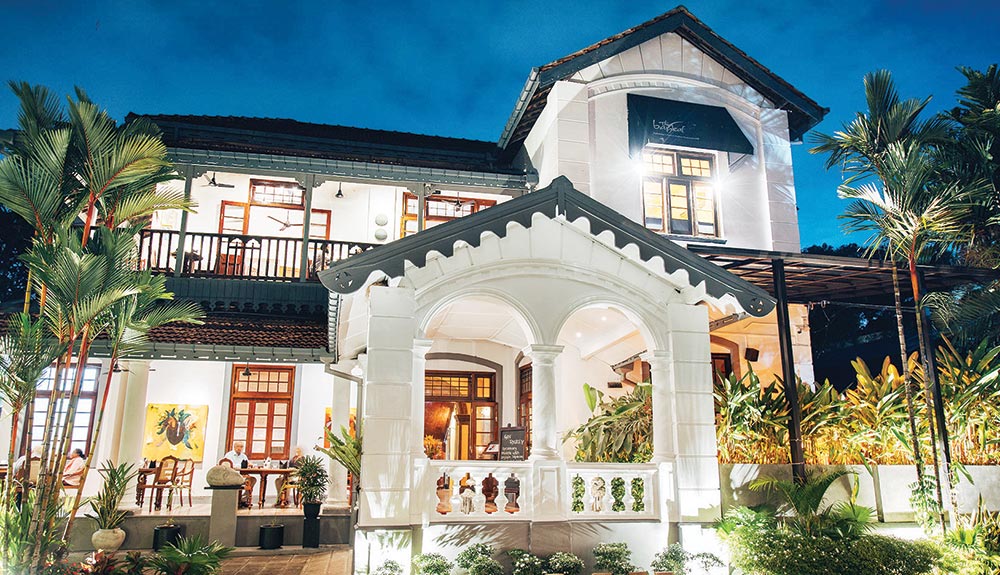
- The Bayleaf
-
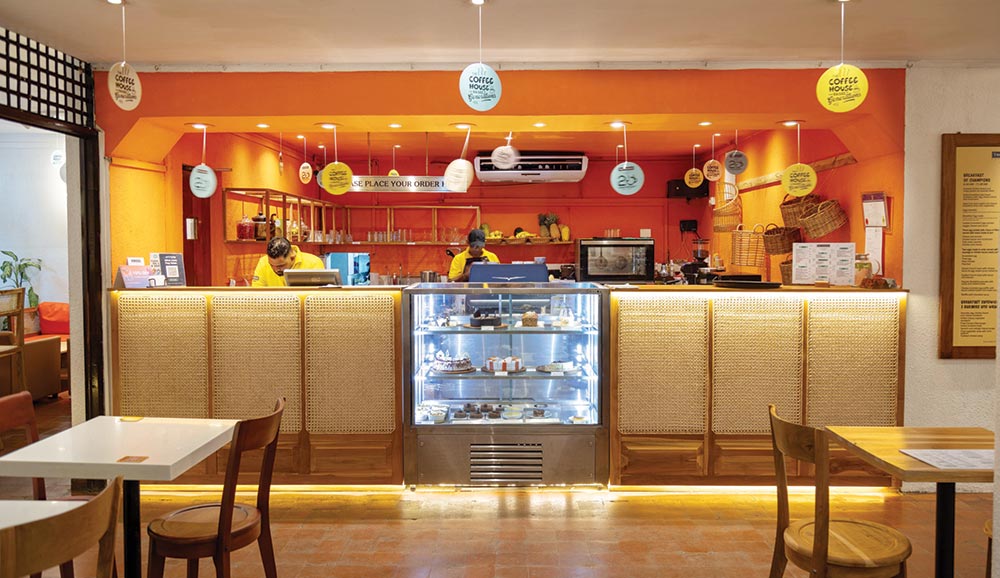
- Commons
In 2005, Harpo opened The Bayleaf on what used to be called Gregory’s Road and is now Srimath R. G. Senanayake Mawatha, one of the first stand-alone Italian restaurants which too he had been managing for a year before acquiring it.
There are probably many who have never visited either of the two ‘Commons’ or The Bayleaf, many who have not been to Harpo’s Euro Med restaurant, Colombo Fort Cafe, which he opened at the Dutch Hospital around 2010, again one of the earliest to serve such cuisine, and many who don’t know about ‘SHOULDERS,’ a small unique Greek infused restaurant with an open kitchen in the promenade area of Havelock City which was launched in November 2023. They probably are unaware that Harpo has a property in Bengalaru, India, ‘Salone Ceylon’ which is a Sri Lankan fusion restaurant while selling among other things hoppers, ‘presented differently,’ as Harpo says. They wouldn’t know that his first overseas venture was to take the pizza brand to the Maldives, way back in 2008, but had to pull out because ‘it was a little too early for the Maldives.’
They would know the brand Harpo though if not for entertainment then for food, thanks to Harpo’s Pizza.
‘Since I was making pizza anyway at The Bayleaf, it made sense to arrange home-delivery. I introduced the concept of wood fire in pizza making. This was in 2008. We initially started from The Bayleaf but now we have four other outlets Pitakotte, Wattala and Nugegoda. We were also the first to make Regular 9″, Large 12″, Gigantic 19″ pizzas and the first square pizza, which is 22″ across.’
The names of these places tell a story. There’s a common touch to The Commons. Well, that common touch signatures the other places as well, but they too have unique stories. Fort Cafe was obviously inspired by the location, but ‘SHOULDERS ’ seems a direct draw from Harpo’s philosophy.
‘It’s a small place. So small that you keep knocking on shoulders. We say “sorry.” And so people communicate. So people get to know one another, become familiar.’

Harpo
‘The Bayleaf’ made sense on account of the type of cuisine, given that it alludes to Greek and Roman history and is a symbol of love, strength, courage and victory.
The love was always there, but courage and strength were required in excess during those early days when an ongoing conflict could wreck anything and everything in the blink of an eye. Such qualities were also required in the aftermath of the Easter Sunday attacks of 2019, the Covid pandemic and the economic and political upheavals a few years later.
‘I started off at the height of the war. We invested at that time. We took a big risk. Also, it was just after the tsunami. So there were bombs and roadblocks. We took some big hits in the first four years or so, but we were strong as a brand. The name “Harpo” was known in the hotel, corporate and entertainment fields. I didn’t have to create from scratch. Doors opened. Simply, people knew me.
‘The most challenging times actually came later. We had to push through several crises. There was the parliamentary coup in 2018, the 2019 Easter Sunday attacks, Covid and the economic crisis when there was no gas, petrol, diesel and electricity. But we survived because first of all the brand was strong and secondly, we had an amazing team of around 150 people who stood with and by me.’
Harpo’s reasoning is remarkably simple: ‘If there is a down, there has to be an up.’
‘I stuck to my guns, people stuck with me, the team stuck together, we innovated, we made difficult decisions and had the courage to alter course when necessary. For example, I had to close down a hotel school in the South which I had run for about eight years, more as a CSR thing to introduce and groom young people to the hospitality industry.’
Harpo didn’t start the world’s first restaurant. Indeed, it wasn’t he who opened Sri Lanka’s first restaurant either. He won’t be the last, that’s for sure as well. And yet, originality seems to be Harpo’s thing.
‘I am a daydreamer. I read, I look around and find what’s missing.’
It’s true. No one did pizza before he did. No one offered Italian cuisine before he did. There were no coffee shops before ‘The Commons.’ The Greek and Mediterranean restaurants were firsts. He’s given us homemade pizza and all kinds of mouthwatering sauces. Who knows what else Harpo would get into next?’
Whatever it is, the underlying philosophy is unlikely to change. Harpo likes people to be comfortable. He is easygoing and creates spaces for the easygoing or simply makes it possible for the tense to shed their anxieties — he puts them at ease. So they come, they see, become comfortable and stay.
‘We’ve created spaces in Colombo for families, couples, executives and kids to come together,’ he said. Even unemployed, underemployed or unemployable graduates, I might add. Anyway, it’s generational. Kids who walked in with parents and ran around screaming their heads off later come with friends, lovers and business associates.
‘The Commons’ has got a new look, perhaps as part of the celebrations, but the feel is the same. Harpo is Harpo but he is acutely aware of changing times and circumstances and the need to adapt and innovate. He outlined the challenge thus:
‘The industry has a huge HR problem on its hands. We don’t have enough and properly trained people coming out to service the traveler. Hospitality is a low-hanging fruit and gives us a lot of income. It’s massive. We do have two-three schools but this is not enough. Hospitality management has to be part of the school curriculum. As a country, the private sector needs to get involved. It’s a fast evolving trade. We need to understand that people come, work for a while, obtain the training and experience and then go overseas. How do we meet the demand? This is a question that all stakeholders need to address.’
Harpo does his part. He sets things rolling. He has faith in what the country and the people have and are so ready to offer:
‘There’s a surge in tourism. We are a lovely country; we have so many things to offer. We have more cafes and restaurants now. It’s a growing sector.’
There’s been competition of course, but as Harpo points out the brand has stood its ground and passed the test of time or rather changing times. He wants to franchise his brands. He believes that ‘The Commons’ is scalable and so too his pizza. He plans to set up a training/grooming school in Jaffna.
Harpo, at 20, is as curious as a child, as enthusiastic as a teen, as driven as someone stepping into an adult world and as wise as someone who’s seen enough to be sober, unanimous and grateful.
Harpo is confident. He is confident about Sri Lanka. He believes that hospitality is a sleeping giant. He’s waking it up. That’s what he’s being doing in his own way. Setting things in motion. ling through it all.
by Malinda Seneviratne ✍️


 ‘Adapt, shrink or die’ – thus runs the warning issued by the Trump administration to UN humanitarian agencies with brute insensitivity in the wake of its recent decision to drastically reduce to $2bn its humanitarian aid to the UN system. This is a substantial climb down from the $17bn the US usually provided to the UN for its humanitarian operations.
Considering that the US has hitherto been the UN’s biggest aid provider, it need hardly be said that the US decision would pose a daunting challenge to the UN’s humanitarian operations around the world. This would indeed mean that, among other things, people living in poverty and stifling material hardships, in particularly the Southern hemisphere, could dramatically increase. Coming on top of the US decision to bring to an end USAID operations, the poor of the world could be said to have been left to their devices as a consequence of these morally insensitive policy rethinks of the Trump administration.
Earlier, the UN had warned that it would be compelled to reduce its aid programs in the face of ‘the deepest funding cuts ever.’ In fact the UN is on record as requesting the world for $23bn for its 2026 aid operations.
If this UN appeal happens to go unheeded, the possibilities are that the UN would not be in a position to uphold the status it has hitherto held as the world’s foremost humanitarian aid provider. It would not be incorrect to state that a substantial part of the rationale for the UN’s existence could come in for questioning if its humanitarian identity is thus eroded.
Inherent in these developments is a challenge for those sections of the international community that wish to stand up and be counted as humanists and the ‘Conscience of the World.’ A responsibility is cast on them to not only keep the UN system going but to also ensure its increased efficiency as a humanitarian aid provider to particularly the poorest of the poor.
It is unfortunate that the US is increasingly opting for a position of international isolation. Such a policy position was adopted by it in the decades leading to World War Two and the consequences for the world as a result for this policy posture were most disquieting. For instance, it opened the door to the flourishing of dictatorial regimes in the West, such as that led by Adolph Hitler in Germany, which nearly paved the way for the subjugation of a good part of Europe by the Nazis.
If the US had not intervened militarily in the war on the side of the Allies, the West would have faced the distressing prospect of coming under the sway of the Nazis and as a result earned indefinite political and military repression. By entering World War Two the US helped to ward off these bleak outcomes and indeed helped the major democracies of Western Europe to hold their own and thrive against fascism and dictatorial rule.
Republican administrations in the US in particular have not proved the greatest defenders of democratic rule the world over, but by helping to keep the international power balance in favour of democracy and fundamental human rights they could keep under a tight leash fascism and linked anti-democratic forces even in contemporary times. Russia’s invasion and continued occupation of parts of Ukraine reminds us starkly that the democracy versus fascism battle is far from over.
Right now, the US needs to remain on the side of the rest of the West very firmly, lest fascism enjoys another unfettered lease of life through the absence of countervailing and substantial military and political power.
However, by reducing its financial support for the UN and backing away from sustaining its humanitarian programs the world over the US could be laying the ground work for an aggravation of poverty in the South in particular and its accompaniments, such as, political repression, runaway social discontent and anarchy.
What should not go unnoticed by the US is the fact that peace and social stability in the South and the flourishing of the same conditions in the global North are symbiotically linked, although not so apparent at first blush. For instance, if illegal migration from the South to the US is a major problem for the US today, it is because poor countries are not receiving development assistance from the UN system to the required degree. Such deprivation on the part of the South leads to aggravating social discontent in the latter and consequences such as illegal migratory movements from South to North.
Accordingly, it will be in the North’s best interests to ensure that the South is not deprived of sustained development assistance since the latter is an essential condition for social contentment and stable governance, which factors in turn would guard against the emergence of phenomena such as illegal migration.
Meanwhile, democratic sections of the rest of the world in particular need to consider it a matter of conscience to ensure the sustenance and flourishing of the UN system. To be sure, the UN system is considerably flawed but at present it could be called the most equitable and fair among international development organizations and the most far-flung one. Without it world poverty would have proved unmanageable along with the ills that come along with it.
Dehumanizing poverty is an indictment on humanity. It stands to reason that the world community should rally round the UN and ensure its survival lest the abomination which is poverty flourishes. In this undertaking the world needs to stand united. Ambiguities on this score could be self-defeating for the world community.
For example, all groupings of countries that could demonstrate economic muscle need to figure prominently in this initiative. One such grouping is BRICS. Inasmuch as the US and the West should shrug aside Realpolitik considerations in this enterprise, the same goes for organizations such as BRICS.
The arrival at the above international consensus would be greatly facilitated by stepped up dialogue among states on the continued importance of the UN system. Fresh efforts to speed-up UN reform would prove major catalysts in bringing about these positive changes as well. Also requiring to be shunned is the blind pursuit of narrow national interests.

 Hi! Great to be back after my Christmas break.
Thought of starting this week with egg white.
Yes, eggs are brimming with nutrients beneficial for your overall health and wellness, but did you know that eggs, especially the whites, are excellent for your complexion?
OK, if you have no idea about how to use egg whites for your face, read on.
Egg White, Lemon, Honey:
Separate the yolk from the egg white and add about a teaspoon of freshly squeezed lemon juice and about one and a half teaspoons of organic honey. Whisk all the ingredients together until they are mixed well.
Apply this mixture to your face and allow it to rest for about 15 minutes before cleansing your face with a gentle face wash.
Don’t forget to apply your favourite moisturiser, after using this face mask, to help seal in all the goodness.
Egg White, Avocado:
In a clean mixing bowl, start by mashing the avocado, until it turns into a soft, lump-free paste, and then add the whites of one egg, a teaspoon of yoghurt and mix everything together until it looks like a creamy paste.
Apply this mixture all over your face and neck area, and leave it on for about 20 to 30 minutes before washing it off with cold water and a gentle face wash.
Egg White, Cucumber, Yoghurt:
In a bowl, add one egg white, one teaspoon each of yoghurt, fresh cucumber juice and organic honey. Mix all the ingredients together until it forms a thick paste.
Apply this paste all over your face and neck area and leave it on for at least 20 minutes and then gently rinse off this face mask with lukewarm water and immediately follow it up with a gentle and nourishing moisturiser.
Egg White, Aloe Vera, Castor Oil:
To the egg white, add about a teaspoon each of aloe vera gel and castor oil and then mix all the ingredients together and apply it all over your face and neck area in a thin, even layer.
Leave it on for about 20 minutes and wash it off with a gentle face wash and some cold water. Follow it up with your favourite moisturiser.

 Superlatives galore were used, especially on social media, to highlight R&B singer Ne-Yo’s trip to Sri Lanka: Global superstar Ne-Yo to perform live in Colombo this December; Ne-Yo concert puts Sri Lanka back on the global entertainment map; A global music sensation is coming to Sri Lanka … and there were lots more!
At an official press conference, held at a five-star venue, in Colombo, it was indicated that the gathering marked a defining moment for Sri Lanka’s entertainment industry as international R&B powerhouse and three-time Grammy Award winner Ne-Yo prepares to take the stage in Colombo this December.
What’s more, the occasion was graced by the presence of Sunil Kumara Gamage, Minister of Sports & Youth Affairs of Sri Lanka, and Professor Ruwan Ranasinghe, Deputy Minister of Tourism, alongside distinguished dignitaries, sponsors, and members of the media.
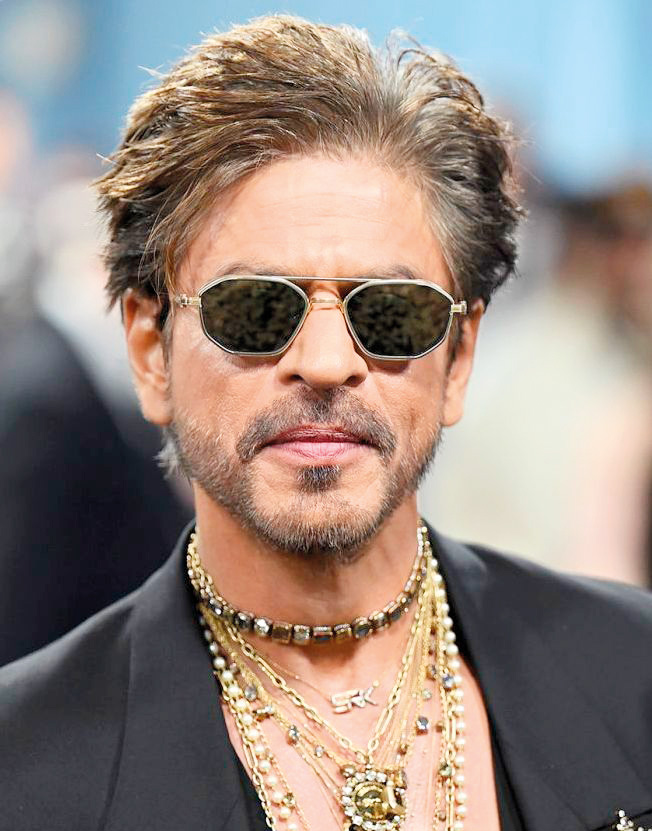
Shah Rukh Khan: Disappointed his fans in Sri Lanka
According to reports, the concert had received the official endorsement of the Sri Lanka Tourism Promotion Bureau, recognising it as a flagship initiative in developing the country’s concert economy by attracting fans, and media, from all over South Asia.
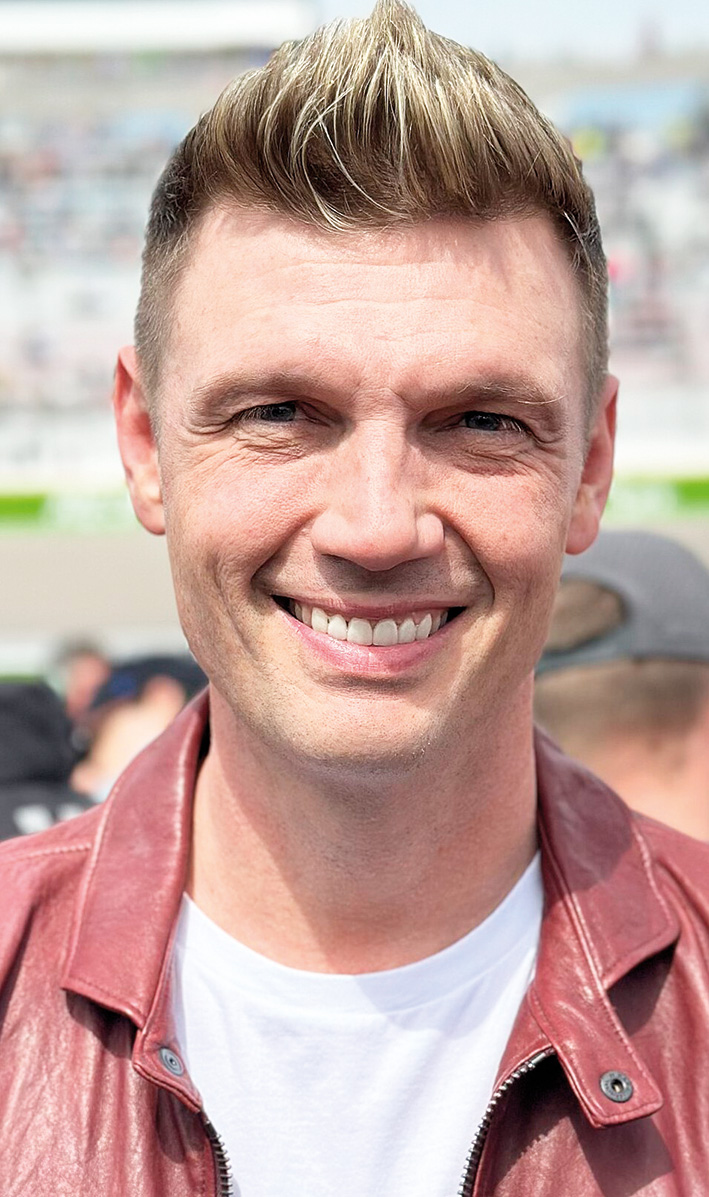
Nick Carter: His concert, too, was cancelled due to “Unforeseen circumstances
However, I had that strange feeling that this concert would not become a reality, keeping in mind what happened to Nick Carter’s Colombo concert – cancelled at the very last moment.
Carter issued a video message announcing he had to return to the USA due to “unforeseen circumstances” and a “family emergency”.
Though “unforeseen circumstances” was the official reason provided by Carter and the local organisers, there was speculation that low ticket sales may also have been a factor in the cancellation.
Well, “Unforeseen Circumstances” has cropped up again!
In a brief statement, via social media, the organisers of the Ne-Yo concert said the decision was taken due to “unforeseen circumstances and factors beyond their control.”
Ne-Yo, too, subsequently made an announcement, citing “Unforeseen circumstances.”
The public has a right to know what these “unforeseen circumstances” are, and who is to be blamed – the organisers or Ne-Yo!
Ne-Yo’s management certainly need to come out with the truth.
However, those who are aware of some of the happenings in the setup here put it down to poor ticket sales, mentioning that the tickets for the concert, and a meet-and-greet event, were exorbitantly high, considering that Ne-Yo is not a current mega star.
We also had a cancellation coming our way from Shah Rukh Khan, who was scheduled to visit Sri Lanka for the City of Dreams resort launch, and then this was received: “Unfortunately due to unforeseen personal reasons beyond his control, Mr. Khan is no longer able to attend.”
Referring to this kind of mess up, a leading showbiz personality said that it will only make people reluctant to buy their tickets, online.
“Tickets will go mostly at the gate and it will be very bad for the industry,” he added.

In pictures: New Year welcomed around the world

Foreign warships commended for their assistance during weather disaster in Sri Lanka

Machu Picchu train crash leaves one dead and dozens injured

I invite you to step into 2026 with renewed energy, hope, and determination – PM

Fairly heavy showers about 75 mm are likely at some places in the Central and Uva provinces and in Batticaloa and Ampara districts

National Audit Office reveals NHSL lapses

‘Dates have the highest sugar content to fight Coronavirus’

Sunday Island 27 December – Headlines

#SundayIsland 17th December – Headlines

Sunday Island – 28th March

Sunday Island Headlines – 21 March

Sunday Island – 21st February – Headlines
-
 News6 days ago
Street vendors banned from Kandy City
-

 Sports3 days ago
Gurusinha’s Boxing Day hundred celebrated in Melbourne
-

 News6 days ago
Lankan aircrew fly daring UN Medevac in hostile conditions in Africa
-
 News1 day ago
Leading the Nation’s Connectivity Recovery Amid Unprecedented Challenges
-

 Sports4 days ago
Time to close the Dickwella chapter
-

 Features6 days ago
Rethinking post-disaster urban planning: Lessons from Peradeniya
-

 Features2 days ago
It’s all over for Maxi Rozairo
-

 Opinion6 days ago
Are we reading the sky wrong?