
Latest News
Grant Fisher smashes world indoor 5000m record in Boston


Less than a week after he took apart the world indoor 3000m record in New York, USA’s Grant Fisher added another world indoor record* to his tally, this time over 5000m at the BU David Hemery Valentine International in Boston on Friday (14).
The double Olympic bronze medallist dropped Jimmy Gressier just after the half way point and continued to extend his lead throughout the second half. After passing 3000m in 7:39.16 – a comfortable 16 seconds outside the world indoor record of 7:22.91 he clocked last Saturday – Fisher continued to churn out sub-31-second laps.
After covering the final 400m in 59.36 seconds, Fisher charged through the line in 12:44.09, a five-second improvement on the previous world indoor record of 12:49.60 set by Kenenisa Bekele in 2004.
Gressier held on for second place in 12:54.92, a European indoor record and outright French record.
[*Subject to the usual ratification procedure]
[World Athletics]


On most days Sri Lanka would enter Thursday’s clash in Kandy against Oman as heavy favourites. They’ve beaten Oman in their solitary meeting – an ODI in 2023 – and are generally formidable in home conditions. But the psychological and tactical knock-on effects of Wanidu Hasaranga being ruled out of the tournament provide an intriguing backdrop.
The star legspinner is a renowned bully of Associates and those lower down the T20 rungs, as highlighted by his match-turning 3 for 25 against Ireland, whose batters found him too much to handle even on one leg. His absence therefore leaves a massive hole in Sri Lanka’s middle-overs containment plan – one Oman will no doubt be looking to exploit – while his power-hitting will also be missed.
His replacement, legspinning allrounder Dushan Hemantha, is like-for-like cover on paper, but the only area in which Hemantha has regularly excelled in in his handful of international white-ball outings has been in the field. The pressure will squarely shift to Maheesh Theekshana and Dunith Wellalage to spearhead the spin attack, with neither being as proficient a wicket-taker as Hasaranga.
Sri Lanka’s bowling had been their trump card coming into this tournament, but Hasaranga’s injury following that of Eshan Malinga’s days prior to the tournament have exposed yet another chink in their armour.
Sri Lanka’s batting concerns have also been exacerbated by Hasaranga’s absence. The middle order has struggled for consistency, particularly against spin – a challenge they’re likely to face in abundance against a spin-centric Omani attack – and now one of their better spin hitters is out.
Runs up the order from Pathum Nissanka and Kusal Mendis have been crucial to Sri Lanka’s recent successes, while a revelatory knock from Kamindu Mendis against Ireland has offered hope lower down. But you sense the key to an unlikely upset will be whether Oman can access Sri Lanka’s soft middle cheaply – do that and it’s anybody’s game.
For Oman, this is a quintessential do-or-die fixture. Currently at the bottom of Group B after a loss to Zimbabwe, they must secure a victory to keep their Super Eight hopes alive. They can draw confidence from their warm-up victory over a Sri Lanka A side earlier this month, where Aamir Kaleem’s blistering 80 and Vinayak Shukla’s finishing proved they can compete with the islanders’ second string. They will also need to find a way to contend with the express pair of Dushmantha Chameera and Matheesha Pathirana, having lost nine wickets to Zimbabwe’s seamers in their opener.
Kamindu Mendis wasn’t even supposed to be here. But Sri Lanka are grateful that he is. Picked, dropped, and picked again, Kamindu has never been sure of a place in Sri Lanka’s XI, but a Player-of-the-Match 44 off 19 against Ireland has removed the doubts. Sri Lanka had been crying out for his ability to bat anywhere in the middle order and provide impetus through the middle overs – particularly against spin.
Sri Lanka’s batters struggled to get away Ireland’s modest spin offering at the Khettarama. The pitch in Pallekele might not be as helpful, but recent history has shown that spinners will still play a role. As such, Sri Lanka will need to be particularly wary of Shakeel Ahmed‘s accuracy. He picked up 2 for 24 against the Sri Lanka A side, and if the Pallekele pitch offers any turn, he is the most likely candidate to exploit the co-hosts’ historical struggles against disciplined left-arm spin.
Hasaranga’s injury will test Sri Lanka’s resolve in whether they stick to a 6-5 combination. Hemantha could slot in for Hasaranga, or Sri Lanka might opt for an extra batter.
Sri Lanka (probable): Pathum Nissanka, Kamil Mishara, Kusal Mendis (wk), Pavan Rathnayake, Kamindu Mendis, Dasun Shanaka (capt), Dunith Wellalage, Dushan Hemantha, Dushmantha Chameera, Maheesh Theekshana, Matheesha Pathirana.
Oman have no injury concerns and are likely to name an unchanged XI.
Oman (probable): Jatinder Singh (capt), Aamir Kaleem, Hammad Mirza, Wasim Ali, Karan Sonavale, Jiten Ramanandi, Vinayak Shukla (wk), Sufyan Mehmood, Nadeem Khan, Shah Faisal, Shakeel Ahmed.
[Cricinfo]
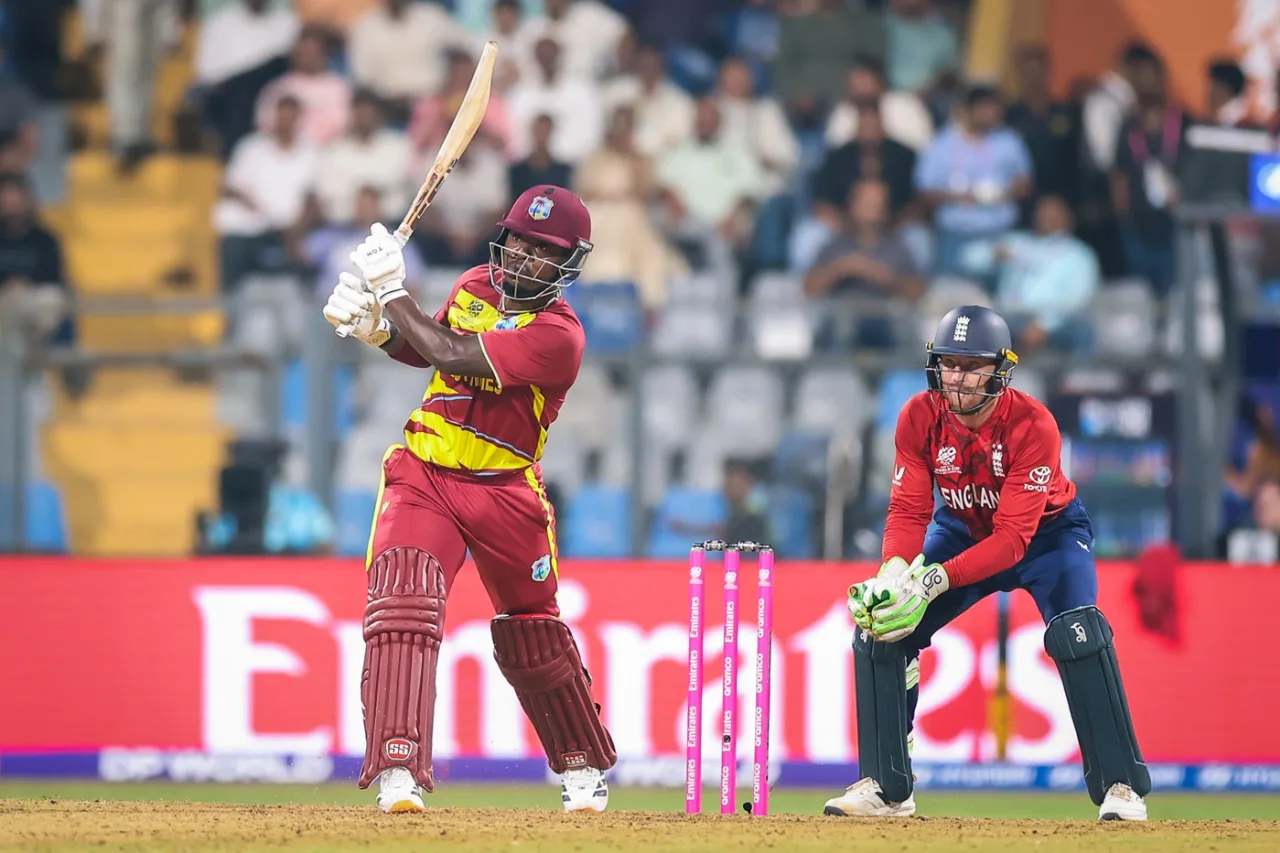
Given all the pre match hype about their 2016 encounter, this contest could well have been set up for a fall. Instead, all the chat about their T20 glory days inspired West Indies with bat and ball, as they landed a brilliant 30-run victory under the floodlights at the Wankhede Stadium, thanks to a calculated but powerful half-century from Sherfane Rutherford, and a stunning spin strangle in dewy conditions, led by Gudakesh Motie’s three wickets.
England looked to have the match in their grasp on numerous occasions: when West Indies slumped to 8 for 2 after losing what seemed a vital toss; when Adil Rashid bounced back from a rough day against Nepal with a stunning boundary-less spell of 2 for 16; when Phil Salt came clattering out of the starting gates to power England along to 67 for 1 in the powerplay.
But the walls closed in on them as soon as West Indies turned to spin. Motie and Roston Chase dovetailed magnificently through the middle overs for combined figures of 5 for 62 in eight, which became 6 for 94 in 12 when Akeal Hosein ended what he had begun by picking off England’s seventh wicket – Jamie Overton – in the covers.
Jofra Archer’s dawdling run-out by a Jason Holder direct hit epitomised an England performance that had run out of road, long before Sam Curran was left high and dry on 43 not out, with Chase’s tumbling catch at deep square leg off Rashid being a fitting way to cap a fine personal display. Having edged over the line against Nepal in their previous game, England’s impressive run of 11 wins in 12 T20Is came to a shuddering halt, and against a familiar World Cup nemesis.
With the 7pm start and heavy prospect of dew, England seemed to have stolen a march by getting the chance to bowl first. Archer, pumped up but erratic, touched 148kph in an opening over that included seven runs in wides, but a wicket as well, as Shai Hope rocked back to slam a cut to deep cover. Curran then made it 8 for 2 after seven legal deliveries, as Brandon King picked out deep point with a similar launch for the stands.
But, almost before they could cement their early advantage, England had it ripped clean from them. In his second over, Curran beat Shimron Hetmyer with a slower ball, then attempted a repeat dose and got smoked through midwicket for six. And Will Jacks, such a threat on Sri Lanka’s spinning decks last week, proved meat and drink with the field up for the powerplay. His loose first over was picked off for 19, including Hetmyer’s second six, high over backward square.
It takes more than one bad day for England to lose faith in their one-day trump card. Rashid’s habitual entry at the end of the powerplay came with the baggage of his brutal treatment against Nepal. But in his three-run opening over, he showcased a ripping legbreak to Chase and a skidding googly past Rutherford’s edge, and from that moment on, West Indies had no option but to treat him with utter deference, seeing him off in a boundary-less four-over spell.
Brook stretched his impact as far as he could dare, first through a change of ends while Overton’s heavy lengths – deemed surplus against Nepal – helped to keep a lid on West Indies’ progress. Rashid’s initial return, for the tenth over, delivered the wicket of Chase for 33 from 29, nailed on the back leg by a wonderful ripping googly, while his two overs were held way back, until the 16th and 18th overs, with Rovman Powell’s miscued slog to long-off capping fabulous final figures of 2 for 16.
As Rashid inadvertently showed in his final over, when dropping Rutherford’s steepling slog across the line on 56, his personal match-up against West Indies’ key man was extremely favourable – and ten balls for ten runs continued that trend.
The trouble was coming at the other end, with England unable to contain a typical West Indies pain-train acceleration, particularly when Rutherford found – in Holder – the ideal long-levered sidekick to clear the Wankhede’s tight boundaries. Jacks returned for a second over but was monstered over the leg-side for back-to-back sixes; Archer’s third was dispatched for 17, including another six for Rutherford that Rashid at deep third parried onto the rope.
Holder got in on the act with four sixes as their stand gathered momentum into the back of a toiling innings, and though he holed out to Overton for 33 from 17 in the final over, Rutherford nailed his seventh six over long-on to close out the innings in style. Without Rashid, England might have been chasing 220. Even with him, West Indies’ outscored England by 13 sixes to six. It was a very throwback means to make the difference.
Salt’s ability to hit fifth gear from the get-go is a rare and enviable trait. He clubbed Hosein’s first ball of the reply through long-off for four, but it was his second-over assault on Holder that ignited England’s powerplay. A match-up that has long been in his favour delivered a 24-run pummeling, as Salt sat deep to the length balls for two sixes over midwicket and carved with impunity through the width for three further fours.
Had he carried on as he’d begun, it might have been a different tale. But he couldn’t, as Romario Shepherd’s harder length cramped his advances for a 14-ball 30. Even so, Jacob Bethell’s left-handedness unlocked the angles against Hosein’s cramping spin, and when Jos Buttler capped a 67-run powerplay with a square-driven four off Shamar Joseph, England seemed very much in control.
Buttler’s first six, from his 13th ball, looked like being the moment that his innings would go into overdrive. Instead, Chase challenged him to repeat his stroke with another determined offbreak on a good length, and long-on was waiting to spring the trap, with Buttler’s 21 leaving him just shy of his 4,000th T20I run.
Enter Motie, an unassuming nemesis maybe, but a player who has seen plenty of this England line-up over the past two years, and whose left-arm spin found just enough purchase amid the rising dew to scupper England’s bid to keep their tempo high.
His spell was not perfect: in particular, his change-up legbreak proved an erratic option, but two balls after Bethell had clubbed a full-toss over midwicket, Tom Banton was picked off at short covers as he failed to time his drive.
One over later, Bethell’s promising stay was done in by Motie’s skiddy line from over the wicket, as he was beaten for pace off the wicket to lose his off stump for 33, and as he bowled his four overs off the reel between overs eight and 14, Motie signed off with the biggest remaining fish. Harry Brook had played within himself for a 14-ball 17, biding his time for the big finish, but he fell within himself too; a tame prod looping back to the bowler to cap a killer spell of 3 for 33.
It wasn’t entirely clear who had been slip-streaming who. But by the end of his four overs, Chase’s figures were even more frugal, 2 for 29, with Jacks’ poor day ending with plumb lbw for 2. England’s lack of bowling partnerships was glaring in the final analysis. It makes their Kolkata Cup clash with Scotland on Saturday all the more compelling.
Brief scores:
West Indies 196 for 6 in 20 overs (Shimron Hetmyer 23, Sherfane Rutherford 76*, Roston Chase 34, Rovman Powell 14, Jason Holder 33; Jofra Archer 1-48, Sam Curran 1-36, Jamie Overton 2-33, Adil Rashid 2-16) beat England 166 in 19 overs (Phil Salt 30, Jos Buttler 21, Jacob Bethell 33, Harry Brook 17, Sam Curran 43*; Akeal Hosein 1-32, Romario Shepherd 1-07, Shamar Joseph 1-30, Gudakesh Motie 3-33, Roston Chase 2-29) by 30 runs
[Cricinfo]
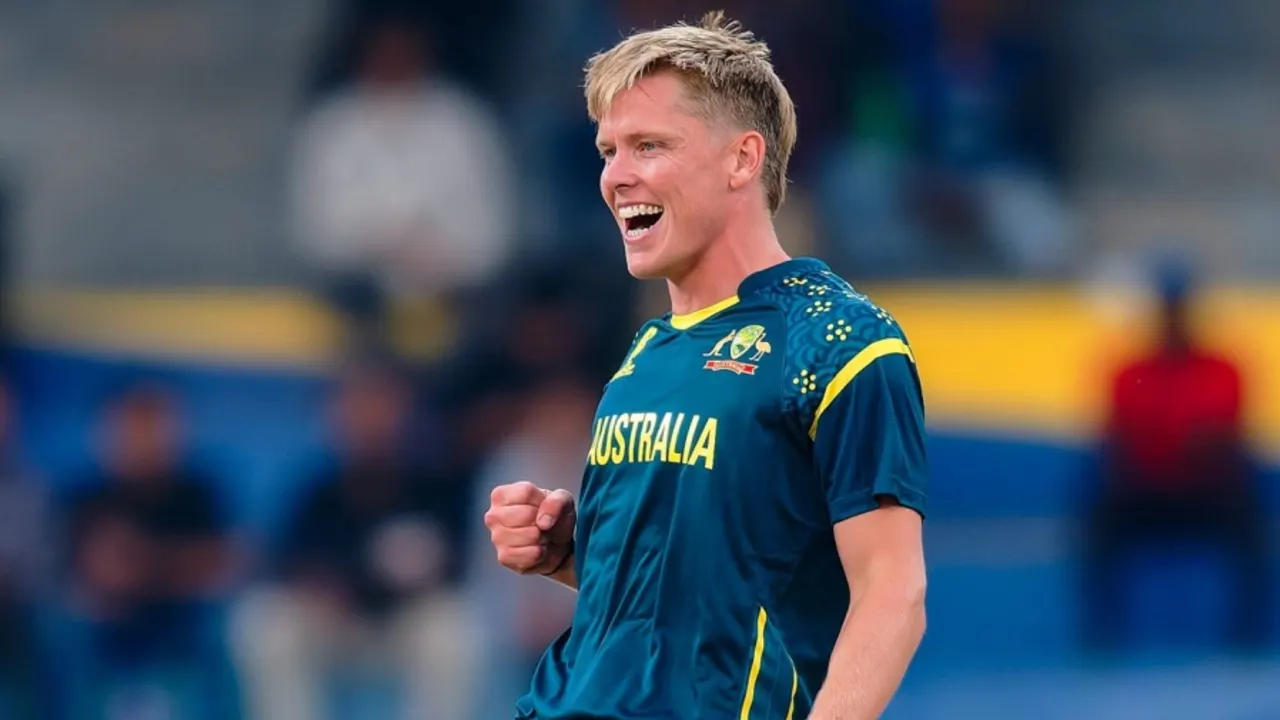
Without their captain, and down to 12 available players, Australia overcame what could have been an awkward start to their T20 World Cup campaign with an impressive all-round display as they downed Ireland by 67 runs in Colombo in a performance that showed their batting is not all about blasting sixes.
It was a dramatic build-up to the game for Australia – the last team to start the tournament – when it was announced 15 minutes before the toss that captain Mitchell Marsh was unavailable due to a testicular injury caused when he was struck in the groin while batting earlier in the week.
Travis Head, therefore, captained Australia and because of the decision to give Tim David an extra couple of days in his recovery from a hamstring injury, and no replacement for Josh Hazlewood having yet been named, it did not leave much for the selectors to choose from.
When Head was run out in the second over there was a chance it could have become a very tricky outing, but a stand of 49 between Josh Inglis and Cameron Green settled things then Matt Renshaw, who was a late addition to the squad, and Marcus Stoinis played excellently in a partnership of 61 off 44 balls to build a total of 182 on a tough, slow, gripping surface.
It was well out of reach for Ireland, who had hoped some familiarity with conditions may help after facing Sri Lanka at the same ground, but they folded for 115. They suffered a huge blow when Pul Stirling retired hurt first ball after hobbling through for a single and the top order was picked apart by Nathan Ellis.
Head was given a life in the first over when he cut Matthew Humphreys to backward point where Ben Calitz put down a low chance. Ireland had dropped seven chances against Sri Lanka and it was an ominous start. However, this one did not cost them as a horrid mix-up led to Head being run out. It added to a sense of unease around Australia, but that didn’t last for long.
Inglis and Green took the attack during the fielding restrictions and Australia were quickly scoring above ten an over. The duo struck a six apiece in the fifth over against Mark Adair – although Inglis’ was nearly a parried boundary catch by Gareth Delany who had just touched the rope with his foot – before Green picked out midwicket.
Inglis followed the over after the powerplay, driving George Dockrell to cover, but the early flurry of boundaries had earnt Australia the ability not to have to force things too hard. Still, with Glenn Maxwell’s lean run continuing when as he edged Harry Tector behind – Lorcan Tucker taking a sharp catch – Australia were 88 for 4 in the tenth over and, with an out-of-form Cooper Connolly then the bowlers to come, a vital stand loomed.
Renshaw’s elevation to the squad in place of Matt Short had been with these exact conditions in mind. He and Stoinis, not a batter often associated with working the ball around, quickly assessed it was not a surface on which to blast the side out of a tricky situation. They tried to keep dot balls to a minimum and ran hard: Australia tallied 22 twos for the innings.
Renshaw waited 28 balls to find the boundary when he drove Dockrell through the covers. Stoinis had found the rope twice in three balls against Tector in the 12th over, but they were a rare breed. It wasn’t until the 18th over, when pace was back in the attack, that the ball cleared the rope again when Stoinis launched Adair over deep midwicket. Three balls earlier, Stoinis had been dropped by Delany in the covers. Adair did remove Stoinis with a low full toss, but Australia were able to cross 180
Ireland needed to replicate Australia’s powerplay burst but instead had to watch their captain limp back to the dugout after the first ball of the innings. He jabbed a full delivery from Xavier Bartlett to the on side and a couple of steps after setting off was in clear pain, barely able to make it to the other end. Ross Adair was dropped by Renshaw, a simple chance at point, in the second over, but Harry Tector lofted Matt Kuhnemann into the deep where the catch was safely held by Green.
Then Ellis, who is the senior member of Australia’s remaining pace attack, showed his bag of tricks. His first delivery was a back-of-the-hand slower ball which completely bamboozled Ross Adair who played all round it and lost middle stump. It was pace-bowling deception at its best.
Two balls later, Curtis Campher pulled to midwicket and the wheels were coming off. At the start of Ellis’ next over, Calitz dragged into leg stump and inside the powerplay his figures red 2-1-5-3. Adam Zampa then did his job, working through the middle and lower order with four wickets, but fittingly it was Ellis who ended the match to finish with a career-best haul.
Brief scores:
Australia 182 for 6 in 20 overs (Marcus Stoinis 45, Jos Inglis 37,Cameron Green 21, Matt Renshaw 37, Cooper Conolly 11*, Xavier Bartlett 11*; Mathew Humphreys 1-33, Mark Adair 2-44, George Dockrell 1-31, Harry Tector 1-24 ) beat Ireland 115 in 16.5 overs (Ross Adair 12, Lorcan Tucker 24, Gareth Delany 11, George Dockrell 41, Mark Adair 12; Maththew Khunemann 1-29, Nathan Ellis 4-12, Adam Zampa 4-23) by 67 runs
[Cricinfo]

Sei Lanka, minus Hasaranga, take on Oman at bogey venue

Showers will occur at times in the Central, Uva, Eastern, Northern and North-central provinces and in Hambantota district

SLPP MP killing: 12 Aragalaya activists sentenced to death

Over one million Lankan devotees venerate sacred relics

Flooded Chemmani mass grave cleared amidst persistent rain

‘Structural constraints on SA media undermined prospects for regional amity – Himal Southasian Editor

‘Dates have the highest sugar content to fight Coronavirus’

Sunday Island 27 December – Headlines

#SundayIsland 17th December – Headlines

Sunday Island – 28th March

Sunday Island Headlines – 21 March

Sunday Island – 21st February – Headlines
-

 Features4 days ago
My experience in turning around the Merchant Bank of Sri Lanka (MBSL) – Episode 3
-

 Business5 days ago
Zone24x7 enters 2026 with strong momentum, reinforcing its role as an enterprise AI and automation partner
-

 Business4 days ago
Remotely conducted Business Forum in Paris attracts reputed French companies
-
 Business4 days ago
Four runs, a thousand dreams: How a small-town school bowled its way into the record books
-

 Business4 days ago
ComBank and Hayleys Mobility redefine sustainable mobility with flexible leasing solutions
-

 Business1 day ago
Autodoc 360 relocates to reinforce commitment to premium auto care
-

 Business5 days ago
HNB recognized among Top 10 Best Employers of 2025 at the EFC National Best Employer Awards
-

 Business5 days ago
GREAT 2025–2030: Sri Lanka’s Green ambition meets a grid reality check