
News
Govt. vows to overhaul loss-making national airline


(AFP) President Anura Kumara Dissanayake vowed Friday to overhaul the country’s loss-making national airline after the government failed to find a buyer, in line with commitments under an IMF bailout.
Successive administrations have sought to sell SriLankan Airlines, which has been burdening the state budget, but Dissanayake told parliament there had been “no takers” despite sustained efforts to attract a foreign buyer.
The International Monetary Fund (IMF) granted a $2.9 billion bailout loan to Sri Lanka in 2023 and had insisted that loss-making state enterprises, including the carrier, should be restructured or sold to ease the strain on public finances.
The carrier, with accumulated losses nearing $2 billion by the end of March 2025, still has an outstanding $175 million sovereign-guaranteed bond awaiting rescheduling.
Dissanayake said the process was expected to be completed by year’s end.
“We will also restructure the management of SriLankan Airlines early next year,” Dissanayake told parliament while unveiling the 2026 budget for the country, which is emerging from its worst economic meltdown in 2022.
He said the management has been asked to formulate a credible business plan to salvage the carrier.
“Should the taxpayers carry the huge burden of SriLankan Airlines?” he asked, warning that if the reforms failed “alternative action” would follow, without elaborating.
The country defaulted on its $46 billion foreign debt in April 2022 after running out of foreign exchange.
The government was on track to resume repaying its own commercial external debt from 2028, thanks to better-than-expected export earnings and remittances, Dissanayake said.
He also proposed reducing the government’s borrowing limit by $200 million next year as the country’s debt burden is expected to gradually decline in the short term.
The IMF has said Sri Lanka’s reforms are paying off, but the country should maintain the momentum amid the “heightened downside risks” posed by global trade uncertainties.
Sri Lanka’s 2022 economic crisis led to months of street protests that eventually toppled then-president Gotabaya Rajapaksa.
The World Bank has warned that Sri Lanka’s recovery remains “uneven and incomplete”, with many households yet to regain livelihoods lost during the 2022 crisis.
by Amal Jayasinghe ✍️






Family sources have confirmed that the interment of singer Latha Walpola will be performed at the General Cemetery Borella on Wednesday (31 December).

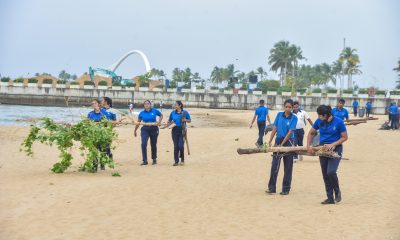
In an environmental initiative commemorating the 75th anniversary of the Sri Lanka Navy, the Western Naval Command organized a cleanup programme at Galle Face Beach on Saturday (27 Dec 25).
The programme focused on the removal of substantial solid waste littering the beachfront, including accumulated plastic and polythene debris. All collected wastey was systematically disposed of utilizing methods designed to safeguard the sensitive coastal ecosystem.
Demonstrating a strong commitment to the cause, the cleanup effort saw the participation of the Commander Western Naval Area and a group of over 200 naval personnel.

Sri Lanka’s environmental protection framework is rapidly eroding, with weak law enforcement, politically driven development and the routine sidelining of environmental safeguards pushing the country towards an ecological crisis, leading environmentalists have warned.
Dilena Pathragoda, Managing Director of the Centre for Environmental Justice (CEJ), has said the growing environmental damage across the island is not the result of regulatory gaps, but of persistent failure to enforce existing laws.
“Sri Lanka does not suffer from a lack of environmental regulations — it suffers from a lack of political will to enforce them,” Pathragoda told The Sunday Island. “Environmental destruction is taking place openly, often with official knowledge, and almost always without accountability.”
Dr. Pathragoda has said environmental impact assessments are increasingly treated as procedural formalities rather than binding safeguards, allowing ecologically sensitive areas to be cleared or altered with minimal oversight.
“When environmental approvals are rushed, diluted or ignored altogether, the consequences are predictable — habitat loss, biodiversity decline and escalating conflict between humans and nature,” Pathragoda said.
Environmental activist Janaka Withanage warned that unregulated development and land-use changes are dismantling natural ecosystems that have sustained rural communities for generations.
“We are destroying natural buffers that protect people from floods, droughts and soil erosion,” Withanage said. “Once wetlands, forests and river catchments are damaged, the impacts are felt far beyond the project site.”
Withanage said communities are increasingly left vulnerable as environmental degradation accelerates, while those responsible rarely face legal consequences.
“What we see is selective enforcement,” he said. “Small-scale offenders are targeted, while large-scale violations linked to powerful interests continue unchecked.”
Both environmentalists warned that climate variability is amplifying the damage caused by poor planning, placing additional strain on ecosystems already weakened by deforestation, sand mining and infrastructure expansion.
Pathragoda stressed that environmental protection must be treated as a national priority rather than a development obstacle.
“Environmental laws exist to protect people, livelihoods and the economy,” he said. “Ignoring them will only increase disaster risk and long-term economic losses.”
Withanage echoed the call for urgent reform, warning that continued neglect would result in irreversible damage.
“If this trajectory continues, future generations will inherit an island far more vulnerable and far less resilient,” he said.
Environmental groups say Sri Lanka’s standing as a biodiversity hotspot — and its resilience to climate-driven disasters — will ultimately depend on whether environmental governance is restored before critical thresholds are crossed.
By Ifham Nizam ✍️

Myanmar votes as military holds first election since 2021 coup

Interment of singer Latha Walpola at Borella on Wednesday [31st]

Western Naval Command conducts beach cleanup to mark Navy’s 75th anniversary

Ex-Malaysia PM Najib Razak given 15-year jail term over state funds scandal

Two dead in 50-vehicle pile up on Japan highway

New York blanketed in snow, sparking travel chaos

‘Dates have the highest sugar content to fight Coronavirus’

Sunday Island 27 December – Headlines

#SundayIsland 17th December – Headlines

Sunday Island – 28th March

Sunday Island Headlines – 21 March

Sunday Island – 21st February – Headlines
-

 News6 days ago
Members of Lankan Community in Washington D.C. donates to ‘Rebuilding Sri Lanka’ Flood Relief Fund
-

 News4 days ago
British MP calls on Foreign Secretary to expand sanction package against ‘Sri Lankan war criminals’
-

 News7 days ago
Air quality deteriorating in Sri Lanka
-

 News7 days ago
Cardinal urges govt. not to weaken key socio-cultural institutions
-

 Features6 days ago
General education reforms: What about language and ethnicity?
-

 Opinion7 days ago
Ranwala crash: Govt. lays bare its true face
-
 News6 days ago
Suspension of Indian drug part of cover-up by NMRA: Academy of Health Professionals
-

 News7 days ago
CID probes unauthorised access to PNB’s vessel monitoring system