
News
Govt can secure electronic evidence Foreign Service providers-Foreign Ministry


Lanka signs Second Additional Protocol to the Convention of Cybercrime
In terms of the Second Additional Protocol to the Convention of Cybercrime Sri Lanka is now in a position to secure electronic evidence from Foreign Service providers for Cybercrime related investigations and prosecutions.
Sri Lanka is the first South Asian country to join the Budapest Cybercrime Convention of 2015, as well as the first to sign the Second Additional Protocol to the Budapest Cybercrime Convention on Enhanced Cooperation and Disclosure of Electronic Evidence.
Ambassador Grace Asirwatham has signed the Second Additional Protocol to the Convention on Cybercrime on Enhanced Cooperation and Disclosure of Electronic Evidence of the Council of Europe at a Treaty Ceremony held on Nov. 30 at the Council of Europe in Strasbourg, in the presence of Deputy Secretary General of the Council of Europe Bjorn Berge, Head of Protocol, Head of Treaty Office, and delegates to the 27th Plenary Meeting of the T-CY. Sri Lanka’s delegate to T-CY, Jayantha Fernando, Director of Sri Lanka CERT and the General Counsel of the ICT Agency of Sri Lanka, also attended the ceremony.
The Cabinet of Ministers has approved on 29 November 2022, a joint Cabinet Memorandum submitted by the Ministry of Foreign Affairs and the Ministry of Justice, Prison Affairs, and Constitutional Reforms recommending Sri Lanka sign the Second Additional Protocol to the Convention on Cybercrime on Enhanced Cooperation and Disclosure of Electronic Evidence. It enables Sri Lanka to secure electronic evidence from Foreign Service providers for Cybercrime related investigations and prosecutions. It also includes new human rights safeguards with additional provisions on data protection which provides for more effective responses to Cybercrime challenges globally.
Ambassador Asirwatham delivering a statement at the event, stated that “the lessons learned during the negotiation of the 2nd Additional Protocol to the Budapest Convention helped Sri Lankan experts to formulate and enact the first Data Protection Legislation in South Asia, through Act, No.9 of 2022”, noting that Sri Lanka’s Data Protection Act provisions are in line with the 2nd Additional Protocol. She also appreciated the support extended to Sri Lanka by the Council of Europe through capacity-building programs under the Global Action Against Cybercrime (GLACY) project, funded by the Council of Europe and the European Union, and reiterating Sri Lanka’s commitment to work closely with the Council of Europe and the States Parties to the Convention on Cybercrime to achieve the goals of the Convention.



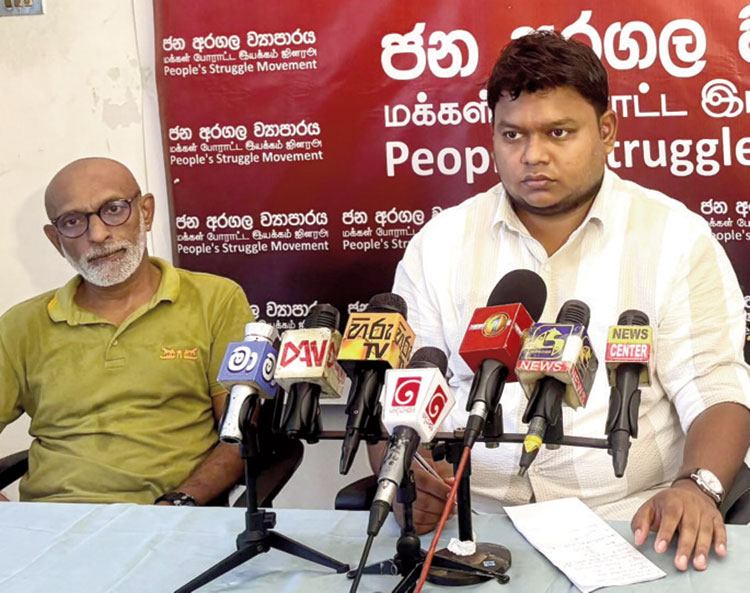
The Frontline Socialist Party-backed People’s Struggle Movement is set to stage a protest march in Colombo today (03) against what it describes as the growing tax burden on the public and the rising cost of living.
The organisers are due to commence the “Colombo March Against Unjust Taxes” at noon from Campbell Park, Borella. The FSP has also been mobilising support for the protest in Colombo and its suburbs in the run-up to the event.
People’s Struggle Movement National Executive Council member Wasantha Mudalige, speaking at a media briefing in Nugegoda yesterday (02), called on the public to join the protest, saying the movement intended to bring the tax burden faced by ordinary people to the forefront.
Mudalige alleged that successive tax measures had placed an excessive burden on households, particularly through taxes on food and educational items. He also criticised the Government over what he described as the high cost of basic food items and the difficulties faced by parents in meeting their children’s educational expenses.
He accused the Opposition of failing to adequately address the issue, claiming that opposition parties raised such concerns, mainly during election periods.
Mudalige also criticised the Government for what he described as a departure from promises made before the 2024 presidential election regarding taxes on educational equipment.
He questioned the tax burden on food items, citing figures of Rs. 100 per kilogramme on dried sprats, Rs. 310 per kilogramme on chicken and Rs. 11 per egg.
He further alleged that while ordinary people were bearing a heavy tax burden, wealthy groups were receiving tax concessions. He also criticised the Government’s economic programme and its implementation of measures associated with the International Monetary Fund (IMF).
The movement has framed today’s protest as part of a broader campaign over the cost of living and taxation. The People’s Struggle Alliance has separately announced that the Campbell Park demonstration will be the first in a series of public actions, with further protests planned in November.
Mudalige said the movement would continue to take the issue to the streets and urged the public to participate in today’s demonstration.
People’s Struggle Movement National Executive Council member Jayantha Amarasinghe also addressed the press.
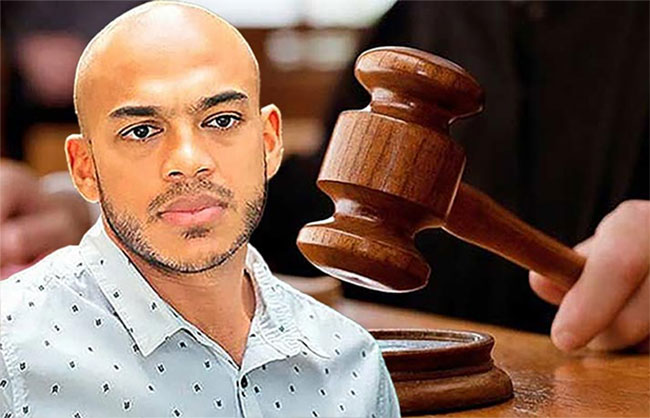
The Colombo High Court yesterday postponed the trial in the case filed under the Prevention of Money Laundering Act against Yoshitha Rajapaksa, son of former President Mahinda Rajapaksa.
The case was taken up before Colombo High Court Judge Udesh Ranatunga, with Yoshitha Rajapaksa, who is currently out on bail, appearing in court.
The trial was postponed as the President’s Counsel appearing for the defence was indisposed.
The Attorney General has filed the case against Rajapaksa, alleging that he committed an offence under the Prevention of Money Laundering Act by purchasing five plots of land in Dehiwala and Ratmalana, worth more than Rs. 73 million.
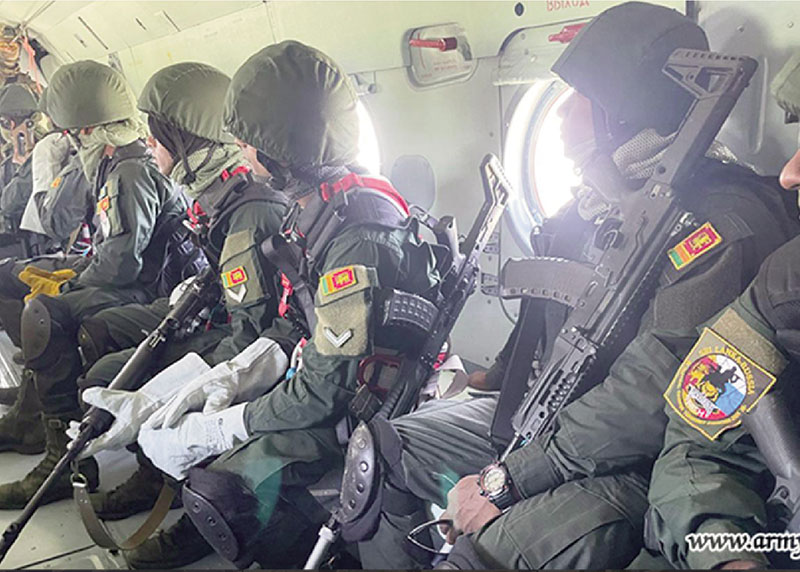
A contingent of the Sri Lanka Army, comprising 20 officers and 55 other ranks, participated in the combined military exercise ‘Wolverine Path II–2026’, conducted with the Armed Forces of the Russian Federation in Vladivostok, Russia, from September 18 to 25.
According to the Ministry of Defence, the exercise primarily focused on counter-terrorism operations and provided participating troops with training in a challenging combined operational environment.
The exercise included a range of tactical activities, including heli-rappelling, close-quarters battle (CQB), ambush operations, sniper firing, drone operations, buggy training and combat medical support.
The Ministry said the training enabled Sri Lankan troops to further develop their combat skills, tactical coordination and operational readiness.
It also provided an opportunity for the two militaries to exchange professional knowledge, operational experience and tactical expertise. Sri Lankan personnel gained exposure to training methodologies, tactical approaches and operational practices adopted by the Russian Armed Forces, the Ministry said.
The participation also enabled the Sri Lankan contingent to identify lessons from the joint training and share its own experiences with the Russian military.
The Sri Lankan contingent returned to the country following the exercise and arrived at Mattala Rajapaksa International Airport on September 28.
The Ministry said participation in the exercise contributed to enhancing the professional knowledge, tactical awareness and operational preparedness of Army personnel while promoting military-to-military cooperation, mutual understanding and professional relations between Sri Lanka and Russia.

Turkish court detains football refereeing chief pending corruption trial

Ten injured after car crashes into rugby supporters in Australia

Polls open in Latvia against backdrop of perceived Russia threat

Abhishek, Tilak and spinners secure gold for India at Asian Games again

Tharindu Rathnayake, bowlers secure Asian Games Bronze for Sri Lanka

G7 to release 100 million barrels of oil and diesel after Trump export ban threat

‘Dates have the highest sugar content to fight Coronavirus’

Sunday Island 27 December – Headlines

#SundayIsland 17th December – Headlines

Sunday Island – 28th March

Sunday Island Headlines – 21 March

Sunday Island – 21st February – Headlines
-

 News6 days ago
Police remove Thileepan statue in Jaffna
-

 Features6 days ago
The 22nd Amendment, constitutional recovery and illiberal slippage
-

 Features6 days ago
Of foreigners as CEOs of Lankan ventures
-

 Latest News4 days ago
Gold winner Tharanga gets brand-new Honda Vezel from SLAAJ
-

 News6 days ago
Sajith rejects Jt. Opp. protest sabotage claim; SJB TU chief demands remedial action
-

 Features4 days ago
Why Sri Lanka needs an Inclusive Civic Nationalism – urgently
-

 Features5 days ago
Thailand’s biggest new global star …
-

 News3 days ago
US-assisted ‘Ice’ detection: NPC to examine IGP’s move to transfer drug-busting team