
News
Govt. accused of giving Indian companies access to Lankans’ biometrics

By Rathindra Kuruwita
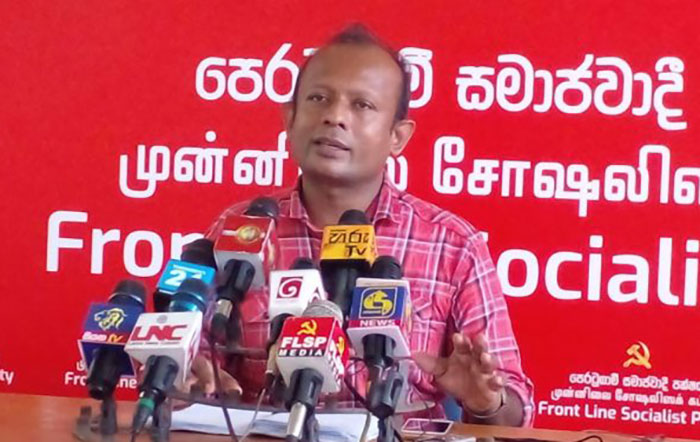
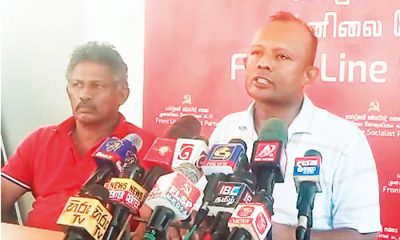
The Frontline Socialist Party (FSP) on Sunday (11) flayed the government for having agreed to grant some Indian companies access to the biometrics of Sri Lankans under the proposed Unitary Digital Identity Framework project.
FSP Education Secretary Pubudu Jayagoda said the High Commissioner of India to Sri Lanka, Santosh Jha had, on 01 February, told the media that an Indian company would print national identity cards with biometric features soon. Jayagoda said there were some issues in the bids made by Indian companies in 2023, but they would be sorted out by mid-2024.
In 2023, the Indian government provided 450 million Indian rupees for the implementation of the Unitary Digital Identity Framework project in Sri Lanka. According to the Memorandum of Understanding (MoU) the vendor should be an Indian company.
The Sri Lankan government called for tenders to select a service provider, but the two Indian companies were disqualified because they were not able to comply with basic criteria.
Jayagoda said: “The ID cards we use now have bio-data like name, date of birth, etc. In 2015, the Registration of Persons Act was changed to allow the issuance of an ID with biometrics.
When this act was amended, only one MP opposed it. We don’t think that the state has the right to access biometrics without a court order. This harks back to the time of kings, when rulers owned the physical bodies of their subjects,” he said.
Jayagoda said that the issue of collecting biometrics had national security implications.
“This started during the Gotabaya Rajapaksa administration. In July 2021, criteria were prepared for a new electronic national identity card. On 28 January 2022, the Cabinet approved Gotabaya Rajapaksa’s Cabinet paper seeking approval to award the digital identification card project to an Indian company. This opened doors for India to step in. On 08 May 2023, the Ranil-Rajapaksa government called for tenders for the project that was only open for Indian companies. The entire project costs 41.09 billion rupees. India will only give about 22 billion rupees and will get access to the biometrics of 22 million Sri Lankans. What an amazing deal for India,” Jayagoda said.
Madras Security Printers (MSP) and Protean Technologies were the Indian companies that offered bids. MSP, who has been blacklisted in India as well as in several other countries, nearly got the tender.
“The project did not get off the ground due to public outrage. Now tenders will be called again. No matter what Indian company wins, this will give access to invaluable data to a foreign state. This is a great threat to national security. No other country has given access to the biometrics of its people to a foreign country.”
Jayagoda said a country like Singapore, which collects biometrics, has gone to great lengths to prevent access to data for private or foreign companies. In the 21st century, data and information are tools that can be used to dominate other states.
“We urge people to not give their biometrics to any foreign company,” he said.










In terms of the provisions of the Establishments Code on payment of festival advance to government officers, there’s a possibility of obtaining rupees 10,000/- as an advance for celebrating festivals of Theipongal, Ramazan, Sinhala and Hindu New Year, Wesak, Deepavali, and Christmas as well as for pilgrimages (Sri Paada pilgrimage and Hajj pilgrimage).
Provisions have been given to recover the said advance in 08 installments or if required earlier without interest. It has been proposed by the Budget 2026 to increase the said festival advance up to rupees 15,000/-.
Accordingly, the Cabinet of Ministers granted approval to the proposal submitted by the Minister of Public Administration, Provincial Councils and Local governments to revise the relevant provisions so that the festival advance can be increased up to rupees 15,000/- .
As per the approval given by the cabinet meeting held on 02-06-2025, action is being taken at present to offer the underutilized lands/properties of the Sri Lanka State Plantation Corporation, the Janatha Etate Development Board, and the Elkaduwa Plantation Company which are under the Ministry of Plantation and Community Infrastructure which have been identified under stage one to suitable investors.
Accordingly, the Cabinet of Ministers has approved the proposal presented by the Minister of Plantations and Community Infrastructure to provide following lands/properties on a lease basis to the suitable investors for optimal utilization following the prescribed procurement procedure.
• underutilized lands/properties identified under stage two owned by the Sri Lanka State Plantation Corporation, the Janatha Estate Development Board, and the Elkaduwa Plantation
Company,
• The Mawarala watte land and the Tea factory 40.48 hectares in extent, located in Matara District belonging to the Tea Shakthi Fund.
• The underutilized land of 1,541 hectares in extent of Kondachchi Estate is enjoyed by the Sri Lanka Cashew Corporation.
The drafting of the National Fisheries and Aquaculture Policy has commenced with the objective of equitable distribution of the benefits of the fisheries industry and the sustainable management of fisheries and aquaculture. This policy has been updated from time to time according to current requirements. However, steps have not been taken to obtain the approval of the Cabinet of Ministers for that purpose.
According to the policy declaration of the present government, ‘Vistas of Prosperity and Splendor’ the National Fisheries and Aquaculture Policy has been redrafted, updating the aforementioned policy in line with the economic and development objectives of the government.
The recommendations of the Department of National Planning have been received for the drafted policy.
Accordingly, the Cabinet of Ministers has approved the proposal presented by the Minister of Fisheries, Aquaculture, and Marine
Resources to implement the National Fisheries and Aquaculture Policy, integrating it with other relevant policies.

Lanka Premier League draft set to take place on March 22

Trump to meet Venezuelan opposition leader Machado at the White House

Festival advance for government officers to be increased
Providing underutilized lands/properties to suitable investors for optimal utilization.
Implementation of the National Fisheries and Aquaculture Policy

Expressions of Interest called to develop selected locations within the Pelawatte Sugar Factory premises

‘Dates have the highest sugar content to fight Coronavirus’

Sunday Island 27 December – Headlines

#SundayIsland 17th December – Headlines

Sunday Island – 28th March

Sunday Island Headlines – 21 March

Sunday Island – 21st February – Headlines
-

 News3 days ago
Sajith: Ashoka Chakra replaces Dharmachakra in Buddhism textbook
-

 Business3 days ago
Dialog and UnionPay International Join Forces to Elevate Sri Lanka’s Digital Payment Landscape
-

 Features3 days ago
The Paradox of Trump Power: Contested Authoritarian at Home, Uncontested Bully Abroad
-

 Features3 days ago
Subject:Whatever happened to (my) three million dollars?
-

 News3 days ago
Level I landslide early warnings issued to the Districts of Badulla, Kandy, Matale and Nuwara-Eliya extended
-

 News3 days ago
National Communication Programme for Child Health Promotion (SBCC) has been launched. – PM
-

 News3 days ago
65 withdrawn cases re-filed by Govt, PM tells Parliament
-

 Opinion5 days ago
The minstrel monk and Rafiki, the old mandrill in The Lion King – II