
News
Govt. accused of facilitating exploitation of paddy farmers

by Norman Palihawadane and Anuradha Hiripitiyage
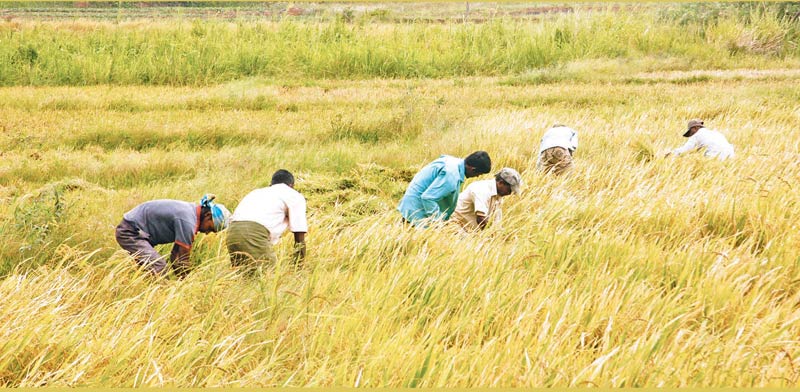
Farmers’ associations and political parties are flaying the government for its failure to set a certified price for paddy and leaving small-scale farmers vulnerable to exploitation by powerful rice millers.
Both the National Freedom Front (NFF) and the Frontline Socialist Party (FSP) have blamed the government for prioritising the interests of the big-time millers over those of struggling farmers.
The NFF has accused the government of deliberately withholding a minimum price for paddy as a favour to millers who allegedly supported the ruling party during elections.
Karunathilaka Herath, leader of the NFF’s Farmers’ Wing, said, “President Anura Kumara Dissanayake claims to be the son of a farmer, but he has failed to offer a solution to the paddy crisis. The government has bowed not only to multinational corporations but also to five leading millers in the country.”
Herath said that the government had reneged on its campaign promise to support the agricultural sector. “A few months have passed since the government was formed, but farmers have been left to fend for themselves, just as they were under previous administrations. Paddy harvesting has already begun, but farmers are without a proper price for their produce. Prices vary widely from district to district, leaving farmers uncertain and desperate,” he said.
The Frontline Socialist Party’s Farmers’ Struggle Movement (FSM) said that the current system benefited millers disproportionately at the expense of farmers.
Addressing the media at the FSP headquarters, in Nugegoda, FSM National Organizer Vimal Wathtuhewa said: “Paddy harvesting is underway in key agricultural districts like Ampara, Batticaloa, Monaragala, Trincomalee, and Hambantota, but the government has failed to announce a guaranteed price. Mill owners are taking advantage of this and setting prices arbitrarily, leaving farmers with significant losses.”
Wathtuhewa said that the government’s allocation of Rs. 500 million for purchasing paddy, was inadequate to meet even four days’ worth of national rice consumption. Claiming that President Anura Kumara Dissanayake had attributed the rice shortage to ‘data distortions’, Waththuhewa argued that the real issue was due to flawed decision-making and the government’s reliance on inaccurate data.
“Even with adverse weather damaging approximately 40,000 hectares, Sri Lanka can still produce around three million metric tons of rice annually, and that amount is enough to meet the country’s annual consumption requirement of 2.4 million metric tons. The idea that data distortions caused the rice shortage is misleading,” he said.
“Five major mill owners collectively release 1.2 million kilos of rice daily into the market, while the national daily rice consumption is 6.5 million kilos. If these mill owners withheld rice for just four to five days, it would create a severe food crisis,” he said.
Both Herath and Wathtuhewa called on the government to act immediately to protect farmers and ensure food security.
“The government was elected to serve the people, not a handful of powerful mill owners. It’s time to address the real issues and ensure farmers receive a fair price for their paddy,” Wathtuhewa said.

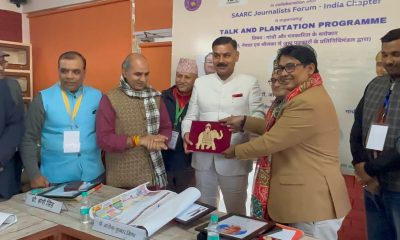


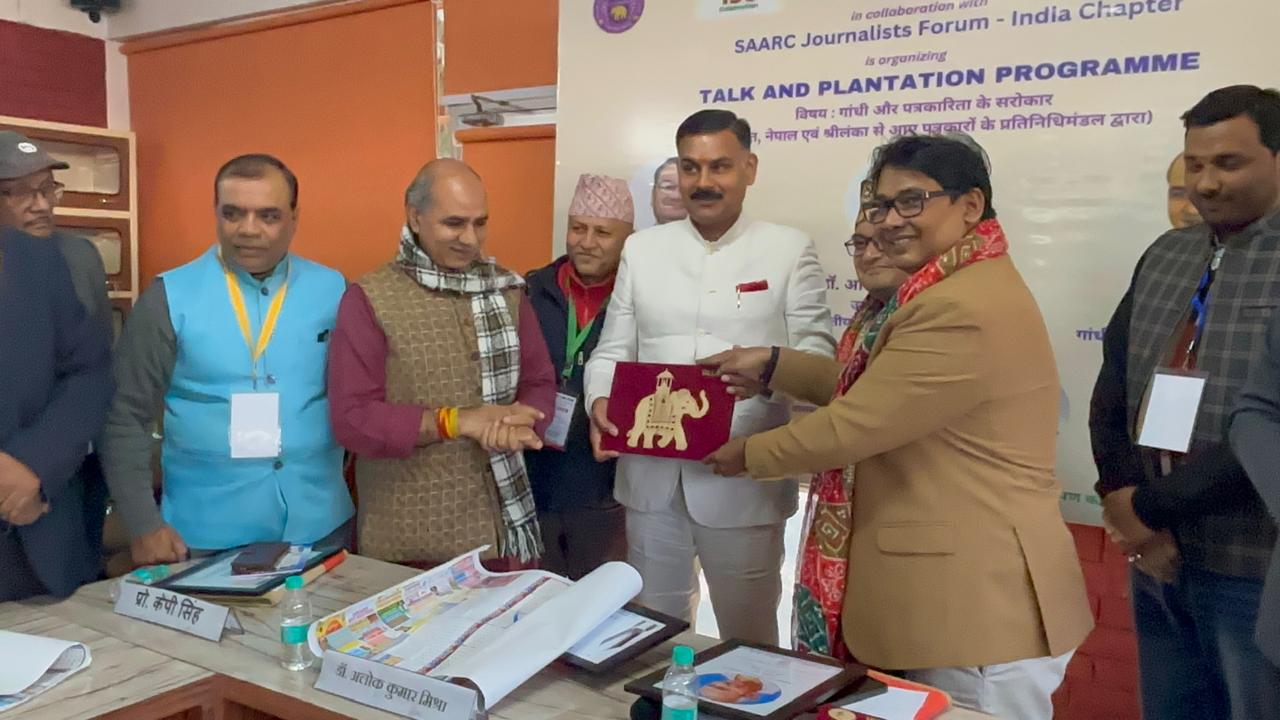
Members of the South Asian Journalists Forum have gathered at the University of New Delhi for a two day conference themed ‘Peace and Co-operation’.
Journalists from Bangladesh, Nepal, Sri Lanka and India are attending the conference hosted by the University of Delhi in collaboration with the India Chapter of SJF, and will deliberate on how the media can act as a catalyst for regional stability and mutual coexsistence.
A tree plantation campaign was also held at the Ghandi Bhawan premises of the University to mark the event and symbolize growing regional ties.
The Sri Lanka delegation is led by President of SJF’s Sri Lanka Chapter Rahul Samantha Hettiarachchi.

The Governor of the of Gujarat, Acharya Devvrat, along with the Deputy Chief Minister of Gujarat, Harsh Sanghvi, met with Prime Minister Dr. Harini Amarasuriya on Thursdy [February 05] at the Parliamentary Complex to discuss the arrangements related to the exposition of the Devnimori Sacred Relics of Lord Buddha, which have been brought to Sri Lanka under the patronage of Indian Prime Minister Narendra Modi and the Government of India.
These sacred relics of Lord Buddha were discovered during archaeological excavations conducted in the 1960s at the historic Devnimori site in Gujarat, the home state of Indian Prime Minister Narendra Modi. Until now, these relics had never been taken outside India. As a result of discussions held between President Anura Kumara Dissanayake and Indian Prime Minister Narendra Modi during his recent visit to Sri Lanka, the people of Sri Lanka have been granted this rare opportunity to venerate these sacred relics.
The exposition of the relics is being held for a period of seven days, from February 05 to February 11, at the Gangaramaya Temple in Hunupitiya, Colombo. Discussions were held between both parties regarding the arrangements related to this event.
The discussion was attended by Samar Nanda, Joint Secretary of the Indian Ministry of Culture; Dr. Satyanjal Pandey, Acting High Commissioner of India in Sri Lanka; Abhijit Halder, Director General of the International Buddhist Confederation; along with several others.
[Prime Minister’s Media Division]

The Indian Naval Ship (INS) GHARIAL made a port call in Colombo for operational turnarounds on 04 Feb 26. The Sri Lanka Navy welcomed the visiting ship in compliance with naval traditions.
Commanded by Commander Gaurav Tewari, INS GHARIAL is a vessel with a length of 124.8 meters.
During this visit, ten (10) Bailey Bridges, brought by ship, through the coordination of the High Commission of India in Sri Lanka, will be handed over to the Disaster Management Center. These bridges will provide temporary transportation links while bridges damaged across the island by adverse weather conditions are repaired.
The crew’s itinerary features scheduled goodwill activities with the Sri Lanka Navy, alongside visits to several tourist attractions across the island.

The SSC finally steps out of the sunshine and into the floodlights

SAARC journalists meet in New Delhi

Governor of Gujarat met with Sri Lanka PM to discuss exposition of Devnimori Relics

India chase sixth Under-19 World Cup title, England their first since 1998

Meet the women protecting India’s snow leopards

Louvre Museum crown left crushed but ‘intact’ after raid

‘Dates have the highest sugar content to fight Coronavirus’

Sunday Island 27 December – Headlines

#SundayIsland 17th December – Headlines

Sunday Island – 28th March

Sunday Island Headlines – 21 March

Sunday Island – 21st February – Headlines
-

 Business6 days ago
Hayleys Mobility ushering in a new era of premium sustainable mobility
-

 Business3 days ago
SLIM-Kantar People’s Awards 2026 to recognise Sri Lanka’s most trusted brands and personalities
-
 Business6 days ago
Advice Lab unveils new 13,000+ sqft office, marking major expansion in financial services BPO to Australia
-
 Business6 days ago
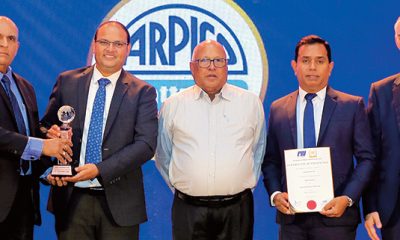
Arpico NextGen Mattress gains recognition for innovation
-

 Business5 days ago
Altair issues over 100+ title deeds post ownership change
-

 Editorial6 days ago
Govt. provoking TUs
-

 Business5 days ago
Sri Lanka opens first country pavilion at London exhibition
-

 Business4 days ago
All set for Global Synergy Awards 2026 at Waters Edge