
Business
‘Golden Memories & Sensational Melodies’ – A Tribute to Legacy and Charity


Continued from yesterday
My father was very skeptical about politics and politicians, and dissuaded him about it and anyway told him, don’t go into politics unless you’re financially independent because you have to be your own master. That he listened to but his relatives in Jaffna said, if you do not speak Tamil and you have not lived here, you will not make it. So he threw himself into being a lawyer and of course, he was very successful.
Then came 1971, the insurrection, which rattled him. I am afraid, I think, I see President Kumaratunga in the audience, but I think of the squeeze economic policies of the times also made him realize that he could not succeed as an independent lawyer here. So he went back to England and those were, in some ways, years of exile for him till he went back to Geneva and was successful in the UN. But I know that this is not really just his life story that I’m recounting, but what he meant to us in the family, as an uncle, as a brother, as a brother-in-law, he had a very special place. I think what was special for us as children is that he saw us as adults and he would engage with us as adults.
I did notice that he was able to communicate with people, irrespective of class or religion or ethnicity. Maybe that was a trait he picked up in Trinity or it may have been his own ingrained personality, but he did manage to cross those worlds which I thought was very special. It is ironic and wonderful, in a way, that he realized his dream to go back into politics when President Kumaratunga asked him to join. At that time, I was very enthusiastic, but I thought he could be a bridge between Tamils and Sinhalese and also between the UNP and the SLFP, which was more hostile to each other than anything else but politics has a life of its own, I think. His own personal life was also such that he was now transiting into a different space in his life, that I think, in some ways, the man we knew and were very familiar with, to some extent, we lost him when the nation gained him. His move into politics really meant an end to the informal gatherings and moving and intellectual challenges that we were able to have with him, and I felt there was more of an isolation from him at that time.
But what are some of the takeaways that I think of with my uncle? I mean, on a personal level, I always thought that I was his favorite niece till I met my cousin who lived in America, who said, no, no, I thought I was his favorite niece. So I said, perhaps he had a way of making each one feel special, specially engaged but some things he reminded me, which I will remember. He did make a reference saying, I was emotionally detached after my mother died and I think that sort of helped, whether helped or hindered him, in the way he navigated life. He did not take things intensely personal. He also gave me a lesson in life when I told him I was going to wing it at some exam and he told me, nothing is ever winged.
You do not know how much hard work goes into making things look seamlessly effortless. So I realized that behind that, there was a very dedicated professional and I think that showed a lot, even in his interactions in Parliament and as a politician. Even today, if I get into an Uber or PickMe they see my name and they ask me whether I’m related to Lakshman Kadirgamar and mourn that the country doesn’t have politicians like him. I would remind them that when President Kumaratunga wanted him to be Prime Minister, people said he could not be Prime Minister because he is not a Sinhalese or a Buddhist and then they mourn it and say, we should have gone with that. So, this is the time that I’m going to pass on to Dayan. So where I finish with my own memories of him as an uncle and what he meant to us in our family and Dayan, you now take over with the Foreign Minister….”
Dr. Dayan Jayatilleka :
“…Lakshman Kadirgamar be friended me after the death of his friend, my father, Mervyn de Silva. I think it was at some event when he had suddenly turned around, he told me, he suddenly turned around because he had heard a laugh just like Mervyn’s and it happened to be me because he knew Mervyn had died, and he did not know who it was. So that’s how we got to know each other personally. My father, Mervyn, and Lakshman Kadirgamar had been students together at university and Law College. When Dr. Gamani Corea and Mervyn de Silva commenced the Foreign Affairs Study Group to review and restructure Sri Lanka’s foreign relations after the battle of the late 1980s, the airdrop and so on and so forth, the Foreign Affairs Study Group was then approached by President Premadasa who appointed Bradman Weerakoon, his Advisor on Foreign Affairs, to be a member of that group and to liaise with it. Mervyn invited his old friend, Lakshman Kadirgamar, who had come back to Sri Lanka after his stint at WIPO and inducted him into the FASG. That was his transition from international law to international relations and international politics. So after my father died, it was in 1999, Mr. Kadirgamar used to invite me. I don’t know whether his wife Sugandhi is in the audience, but if she were, she would confirm that he would send the car for me at 8 pm. The car brought me to his place and took me back at 3 am. He used to have this bottle of rum from the Caribbean, not Cuban, which he used to share with me and we used to discuss the problems of Sri Lankan politics at the time, in wartime. Very complex, the Norwegian negotiations, the ceasefire agreement of Prime Minister Ranil Wickremasinghe, the knock-on effects on our security in India. There were many, many complex problems, and he thought that somehow inviting me over for those long one-on-one chats was of some use.
Now, to move from the personal to Lakshman Kadirgamar’s thinking, which is what he leaves us, I think I was privy to that, not only through my conversations, but in the sense that all of us are, because he was a public person, and there’s nothing that he said in private that was at variance with his publicly held positions. I would go so far as to say that whenever we fret about the absence of Lakshman Kadirgamar, we should remember what he thought and did, and try to extract from that the principles concerned, which we may then apply and fight for in the political and intellectual arena today. Lakshman Kadirgamar did what was very difficult to do. He balanced antinomies, managed contradictions, reconciled and synthesized opposites, which is very, very difficult to do. He was a principled man who took principled positions on difficult matters, but did so while remaining perhaps the most civilized, cultured, cultivated, and charming personality in public life that we have seen for a very long time. His affability and his wit in no way were at the expense of principle.
Now, what are these issues, and of what relevance are they? I would say that the problems with which Lakshman Kadirgamar grappled are in one way or the other the same problems that we face today, and which will intensify in the new period in international affairs we have stepped into with, if I may say so, the second Trump administration. Now, Lakshman Kadirgamar reconciled the need for an autonomy-based or devolution-based political solution to what was known as the Tamil question or the question of the coexistence of the constituent communities of Sri Lanka, the one side of the equation, with the need for safeguarding national sovereignty, independence, and territorial integrity. Now, this was very difficult to do, because in Sri Lanka at that time, during wartime, you had a schism between the narrow nationalists who were opposed to devolution, just as they were opposed to peace; you had those who were for devolution, but were willing to engage in negotiations leading to policies which Kadirgamar considered to be those of appeasement, and which he opposed.
So, he proposed devolution; he made a brilliant speech when President Kumaratunga presented her August 2000 constitutional reform package, the draft constitution, a very impassioned plea to Parliament that it be supported. I was at his place, he had wanted me to come over, and when he came back from Parliament, he was crestfallen because Mr. Sambandan and the TULF, which had promised to support him, had let him down on the occasion. So he was very much for devolution, he never stopped being for an autonomy-based solution, but he was also very strongly, very firmly, opposed to the LTTE, and he was opposed to excessive unilateral concessions which he thought were being made by the Norwegian facilitators. He and President Kumaratunga tried to manage that by bringing in Vidar Helgesen and talking to the Norwegians and trying to change the mix at that end. So this is one issue, how one reconciles the need for autonomy with the need to safeguard the Sri Lankan state, and to resist any kind of secession.
Lakshman Kadirgamar was a very, very strong votary of national sovereignty, and he went to sort of a war of ideas on the matter. When Prime Minister Wickremasinghe signed the ceasefire agreement, Mr. Kadirgamar made a landmark speech in Parliament, and then sought its publication, and obtained it in the Sunday Times. The Foreign Ministry itself was not quite sure as to whether he should be more muted, so he brought, I think, either Mr. Sinha Ratnatunga or Iqbal Athas home, he told me he brought them home and said: this is the speech; here is my transcript. And it was published as a full page in the Sunday Times, making the point that the ceasefire agreement bore the danger of a division, of recognizing two territories in the country which could become a hard border.

Business
Sri Lanka’s apparel sector records 5.42% growth for January-November 2025: November slight dip


Sri Lanka’s apparel industry delivered a robust performance during the first eleven months of 2025, with cumulative exports reaching US$4,571.99 million marking a 5.42% increase over the same period last year, according to data released today by the Joint Apparel Association Forum (JAAF).
Sri Lanka’s total apparel exports for November 2025 reached US$367.60 million, representing a slight decrease of 1.96% compared to US$374.94 million in November 2024.
The monthly performance showed mixed results across key markets: United States: US$152.32 million (up 5.79% from US$143.98 million), European Union (excluding UK): US$119.61 million (up 3.35% from US$115.73 million), United Kingdom: US$43.63 million (down 13.83% from US$50.63 million), Other Markets: US$52.04 million (down 19.44% from US$64.60 million)
Strong cumulative performance: January-November 2025
Despite the November softness, cumulative apparel exports for the eleven-month period from January to November 2025 demonstrate solid growth, reaching US$4,571.99 million—a 5.42% increase over the corresponding period in 2024 (US$4,336.84 million).
Year-to-Date Performance by Market:
European Union (excluding UK): US$1,435.39 million (up 13.07%)
Other Markets: US$742.98 million (up 5.75%)
United States: US$1,769.08 million (up 1.73%)
United Kingdom: US$624.54 million (down 0.22%)
Commenting on the export data, JAAF stated “The 5.42% growth in our cumulative exports for the first eleven months of 2025 reflects the resilience and adaptability of Sri Lanka’s apparel sector in navigating a challenging global environment. While we experienced a modest 1.96% decline in November, this should be viewed within the broader context of our strong year-to-date performance.
“Particularly encouraging is our 13.07% growth in the European Union market, which demonstrates the success of our strategic focus on strengthening relationships with EU buyers and meeting their increasingly stringent sustainability and compliance requirements. Similarly, our continued growth in the US market, despite tighter margins, shows that Sri Lankan manufacturers remain competitive on quality, delivery, and ethical manufacturing standards”.
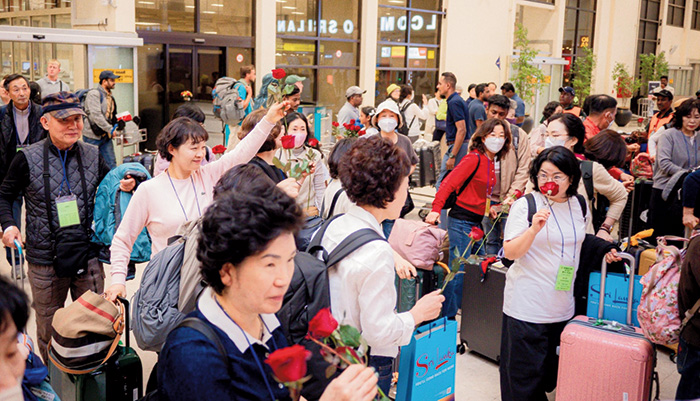
Sri Lanka Tourism, in collaboration with the Embassy of Sri Lanka to the Republic of Korea, is providing support for the two VVIP South Korean Buddhist delegations visiting the country, demonstrating solidarity and strengthening cultural and religious ties with Sri Lanka.
The first delegation included Anunayake thero of Jogye order , South Korean chief Buddhist monks and devotees arrived in Sri Lanka consisting of 120 , on 01st December 2025, with the intention of undertaking a pilgrimage tour and highlighting Sri Lanka’s importance as a major Buddhist attraction for Buddhists around the world.
As same as the first delegation, the second VVIP Buddhist delegation which arrived on the 10th of December, 2025, was also given warm and a colorful welcome at the Bandaranaike International Airport, complete with a Cultural Dance troupe and a group of Sri Lankan children to greet them upon their arrival, making them feel at home and happy to see such a sensational sight. Ms . Thanuja Muniweera , Deputy Director and also the officer in charge of the Korean Market , was there to welcome the much revered guests . The delegation consisted of 150 visitors including both priests and devotees.
Led by Ven . Hyeil, , Chief priest of Haeinsa Temple , the main purpose of this visit is to show Sri Lanka as a welcoming and culturally vibrant destination. This will be a great opportunity to show the importance of the Korean Market as an emerging market and also promote Buddhist and Pilgrimage Tourism. South Koreans are known to be travelling in large numbers, including December 2025. The South Korean Buddhist delegation is one such example.

Diversified conglomerate Sunshine Holdings PLC (CSE: SUN) has been included in the S&P Sri Lanka 20 Index, following the 2025 year-end index rebalance announced by the Colombo Stock Exchange (CSE) and S&P Dow Jones Indices. The inclusion takes effect from 22 December 2025, after market closing on 19 December 2025.
The S&P Sri Lanka 20 Index represents the 20 largest and most liquid companies listed on the CSE, selected based on stringent criteria including market capitalisation, liquidity, financial viability and sustained profitability. Constituents are weighted by float-adjusted market capitalisation, with a single-stock caps to ensure balanced representation.
Commenting on the milestone, Sunshine Holdings Group Chief Executive Officer, Shyam Sathasivam, said, “Our inclusion in the S&P Sri Lanka 20 is the result of more than five decades of collective effort and perseverance by our people, past and present, who have built Sunshine Holdings into the institution it is today. This recognition reflects the strength of our foundations, the discipline with which we have grown, and the consistency of our performance across business cycles. As we move forward, we remain focused on building resilient businesses, upholding strong governance standards and delivering sustainable long-term value to all stakeholders.”
The S&P Sri Lanka 20 Index is constructed in line with global index methodologies and international best practices, with all constituents classified under the Global Industry Classification Standard (GICS®). Eligibility requires a minimum float-adjusted market capitalisation of Rs. 500 million, a six-month median daily value traded of Rs. 250,000, and positive net income over the twelve months preceding the rebalancing reference date.
Sunshine Holdings’ inclusion in the S&P Sri Lanka 20 reflects the Group’s long-term capital markets journey, evolving from a closely held family enterprise into a widely held blue-chip listed company. Over the years, the Group has focused on building institutional credibility, strengthening governance standards and expanding its shareholder base, resulting in a current market capitalisation of approximately LKR 70 billion, underscoring its scale and relevance within the Colombo Stock Exchange.

Navy seize an Indian fishing boat poaching in northern waters

US Coast Guard suspends search for survivors of Pacific boat strike

Venezuela’s capital hit by explosions, Caracas blames the US

Tri-Forces donate LKR. 372 million, a day’s pay of all ranks to ‘Rebuilding Sri Lanka’ Fund

Rabada to lead strong South Africa pace attack at T20 World Cup

Showes about 75 mm are likely at some places in the Eastern and Uva provinces and in Matale, Nuwara-Eliya and Polonnaruwa districts.

‘Dates have the highest sugar content to fight Coronavirus’

Sunday Island 27 December – Headlines

#SundayIsland 17th December – Headlines

Sunday Island – 28th March

Sunday Island Headlines – 21 March

Sunday Island – 21st February – Headlines
-

 Sports5 days ago
Gurusinha’s Boxing Day hundred celebrated in Melbourne
-
 News3 days ago
Leading the Nation’s Connectivity Recovery Amid Unprecedented Challenges
-

 Sports6 days ago
Time to close the Dickwella chapter
-

 Features4 days ago
It’s all over for Maxi Rozairo
-

 News6 days ago
Environmentalists warn Sri Lanka’s ecological safeguards are failing
-
 News4 days ago
Dr. Bellana: “I was removed as NHSL Deputy Director for exposing Rs. 900 mn fraud”
-
 News3 days ago
Dons on warpath over alleged undue interference in university governance
-
 Features6 days ago
Digambaram draws a broad brush canvas of SL’s existing political situation