
News
GMOA asks for guidelines on handling bodies of those who die of COVID-19 at home


Not all deaths at home due to coronavirus
By Rathindra Kuruwita
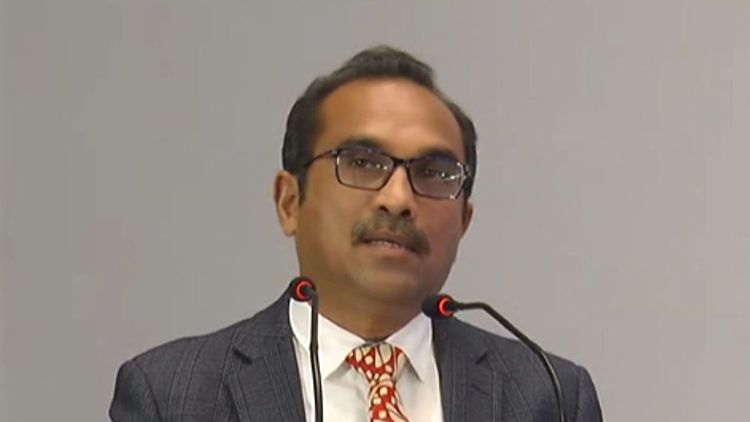
The Ministry of Health should prepare guidelines for health staff on handling the bodies of those who die of COVID-19 at their homes to prevent the spread of the disease, Editor of the Government Medical Officers’ Association (GMOA,) Dr. Haritha Aluthge said yesterday.
“We proposed that we do a review of COVID-19 deaths and the Director General of Health Services, Dr. Asela Gunawardena agreed. He has appointed a committee to look into it and they have been given a week to study the COVID-19 deaths so far. They have also been asked to analyse daily COVID-19 deaths and present the report to the DGHS within 48 hours.”
Dr. Aluthge said they had asked the committee to submit its report on COVID-19 deaths so far to the DGHS within this week so that future action could be determined as soon as possible. Aluthge added that from what they had seen, some of the deaths that occurred at home could have been prevented.
“We must remember that a lot of people die at home due to various diseases including COVID-19. Even before the pandemic came about, a lot of old people, those with chronic diseases and those who had returned home from medical procedures died at their homes. The difference now is that we have to determine if these deaths are COVID-19 related. If we have done a large number of random tests as we proposed, we could have identified at least some of those who had died of COVID-19.”
Dr. Aluthge said: “There are several practical issues that need to be addressed. There must be health guidelines on how to conduct PCR tests on those who had died at home; whether the tests must be carried out at home or the bodies have to be brought to hospital; how the bodies should be transported and where the bodies should be placed until PCR test results are made known.”
Dr. Aluthge said that while a body was being transported, there was the risk of others contracting the virus. The Health Ministry should talk to PHIs and MoHs who knew the practical issues and obtain their opinion before preparing the guidelines, Dr. Aluthge said.


Minister of Transport, Highways and Urban Development Bimal Ratnayake yesterday told Parliament that issues faced by the public in obtaining fuel QR codes would be addressed within the day.
Responding to a query, the Minister said fuel consumption in several districts had risen to nearly double the usual levels, placing added strain on the distribution system.
He said difficulties in accessing QR codes had primarily affected individuals using mismatched vehicle and phone number records, including owners of older vehicles with new phone numbers and those with newly registered vehicles linked to old numbers. He assured that steps were being taken to rectify these issues promptly.
The Minister noted that no such complications had been reported among users with consistent records, such as old vehicles paired with original phone numbers or new vehicles registered with updated contact details.
Providing an update on the system, he said around seven million users were registered under the QR programme in 2023, with the figure expected to increase to approximately 7.2 million this year. At present, about 5.5 million users have completed registration.
He said approximately 2.7 million outdated entries in the database had been removed over a two-day period as part of system improvements.
Minister Ratnayake said some filling stations had reported sales volumes reaching up to two-and-a-half times normal levels, exerting pressure on storage and distribution capacities. He urged the public to avoid panic, expressing confidence that the situation would normalise by today.
He said the “odd-even” fuel distribution system had been introduced to ease unnecessary pressure, although the QR-based system alone was sufficient to manage distribution efficiently.
The Minister also clarified that vehicle owners without number plates could still obtain fuel by producing valid documentation, including a revenue licence, emission certificate, vehicle registration certificate or insurance certificate, all of which carry the registration number.
He added that once the system stabilises, authorities would take action against any fraudulent activities linked to fuel distribution.
By Saman Indrajith

Sri Lanka has been ranked among the least happy countries in the World Happiness Report 2026, placing 134th with a score of 4.0.
The latest report shows Sri Lanka slipping one position from 133rd in 2025, ranking alongside Ethiopia and trailing behind regional neighbours India, Pakistan and Bangladesh.
Finland topped the global rankings as the happiest country, followed by Iceland, Denmark, Costa Rica and Sweden. Norway, the Netherlands, Israel, Luxembourg, Switzerland, New Zealand, Mexico, Ireland, Belgium and Australia completed the top 15.
The report, compiled by the Wellbeing Research Centre at the University of Oxford, is based on findings from the Gallup World Poll, which surveys respondents in 147 countries.
Participants are asked to evaluate their lives using the Cantril Ladder scale, ranging from 0, representing the worst possible life, to 10, representing the best possible life.
Researchers analyse six key factors; GDP per capita, life expectancy, generosity, and perceptions of freedom and corruption to explain differences between countries. Rankings are calculated using a three-year average to minimise fluctuations caused by major events such as conflicts or economic crises.
Latest News
Heat Index likely to increase up to ‘Caution level’ at some places in Western, Sabaragamuwa, North-central, Southern and North-western provinces and in Monaragala, Mannar, Vavuniya and Mullaitivu districts

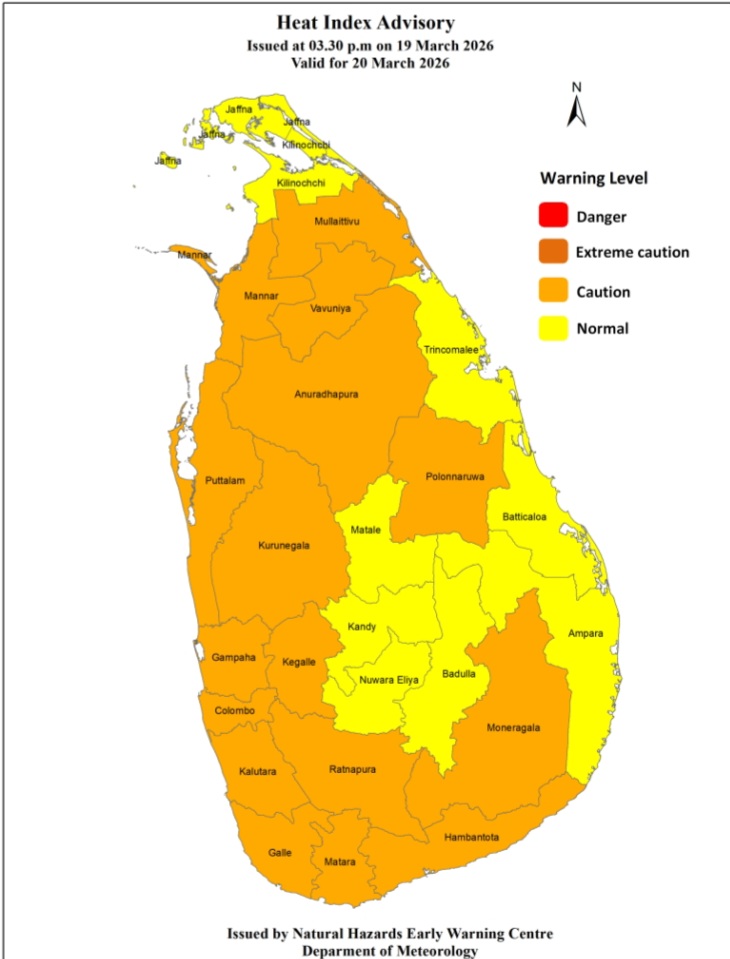
Warm Weather Advisory
Issued by the Natural Hazards Early Warning Centre
at 3.30 p.m. on 19 March 2026, valid for 20 March 2026.
The public are warned that the Heat index, the temperature felt on human body is likely to increase up to ‘Caution level’ at
some places in Western, Sabaragamuwa, North-central, Southern and North-western provinces and in Monaragala, Mannar, Vavuniya and Mullaitivu districts.
The Heat Index Forecast is calculated by using relative humidity and maximum temperature and this is the condition that is felt on your body. This is not the forecast of maximum temperature. It is generated by the Department of Meteorology for the next day period and prepared by using global numerical weather prediction model data.
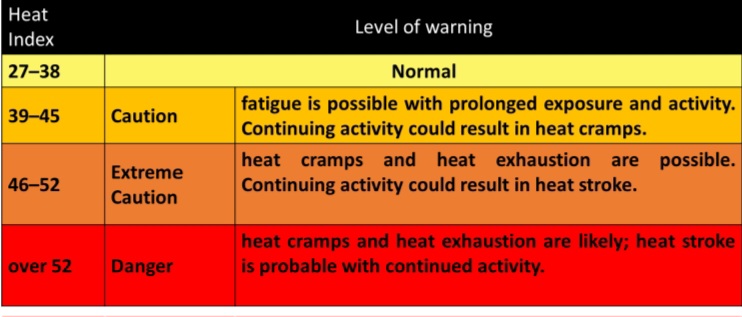
Effect of the heat index on human body is mentioned in the above table and it is prepared on the advice of the Ministry of Health and Indigenous Medical Services.
ACTION REQUIRED
Job sites: Stay hydrated and takes breaks in the shade as often as possible.
Indoors: Check up on the elderly and the sick.
Vehicles: Never leave children unattended.
Outdoors: Limit strenuous outdoor activities, find shade and stay hydrated.
Dress: Wear lightweight and white or light-colored clothing.
Note:
In addition, please refer to advisories issued by the Disaster Preparedness & Response Division, Ministry of Health in this regard as well.
For further clarifications please contact 011-7446491.

Iran war threatens Sri Lanka’s fragile recovery; SMEs face “Survival Crisis” – Prof. Rohan de Silva

Hidden costs of war

Science and diplomacy in a changing world

Netanyahu says Israel ‘acted alone’ in attack on Iranian gas field

Be a woman who re-designs life!

Transport Minister assures parliament glitches in fuel QR codes will be addressed immediately

‘Dates have the highest sugar content to fight Coronavirus’

Sunday Island 27 December – Headlines

#SundayIsland 17th December – Headlines

Sunday Island – 28th March

Sunday Island Headlines – 21 March

Sunday Island – 21st February – Headlines
-

 Business4 days ago
Browns EV launches fast-charging BAW E7 Pro at Rs. 5.8 million
-

 Life style5 days ago
From culture to empowerment: Indonesia’s vision for Sri Lanka
-

 News2 days ago
CIABOC questions Ex-President GR on house for CJ’s maid
-

 Business6 days ago
Sri Lanka Institute of Information Technology raises the bar for academic excellence
-

 Life style5 days ago
Ranjith Fernando celebrates cricketing journey with Hob Nails to Spikes
-

 Latest News5 days ago
QR code system will be implemented for fuel with effect from 06.00 a.m. today (15th)
-

 News3 days ago
Australian HC debunks misleading travel risk claims for Sri Lanka
-

 News3 days ago
Sri Lankan marine scientist Asha de Vos honoured at UNGA opening