
News
GL at KDU confab:

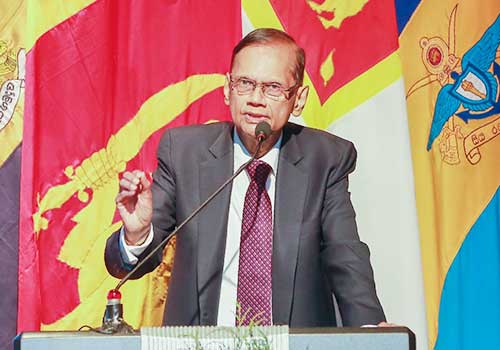
Prof. Peiris addressing KDU conference recently (pic courtesy Education Ministry
Reconciliation cannot be achieved at the expense of the majority community
Education Minister Prof. G.L. Peiris recently said that reconciliation could never be achieved without accommodating the interests of the majority community.
The one-time External Affairs Minister said that the previous government’s (2015-2019) reconciliation efforts failed primarily because the sentiments of the majority community were conveniently ignored. The SLPP Chairman said so addressing the 13th International Research Conference, KDU.
Commenting on what he called the concept of reconciliation, which became very important after the end of the war in 2009, Prof. Peiris said: “There was then, naturally, the feeling that we have to leave the pain and anguish of the war behind us. We have to emphasize unity and solidarity and bring together all the people of our cherished land, irrespective of caste, creed, ethnic or religious identity, to emphasize the oneness of this nation. That is the pith and substance of the concept of reconciliation.
“But it all went wrong during the yahapalana administration of 2015 to 2019. It is worth examining in an objective spirit the reasons why that endeavour failed so miserably.”
Alleging that the authorities at that time, forgot the sentiments, and aspirations of the majority community, Prof. Peiris said: ” Reconciliation, of course, places emphasis on minority aspirations, to make them comfortable, to convey to them in definite terms, the conviction, that they are very much a part of the country, they belong. That confidence has to be imparted to the minorities and at the same time, it is absolutely necessary to carry the majority community with you. If you leave them behind, if you engender in the minds of the majority community that they are not important, they can be side lined and forgotten about, they do not matter, such an exercise in reconciliation, is doomed to failure, as the empirical experience of those four years convincingly demonstrated.”
Excepts of the minister’s speech: “There is an intimate connection between national growth and security. It is fanciful to talk of any kind of national growth without the assurance of security. Security is the necessary and indispensable foundation. Without security, it is impossible to achieve growth in any sector of the country. The celebrated political scientist, the late Professor Harold Laski, of the London School of Economics said that the basic duty of a State is to provide security for its people. That is the ultimate reason for the existence of the Nation State.
We have seen empirical evidence of this in the recent past of our country. Through the 30-year conflict with the LTTE, it was impossible to attract substantial investment into this country. Every facet of Sri Lanka’s economy suffered grievously during that period. How can you attract investors into a country, which is being torn asunder by a ferocious war? Investment, international trade, all this was affected by the ongoing conflict.
“What happened during that period? I think the most alarming spectacle that we are seeing in this country today is the evidence that is transpiring on a daily basis before the Presidential Commission that is going into the catastrophic phenomenon of the Easter Sunday carnage. The evidence before the P CoI emphasizes the total breakdown of the security apparatus in the country at the time. It was not mere debilitation or weakening of the security apparatus, it was a total collapse of it.
“When the incumbent President Gotabaya Rajapaksa was Secretary to the Ministry of Defence, there was very close collaboration between the intelligence arm and immigration authorities. Whenever an application was made by a foreign preacher, somebody who wanted to come and teach in this country, when a visa was requested, a very thorough background check was done. And if there was something unsavory in the past of that person, if he had been involved in any activity which led to disharmony among communities, then the immigration authorities in close consultation with the intelligence arm, would turn down such a request for a visa to enter this country. That whole apparatus was consciously and deliberately dismantled. It did not happen unwittingly or inadvertently, it was the deliberate policy of the then government. The intelligence personnel were made to feel that they were an embarrassment. Surely, if you are talking of national growth and security, the first thing to ensure, is that funds coming from abroad, are brought in through proper channels. We have in this country such an established conduit. The conduit is the External Resources Department of the Central Bank of Sri Lanka. Of course, these resources are welcome. But they must come through the External Resources Department. The Central Bank must know the source, the origin of these funds. Where are these funds coming from? We must know the purpose for which these resources are going to be applied. Who is going to manage these resources? There must be audited accounts. All of this was dismantled. You then have a situation where, a university or what purports to be a university comes up in Batticaloa. The buildings that are constructed are better than the buildings that you have here at the Kotelawala Defence University. They are superior to the quality of the infrastructure in the Universities of Colombo and Peradeniya. If you go to Kattankudy blind folded and when the blind fold is taken off if you get there you will feel that you are in The Middle East. The date palms, the architecture, and the overall environment. The sums of money involved are colossal. But all of these was shrouded in secrecy. There is no exposure, visibility or accountability. It is that, that brought about a situation that culminated in the total collapse of the security establishment.
“Madrasas came up all over the country. They are not Sunday schools; many of them are providing instruction on a daily basis. Nobody examined the curriculum. There is no regulatory mechanism at all. So the seeds of racial hatred are sown in those institutions.
“This was true not only within the country, but in the conduct of our foreign relations. What happened there? Sri Lanka is unique among the nations of this world in committing to a Resolution in 2015 at the UN Human Rights Council, Sri Lanka became co-sponsor of a Resolution condemning its own armed forces, accusing them of grievous crimes under international law and under international humanitarian law. The preamble to Resolution 30/1 of the 1st of September 2015 acknowledged with appreciation the Report of the High Commissioner for Human Rights, The High Commissioner’s Report made the most damaging allegations, against the armed forces of this country. And the government of Sri Lanka endorsed all of that, and called for a thorough investigation at the international level. The Resolution gave responsibility to The Human Right Council and to the Commissioner for Human Rights, to keep Sri Lanka under constant review.
“So here was a government, which deliberately submitted the country to adjudication and assessment in respect of its armed forces to international tribunals.
“Just consider the enormity of what happened. There were pledges given in Resolutions 30/1 and 34/1, which are clearly contrary to the highest law of this country, the Constitution of Sri Lanka. Operative para six, of the first resolution 30/1 recommended that, Commonwealth and other foreign judges, should be entrusted with the task of judging our armed forces This is not possible under Sri Lanka’s Constitution, because foreigners cannot exercise judicial power in respect of our citizens. The then High Commissioner for Human Rights Prince Hussein, publicly conceded that in respect of no other country has the Human Rights Council based in Geneva adopted so intrusive an approach, interfering directly with domestic policy in that country. The Resolutions involved matters, which are clearly within the domain of the Sri Lankan Parliament, not the business of foreigners. It calls for constitutional reforms. It calls for the devolution of greater powers to Provincial Councils. It calls for a thorough overhaul of Sri Lanka’s Armed Forces and the Police.
“The previous government’s attitude, which destroyed the very foundations of our national security, manifested itself both in respect of domestic policy and the conduct of the country’s foreign relations during the period 2015 to 2019. In such a situation you cannot possibly have national growth, you cannot have economic advancement, because security has broken down entirely.
“Just one other point that I would like to make before I conclude, That is the reference to militarization in the current political discourse. Non-governmental organizations and elements of the Opposition, as well as some prejudiced and biased foreign commentators, are finding fault with the role of the military in the conduct of national affairs in Sri Lanka at this time. They purport to sound a note of caution against an increasing role for the military in the conduct of Sri Lanka’s affairs. But no objective observer of the Sri Lankan scene can doubt the fact that when it came to the control of COVID-19, this country could not possibly have achieved what it did without the vigorous involvement and cooperation of the armed forces, particularly the intelligence arm. We were able to control the pandemic, because the armed forces were able to identify those who had been infected. First the immediate circle and next the outer periphery, that is still being done. The role of the armed forces is indispensable.”

Latest News
Sun directly overhead Pomparippu, Anuradhapura, Mihinthale, Galenbindunuwewa, Agbopura and Serunuwara about 12:11 noon today (11)


On the apparent northward relative motion of the sun, it is going to be directly over the latitudes of Sri Lanka from 05th to 15th of April in this year.
The nearest areas of Sri Lanka over which the sun is overhead today (11th) are Pomparippu, Anuradhapura, Mihinthale, Galenbindunuwewa, Agbopura and Serunuwara about 12:11 noon.

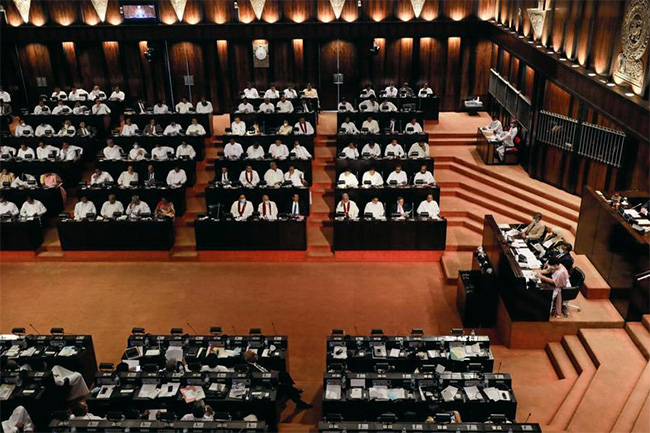
A no-confidence motion brought by the Opposition against Energy Minister Kumara Jayakody was defeated in Parliament yesterday by a majority of 104 votes.At the end of the debate, 49 members voted in favour of the motion, while 153 voted against it.
The motion, submitted to the Speaker on 19 March, was signed by Opposition Leader Sajith Premadasa, SJB MPs, and other Opposition members.
It accused Minister Jayakody of failing to ensure the procurement of adequate and quality coal for the Lakvijaya Coal Power Plant in Norochcholai, alleging that such negligence amounted to a breach of ministerial responsibility over a critical national energy asset.
The motion also cited ongoing legal proceedings against the Minister, noting that he has been indicted by the Commission to Investigate Allegations of Bribery or Corruption and produced before the Colombo High Court under Section 70 of the Bribery Act, in connection with alleged acts of corruption during his tenure as Procurement Manager of the Ceylon Fertiliser Company Limited.
The motion read: Vote of No Confidence against Kumara Jayakody, Minister of Energy,— Whereas the Provision in Section 6 of the Part III of the Code of Conduct for Members of Parliament which states that: “The Members shall on all occasions act in accordance with the public trust entrusted with them and shall always behave with probity and integrity, including the use by them of any public resources.” has been violated; And whereas the following rules of conduct set out in Section 9 of the Part V of the Code of Conduct for Members of Parliament have prima facie been breached, namely:- “(a) to be conscience; (c) to act so as to merit the trust and respect of the people; (e) to hold themselves accountable for the conduct and duties for which they are responsible;” And whereas it is observed that the Minister has failed, in his capacity as a Minister of the Cabinet of Ministers, to discharge the fundamental duties incumbent upon him in accordance with Article 28 of the Constitution;
And whereas it is established that the Minister of Energy has failed to discharge his primary duty of ensuring the procurement of adequate and good quality coal for the Norochcholai Lakvijaya Coal Power Plant;
And whereas such gross negligence in overseeing a critical national energy asset constitutes a fundamental breach of ministerial responsibility;
And whereas the Minister of Energy has failed to carry out the subjects and functions vested in him by the Notification of Gazette Extraordinary No. 2412/08 of 25th November 2024 of the Democratic Socialist Republic of Sri Lanka, including taking necessary steps to reduce the losses at the institutional management level and technical damages that occur to the electricity generation and distribution system and reduction of costs for generating electricity and removal of uncertainties during generation;
And whereas the Commission to Investigate Allegations of Bribery or Corruption has filed formal indictments before the Colombo High Court against the incumbent Minister of Energy under Section 70 of the Bribery Act (Chapter 26) for the offence of “corruption” in connection with acts of corruption allegedly committed while he was serving as the Procurement Manager of the Lanka Fertilizer Company;
And whereas, in light of the foregoing, the Minister of Energy has irretrievably forfeited the confidence of Parliament and the people of Sri Lanka by causing losses to public finances, endangering national energy security, corruptly mishandling the procurement process, being subjected to active judicial proceedings for the offence of “corruption”, and betraying the Government’s own “anti-corruption mandate”, and his continued tenure as the Minister of Energy is contrary to the public interest, the rule of law, and the principles of good governance;
That this Parliament resolves that it has no confidence in the competence of Kumara Jayakody, Minister of Energy to function as a Minister of the Cabinet of Ministers any longer.”
by Saman Indrajith

Chinese Ambassador to Sri Lanka Qi Zhenhong yesterday assured that China would not allow a fuel crisis to arise in Sri Lanka, under any circumstances, reaffirming Beijing’s continued support to the country.
The Ambassador made these remarks addressing the media after attending a dry ration distribution programme for 350 low-income families at Sri Chandananda Buddhist College, at Asgiriya, in Kandy.
Highlighting the longstanding ties between the two countries, Ambassador Qi said China has consistently stood by Sri Lanka and remains ready to extend assistance whenever required.
Amid concerns over global energy disruptions, stemming from the ongoing Middle East conflict, he noted that several countries are already facing difficulties, but stressed that China is prepared to support Sri Lanka at any time.
He said that any potential fuel shortage in Sri Lanka could be managed with the involvement of China’s Sinopec.
Reiterating Beijing’s commitment to Sri Lanka’s economic recovery and development, the Envoy also expressed hope that the current ceasefire in the Middle East would hold, while assuring that China stands ready to respond to any future developments and assist Sri Lanka as needed.
By SK Samaranayake

Sooryavanshi blitz, Jurel 81* help Rajasthan Royals take down Royal Challengers Bengaluru with ease

Sun directly overhead Pomparippu, Anuradhapura, Mihinthale, Galenbindunuwewa, Agbopura and Serunuwara about 12:11 noon today (11)

Showers expected in the Western, Sabaragamuwa, North-western , Southern and Uva provinces and in Anuradhapura, Mannar, Kandy and Nuwara-Eliya districts after 2.00 p.m.

Opposition NCM against Energy Minister defeated

Chinese Ambassador assures Lanka China will not allow a fuel crisis to develop here

Minister Jayatissa blames administrations since 2010 for not following proper procedures when procuring coal

‘Dates have the highest sugar content to fight Coronavirus’

Sunday Island 27 December – Headlines

#SundayIsland 17th December – Headlines

Sunday Island – 28th March

Sunday Island Headlines – 21 March

Sunday Island – 21st February – Headlines
-

 Features7 days ago
Ranjith Siyambalapitiya turns custodian of a rare living collection
-

 News7 days ago
Global ‘Walk for Peace’ to be held in Lanka
-

 News5 days ago
Lankan-origin actress Subashini found dead in India
-

 News3 days ago
AG: Coal procurement full of irregularities
-

 Business2 days ago
Israeli attack on Lebanon triggers local stock market volatility
-

 Features7 days ago
Beyond the Blue Skies: A Tribute to Captain Elmo Jayawardena
-

 Features7 days ago
Aspects of Ceylon/Sri Lanka Foreign Relations – 1948 to 1976
-

 Business3 days ago
Hayleys Mobility introduces Premium OMODA C9 PHEV