
News
Geneva controversy: Ambika hits back hard at Foreign Ministry


Human Rights Advocate Ambika Satkunanathan has alleged that the culture of impunity is well documented, not only by civil society organisations, human rights defenders and the UN, but most importantly the Supreme Court and the Human Rights Commission of Sri Lanka. Since 2020 several incidents of violence by state officials have been publicly recorded. Yet, to date, the number of persons held accountable is negligible.
The former member of the Human Rights Commission said so in a statement issued in response to a statement titled ‘Human Rights: FM challenges Neelan Tiruchelvam Trust over its representations to Geneva ‘ in Feb 5, 2022 edition of The Island. The following is the text of her statement issued in response to the Foreign Ministry statement that dealt with Satkunanathan’s representations before the European Parliament Sub-Committee on Human Rights:”The FM statement contains numerous misrepresentations and insinuations, and appears to be aimed at silencing critique of government policies and actions.
In my statement to the Sub-Committee, I spoke of a number of issues, many of which I have previously written about with supporting evidence. This is available in the public domain. These are issues that other civil society organisations and activists have raised and documented over the years. In this context, the government labelling my statement “misleading”, appears to be an effort to downplay the issues raised and deceive the public.
It is disturbing the government has taken umbrage at my appeal to the European Union (EU) to advocate with the government to fulfil its international human rights obligations using GSP Plus trade privileges as a conduit. The GSP Plus privileges are dependent on the recipient fulfilling human rights obligations. The said human rights obligations are obligations the government has a duty to fulfill as a member of the United Nations and signatory to several UN conventions. These are obligations that provide protections to the citizens of Sri Lanka.
It is regrettable the government refuses to acknowledge that any adverse outcome of the GSP Plus review process would only be due to its failure to fulfill the GSP Plus scheme’s requirements. Hence, it is the government that has to take responsibility for any adverse outcomes. Instead, the government implies that those who advocate for the protection of the marginalised, such as Free Trade Zone workers, are responsible for a possible adverse outcome because they highlight the government’s failures. This is an attempt to deflect blame. To ensure there is no adverse impact on vulnerable communities, the government needs to acknowledge that the crisis is the result of its poor policy decisions, taken without bearing the best interests of citizens in mind.
Efforts to bring lasting peace to Sri Lanka are undermined by denials of the root causes of the armed conflict, i.e. discrimination. Instead, the MFA statement labels discussion of the root causes as LTTE propaganda. This is ominous given the decades long strategy of weaponising the PTA against Tamils. Implying such discussion is a danger to communal harmony, as the Ministry does in its statement, can be used to weaponise the International Covenant on Civil and Political Rights Act to stifle dissent. The government’s use of these phrases will create fear amongst civic activists, especially in the North and East, and shrink civic space further. The very space the government denies is shrinking.
In this regard, the insinuations made in the Ministry’s statement are dangerous. My attention has been drawn to articles peddling false information about my supposed links to the LTTE being circulated on social media in the wake of the statement. The statement therefore could cause persons with racist ideologies to harass and perpetrate violence, including cyber violence against me.
The culture of impunity is well documented, not only by civil society organisations, human rights defenders and the UN, but most importantly the Supreme Court and the Human Rights Commission of Sri Lanka. Since 2020 several incidents of violence by state officials have been publicly recorded. Yet, to date, the number of persons held accountable is negligible.
The “war on drugs” (erroneously referred to as war and drugs in the statement) is being used to justify arbitrary arrests and detention as well suspected extra-judicial killings by police in Sri Lanka. The Bar Association of Sri Lanka too has raised concerns about this. It is important to curb the supply of drugs and international drug trafficking. However, such policies need to adhere to human rights standards.
Although the MFA claims Sri Lanka is a secular country, several statements have been made by the President in which he mentions inter alia, that ‘’protection of Sinhala Buddhists is his foremost responsibility’’ and that “all others who would love to live in unity have to be assimilated into this main socio-cultural basis of this country, based on rich Buddhist values”. This is illustrative of the Sinhala Buddhist nationalism to which I referred in my statement. Another example is the Presidential Task Force on Archeological Heritage Management in the Eastern Province, which has the membership of Buddhist clergy and is headed by a Buddhist monk. The ‘One Country One Law’ Task Force is chaired by Gnanasara Thera, who has publicly made inflammatory and discriminatory statements and incited violence against Muslim community. Such an appointment begs the question whether the government is concerned about the preservation of social harmony.
The Ministry has conflated the process of militarisation, with the military occupation of land. The former includes the military undertaking tasks that were and should be within the purview of civilian entities. The phenomenon of militarization has been meticulously recorded by civil society, including myself, and is publicly available for reference.
Despite the Ministry’s claim the government views civil society as partners and not adversaries, regrettably, its statement singling out my statement to the EU, is the perfect example of the government’s intolerance of dissent. Furthermore, several civil society organisations and activists, particularly from the North and East, have been questioned by the Terrorism Investigation Division (TID) during the last year. That they are being subject to these “routine security checks” when there is no prima facie evidence of wrongdoing, casts doubt on the government’s assertion of partnership with civil society.
As a Sri Lankan citizen, it is my right and civic duty to question the actions of elected representatives of this country when such actions lead to the suffering and marginalisation of vulnerable communities, and demand accountability. Only a country that respects this right can be considered truly independent and democratic.
Finally, the Ministry has referred to my position as Chairperson of the Neelan Tiruchelvam Trust in the statement. However, I did not make the statement to the Sub Committee as Chairperson nor represent the Trust at the hearing. I delivered the statement in my capacity as a human rights advocate, and it in no way has any relationship to the Trust.”

Latest News
Heat Index at Caution level’ in the Northern, North-central, North-western, Western and Southern provinces and in Trincomalee district.


Warm Weather Advisory
Issued by the Natural Hazards Early Warning Centre
Issued at 3.30 p.m. on 12 April 2026, valid for 13 April 2026.
Heat index, the temperature felt on human body is likely to increase up to ‘Caution level’ at some places in the Northern, North-central, North-western, Western and Southern provinces and in Trincomalee district.
The Heat Index Forecast is calculated by using relative humidity and maximum temperature and this is the condition that is felt on your body. This is not the forecast of maximum temperature. It is generated by the Department of Meteorology for the next day period and prepared by using global numerical weather prediction model data.

Effect of the heat index on human body is mentioned in the above table and it is prepared on the advice of the Ministry of Health and Indigenous Medical Services.
ACTION REQUIRED
Job sites: Stay hydrated and takes breaks in the shade as often as possible.
Indoors: Check up on the elderly and the sick.
Vehicles: Never leave children unattended.
Outdoors: Limit strenuous outdoor activities, find shade and stay hydrated.
Dress: Wear lightweight and white or light-colored clothing.
Note:
In addition, please refer to advisories issued by the Disaster Preparedness & Response Division, Ministry of Health in this regard as well. For further clarifications please contact 011-7446491.

On the apparent northward relative motion of the sun, it is going to be directly over the latitudes of Sri Lanka from 05th to 15th of April in this year.
The nearest areas of Sri Lanka over which the sun is overhead today (13th) are Pesalai, Mankulam and Nedunkerny about 12:11 noon.
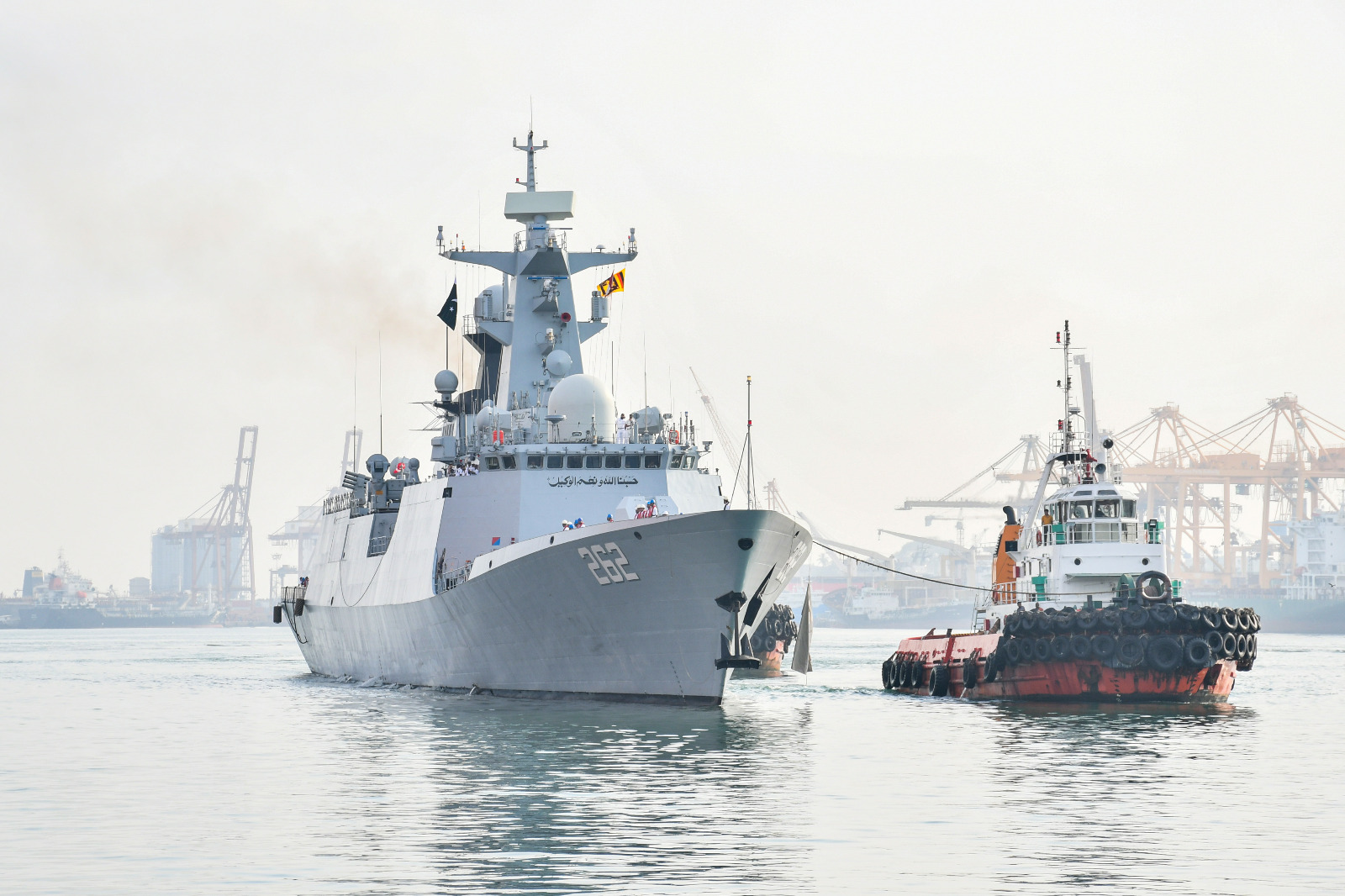
The Pakistan Navy Ship (PNS) TAIMUR and ASLAT arrived at the Port of Colombo on a goodwill visit on 12 Apr 26.
The visiting ships were welcomed by the Sri Lanka Navy in
compliance with naval traditions.
The duo of ships is commanded by Captain NIAMAT SAEED KHAN (PNS TAIMUR) and Captain NADIR MATEEN AFRIDI (PNS ASLAT).
Meanwhile, the ships are expected to conduct a Bilateral Naval Exercise LION STAR V with the Sri Lanka Navy in Colombo seas.

Salt and Patidar power RCB past Mumbai Indians

Prasidh, Buttler set up comfortable win for Gujarat Titans

Heat Index at Caution level’ in the Northern, North-central, North-western, Western and Southern provinces and in Trincomalee district.

Showers above 75 mm are likely at some places in the Western, Sabaragamuwa, Central, Southern and North-western provinces.

Sun directly overhead Pesalai, Mankulam and Nedunkerny about 12:11 noon

PNS TAIMUR & ASLAT arrive in Colombo

‘Dates have the highest sugar content to fight Coronavirus’

Sunday Island 27 December – Headlines

#SundayIsland 17th December – Headlines

Sunday Island – 28th March

Sunday Island Headlines – 21 March

Sunday Island – 21st February – Headlines
-

 News2 days ago
CEB orders temporary shutdown of large rooftop solar systems
-

 News7 days ago
Lankan-origin actress Subashini found dead in India
-

 News5 days ago
AG: Coal procurement full of irregularities
-

 Business4 days ago
Israeli attack on Lebanon triggers local stock market volatility
-

 Business5 days ago
Hayleys Mobility introduces Premium OMODA C9 PHEV
-

 News7 days ago
UN Regional Director launches SL’s first Country Gender Equality Profile during official visit
-

 News7 days ago
Dialog Launches ‘GanuDenu QR’, Making Cashless Transfers Free for All with eZ Cash and Dialog Finance
-

 Business4 days ago
HNB Assurance marks 25 years with strategic transformation to ‘HNB Life’