
Latest News
Gaza peace plan talks to continue as Trump says chance of a deal is ‘really good’


Indirect talks aimed at reaching a final agreement on a US peace plan to end the war in Gaza are set to continue on today [Tuesday] in the Egyptian city of Sharm El-Sheikh.
Palestinian and Egyptian officials have told the BBC that the sessions are focused on “creating the field conditions” for a possible exchange that would see the release of all Israeli hostages in return for a number of Palestinian prisoners.
Israel’s prime minister said on Saturday that he hoped to announce the release of hostages “in the coming days”.
As the officials met on Monday, US President Donald Trump told reporters at the White House: “We have a really good chance of making a deal, and it’ll be a lasting deal.”
Hamas has said it agrees to the peace plan proposals in part, but has not responded to several key demands – including its disarmament and not having any future role in the governance of Gaza.
The second day of the talks, which will see Egyptian and Qatari officials holding shuttle meetings with delegations from both Israel and Hamas separately, will be taking place on the second anniversary of the Hamas-led attack on southern Israel on 7 October 2023, in which about 1,200 people were killed and 251 others were taken hostage.
The Israeli military launched a campaign in Gaza in response. Since then, 67,160 have been killed by Israeli military operations in Gaza, including 18,000 children, according to the territory’s Hamas-run health ministry.
In a statement commemorating the anniversary, United Nations Secretary-General Antonio Guterres said Trump’s plan “presents an opportunity that must be seized to bring this tragic conflict to an end”.
UK Prime Minister Sir Keir Starmer reiterated his support for the plan in his statement commemorating the anniversary, saying: “We welcome the US initiative towards peace in the Middle East, and this government will do everything in our power to bring about the day where every child of Israel can live peacefully, alongside their Palestinian neighbours, in safety and security.”
A senior Israeli security source said the talks initially would focus only on the release of hostages and give Hamas a few days to complete that phase.
These discussions are expected to be among the most consequential since the start of the war and could determine whether a path toward ending the conflict is finally within reach.
US special envoy Steve Witkoff, Trump’s son-in-law Jared Kushner and Qatari foreign minister Sheikh Mohammed bin Abdulrahman Al Thani are among those attending.
Trump, writing on social media, has urged everyone involved in efforts to end the Gaza war to “move fast” and says he has been told the first phase of the peace plan – which includes the hostage release – “should be completed this week”.
On Monday, he told reporters that “Hamas has been agreeing to things that are very important.”
“I really think we’re going to have a deal,” he said at the White House.
A Palestinian official close to the negotiations told the Reuters news agency that the first session ended late Monday evening, and more talks were due to take place on Tuesday.
State-affiliated Al-Qahera News also said talks would continue on Tuesday – and that the first day had ended “amid a positive atmosphere”.
The 20-point plan, which has been agreed upon by Trump and Israeli Prime Minister Benjamin Netanyahu, proposes an immediate end to fighting and the release of 48 hostages, only 20 of whom are thought to be alive, in exchange for hundreds of detained Gazans.
The plan stipulates that once both sides agree to the proposal “full aid will be immediately sent into the Gaza Strip”.
It also states that Hamas would have no role in governing Gaza, and it leaves the door open for an eventual Palestinian state.
However, after the plan was announced publicly a week ago, Netanyahu reinstated his longstanding opposition to a Palestinian state, saying in a video statement: “It’s not written in the agreement. We said we would strongly oppose a Palestinian state.”
On Friday, Hamas responded to the proposal in a statement, in which the group agreed “to release all Israeli prisoners, both living and dead, according to the exchange formula contained in Trump’s proposal” – if the proper conditions for the exchanges are met.
It did not specifically mention or accept Trump’s 20-point plan but said it “renews its agreement to hand over the administration of the Gaza Strip to a Palestinian body of independents (technocrats), based on Palestinian national consensus and Arab and Islamic support.”
The statement made no mention of one of the key demands of the plan – that Hamas agree to its disarmament and to playing no further role in the governance of Gaza.
It added that the part of the proposals dealing with the future of Gaza and the rights of Palestinian people was still being discussed “within a national framework”, of which it said Hamas will be a part.
Many Palestinians described Hamas’ response to the peace plan as unexpected, after days of indications that the group was preparing to reject or at least heavily condition its acceptance of Trump’s peace plan proposal.
Instead, Hamas refrained from including its traditional “red lines” in the official statement, a move many interpret as a sign of external pressure.
European and Middle Eastern leaders have welcomed the proposal. The Palestinian Authority (PA), which governs parts of the Israeli-occupied West Bank, has called the US president’s efforts “sincere and determined”.
Iran – which has been one of Hamas’s main sponsors for many years – has also now signalled its support for Trump’s Gaza peace plan.
Israeli bombardment continued in several parts of the Gaza Strip on Monday ahead of the talks beginning.
Israel is carrying out an offensive in the city, which it has said is aimed at securing the release of the remaining hostages.
Mahmoud Basal, spokesman for Gaza’s Hamas-run civil defence, told the BBC that “no aid trucks have been allowed into Gaza City since the offensive began four weeks ago”.
“There are still bodies we cannot retrieve from areas under Israeli control,” he said.
Hundreds of thousands of Gaza City residents have been forced to flee after the Israeli military ordered evacuations to a designated “humanitarian area” in the south, but hundreds of thousands more are believed to have remained.
Israel’s defence minister has warned that those who stay during the offensive would be “terrorists and supporters of terror”.
In the last 24 hours, 21 Palestinians have been killed in Gaza and a further 96 injured, the Hamas-run health ministry said in its latest update.
International journalists have been banned by Israel from entering the Gaza Strip independently since the start of the war, making verifying claims from both sides difficult.
[BBC]


The Japan Premier League (JPL) T20 competition is cricket’s unlikely outpost – a self-sustaining though struggling-to-survive tournament far away from cricket’s traditional centres. It’s on a growth path just over a decade into its existence, starting to connect local players to those outside, and looking to create a cricketing community in the country.
It was founded in 2015 with four regions – North, South, East and West Kanto (Tokyo region) – in the fray, with games held at the home venues of each of the teams. That model was scrapped owing to low turnouts, and the tournament has since been played at one or the other venue, while Kansai (Osaka region) has come in as the fifth team.
In 2026, the JPL will be a three-day competition – May 2 to 4 – with 12 games at the Sano International Cricket Ground. All the buzz in the lead-up is about the participation of former Sri Lanka captain Dimuth Karunaratne, BBL winner Josh Brown, and Nepal allrounder Karan KC.
“A major goal,” Alan Curr, the Japan Cricket Association (JCA) chief operations officer, says, “is to showcase a good standard of cricket for Japanese fans so that they can really see and understand what the sport looks like.”
The challenge there is that despite being played in Japan since 1863, cricket hasn’t found a niche. There has been some systemic progress, with the formation of the JCA in the 1980s, five-year plans running up to 2032, and the presence of men and women’s leagues for juniors and seniors – including the JPL, which struggled to find traction early on.
One of the reasons for excitement recently was that a significant majority of the 15 players in Japan’s squad at the 2020 Under-19 World Cup came through the Cricket Blast, the junior participation programme. However, that’s not translated to mass acceptance or participation.

“Often, for us, cricket in itself isn’t enough to attract people to the ground,” Curr says. “We have to be creative and come up with other things – dance, music, food, drinks and Japanese commentary. But the hope is that if they see the game, it’s of a high standard because when fans see players doing special things, it’s easier to be impressed.”
When it comes to the players, not everyone is too ambitious. Those that are have rewards to aim for as the JPL can have a significant effect on selection for the national side. Having said that, those in the national side are not professionals – they are students or are employed – and use their annual leaves for international assignments. Making time can be a challenge.
“A lot of the players here play recreationally,” Curr says. “Cricket is a recreational hobby to them rather than a high-performance pursuit. For us, concentrating the talent, getting players together at once to give local players the opportunity to play at a higher standard, and going overseas and playing cricket isn’t a feasible option. [So] to be able to bring high-level cricket here is really important.”
The last bit is why Brown, especially, coming to JPL in 2024 was critical. Brown is a “pro player” – each team gets one – and will be returning for his third year in a row.
“He signed up quite a long time in advance – that year he had a breakthrough year in the Big Bash,” Curr says. “He scored 140 off 57 balls against Adelaide Strikers. We had him locked in when he did that, but we hadn’t announced it. Then his profile went up, and he started playing leagues around the world. Fair play to him, he still came.
“That year, people were pretty excited when we made that announcement, and people did come and the live-streaming certainly got up. It was the first time we had someone of genuine stature coming over and being involved.”
Other than pro players, the 14-player squads have four retained from the previous year’s teams. All of them find their teams in a draft – this year’s draft took place on March 24.

Where do these players come from, and how do they make their way? “Inside Japan is through domestic performances and trials at the start of the year for any new players,” Curr says. “The overseas talent right now comes from our own contacts as we want to make sure we get players who really understand what the tournament is about. It’s a development league; there’s no salary for these players. We just cover their costs.”
As for the future, there are different avenues for expansion. One is getting more pro players into teams, which, according to Curr, could squeeze out local players, making it a less-than-ideal option. Having more teams is more appealing, as is the prospect of having a nine-day tournament than one only over a long weekend.
“All of those things require funding. At the moment, we are relying heavily on the goodwill of people, who are happy to come out and play for no payment and out of the kindness of their heart,” Curr says. “We know that’s not sustainable. If we can get financial backing, getting a sponsor on board will really make a big difference.”
So far, cricket in Japan made news when the national team did anything of note, like qualifying for the 2020 and 2026 men’s Under 19 World Cups. If the JPL can take the next steps towards becoming bigger and better, maybe it will start attracting interest from other parts of the world in a more significant way. And that in turn could mean the next step for cricket in Japan as a whole.
[Cricinfo]
Latest News
Heat Index likely to increase up to ‘Caution level’ at some places in the Western, Sabaragamuwa, Southern, North-western, Northern and North- central provinces and in Monaragala district
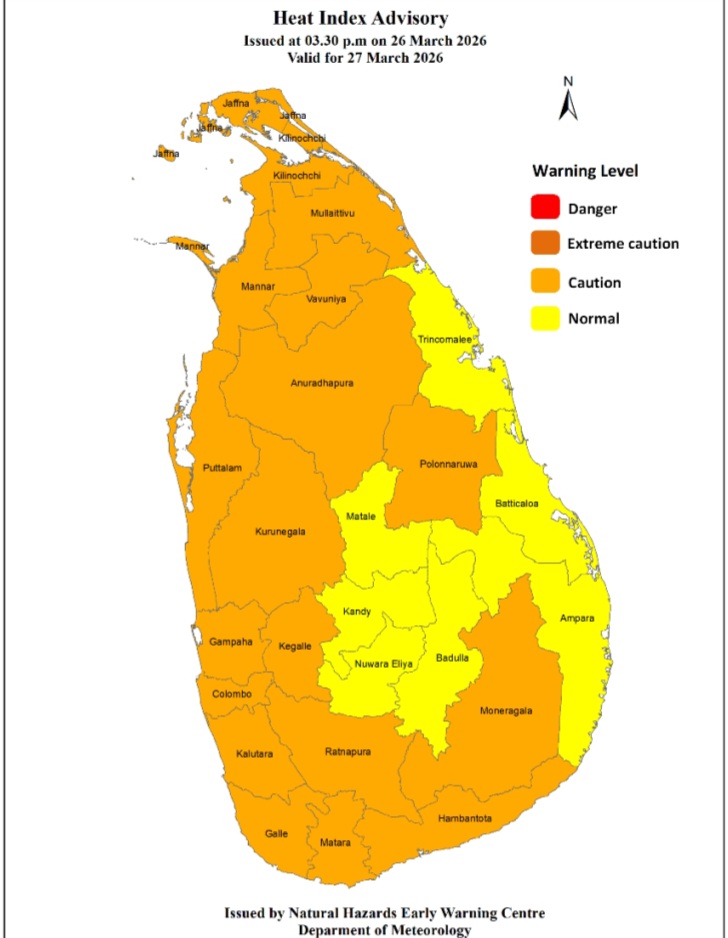
Warm Weather Advisory
Issued by the Natural Hazards Early Warning Centre of the Department of Meteorology
Issued at 3.30 p.m. on 26 March 2026, valid for 27 March 2026.
Thw Heat index, the temperature felt on human body is likely to increase up to ‘Caution level’ at some places in the Western, Sabaragamuwa, Southern, North-western, Northern and North-
central provinces and in Monaragala district.
The Heat Index Forecast is calculated by using relative humidity and maximum temperature and this is the condition that is felt on your body. This is not the forecast of maximum
temperature. It is generated by the Department of Meteorology for the next day period and prepared by using global numerical weather prediction model data.

Effect of the heat index on human body is mentioned in the above table and it is prepared on the advice of the Ministry of Health and Indigenous Medical Services.
ACTION REQUIRED
Job sites: Stay hydrated and takes breaks in the shade as often as possible.
Indoors: Check up on the elderly and the sick.
Vehicles: Never leave children unattended.
Outdoors: Limit strenuous outdoor activities, find shade and stay hydrated.
Dress: Wear lightweight and white or light-colored clothing.
Note:
In addition, please refer to advisories issued by the Disaster Preparedness & Response Division, Ministry of Health in this regard as well. For further clarifications please contact 011-7446491
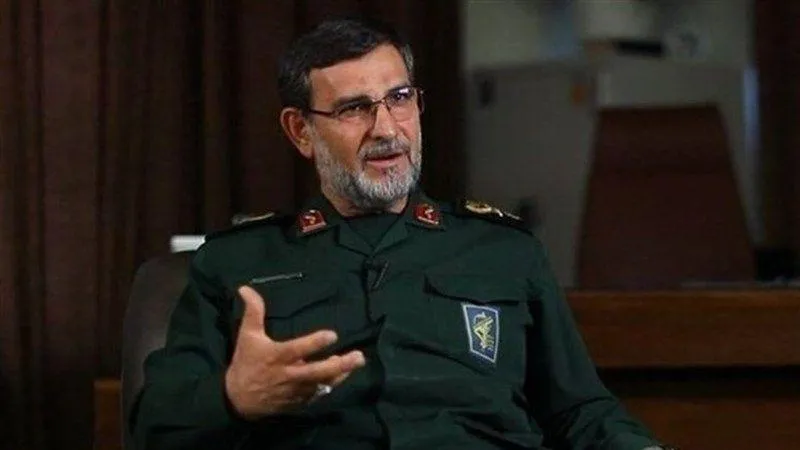
Israel says it has killed the Iranian navy chief overseeing what is a near-total blockade of the Strait of Hormuz.
Alireza Tangsiri, head of the Islamic Revolutionary Guards Corps (IRGC) navy, was “directly responsible for the terrorist act of bombing and blocking the Strait of Hormuz”, and has been “blown up”, according to Israel’s defence minister Israel Katz.
He added that a number of other “senior Navy command officials” have also been killed. Iran has not yet commented.
Since the start of the war on 28 February, Israel has assassinated several top Iranian officials, including Supreme Leader Ayatollah Ali Khamenei and security chief Ali Larijani.
Effectively blockading the Strait of Hormuz – the thin waterway between Iran, the United Arab Emirates (UAE) and Oman, through which around 20% of the world’s oil and liquefied natural gas normally passes – has been a key pillar of Iran’s strategy in the war.
Oil prices have consequently shot up, placing a direct price of the war on consumers in not only the US and Israel but across the world.
In recent weeks, an X account attributed to Tangsiri and cited by Iranian media has posted frequently about the Hormuz blockade, writing that “no vessel associated with the aggressors against Iran has the right to pass through”.
Tangsiri was appointed as the commander of the Navy in 2018, having previously served as deputy commander since 2010. In 2019, he was sanctioned by the US Treasury along with other IRGC commanders after Iran shot down a US surveillance drone near the strait.
Israeli Prime Minister Benjamin Netanyahu described Tangsiri as an individual with “a great deal of blood on his hands” and said his assassination was “yet another example of the co-operation between us and our friend, the United States, toward the common goal of achieving the objectives of the war”.
US Central Command said in a statement Tangsiri’s death “makes the region safer” and that the IRGC’s navy “is on an irreversible decline”. It also called on serving members of the IRGC to abandon their posts and return home “to avoid further risk of unnecessary injury or death”.
Israel’s military said in a statement posted on X that the head of the IRGC Navy’s intelligence directorate, Behnam Rezaei, was also “eliminated”.
(BBC)

Japan Premier League [JPL], building cricket from the ground up

Showers may occur at a few places in the Sabaragamuwa province and in Galle, Matara, Kalutara and Nuwara-Eliya districts in the evening

Energy Minister indicted on corruption charges ahead of no-faith motion against him

Over 1000 complaints of misuse of QR quotas

Fuel bowser operators demand 25% hike in haulage charges

Charge sheet issued against former NIE Director for contempt of court

‘Dates have the highest sugar content to fight Coronavirus’

Sunday Island 27 December – Headlines

#SundayIsland 17th December – Headlines

Sunday Island – 28th March

Sunday Island Headlines – 21 March

Sunday Island – 21st February – Headlines
-

 News2 days ago
Senior citizens above 70 years to receive March allowances on Thursday (26)
-

 Features4 days ago
Trincomalee oil tank farm: An engineering marvel
-

 Business1 day ago
Dialog Unveils Dialog Play Mini with Netflix and Apple TV
-

 Features4 days ago
The scientist who was finally heard
-

 News1 day ago
US dodges question on AKD’s claim SL denied permission for military aircraft to land
-

 News2 days ago
CEB Engineers warn public to be prepared for power cuts after New Year
-
 News2 days ago
Japanese boost to Sri J’pura Hospital, an outright gift from Tokyo during JRJ rule
-

 News6 days ago
Colombo, Oslo steps up efforts to strengthen bilateral cooperation in key environmental priority areas