
News
FSP urges NPP MPs to reject unfair tax policies


The Frontline Socialist Party (FSP) has sent a letter to all MPs of the ruling National People’s Power (NPP) government, urging them to reject what it describes as a severely unfair tax policy outlined in the 2025 Budget. The party has warned that the proposed tax structure will place an unbearable burden on the public, while at the same time granting significant concessions to large corporations and wealthy individuals.
The 2025 Budget, which was presented to Parliament on 17 February, is scheduled for a final decision on 21 March. The FSP stated that tax policies were generally designed to reduce economic inequalities, prioritise economic development, and regulate market consumption patterns. It argued that the 2025 Budget approached taxation solely as a means of generating government revenue, disregarding the economic hardships faced by the majority of the population.
The FSP has raised concerns over the significant increase in Value Added Tax (VAT) on goods and services, which is set to rise by 25.94% in 2025. The government aims to increase tax revenue from Rs. 2,201 billion in 2024 to Rs. 2,772 billion in 2025, resulting in a notable rise in the financial burden on ordinary citizens. According to the FSP’s analysis, this means that in 2024, an average Sri Lankan household paid Rs. 31,623 per month in indirect taxes on goods and services. In 2025, this figure is expected to increase to Rs. 39,817 per month, placing an additional Rs. 4,200 in taxes on each household. The party argued that this increase is unbearable for families already struggling under the weight of the economic crisis.
Citing data from the Department of Census and Statistics, the FSP has highlighted that the average monthly household income in Sri Lanka is Rs. 76,414, while monthly expenses amount to Rs. 63,130. It has warned that nearly two-thirds of a family’s monthly spending would now be consumed by taxes, describing this as a severe economic blow to working-class and lower-income groups. The party accused the government of betraying the expectations of the people who placed their trust in the NPP administration.
While the government has defended its decision by claiming that the higher VAT collection is not the result of introducing new taxes, but rather improving tax enforcement, the FSP dismissed this argument as misleading. It pointed to the Ministry of Finance’s own report, which stated that between 2023 and 2024, businesses collected Rs. 333.1 billion in taxes from consumers but failed to remit them to the state. Despite this massive tax evasion by corporations, the 2025 Budget does not prioritise recovering these unpaid revenues or strengthening direct taxation on high-income earners. Instead, the government has doubled the withholding tax on savings from 5% to 10%, imposed a 15% tax on foreign income earned through online services, and extended import duties on 63 essential goods, including food items, from 1 January 2025.
The FSP also criticised the government’s handling of VAT rates, which have been rising continuously since 2022. The VAT rate, which was 8% in early 2022, was increased to 12% in August 2022, then raised to 15% in January 2023, and further increased to 18% in January 2024. The party warned that the government appears to be following a pattern of gradually increasing VAT, making it even more difficult for ordinary people to afford basic goods and services. Additionally, a Social Security Contribution Tax was introduced in 2023, further exacerbating financial pressures on the public.
Beyond the tax hikes on ordinary citizens, the FSP condemned the favourable treatment given to wealthy individuals and large corporations. It cited a Parliamentary Committee on Public Accounts (COPA) report from March 2024, which revealed that large corporations evaded Rs. 1,068 billion in taxes, while domestic and foreign corporate entities received tax concessions worth Rs. 978 billion. Despite these staggering figures, the government has only planned to increase direct tax revenue by Rs. 141 billion, indicating that it has no real intention of recovering unpaid taxes from the country’s largest businesses.
The FSP also highlighted a controversial clause in the 2025 Budget that offers a six-month amnesty period for overdue tax payments. This clause, buried in the technical section (Clause 1.9) of the budget document—which was only released in English—states that businesses that failed to pay taxes between 2022 and 2023 can settle their dues without facing penalties or interest charges. The party described this as a shameful giveaway to tax-evading corporations, arguing that it directly undermines the government’s claims of enforcing tax compliance.
In its letter to MPs, the FSP urged lawmakers to reject the tax policy and stand against what it called a blatant betrayal of the public interest. The party reminded Parliamentarians that Sri Lanka’s economic crisis, IMF-imposed financial restructuring, and rising inflation have already pushed millions into financial hardship, and that imposing additional tax burdens on struggling families would only deepen the crisis.
The FSP warned that if MPs vote to approve these unfair tax measures, they risk facing public outrage and a loss of trust. It called for an immediate revision of the 2025 Budget’s tax policy, urging the government to shift the tax burden away from ordinary citizens and onto the country’s wealthiest individuals and corporations.







Latest News
Advisory for Severe Lightning issued to the Western and Sabaragamuwa provinces and Galle and Matara districts

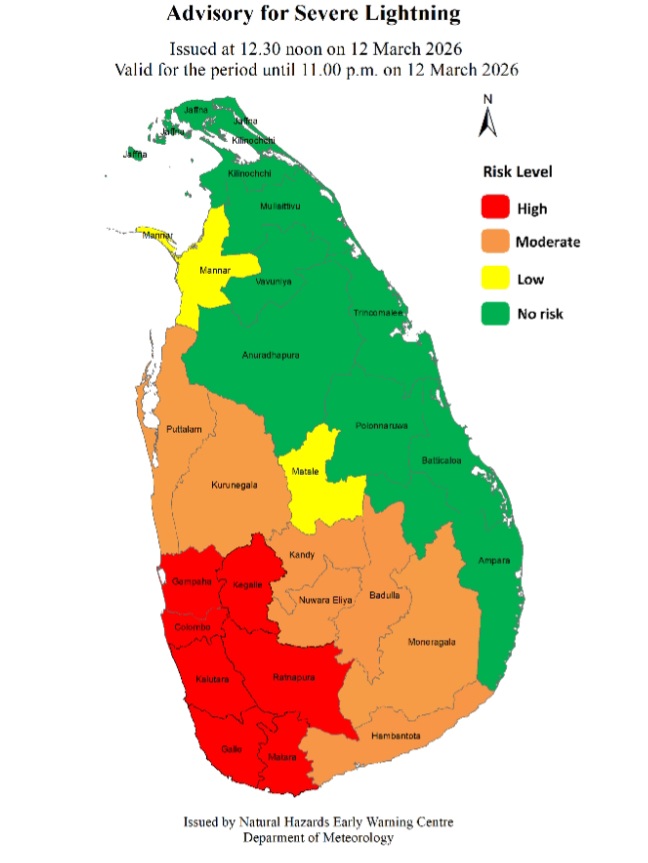
Advisory for Severe Lightning Issued by the Natural Hazards Early Warning Centre at 12.30 noon 12 March 2026 valid for the period until 11.00 p.m. 12 March 2026
Thundershowers accompanied with severe lightning are likely to occur at some places in the Western and Sabaragamuwa provinces and in Galle and Matara districts after 2.00 p.m.
There may be temporary localized strong winds during thundershowers. General public is kindly requested to take adequate precautions to minimize damages caused by lightning activity.
ACTION REQUIRED:
The Department of Meteorology advises that people should:
Seek shelter, preferably indoors and never under trees.
Avoid open areas such as paddy fields, tea plantations and open water bodies during thunderstorms.
Avoid using wired telephones and connected electric appliances during thunderstorms.
Avoid using open vehicles, such as bicycles, tractors and boats etc.
Beware of fallen trees and power lines.
For emergency assistance contact the local disaster management authorities.

A Van Allen Probe spacecraft weighing more than 1,300lb (600kg) is expected to re-enter Earth’s atmosphere almost 14 years after its launch, Nasa says.
The spacecraft is projected to re-enter around 19:45 EDT (23:45 GMT) on Tuesday the US Space Force predicted, according to Nasa, though there is a 24-hour margin of “uncertainty” in the timing.
The Van Allen Probe A, which launched in 2012, is expected mostly to burn up as it travels through the atmosphere, though some components may survive.
The space agency said there is a one in 4,200 chance of being harmed by a piece of the probe, which it characterised as “low” risk.
The spacecraft and its twin, Van Allen Probe B, were on a mission to gather unprecedented data on Earth’s two permanent radiation belts.
It was not immediately clear where in Earth’s atmosphere the satellite is projected to re-enter. The BBC has contacted Nasa for further detail.
Nasa and the US Space Force have said they will monitor the re-entry and update any predictions.
The mission, which was originally designed to last two years, went on for almost seven. It ended after the spacecrafts ran out of fuel and were no longer able to orient themselves toward the Sun.
The probes flew through rings of charged particles trapped by Earth’s magnetic field from 2012 to 2019, in order to study how particles were gained and lost, per Nasa.
Those rings, called the Van Allen belts, shield Earth from cosmic radiation, solar storms and streaming solar wind, which are harmful to humans and can damage technology.
The mission made significant discoveries, including the first data that show the existence of a transient third radiation belt, which can form during times of intense solar activity, Nasa said.
Van Allen Probe B is not expected to re-enter the Earth’s atmosphere before 2030.
[BBC]

Prime Minister Dr. Harini Amarasuriya visited the International Rice Research Institute (IRRI) headquarters in Los Baños, Laguna, Philippines, on 11 March 2026, and held bilateral discussions with Yvonne Pinto, Director General of IRRI, focusing on strengthening cooperation in the field of rice research and sustainable agricultural development.
During the meeting, discussions centered on rice cultivation in Sri Lanka, including the key challenges faced by Sri Lankan paddy farmers. The Prime Minister highlighted issues affecting the sector such as productivity constraints, climate-related impacts, and the need to support farmers through improved agricultural practices and technological innovations.
Both sides also discussed the importance of introducing modern techniques and research-driven approaches to rice cultivation in order to enhance productivity and ensure long-term food security. In this regard, IRRI shared insights on ongoing global research initiatives aimed at improving rice varieties, strengthening climate resilience, and promoting sustainable farming practices.
The discussion further focused on the potential for expanded collaboration between Sri Lanka and IRRI, particularly in areas such as research partnerships, knowledge sharing, and capacity building for Sri Lankan agricultural institutions and farmers. The Prime Minister emphasized Sri Lanka’s interest in strengthening cooperation with IRRI to support the development of the country’s rice sector and to improve the livelihoods of paddy farmers.
The visit reaffirmed the importance of science-based agricultural innovation and international collaboration in addressing food security challenges and enhancing sustainable rice production in Sri Lanka.

(Prime Minister’s Media Division)

Advisory for Severe Lightning issued to the Western and Sabaragamuwa provinces and Galle and Matara districts

Jemimah Rodrigues, Harmanpreet Kaur, Mitchell Starc and Kuldeep Yadav among ESPNcricinfo award winners for 2025

China approves ‘ethnic unity’ law requiring minorities to learn Mandarin

Nasa spacecraft weighing 1,300lb due to re-enter Earth’s atmosphere

Chinese national arrested over attempt to smuggle 2,000 queen ants from Kenya

Attacks reported on three more cargo ships in Gulf, with oil price back near $100

‘Dates have the highest sugar content to fight Coronavirus’

Sunday Island 27 December – Headlines

#SundayIsland 17th December – Headlines

Sunday Island – 28th March

Sunday Island Headlines – 21 March

Sunday Island – 21st February – Headlines
-

 News7 days ago
University of Wolverhampton confirms Ranil was officially invited
-

 News6 days ago
Peradeniya Uni issues alert over leopards in its premises
-

 News7 days ago
Female lawyer given 12 years RI for preparing forged deeds for Borella land
-

 News4 days ago
Repatriation of Iranian naval personnel Sri Lanka’s call: Washington
-

 News7 days ago
Library crisis hits Pera university
-

 News6 days ago
Wife raises alarm over Sallay’s detention under PTA
-

 News7 days ago
‘IRIS Dena was Indian Navy guest, hit without warning’, Iran warns US of bitter regret
-
 Latest News7 days ago
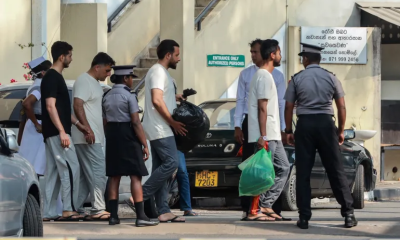
Sri Lanka evacuates crew of second Iranian vessel after US sunk IRIS Dena