
Features
Frenzied feeding of fish and more jungle tales

by Walter. R. Gooneratne
(Continued from last week)
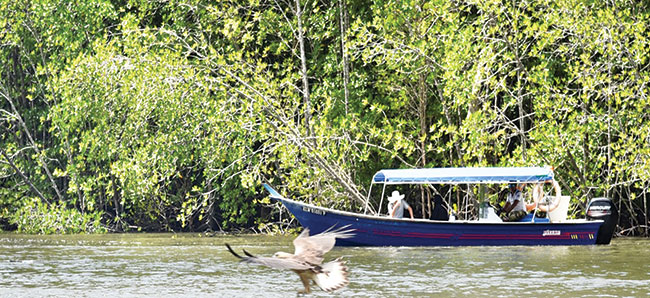
About 5 pm we witnessed something we had never seen before. The river came alive with fish, mainly godaya or grey mullet, dashing upriver, and sometimes leaping in the air, followed by a shoal of koduwa or estuary perch (Latef calcarifer) in a frenzy of feeding. Behind this trail of turmoil followed a small dingy with an outboard motor. In it were the late Dr. Douggie Zilva and another, trolling a line. We heard that the other occupant of the boat was Mr Phillip K. Crowe, the American ambassador who later wrote the book, Diversions of a diplomat in Ceylon on his jungle experiences.
Garuwa told us that this phenomenon occurs not only in the river but also in the two lagoons, Itikala and Yakala Kalapuwa. Even when the mouths of the lagoons are closed. the landlocked koduwas start their frenzied dinner at about 5.30 pm and stop as abruptly at about 6 pm. I witnessed this once again at Yakala on a subsequent trip.
I have seen this kind of frenzied feeding twice more, but this was when there were crocodiles feeding on fish. The first occasion was at Katagamuwa tank. Pervey, Simon and his wife Emilda, Mackie and I were camped on the shore of the lake while on a pig-shooting expedition. One morning there were loud splashing noises coming from the take. I rushed out of the tent thinking a herd of elephants was wading across the water. Just then our tracker came rushing up and wanted us to witness this most unusual sight. A group of about 30 to 40 crocodiles had surrounded a shoal of fish, mainly bolas or murrel or giant snakeheads and walaya or cat fish, and tossed the hapless fish in the air so as to align them and swallow head first. I witnessed the same thing once again on Kokkare Villu in Willpattu National Park.
Partly eaten bait
The next morning we rose early and went to inspect the bait. Sure enough, it had been partly eaten by a leopard. However, as only a small portion of it had been consumed, Garuwa said that the bait had probably been found by it only in the morning and the animal would return early to the feast. Leaving the bait undisturbed, we drove on to Kumana tank. Almost in the centre of the tank was a large sambhur stag feeding on probably the yams of the lotus which grew there in abundance. At the sight and sound of the jeep, it galloped across the lake splashing water before it — a spectacular sight.
After breakfast in the camp, we went back to where the bait was and built a hide in the manner I have described earlier. It was about 15 yards from the bait. However, the rear wall of the hide was an abandoned termite mound which was conveniently located.
Prawns and Russell’s viper
Back at camp, Wasthua suggested that we should have prawns for lunch. He gave me the modus operandi. There were clumps of dead and decaying leaves and twigs stranded in the shallow parts of the riverbed. All one had to do was to pick up these clumps and throw them on the shore and gather up the stranded, hopping prawns that were in them. I was by his side watching the demonstration, but as always in those days, I carried my gun with me. Suddenly Wasthuwa saw what he thought was an extra large prawn wriggling in a clump of leaves. He lifted up what he thought was a king-sized prawn, when he let out a yell, polonga (viper) and ran for dear life. I immediately shot the Russell’s viper which he had pulled out of the water. He was still shivering from fright when I went up to him. Having lived all his life in the jungle, he declared that this was his most terrifying experience. He said that he had once been chased by a wild elephant which had snatched the towel from his shoulder, but that experience was not half as terrifying as this one.
Some years later I came with Mr. Lyn de.Alwis to Kumana on an expedition to collect animals for the zoo. On that occasion, Wasthua accompanied us, and was astounded at the ease with which the staff of the zoological gardens captured deadly snakes, such as cobras and vipers.
Leopard returns
We left camp early at about 4.45 pm for the evening’s adventure with the leopard. Garuwa insisted that the ladies remain in camp, much to their disappointment. Having arrived where the bait was, we found it undisturbed. Spreading out the ground-sheet on the floor of the kotuatte (hide), we sat down on it as comfortably as possible and started our vigil.
Till about 5.30 the jungle was comparatively quiet. Shortly after, a mongoose walked up gingerly, and having checked all was clear, started to feed on the carcass. A few minutes later, the jungle folk started their calls, warning everyone that a leopard was on the prowl. The first was the bark of a muntjak or barking deer. This was followed shortly after by the alarm calls of a troop of langur monkeys. Soon the jungle was alive with calls from more monkeys as well as spotted deer. Obviously the leopard did not bother to conceal himself, as he knew that he had a ready made feast awaiting him.
Suddenly the jungle fell silent and the mongoose scurried away. Garuwa covered the peepholes and signalled to us to be quiet. Two minutes later the tearing of flesh and crunching of bones were clearly audible. A little more time was given for the leopard to settle down. Garuwa then gently opened the peepholes and signaled Ivor to shoot. He was using my shotgun. After what appeared to be a long time, Ivor fired. We heard an animal dashing away into the jungle beyond. We checked to see if there were signs of injury to the animal. Ivor was thoroughly disappointed when there was none.
Garuwa cheered him up, saying that since the animal was unhurt, he would think that the sound of gunfire was due to thunder and therefore return to the kill. I have seen this happen before. As there was still plenty of light, we decided to continue our vigil.
Ferocious elephant
Garuwa had warned us that there was a vicious elephant in these parts and it had attacked a number of people recently. As if in answer to his warning, there suddenly was loud trumpeting of an elephant to our right. As seen through the peephole that covered the track leading to the tank, was a huge elephant, waving its trunk and eyeing us menacingly. Garuwa and I shouted at it in unison. The infuriated animal trumpeted and dashed off into the scrub jungle to our left and a little way behind the bait. From there it made squealing noises and made short rushes at our hide. At our shouts, it would stop and thrash the bush, uttering its squealing noises all the time. Garuwa thought it meant business and decided to beat a hasty retreat. We made an exit through the rear of the hide, over the termite hill, to the jeep which was parked a short distance away.
We made a dash to the camp and safety, though on the way another elephant made a short but abortive charge in the wooded part of the track. When the ladies heard our story, they were not so annoyed that they had been left behind.
As the moon was quite bright, Wasthua suggested that we have a swim in what he said was a clear rock pool lower down the river. The pool was indeed a lovely one, glistening like silver in the bright moonlight. Having returned to the camp quite refreshed, I inquired from Garuwa whether the pool had a name. Of course, he answered, it was called Thummini Gala or Three-death-rock, since three persons had been killed there by crocodiles. I berated him for putting us in such danger. A sundowner was followed by dinner and bed where we were lulled by the persistent call of a nightjar.
Leopard returns again
Early next morning we went to see if the leopard had returned to the kill. The sight that met us was unbelievable. The kotuatte (hide) had been smashed to smithereens, and the termite mound flattened to the ground by the elephant. We thanked our lucky stars for our miraculous escape. However, the leopard had returned to the bait and finished off quite a bit of it. Garuwa was sure it would return as there was quite a lot of flesh left. He set about building a new hide a few yards from the old one and to its left.
We then went bird watching to the villu. There was a large variety of them, mostly aquatic birds, with nests and hatchlings in them. They included spot-billed pelican, painted stork, ibis, spoonbill, and several species of egrets, cormorants, Indian darters, shags, whistling teal, grebes, white-breasted and stork-billed kingfishers and pond herons. A few crocodiles were also seen cruising about in the villu, and a sounder of wild boar was grubbing about on the far side of the villu. A bath in jungle rivers is always most refreshing. After a glass of chilled beer, and a chicken-curry lunch, we retired for a short siesta as we had to be up early in preparation for the evening’s adventure.
After previous evening’s happenings, the ladies were not keen on accompanying us. At about 4.30 pm, Garuwa, Wasthuwa, Ivor and I left for the hide. Having made ourselves as comfortable as possible in the cramped conditions, we settled down to our vigil. By 5.30 the mosquitoes descended on us in their buzzing hordes.
Having been undisturbed the previous night, the leopard, as predicted by Garuwa, was coming early to the banquet, as evidenced by the chorus of alarm calls by the jungle community. The first was a cacophony from the langur monkeys. This was followed shortly after by the calls of peafowl and spotted deer. At 6.05 pm the noise of tearing flesh and crunching of bones came from the site of the bait. Our prize was at his meal, and too engrossed in it to notice the danger he was in.
Garuwa cautiously uncovered his peephole, and peered through it. I was behind him and saw the leopard lying down and feeding. Garuwa now silently uncovered Ivor’s peephole too and motioned him to shoot. Soon a shot rang out and the leopard was felled by the impact of the SG slugs, and there was no further movement from it. We waited awhile, threw some sticks at it and as there was still no movement, we knew the animal was dead. It was a young male in its prime. Ivor was jubilant with his trophy.
We hove it onto the bonnet of the jeep and drove back to camp in triumph. There were congratulations for Ivor on his trophy. Kadisara stroked the animal in admiration. After a bath there were more celebrations. Garuwa and Wasthua were given a double dose of their “cup that cheers”.
(To be continued next week)
(Excerpted from Jungle Journeys in Sri Lanka edited by CG Uragoda)


 Despite some sections of the Trump administration persisting with the view that the possibility could not be entirely ruled out of there being a diplomatic solution to the current US-Iran hostilities in West Asia, the skeptic could not be blamed for thinking otherwise. The intensity, scale and frequency of the tit-for-tat strikes by the antagonists over the past few days against selected military targets and civilian infrastructure in particular in West Asia make the adoption of this stance excusable.
The continuing hostilities render the mentioning of the MOU signed between the warring parties in mid-June a laughable matter. While it could very well be that the foes are wishing privately for a cessation of hostilities before long, what seems to be uppermost on their minds right now is to negotiate with each other from a position of strength. This strategy compels them to incapacitate each other militarily to the extent possible, lest they have to concede too much to each other during negotiations. Hence the stepped-up hostilities.
However, even on the question of there being a negotiated political settlement in the West Asian theatre in the longer term, the skeptic could come to be seen as scoring over the optimist. Developments on the ground account for this.
At the time of writing Israel’s Netanyahu government is going ahead in fairly care-free fashion with the establishment of more Jewish settlements in the Gaza and the West Bank, and it’s all happening under the apparently complacent gaze of the US. In fact, some quarters estimate that Israel is in control of some 65% of the Gaza Strip. Ethnic cleansing, that is, is being drastically stepped-up.
Accordingly, in terms of the power relations of West Asia, the world is almost back to the status quo of the late forties of the last century when the state of Israel was established and the Palestinians were reduced to a microscopic minority in the land they came to inhabit. Therefore, even the impartial observer would be compelled to ask: ‘Will a negotiated peace be ever possible in the Middle East?’
The humanist in the observer would prefer to answer this question in the affirmative and it is indeed the ideal stance to adopt considering the staggering human and material costs of the conflict. But the way ahead to peace could be expected to be highly hazardous and arduous. Among other odds, it would also prove an uphill endeavour to win minds and hearts.
The US’ Trump administration would need to be counted out in this pursuit. This is on account of the fact that it has been far too wayward in its management of West Asian affairs in particular over the past couple of years. Given its unpredictable character it is a matter for conjecture whether it could be counted on to live up to its commitments.
Moreover, Israel could be expected to ‘go it alone’ in the Middle East regardless of whether US help is coming or otherwise. It has indicated as much in recent times and Israel could be doubted on this score only at the doubter’s peril. Because time and again Israel has demonstrated that it could steadfastly defend its interests even single-handedly in the Middle East. History bears this out.
However, a durable alliance with the US would stand Israel in good stead. On the matter of military and intelligence assistance, for example, the US’s help proved invaluable for Israel in the past and going forward this is bound to be so as well. Moreover, it is unlikely that the Trump administration would give up on Israel, considering that a strong Israel is crucial for the furtherance of the US’ strategic and economic interests in West Asia.
But whether the above factors would have a considerable bearing on the question of working out a durable solution to the West Asian tangle is an entirely different matter. Israel, as in the case of the Palestinian enclaves, is acutely security conscious and would need to satisfy itself fully that it could live in a security environment that would guarantee its complete safety, going forward.
The Middle East is badly in need of another peace effort on the lines of the Oslo Accords of the mid-nineties that brought the key actors together and helped hammer out a solution that addressed some of their notable concerns. To be sure, that process did not prove to be the ideal answer to the tangle, but it yielded some respite to the region and drove home that one-time sworn foes could indeed negotiate with a degree of success. The West Bank authority, although falling short of fulfilling some key Palestinian aspirations, is testimony that a degree of success is possible if the intent is right.
Given the current realities of West Asia, peace-making is bound to be an uphill challenge. The violence faced in recent times by the Palestinian community, in particular, has been nothing less than mind-numbing. Merciless has been the violence visited on them by the Israeli side. In such circumstances, durable peace in the region could smack of an idealist’s dream.
Nevertheless, there needs to be urgently, a meeting of minds over the divides. The US would need to be counted out as an honest broker in bringing the sides together but the rest of the West would do well to step up to the challenge.
In this exercise the onus would be on the world’s democracies to take the initiative and doggedly stay the course. An acceptable combination would be the EU and the UN. Given their credentials, the main sides in West Asia ought to find them the least controversial.
Even if the relevant institutional and political arrangements could be shored up to take a reconciliation process forward, winning hearts and minds for the peace drive would prove a grueling challenge. Over the past few years in particular tens of thousands of hearts and minds on both sides of the divide have been bruised badly in the runaway murderous violence that has come to define the Middle East.
These badly scarred personalities would need to experience healing without much delay. It is therefore a multi-faceted challenge that is at hand. Since wide-ranging expertise would be needed in the healing process, people’s participation in peace-making, ranging over the divides, would need to be made a durable reality. It will be a time for enthroning humanity and ensuring the rejection of all forms of violence and coercion.

 For many Sri Lankans, Thailand is the go-to holiday — beaches, temples, food, and that famous warm hospitality.
In fact, I’ve been to Amazing Thailand 24 times myself, and was honoured with the Friends of Thailand International Media Award by the Tourism Authority of Thailand for promoting Thai tourism.
The good news I have for you today is that you don’t even need a passport to get a taste of Amazing Thailand.
The Royal Thai Embassy, in Colombo, is bringing a vibrant slice of Thailand, to the city of Colombo, with Thai Festival 2026 — a cultural experience like never before.
Whether you are an avid enthusiast of Thai culture, a total novice, or simply just interested in exploring foreign cultures, Thai Festival 2026 is going to be the perfect opportunity for you to get more than just a glimpse into one of the most celebrated cultural heritages in South East Asia. And ENTRANCE IS FREE.
The festival will be held on the 1st and 2nd of August, 2026, at Siam Nivasa, 43, C.W.W. Kannangara Mawatha, Colombo 7, and the East Parking Area, of the Colombo Municipal Council, from 11:00am to 5:00pm.
Both days will be full of live entertainment, and dispersed throughout with Thai cultural displays, including exhilarating traditional dance performances and breathtaking Muay Thai demonstrations.
Exploring art and craft specific to Thailand, tasting irresistible authentic Thai cuisine, and playing arcade games, are just a few more fun-filled events available for visitors at the festival premises.
An array of Thai products will also be available for purchase.
While at the festival, you will find Sri Lankan Alumni from Thai universities sharing their experiences with you and willing to answer any questions you might have, related to studying abroad in Thailand.
You can also register for the Muay Thai workshop that will be happening on the 7th and 8th of August, 2026, in Colombo.

Irresistible authentic Thai cuisine
Visitors can also stand a chance to win traditional Thai souvenirs, get exclusive photo opportunities, and, the big one — to enter the raffle draw, at the end of each day, for the grand prize of an all-inclusive round trip to Thailand.
Be sure to avail yourself of this exceptional opportunity and add a cultural spin to your weekend.
To keep up with the latest updates on Thai Festival 2026, head over to the Thai Festival official social media pages.
The Royal Thai Embassy in Colombo official webpage:
https://colombo.thaiembassy.org
Official social media:
Facebook: @RTEColombo
Instagram: @thaiembassysrilanka
Thai Festival official social media:
Facebook: Thai Festival in Colombo
Instagram: @thaifestival_colombo
TikTok: @thaifestival.incolombo

 Hair fall, in this heat, can be so frustrating, and noticing a thin patch is even more worrying. The good news is … yes, with a little care and kitchen ingredients, you can nourish your scalp and support healthy regrowth.
Try these four easy home remedies … even our grandmothers trusted:
* Coconut Oil and Curry Leaves Tonic:
Warm 04 tablespoons of coconut oil, with a handful of curry leaves, till the leaves turn black. Cool, strain, and massage into scalp 02-03 times a week. Leave for 01 hour, or overnight.
Why:
Coconut oil deeply nourishes, while curry leaves help strengthen roots and add shine.
* Onion Juice for Spot Treatment:
With cotton, dab the juice of 01 small onion, directly on the thin/bald patches. Leave for 20-30 minutes, and then wash with a mild shampoo. Use twice a week.
Why:
Rich in sulfur, onion juice helps boost blood circulation to the scalp.
* Aloe Vera and Castor Oil Mask:
Mix 02 tablespoons of fresh aloe vera gel and 01 tablespoon castor oil and apply to the scalp, focusing on thinning areas. Leave for 45 minutes, and then rinse with cool water.
Why:
Aloe vera soothes the scalp, while castor oil coats hair to make it look thicker.
* Fenugreek and Curd Strengthening Pack:
You will need 02 tablespoons fenugreek seeds, soaked overnight, and 02 tablespoons plain curd.
Grind to a paste, apply to scalp for 30 minutes, and then wash.
Why:
Fenugreek strengthens strands and reduces breakage.
Extra Tips for Healthy Hair:
Avoid tight hairstyles that pull on the scalp.
Eat iron and protein rich foods: greens, dhal, eggs, fish.
Use lukewarm water, not hot.
Be gentle when brushing and drying.
Manage stress — it plays a big role in hair fall.
Important: If bald patches are growing, or there is itching/redness, please consult a dermatologist.
Home remedies support hair health, but a doctor can find the exact cause.
Remember, healthy hair starts with a healthy, happy you.

Taskin Ahmed withdraws from LPL to prepare for Australia tour

US and Saudi Arabia announce nuclear cooperation deal

Navy seize Indian fishing trawler, nine fishermen poaching in Sri Lankan waters

Sri Lanka edge Qatar in Davis Cup opener

Dambulla Sixers hand Galle Gallants first defeat in LPL 2026

Jaffna Kings beat Colombo Kaps by five runs

‘Dates have the highest sugar content to fight Coronavirus’

Sunday Island 27 December – Headlines

#SundayIsland 17th December – Headlines

Sunday Island – 28th March

Sunday Island Headlines – 21 March

Sunday Island – 21st February – Headlines
-

 Features4 days ago
Two memorable excerpts from a former SLAF commander’s memoir
-

 Business4 days ago
‘Giving up was never an option’: The fisherman who fought back after losing millions in SL
-

 Latest News5 days ago
Davis cup Asia/Oceania Group IV 2026 to be held in Colombo from 20th to 25th July
-

 Features4 days ago
Erdoğan’s New Republic
-

 Life style4 days ago
Taste of the Swiss Alps comes to Colombo
-

 News5 days ago
Evidence recorded in money laundering case against Yoshitha Rajapaksa
-
 News5 days ago
Dengue outbreak gallops ahead: Infections surpasses 73,455, leaving 50 dead
-

 Midweek Review1 day ago
Three high-profile alleged suicides shaping key investigations