Connect with us

News

Financial crisis so acute teachers’ demands cannot be met – SLPP Chairman

Published

on

300,000 entering schools for first time this year among those victimised

By Shamindra Ferdinando

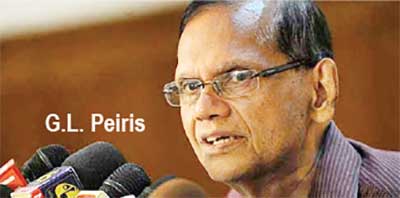
SLPP Chairman and Foreign Minister Prof. G.L. Peiris yesterday (18) emphasised that the worsening financial crisis experienced by the country was so acute the government wasn’t in a position to grant the salary increase sought by school principals and teachers.

Prof. Peiris, who served as the Education Minister till August this year said that the public realised the government lacked the wherewithal to meet the striking teachers’ demands. The academic said so at the weekly SLPP media briefing at the party office in Battaramulla.

Responding to media queries, Prof. Peiris stressed that the government expected the striking teachers to facilitate re-opening of schools on a staggered basis beginning Oct 21 (Thursday). The Minister indicated that striking unions shouldn’t expect to settle the salary issue on their terms as the government lacked the means even if it wanted to do so.

Referring to the rapid deterioration of public finances in the wake of Covid-19 eruption in early 2020, Prof. Peiris said that Budget 2022 was presented amidst an extremely difficult time.

The top SLPP spokesperson reiterated the government’s commitment to grant strikers’ demand in two stages as announced by Prime Minister Mahinda Rajapaksa at a meeting with striking unions at Temple Trees. Premier Rajapaksa on Oct 12 told a delegation of striking unions that the government would pay one third of the increase through the Budget 2022 and the remaining two in the following year’s budget.

The Premier’s Office quoted him as having told the delegates that the sharp drop in government income deprived the administration of an opportunity to grant the increase. Striking unions want the government to settle the issues immediately in one go.

Prof. Peiris appealed to those who have been on strike for 100 days to resume teaching. The student community really suffered due to the Covid 19 eruption and further delay in resuming studies would be catastrophic, Prof. Peiris said, underscoring the importance of restoring normalcy as about 300,000 would go to schools for the first time in their life.

Prof. Peiris said that schools that conduct classes from Grade 1 to 5 and those with less than 200 students would be re-opened on Oct 21. According to the minister, approximately 3,800 schools would be re-opened as scheduled.



Continue Reading
Advertisement
Click to comment

Leave a Reply

Your email address will not be published. Required fields are marked *

Latest News

Prime Minister off to the United Kingdom to participate in the 22nd Annual Commonwealth Education Forum

Published

on

By

Prime Minister Dr. Harini Amarasuriya departed on an official visit to the United Kingdom to participate in the 22nd Annual Commonwealth Education Forum and the Commonwealth of Learning (COL) 2026 Board of Governors Meeting.

During the visit, the Prime Minister is scheduled to participate in several high-level academic and diplomatic engagements aimed at strengthening cooperation in the fields of education, development studies, research collaboration, and international partnerships.

As part of the visit, the Prime Minister will meet with Ms.Bridget Phillipson, Secretary of State for Education of the United Kingdom, at the UK Department for Education, to discuss areas of cooperation in education and related sectors. She is also expected to meet Ms.Yvette Cooper, Foreign Secretary of the United Kingdom, for discussions on matters of bilateral interest and cooperation between Sri Lanka and the United Kingdom.

In addition, the Prime Minister is expected to meet Ms.Shirley Ayorkor Botchwey, Secretary-General of the Commonwealth, on the sidelines of the 22nd Annual Commonwealth Education Forum and the Commonwealth of Learning (COL) 2026 Board of Governors Meeting.

During the visit, the Prime Minister will attend a public event at the Institute of Development Studies at the University of Sussex and she will also take part in the ceremony marking the 60th Anniversary of the Institute of Development Studies. The Prime Minister is also scheduled to address a session at the Oxford School of Global and Area Studies at the University of Oxford, followed by a question-and-answer session with scholars and students.

The visit is expected to strengthen Sri Lanka’s engagement with academic institutions, international development partners, and Commonwealth member states, particularly in the areas of education, research, policy dialogue, and capacity building.

[Prime Minister’s Media Division]

Continue Reading

Latest News

Steps initiated to safeguard Sri Lanka’s Maritime Heritage

Published

on

By

Taking a decisive step towards safeguarding Sri Lanka’s maritime heritage, a high-level discussion was held today (18) at the Ministry of Environment.

Jointly chaired by the Deputy Minister of Environment Anton Jayakody and Deputy Minister of Defence Aruna Jayasekara, the meeting focused on the urgent need to prevent environmental pollution and protect the coastal waters around the northern seas and their adjacent islands.

The discussion was attended by senior naval officers, Secretary to the Ministry of Environment  K.R. Uduwawala, Chairman of the Marine Environment Protection Authority (MEPA)  Samantha Gunasekara, Director General of the Coast Conservation and Coastal Resource Management Department Prof. Turny Pradeep Kumara, and Conservator General of Forests  along with several other officials from the Department of Wildlife Conservation and the Ministry of Environment, and the senior ecologists from IUCN.

The discussion placed a strong emphasis on enhancing environmental threats and accelerating the declaration of  new Marine Protected Areas (MPAs) in the northern region. Officials emphasized that protecting this marine zone is crucial for conserving biodiversity, securing the livelihoods of local fishing communities, and enhancing Sri Lanka’s strategic maritime profile on the global stage.

Primary attention was drawn to the severe ecological destruction caused by Illegal, Unreported, and Unregulated (IUU) fishing. The Ministers highlighted the grave threats these unlawful activities pose to both marine biodiversity and the economic stability of local fishermen, stressing the immediate need for comprehensive surveillance and stricter enforcement mechanisms. Furthermore, extensive discussions took place on how to divest a strategic destructive fishing practices—such as dynamite fishing, unauthorized spearfishing, and the use of banned fishing gear—which inflict irreversible damage on fragile coral reef systems and endangered fish species.

The meeting also addressed infrastructure and governance gaps within fishing harbors, identifying the lack of proper management and formal regulatory mechanisms as key vulnerabilities. As a progressive step forward, suitable islands and surrounding marine zones in the Northern Province have been identified for official declaration as Marine Protected Areas. It was clarified that establishing these MPAs will not restrict the livelihoods of local communities; instead, they are designed to protect and promote sustainable fishing and eco-tourism. Moving forward, these protected zones will be developed into premier eco-tourism destinations, creating new economic opportunities for the region. Ultimately, declaring these Marine Protected Areas will bring international recognition and strategic importance to Sri Lanka’s northern islands. By establishing these zones, Sri Lanka aligns itself strongly with global biodiversity commitments, showcasing its role on the international stage as a responsible custodian of the Indian Ocean’s rich marine resources.

During this discussion, it was proposed to establish a working group comprising experts from the Ministry of Tourism, the Ministry of Fisheries, the Ministry of Defence, the Ministry of Environment, and the Ministry of Justice to implement a joint mechanism for protecting the country’s coastal and marine resources, with the Ministry of Environment taking the lead in this initiative.

This conservation initiative marks yet another milestone in the country’s ongoing journey toward achieving a sustainable biosphere and an evergreen future.


Continue Reading

News

Surcharge on vehicle imports irks SJB, pleases ex-Finance Minister

Published

on

Opposition and SJB Leader Sajith Premadasa has launched a scathing attack on the government for the 50% Customs duty surcharge on vehicle imports, accusing the latter of burdening the public with additional costs, despite its earlier promises to make vehicles more affordable.

Addressing the media in Tissamaharama, on Saturday, Premadasa said those who had once pledged to make a Vitz car available for Rs. 1.2 million had now moved in the opposite direction by increasing duties on vehicles.

Premadasa questioned assurances given by Deputy Finance Minister Dr. Anil Jayantha Fernando that vehicle prices would not significantly increase due to the surcharge, asserting that the President, the government and its 159 Members of Parliament must take responsibility for the consequences of the decision.

The Opposition Leader also voiced concern over the depreciation of the rupee, warning that the local currency was weakening rapidly against the US dollar and that continued depreciation would lead to higher inflation, rising commodity prices and further increases in the cost of living.

He said economic stabilisation could only be achieved through stronger export earnings, growth in the tourism sector, higher foreign remittances and increased Foreign Direct Investments (FDIs).

Premadasa further accused the President, the Finance Minister and the Government of lacking a basic understanding of economics, claiming that repeated policy mistakes had adversely affected the economy and the public.

He called for an increase in subsidies, arguing that rising living costs were placing families under severe financial strain and affecting their ability to look after their families.

Premadasa added that shoring up foreign reserves and arresting the depreciation of the rupee would be critical in meeting debt obligations and safeguarding public welfare.

Meanwhile, the Vehicle Importers Association of Sri Lanka (VIASL) warned that the Customs duty surcharge would lead to steep increases in vehicle prices, further reducing affordability for consumers.

VIASL spokesperson Arosha Rodrigo told the media that the surcharge, introduced through a gazette notification, had come on top of existing customs duties and the depreciation of the rupee against the US dollar.

“Vehicle prices are rising at a rate that no one can afford. The new surcharge on top of this is unbearable for vehicle importers. Many vehicles will increase by Rs. 1.5 million to Rs. 2.5 million,” Rodrigo said.

He explained that customs duties on all vehicles, whether imported privately or through dealerships, would rise due to the duty surcharge.

Responding to mounting criticism, Deputy Finance Minister Dr. Anil Jayantha urged the public not to be misled by what he described as false claims that vehicle prices would rise by 150% due to the surcharge.

Dr. Jayantha said misinformation was being circulated regarding the surcharge and insisted that claims of a 150% increase in taxes or vehicle prices were “completely false.”

He explained that the temporary three-month surcharge was intended to delay non-essential private vehicle imports and reduce pressure on foreign exchange reserves during a period of economic uncertainty.

“The message we are giving is simple: if you can postpone importing a vehicle for personal use, please do so. This is not a move intended to increase vehicle prices,” he said.

According to the Deputy Minister, existing taxes on vehicle imports were already at approximately 130%, and the newly announced surcharge mechanism had been widely misunderstood in public discourse.

He further clarified that vehicles imported under Letters of Credit opened on or before May 15, 2026, would not be affected by the revised tax structure.

“Even if those vehicles arrive months later, they will continue to be taxed under the previous rates. The new tax structure only applies to LCs opened after May 15,” Dr. Jayantha said.

He also stressed that there was no reason for consumers to rush to purchase vehicles, fearing price increases.

Dr. Jayantha noted that motorcycles, three-wheelers and vehicles imported for commercial purposes had been excluded from the temporary measure.

He maintained that the policy was aimed at managing pressure on foreign exchange reserves, maintaining economic stability and curbing unnecessary import demand during the three-month period.

Meanwhile, former Finance Minister Ali Sabry, in a social media post, has endorsed the government’s decision to impose a 50% Customs duty surcharge on vehicle imports, calling a timely intervention to protect the country’s foreign currency reserves. He has said it is a necessary safeguard.

“The Government’s decision to impose a 50% surcharge on the import of vehicles, in the midst of escalating global uncertainty and external pressures, is a prudent and timely measure aimed at protecting Sri Lanka’s fragile external sector and preserving scarce foreign exchange reserves,” Sabry said in a statement on social media.

He has also praised the government’s decision to exempt the Letters of Credit opened on or before May 15, 2026, from the surcharge. “It avoids unnecessary uncertainty, prevents retrospective complications, and protects already embattled importers from further hardship and arbitrary administrative difficulties. In times of crisis, clarity, consistency, and fairness in implementation are just as important as the policy itself,” the former Minister has said, warning that Sri Lanka’s recovery remains vulnerable to global conflicts that disrupt energy markets, trade routes, supply chains, investor confidence, tourism, and financing conditions.

Continue Reading

Trending