
News
Eyebrows raised over axing Covid Prevention State Ministry Secretary

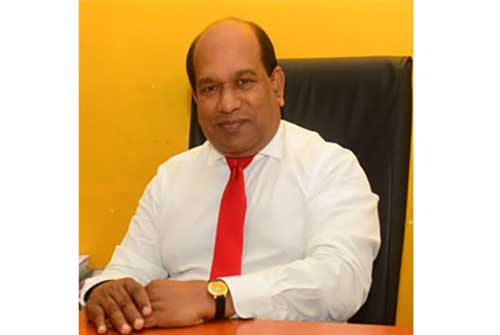
‘High achievers cannot co-exist amidst tail waggers and tale-carriers’ – PSUNU leader
By Suresh Perera
The unceremonious exit of Sri Lanka’s most senior medical administrator just three months after his appointment as Secretary to the State Ministry of Primary Health Services, Pandemics and COVID Prevention, has raised more questions than answers, especially at a time the country is in the throes of a raging deadly virus.
The sudden removal of Dr. Amal Harsha de Silva, a medical specialist with a highly acclaimed academic background, has triggered speculation that the marching orders came after, what was described as “preferential treatment” accorded to a former national cricket captain to receive the Covid-19 jab.
The assertion seems to have gained currency, going by social media reports doing the rounds, but if true, it’s a “from the sublime to the ridiculous”
scenario as VIP lists to administer the vaccine on a priority is an open secret, health officials said.
Colombo’s Mayor Rosy Senanayake was also accused of forwarding a list of 700 plus names for preferential treatment for the jab. The well tabulated list became the talking point after it was posted on social media platforms. However, the Mayor vehemently denied prioritizing any VIPs for the vaccine, saying it’s a “bid to vilify her”.
While many VIPs and their relatives received the jab without much hassle, health officials said that it was to the credit of Minister Vasudeva Nanayakkara that his wife Wasanthi stood in the queue for almost two hours at an inoculation centre in Colombo.
She politely declined a request to be given the vaccine on a priority basis and stood in the queue for her turn”, they said.
“Eminent medical professionals who have proved their mettle are being tossed around and posted to institutions, which are totally irrelevant to their knowledge and expertise”, says Ven. Muruththettuwe Ananda Thera, president of the Public Service United Nurses Union (PSUNU).
What’s happening in the government health sector is beyond sense and logic. Everything has gone haywire, he complained.
Can anybody justify moving out an accomplished medical specialist cum the country’s senior most medical administrator to an institution where they make poonac”, the prelate asked, referring to Dr. de Silva’s transfer as Secretary to State Ministry of Backward Rural Areas Development & Promotion of Animal Husbandry and Minor Economic Crop Cultivation.
The crux of the matter here is not so much about administering a vaccine to a cricketer, but the incompetence of the health secretary on whose watch the whole health sector has plunged to a new low, he asserted.
“It is a clear cut case of incapable officials feeling uneasy and uncomfortable when there are highly accomplished and competent people in their midst”, he remarked.
The initial faux pas was the transfer of eminent Consultant Surgeon, Dr. Anil Jasinghe, who spearheaded the first Covid-19 wave as Director-General of Health Services, the PSUNU leader recalled.
“Dr. Jasinghe earned plaudits for effectively tackling the initial Corona outbreak and instead of being honored for a job well done, he ended up in the Environment Ministry, an alien, non-medical institution”, he noted.
Dr. Amal Harsha de Silva, who coordinated the concerted effort against Covid-19 as Secretary of the State Ministry in charge of the specific subject, was paid with the same coin. He has now been moved out to supervise animal husbandry, the prelate continued.
Health officials said that Dr. de Silva played a pivotal role in coordinating the import of Covid-19 vaccines to Sri Lanka and put together the inoculation drive.
As a top medical professional, he knew what he was doing unlike some officials in the hierarchy who are groping in the dark, they said. “It appears that high achievers cannot co-exist amidst tail waggers and tale-carriers”.
Dr. de Silva served as the Deputy Director-General (Medical Services) prior to his appointment as Secretary to the State Ministry in charge of Covid prevention. (Also see GMOF statement on Page 3)



News
Establishment of an Institutional Framework to Inagurate Upper Hydro Catchment Areas Management Authority

Policy approval of the Cabinet of Ministers was granted at their meeting held on 08.06.2026 to establish the Upper Hydro Catchment Areas Management Authority for identification and
execution of a formal and long – lasting remedy to secure the central hills including the upper hydro catchment areas enabling them to sustain amidst extreme weather conditions
due to natural calamities and human activities as well as to be used for the sustainable development of the country.
Accordingly, a concept paper has been prepared including
institutional structure, activities, powers, active subject area as well as administrative and coordination mechanism for the proposed authority by an expert technical committee appointed by the Secretary to the President.
Based on the said concept paper, the Cabinet of Ministers granted approval to the resolution furnished by the President to instruct the Legal Draftsman to prepare a draft bill including legal provisions required for the establishment of Upper Hydro Catchment Areas Management Authority.
News
Introduction of Flora and Fauna (Regulation of actions of the Indigenous Community within the nominated areas) Regulations
With the objective of securing the traditional livelihood and the eco system of the indigenous community, it has been recognized the necessity of introducing a formal regulation methodology to secure their engagement in livelihood activities by being more sensitive to the existing laws.
Thereby, the Fauna and Flora (regularizing) regulations under the Fauna and Flora Protection Ordinance (Authority 469) have been prepared so that nominated activities within the prescribed area to a member of the indigenous community
who has been registered for securing the rights acquired from law or custom or usage or traditional stance to execute an act within a certain state land that is fundamental to the survival of the indigenous community permission can be granted
Accordingly, the Cabinet of Ministers granted approval to the resolution furnished by the Minister of Environment to publish the said regulations in the government gazette notification and thereby submit to the Parliament for its concurrence.
Latest News
M. M. D. J. Senarathne, appointed Director General of the Department of National Botanical Gardens
The Cabinet of Ministers approved the resolution furnished by the Minister of Environment to appoint M. M. D. J. Senarathne, who is the senior most officer in Grade I of Sri Lanka Scientific Service se

Establishment of an Institutional Framework to Inagurate Upper Hydro Catchment Areas Management Authority
Introduction of Flora and Fauna (Regulation of actions of the Indigenous Community within the nominated areas) Regulations
M. M. D. J. Senarathne, appointed Director General of the Department of National Botanical Gardens

Harmanpreet Kaur steps down as India captain

Turkiye, Pakistan agree Saudi Arabia military deployment under Mecca pact

Rumesh Tharanga among nominees announced for World Athlete of the Year 2026

‘Dates have the highest sugar content to fight Coronavirus’

Sunday Island 27 December – Headlines

#SundayIsland 17th December – Headlines

Sunday Island – 28th March

Sunday Island Headlines – 21 March

Sunday Island – 21st February – Headlines
-

 Latest News7 days ago
Gold winner Tharanga gets brand-new Honda Vezel from SLAAJ
-

 News6 days ago
US-assisted ‘Ice’ detection: NPC to examine IGP’s move to transfer drug-busting team
-

 Features7 days ago
Why Sri Lanka needs an Inclusive Civic Nationalism – urgently
-

 Editorial5 days ago
Colombo Port drug bust: The plot thickens
-

 News7 days ago
Civil society activist accuses govt. of favouring Ven. Gnanasara
-
 Midweek Review7 days ago
Dappula’s Easter Sunday ‘grand conspiracy’ claim demolished
-

 Editorial7 days ago
When crime bosses rise above law and shrines
-
Editorial6 days ago
Drug busting, transfers and trust deficit