
Sports
Exodus of white South African cricket talent

by Rex Clementine
Every time Sri Lankan teams go to South Africa, they ask the locals one question. ‘What happened to Marchant de Langa?’ The six foot seven inch tall quick, made his Test debut against the Sri Lankans in Durban in 2011. He took seven wickets in the first innings and his victims included Kumar Sangakkara, Angelo Mathews, and Tilan Samaraweera et al. Yet, after that, he was hardly heard of. So what actually happened to de Langa? Well, he turned ‘Kolpak’ preferring County Cricket in England instead of Test cricket for his country.
Isn’t that absurd? One may wonder. The ultimate joy for any player is to represent your country. That too, after you had proven yourself in Test cricket, why do you want to return to First Class cricket? Well, the reason being, white South African cricketers get a raw deal in their country and they are seeking greener pastures in Europe or in places like Australia and New Zealand. Not just cricketers, this includes farmers, businessmen and other professionals. Australia in particular welcomes South African farmers with open arms.
For decades, the black South Africans suffered at the hands of white rulers and those terrible apartheid laws not only segregated them but deprived them of equal opportunities. The world took notice and imposed trade embargos on South Africa. Sports associations followed banning bilateral sporting ties with South Africa and in the end; they were left with Hobson’s choice but to give in for fair play.
Sadly, now white South Africans are at the receiving end due to the ‘quota system’ that is prevalent across all walks of life. When seeking employment, black South Africans get the preference, followed by coloured and those of Indian origin and the whites come last. So opportunities for them are few and rare. In sports too talent alone won’t get you there. The quota system encourages more black South African representation and as a result the whites are moving out.
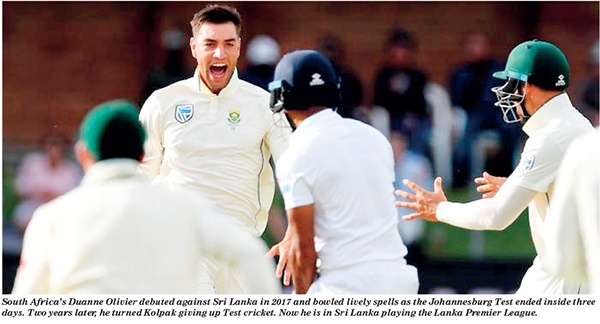
In the Lanka Premier League, two South Africans share the new ball for Jaffna Stallions – Kyle Abbott and Duanne Olivier. Both were successful international cricketers before they turned Kolpak settling in England to play County Cricket.
Abbott was playing the New Year Test against Sri Lanka in Cape Town in 2017. That he had signed a Kolpak deal was a poorly kept secret and the news was out during the Test match. Cricket South Africa reacted angrily and wanted to separate. The fast bowler announced his retirement at the conclusion of the Test match. This was the second Test. So for the third game in Johannesburg, the Proteas were short of a fast bowler. They drafted in Duanne Olivier.
Olivier on debut was on the money and his pace was too much to handle for the Sri Lankans. The game was lost inside three days. Two years later when Sri Lanka returned to South Africa, Olivier along with Kagiso Rabada was South Africa’s premier bowlers. Yet, after the second Test, Olivier too turned Kolpak and South Africa lost yet another fine talent in his prime.
All South Africans who have turned Kolpak are doing a terrific job for their respective counties. Their country meanwhile is struggling to make an impact in the sport. South Africa are ranked sixth in Tests and fifth in ODIs and T-20s. Not the true reflection of their sporting greatness.
What the Kolpak ruling means is that citizens of the country who have trade agreements with the European Union countries are eligible to work as locals. Now South Africa is not part of the EU, but they have a trade agreement with EU and that qualifies their citizens. So when English counties hire South Africans, it’s not considered an overseas signing.
In the last few years with Britain exiting from the European union more South Africans turned Kolpak in order to qualify. Cricket authorities in South Africa must be hoping that now their problems will end as Kolpak deal is no longer valid once Britain exits EU. However, unless they deal with serious issues like equal opportunities to all, they are going to face more problems.






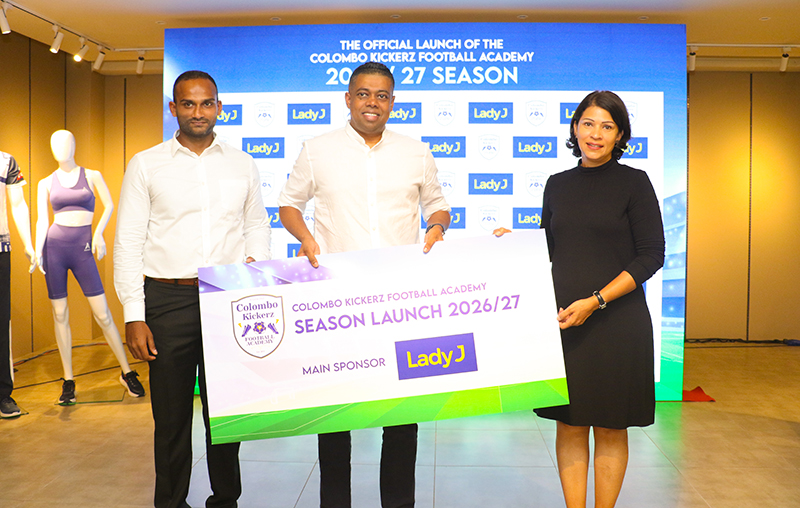
Colombo Kickerz Football Academy at a media briefing held on Wednesday (25) announced that ‘LadyJ’ one of the largest homewear stores in Sri Lanka has come on board as the acadamie’s main sponsor and The Papapare as the Digital Media Partner in the 2026/27 season.
With over 300 aspiring football enthusiasts between the ages of 5 to 18 on roll,
Colombo Kickerz Football Academy founded in 2015 by Ms Viveca Weerasinghe is one of the largest football academies in the island.
The academy provides their changes woth the opportunity of being nurtured by internationally trained coaches and gain experience by playing in local and international competitions on their way to become Sri Lanka’s future football stars.
Managing Director of LadyJ Anuraddha Wijerathne highlighted the importance of investing in sports at grassroot level and supporting young athletes.
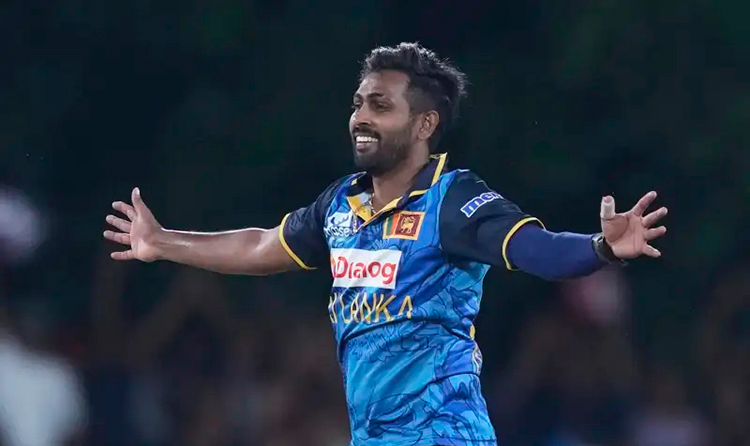
Many would argue that had Sri Lanka gone into the recent World Cup with all their big guns fit and firing, they might have reached the semis. That’s the popular line doing the rounds. But if we are calling it as we see it, this campaign was heading for a collapse even before the first ball was bowled.
Reappointing Dasun Shanaka as captain was a gamble, lacked foresight and in the end created divisions within the team. The decision to bring back Pramodya Wickremasinghe as Chairman of Selectors didn’t inspire confidence either. It was a move that had trouble written all over it, the kind that can unsettle a dressing room before a ball is even delivered. It’s like appointing Mervyn Silva as Public Relations Minister. A bull in a China shop is less troublesome than these two southerners.
Of course, injuries played their part. Losing Matheesha Pathirana and Eshan Malinga robbed the attack of bite, but the biggest dent was the absence of Wanindu Hasaranga. A proven match-winner, Hasaranga is the sort who can turn a game on its head in the space of a couple of overs. Without him, Sri Lanka were always chasing the game.
What is more concerning is the recurring nature of Hasaranga’s injuries. Missing yet another global tournament due to a hamstring issue raises serious questions. Over the last two years, the pattern has been far from encouraging, and for a professional cricketer, that’s an area that needs urgent attention.
Clearly frustrated by the injury crisis that derailed the campaign, Sri Lanka Cricket have decided to take a firmer stance. Players seeking No Objection Certificates for the IPL will now have to clear fitness tests first. It’s a step in the right direction and one that had been coming for some time.
In the past, when the board tried to assert control, players pushed back, often using franchise connections to apply pressure. This time, however, SLC seem prepared to stand their ground and ensure that national duty is not treated as optional.
There has to be a sense of accountability. It does not sit well when key players miss a World Cup and then turn up fully fit for franchise cricket. That is a contradiction that undermines both the team and the system.
Nuwan Thushara’s situation, however, presents a slightly different picture. The slinging seamer, who was not part of the World Cup squad, has also struggled to meet fitness standards. SLC have inserted a clause allowing them to withhold NOCs for three months beyond the contract period, a move that shows the board have learned from past lapses.
That said, Thushara’s case deserves a degree of empathy. At 31, he is nearing the latter stages of his career and opportunities like the IPL do not come around often. While fitness standards must be upheld, there is also room for discretion, particularly in cases where the player was not part of the World Cup plans.
If players are now seeking leniency, it also reflects gaps in how fitness has been managed over time. Preparation at this level is a long-term investment, not something that can be patched up overnight.
by Rex Clemetine
Latest News
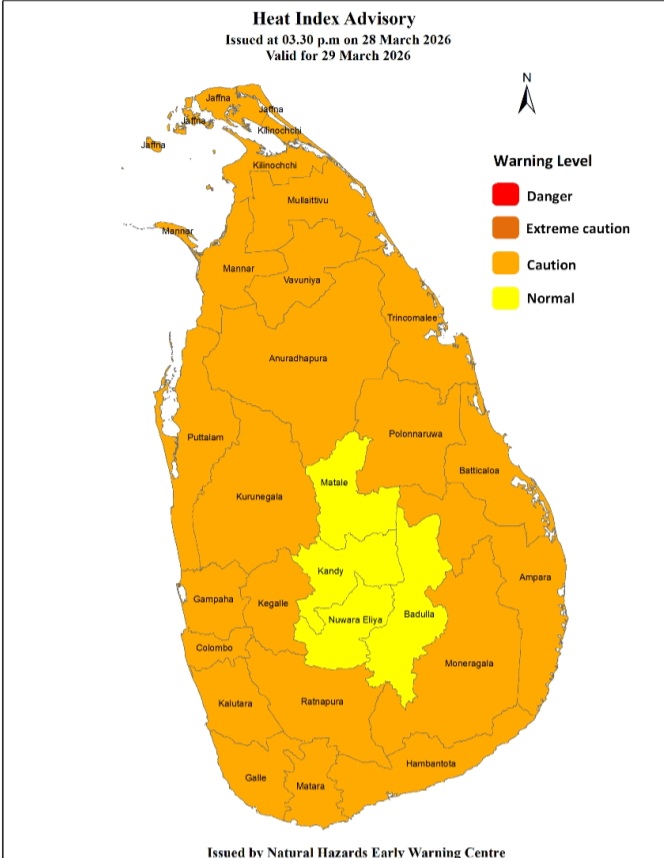
Heat Index likely to increase up to ‘Caution level’ at some places in the Western, Sabaragamuwa, Southern, Eastern, North-western, Northern and North-central provinces and in Monaragala district

Warm Weather Advisory
Issued by the Natural Hazards Early Warning Centre of the Department of Meteorology
Issued at 3.30 p.m. on 28 March 2026, valid for 29March 2026.
Heat index, the temperature felt on the human body is likely to increase up to ‘Caution level’ at some places in the Western, Sabaragamuwa, Southern, Eastern, North-western, Northern and North-central provinces and in Monaragala district.
The Heat Index Forecast is calculated by using relative humidity and maximum temperature and this is the condition that is felt on your body. This is not the forecast of maximum temperature. It is generated by the Department of Meteorology for the next day period and prepared by using global numerical weather prediction model data.
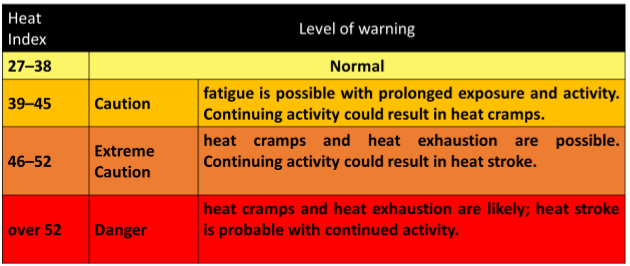
Effect of the heat index on human body is mentioned in the above table and it is prepared on the advice of the Ministry of Health and Indigenous Medical Services.
ACTION REQUIRED
Job sites: Stay hydrated and takes breaks in the shade as often as possible.
Indoors: Check up on the elderly and the sick.
Vehicles: Never leave children unattended.
Outdoors: Limit strenuous outdoor activities, find shade and stay hydrated.
Dress: Wear lightweight and white or light-colored clothing.
Note:
In addition, please refer to advisories issued by the Disaster Preparedness & Response Division, Ministry of Health in this regard as well. For further clarifications please contact 011-7446491.

War-linked power crunch pushes Lanka to four-day week

Lanka to swelter through April and May, Met Dept warns

Pathfinder Foundation launches Proposal for a National Security Strategy for Sri Lanka

After Iranian frigate sinks near Sri Lanka, a call for a Colombo-based framework to prevent regional spiral

No-shows, ‘witch-hunt’ and waste of energy

Grace, grooming and confidence

‘Dates have the highest sugar content to fight Coronavirus’

Sunday Island 27 December – Headlines

#SundayIsland 17th December – Headlines

Sunday Island – 28th March

Sunday Island Headlines – 21 March

Sunday Island – 21st February – Headlines
-

 News4 days ago
Senior citizens above 70 years to receive March allowances on Thursday (26)
-

 Features1 day ago
A World Order in Crisis: War, Power, and Resistance
-

 Features6 days ago
Trincomalee oil tank farm: An engineering marvel
-

 News2 days ago
Energy Minister indicted on corruption charges ahead of no-faith motion against him
-

 News3 days ago
US dodges question on AKD’s claim SL denied permission for military aircraft to land
-

 Features6 days ago
The scientist who was finally heard
-

 Business3 days ago
Dialog Unveils Dialog Play Mini with Netflix and Apple TV
-

 Sports2 days ago
SLC to hold EGM in April