
News
Excerpts from SJB’s National Green Initiative

We acknowledge that human beings are only a part of the natural world, and we respect the specific values of all forms of life, including non-human species. We acknowledge the wisdom of the indigenous people of the world, as custodians of the land and its resources. We acknowledge that human society depends on the ecological resources of the planet, and must ensure the integrity of ecosystems and conserve biodiversity and the resilience of life supporting systems.
We recognize that there are limitations to material expansion of human society within the biosphere, and the need to conserve biodiversity through sustainable use of renewable resources and responsible use of non-renewable resources. We believe that to achieve ecological sustainability, and in order to provide for the needs of present and future generations within the finite resources of the earth, continuing growth in global consumption, population and material inequity must be halted and reversed.
We recognize that sustainability will not be possible as long as poverty persists. Political Leadership in Environmental Sustainability We recognise the significance of providing necessary political leadership and requisite political commitment. Through the National Green Initiative leadership will be provided for a new political culture in Sri Lanka to mainstream environmental sustainability into the National Development Agenda to boost the country’s ability to provide sustainable ecosystem services for its development.
Participatory Environmental Conservation: We strive for a democracy in which all citizens have the right to express their views, and are able to directly participate in the environmental, economic, social and political decisions which affect their lives; so that power and responsibility are devolved to local and regional communities, with ascent to higher tiers of government only where essential.
Preamble : We stand at a critical moment in Earth’s history, a time when humanity must choose its future. As the world becomes increasingly interdependent and fragile, the future holds great peril and great promise, at the same time. To move forward we must recognize that in the midst of a magnificent diversity of cultures and life forms we are one human family and one Earth community with a common destiny.
We must join to bring forth a sustainable global society founded on respect for nature, universal human rights, economic justice, and a culture of peace. Towards this end, it is imperative that we, the peoples of Earth, declare our responsibility to one another, to the greater community of life, and to future generations. The choice is ours: form a global partnership to care for Earth and one another or risk the destruction of ourselves and the diversity of life.
Fundamental changes are needed in our values, institutions, and ways of living. We must realize that when basic needs have been met, human development is primarily about being more, not having more. We have the knowledge and technology to provide for all, while reducing our impact on the environment. The emergence of a global civil society is creating new opportunities to build a democratic and humane world. Our environmental, economic, political, social, and spiritual challenges are interconnected, and together we can forge inclusive solutions.
People need Nature. Nature is essential for every aspect of human living. It enhances our lives, helps us feel better, has positive impacts on our social skills and therefore lays the launch pad for us to become environmentally responsible citizens. It gives us all food, air and water that we need to survive. But we are taking more from nature than it can provide, and we are putting our own lives on the line. Nature “needs” People. We live on a planet of finite resources. We can’t continue to consume our stocks of natural capital because there will be nothing left for our grandchildren. So while people need nature, increasingly, nature needs people. Nature has to be nurtured and protected so that the benefits we get from it continue to flow. For that people and nature must work as players in the same team.
Policy on Environment, Biodiversity Conservation and Climate Change: Not only do we live on an island with finite resources, but we live on a planet with finite resources. Therefore, we can’t continue to consume our stocks of natural assets in an unsustainable manner because there will be nothing left for our future generations. We have an expanding human population and a declining natural resource base within a finite land area. It is obvious that this model cannot be sustained in the long term.
The country is currently confronted with the serious degradation of its ecosystems and the biodiversity they host. This will no doubt have a detrimental effect on the provision of ecosystem services. It is well established that a reduction in ecosystem service provision will adversely impact economic development. Reversing the current trend of ecosystem degradation should be a priority for every Sri Lankan regardless of our political affiliations.
SJB as the first ever officially declared green political party will ensure that environmentally sustainable development will be the central goal of our future Government’s policy. We are fully committed to mainstreaming the principles of the UN’s Sustainable Development Goals throughout the decision making and operational processes so that development under a future SJB led Government will truly be sustainable.
Reversing the Trend of Biodiversity Loss: Despite decades of conservation efforts, deforestation, forest degradation and biodiversity loss continues. Considering that biodiversity influences the quality of ecosystems services, which in turn affects the country’s development and human well being, conservation of biodiversity including the ecological processes that sustain ecosystem services will be a priority under a future SJB led Government .
National Priority on Environment, Biodiversity Conservation and Climate Change Environment, biodiversity conservation and climate change were a national priority under the Environmental Charter placed before the public by me as the presidential Candidate in 2019. This was the first time in Sri Lanka that any presidential candidate had placed an Environmental Charter before the public. As the leader of the SJB, I have commenced a process of consultation with environmental experts to update the Environmental Charter to address the unprecedented threats posed to Sri Lanka’s natural resources from the misguided and short sighted decisions made over the last two years.
The Environmental Charter will be revised to take pragmatic action to address the current threats and to accommodate the “new normal” conditions resulting from the Coronavirus pandemic. Considering the crucial role Sri Lanka’s natural assets play in the country’s development, our future Government will consider proper management of the environment, biodiversity conservation and climate change as a national priority. With an outcome oriented program with tangible targets.
The first step will be to end the fragmentation of institutional mandates and eliminate conflicting responsibilities by introducing an effective institutional mechanism for inter-ministerial coordination to mainstream conservation into the development process. National priority programs on Environment, Biodiversity Conservation and Climate Change under our future government will have clearly defined outcomes and targeted goals to be achieved. An effective, new mechanism for timely follow-up and monitoring of implementation progress of the proposed national priority programs will be introduced to ensure the timely achievement of outcomes.
Our future Government will ensure that the country’s development pathway is economically, environmentally and socially sustainable. Sri Lanka joined all UN member states in 2015 to adopt the UN’s Sustainable Development Goals which are a universal call to action to end poverty, protect the planet and ensure that all people enjoy peace and prosperity by 2030. The SDGs will form the cornerstone of our national sustainable development program, but we will be taking a pragmatic approach to ensure that Sri Lanka’s development is sustainable.
National priority will be given for Wildlife and Ecosystem Conservation & Mitigation of the Human Elephant Conflict. Our Government is committed to the long term conservation of keystone (flagship) species. Special emphasis will be given to long term conservation of three keystone (flagship) species, the Sri Lankan elephant, Sri Lankan leopard and blue whale Focused conservation and management programs will be initiated.
The Government will give special focus to plastic waste management and waste management in urban areas. Measures will be taken to mitigate per capita plastic consumption to protect what mother nature has given us. Forest Conservation & Reforestation Forests are the lungs of our land. The national goal of Sri Lanka should be to have one third of the total land area of the country under forest and tree cover. Maintaining environmental stability through preservation and restoration of the ecological balance where needed, is a priority for the government. A comprehensive program for reforestation will be initiated, while taking all possible measures to mitigate deforestation.
The Government will initiate a special mechanism to investigate and resolve all problems related to unauthorized deforestation issues and ensure strict law enforcement. The Government will introduce a National Policy on Land Utilization which will rationalize the use of land. Emphasis will be given to protect critical ecosystems so that the country’s economic development will benefit from much needed ecosystem services. We hope that this platform will enable us to develop a sincere and fruitful partnership between the nongovernmental conservation organizations and our Government, to promote a genuine conservation agenda in Sri Lanka and ensure that the country’s development is truly sustainable.

By Shamindra Ferdinando
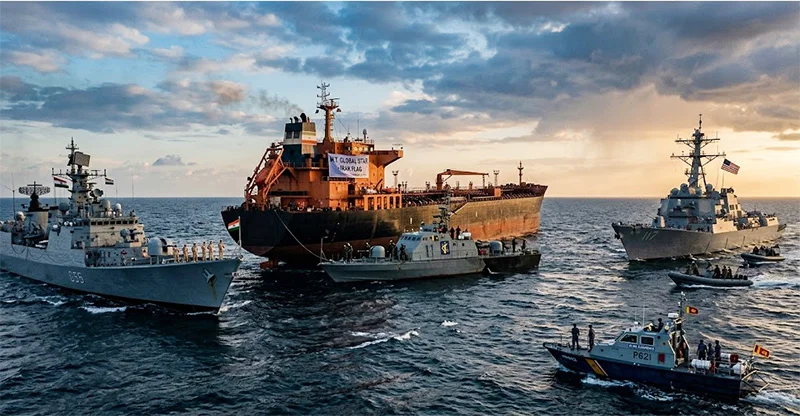
Iran has sought the Indian intervention, at the highest level, to provide lifesaving support to the crews of empty Iranian vessels stranded just outside Sri Lanka’s 12-nautical mile territorial waters off Galle.
Sources familiar with the issue said that Iran had brought the developing situation to the attention of New Delhi as the crews of almost 20 vessels, included Indian nationals. Sources stressed that the group of vessels that unloaded crude oil a couple of months back were now stranded within Sri Lanka’s Exclusive Economic Zone (EEZ).
The US Navy torpedoed an unarmed Iran frigate, returning from India, on 04 March, 2026, about 19 nautical miles off the Galle coast. The unprovoked attack killed nearly 100 Iranians.
The Iranian Embassy in Colombo has inquired from the Indian High Commission of their response to the situation, sources said. The US has issued a global warning against providing food, water, medicine and other services to the Iranian vessels. The outcome of Iran-India talks on the issue at hand was not known, though sources asserted India may not throw its weight behind Iranian efforts to address the issue.
Responding to The Island queries, sources said both Sri Lanka and India were in a dilemma due to the US warning. India couldn’t ignore the plight of the Indian crew members and the Iranian vessels in its backyard.
The Sri Lankan government remains tight-lipped about the vessels stranded in its EEZ. Our efforts to elicit a response from relevant authorities were in vain. In addition to Indians, there are Bangladeshis among the crew members. Iran has explicitly stated the responsibilities of the countries concerned to provide assistance in terms of international law.
The Iranian position was articulated by its Ambassador to Sri Lanka, Dr.Alireza Delkhosh, recently. In a special statement, Ambassador Delkhosh emphasised that in terms of the Convention on the Law of the Sea (Article 98) as well as SOLAS and SAR
Conventions, Sri Lanka couldn’t refrain from providing the needs of the Iranian vessels stranded in its EEZ.
SLMC leader Rauff Hakeem lambasted the NPP government in Parliament for failing to provide assistance to the Iranian ships. The former Minister alleged that the government was simply carrying out dictates of the US. He strongly criticised the way Foreign Minister Vijitha Herath was handling the issue.
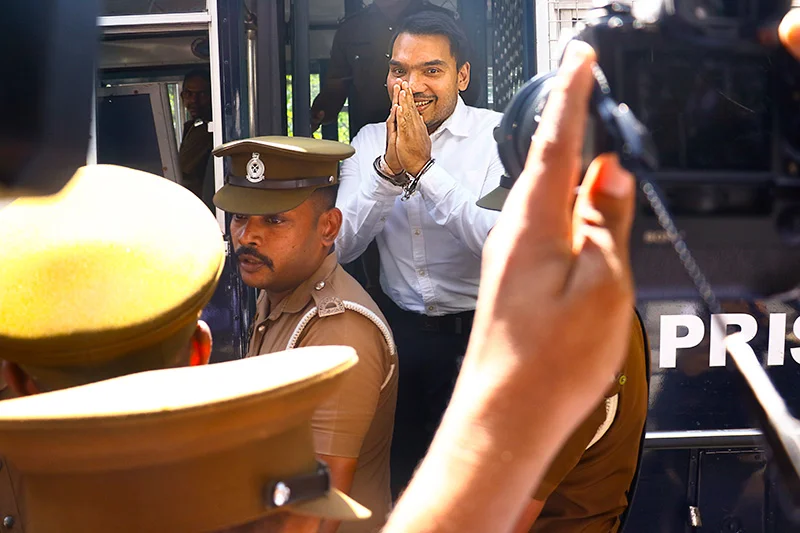
MP Namal Rajapaksa, who is in remand custody over the controversial Airbus deal, was further remanded until October 27 by the Colombo Magistrate’s Court yesterday (13).
Colombo Chief Magistrate Asanga S. Bodaragama made the order after considering submissions by officers of the Commission to Investigate Allegations of Bribery or Corruption and lawyers representing Rajapaksa.

Sri Lanka’s economy is expected to sustain its recovery over the next two years, although growth is projected to moderate amid mounting global uncertainties, according to the International Monetary Fund’s (IMF) latest World Economic Outlook.
In its World Economic Outlook 2026: Resilience Under Strain, Urgent Choices, the IMF projects Sri Lanka’s economy to expand by 4% in 2026, slowing to 3.7% in 2027, following estimated growth of 5% in 2025.
Inflation, meanwhile, is forecast to rise to 5.3% in 2026 and 5.4% in 2027, reversing the average deflation rate of 0.5% recorded in 2025.
Unemployment is expected to remain steady at 3.9% throughout the forecast period.
The projections come amid growing pressure on the global economy from the ongoing conflict in the Middle East, elevated energy prices, geopolitical tensions and trade disruptions.
Sri Lanka’s external position is also expected to weaken, with the current account balance projected to shift from a surplus of 1.6% of gross domestic product (GDP) in 2025 to deficits of 0.5% in 2026 and 0.3% in 2027.
The IMF’s outlook points to continued economic expansion in Sri Lanka, but with slower growth, rising inflation and a narrowing external surplus giving way to current account deficits over the forecast period.

Heavy showers above 100 mm are likely at some places in the Western, Sabaragamuwa, Southern, Central, and North-western provinces and in Anuradhapura district.

Sri Lanka, India caught in US-Iran ship crisis

Namal further remanded

IMF projects Lankan economic growth to moderate amidst mounting global uncertainties

Major Gen Pushpakumara assumes command of 56 Infantry Division

Dickwella axed, Bandara earns maiden Test call up

‘Dates have the highest sugar content to fight Coronavirus’

Sunday Island 27 December – Headlines

#SundayIsland 17th December – Headlines

Sunday Island – 28th March

Sunday Island Headlines – 21 March

Sunday Island – 21st February – Headlines
-

 Features6 days ago
The Sri Lankan who made Scottish history
-

 Sports6 days ago
Nissanka absence opens door for Sri Lanka’s young guns
-

 News5 days ago
NDB fraud Rs 60mn more than reported
-

 News5 days ago
Removing monk’s robes matter for Sangha to decide: Mahanayake Theras
-

 News6 days ago
Shiranthi R remanded until 13 Oct.
-

 Features6 days ago
Future of Sri Lanka’s state university system: Should it be shut down and reopened?
-

 News3 days ago
Sri Lanka escalates anti-graft drive with Shiranthi’s jailing
-

 News4 days ago
NPP govt. reminded of its responsibilities as US warship leaves Colombo