
Business
Eran outlines practical solutions aimed at resolving corruption and other issues

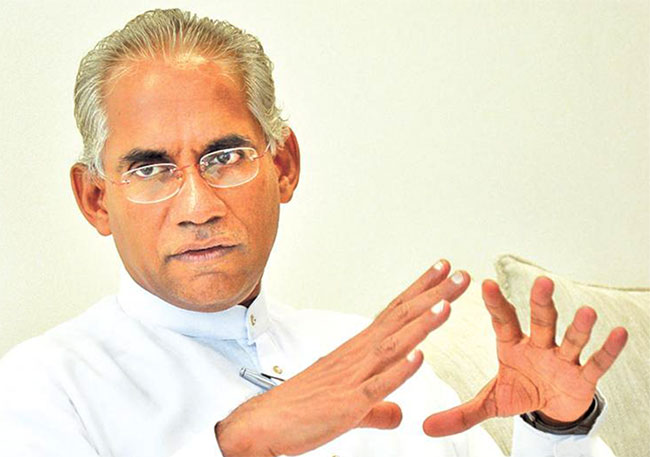
Samagi Jana Balavegaya M.P Eran Wickramaratne recently unveiled the following eleven-point blueprint for the country’s economic development under a future SJB government. Eran Wickramaratne, who is a member of the SJB’s Centre for Economic Policy, outlined his project titled, ‘The Correct Direction of the Economy’ at a forum attended by the local business community, at the Hilton Hotel on February 14.
Following is a transcript of Eran Wickramaratne’s address:
One of the things we will do immediately is making the CBSL independent
We know what happened with printing of money and inflation and the consequences resulting from them.
Monetary Policy of the CBSL will be independent from the Fiscal Policy of Treasury.
The law was drawn in 2019. The then Secretary to Treasury Dr .R.H.S Samaratunge, CBSL Governor Dr. Indrajith Cooomaraswamy, Dr. Nandalal Weerasinge, Minister of Finance at that time Mangala Samaraweera and myself as the State Minister of Finance and other officials were all involved in it. I am calling upon the present government to bring in this piece of legislation even before we come to office, otherwise it will be the first legislation we will enact.
Bribery and corruption
If we are going to build this country, we must focus on some special issues. Bribery and corruption must be stopped.
Politicians like us, high-level officials, must publicize our assets and liabilities. I beg you, you don’t have to wait for the law to come in. As a private member, I have submitted a bill to parliament regarding disclosure of assets and liabilities, and I am asking the government to make that bill law.
Special attention will be focused on anti-corruption measures, as they are a panacea for all ills in governance. Country cannot be changed only by law but by the example of leaders.
We urge the govt. to bring in the law which has already been submitted as a private member’s bill to enable the publicising of assets and liability declarations of politicians and those of senior officials.
There is no need to wait for the draft, I request President Ranil Wickremesinghe.
There is no need for a law to exist; make your declaration of assets and liabilities public.
There are two other former Presidents in parliament, Mahinda Rajapaksa and Maithripala Sirisena, and I request them also to make their assets declarations public. This is an exemplary act that could be gone through forthwith by rulers. Countries don’t change only by law-making, on the contrary, countries change by the examples of leaders.
Therefore, I called upon the present and former Presidents who are sitting in parliament to go public with their Asset Declarations which will compel MPs, such as myself and high officials in this country, to be accountable to the public.
Secondly: Make CIABOC independent. Now it is not independent. When a theft is reported, people are tracked down and police officers are appointed by the government to investigate it. As soon as the government changes, those officials are transferred out of it. It completely disrupts the investigations. This is the type of anti-corruption system this country has. So the law to make the Commission independent is a must.
The third point is: The Star Program. The Stolen Assets Recovery Program, a program of the United Nations. We will bring a law to implement this program. According to that law, even if such stolen resources are hidden in Sri Lanka or in a foreign country, they could be traced and brought back to the country.
The fourth point related to bribery corruption is: For example, today a person could be a minister, tomorrow he may get involved in stealing. Today the Attorney General’s Department could be his counsel, tomorrow the Attorney General could file a case against him. We need to get rid of this system. A conflict of interest is evident here. That is why we demand that there should be an independent prosecutor’s office in this country.
If we put an end to bribery and corruption, others will be fixed automatically. I don’t have to tell you as businessmen, this is an environment where bribes have to be paid from the bottom to top. Therefore, to move our country forward, we must change it and we will change it. These are some measure we intend to do to fight corruption.
The other thing we intend to do is to create;
A Unified Revenue Collection Authority
This is very important. Businessmen do pay taxes. 75 per cent or more of Sri Lanka’s revenue comes from three main institutions, namely, Inland Revenue Dept, Sri Lanka Customs Dept and the Excise Dept, I believe none of you would have accused me or Mangala Samaraweera of stealing a rupee or a dollar, even while we were in office. But the level of corruption in those departments did not go down. Therefore, we can’t rely on individuals, we have to initiate systemic changes. That is why we are going to put in place a Unified Revenue Collection Authority.
As businessmen when you import goods you go to your bank and open an LC and you have to get it cleared. You go to the Customs, I don’t need to tell the rest of the story. Customs only become the clearing hub. Excise and Inland Revenue similarly. You can use technology and these are not new ideas, other countries have done these things. Assessment is done in one place; payment is made centrally; interactions with officials become minimal. Instructions go to the Customs and the payment is centrally made and the goods can be cleared from the Customs.
To be Continued






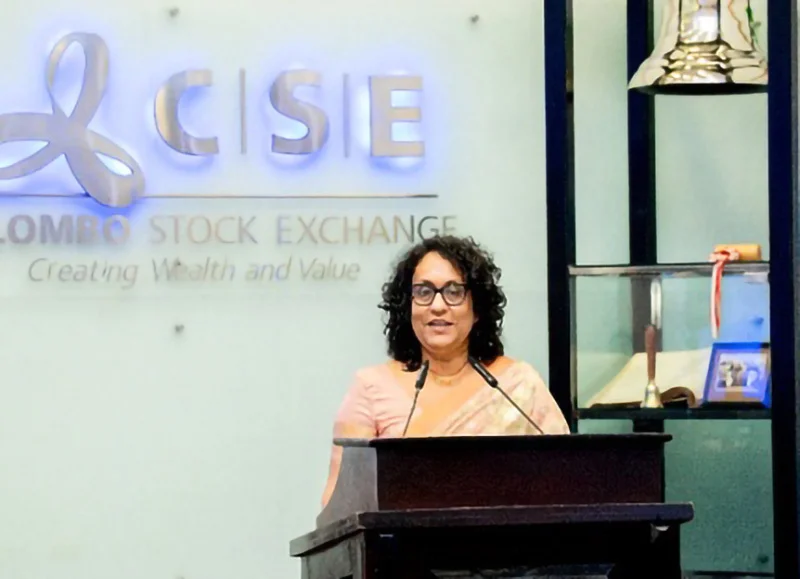
As part of World Investor Week (WIW) 2026, the Securities and Exchange Commission of Sri Lanka (SEC) and the Colombo Stock Exchange (CSE) joined stock exchanges around the world in ringing the market opening bell for financial literacy on 5 October 2026, under the patronage of Dr. Harini Amarasuriya, Prime Minister of the Democratic Socialist Republic of Sri Lanka.
World Investor Week is an annual global campaign led by the International Organization of Securities Commissions (IOSCO) to raise awareness of the importance of investor education and investor protection. The “Ring the Bell for Financial Literacy” initiative, pioneered by the World Federation of Exchanges (WFE), brings together stock exchanges and other stakeholders worldwide to promote greater financial literacy and encourage individuals to make informed financial decisions.
The ceremony also marked the 40th anniversary of the CSE and the joint launch by the SEC and the CSE of the Stock Market Game, an online stock market simulation based on the ATrad trading system.
The Stock Market Game enables participants to gain practical experience of how the stock market works, make investment decisions and construct portfolios of listed shares without using real money. The platform is accessible through the websites of the SEC and CSE and is expected to serve as an important practical tool for promoting financial education. It is envisaged that the Stock Market Game will also be used to conduct simulation competitions among universities and the 100 Capital Market Clubs established in schools across the country.
The ceremony also featured the commemorative issuance of a stamp and First Day Cover to mark the 40th anniversary of the CSE. Issued in collaboration with the Department of Posts and the Philatelic Bureau of Sri Lanka, the commemorative stamp and First Day Cover were presented to Prime Minister Dr. Harini Amarasuriya, by the SEC Chairman Snr. Prof. D.B.P.H. Dissabandara and Ray Abeywardena, Director CSE and Chairman of Central Depository Systems (CDS).
Welcoming the gathering, Rajeeva Bandaranaike, Chief Executive Officer of the CSE, highlighted the importance of obtaining reliable information when making investment decisions.
“We operate in a digital world where a vast amount of information and data is disseminated through social media. While some of this information is factual, some may be inaccurate or misleading. When investing in the stock market, it is essential to make informed and prudent investment decisions. Therefore, investors should obtain information and data from reliable and responsible sources and persons before making investment decisions.”
Addressing the gathering, SEC Chairman Snr. Prof. D.B.P.H. Dissabandara emphasised that the SEC’s role extends beyond regulation to facilitating the further development of the capital market.
“The SEC needs to determine how best to introduce the stock market to Generation Alpha, Generation Beta and generations beyond. When it comes to investors, we need to build confidence in the market, because people will invest only when they have confidence in the market.’’
Business
Rs. 5 million worth of prizes to be given at 8th edition of CSE Masterminds Quiz Competition

The Colombo Stock Exchange (CSE) has announced that the eighth edition of the CSE Masterminds Quiz will be held on 9th October 2026, from 3.00 p.m. onwards, at the Main Ballroom, Shangri-La Colombo.
Recognised as Sri Lanka’s premier capital market quiz competition, CSE Masterminds brings together teams from the public and private sectors. Participants will be tested across international business, global markets, current affairs, the Sri Lankan economy and business, the Sri Lankan stock market, and sports and entertainment, before a concluding rapid-fire round.
This year the winning team can win up to Rs. 2,000,000, the runners-up up to Rs. 1,000,000, and the second runners-up Rs. 750,000. Sector awards will also be presented to the highest-performing team from each participating sector. Guest participants will also be able to compete in rounds of Audience questions, and will have the opportunity to participate a raffle draw for three free return tickets provided by Fits Aviation (Pvt) Ltd.
The evening will also include an exclusive after-party with live music provided by the band ‘Doctor’ featuring guest performer Umara Sinhawansa, fine food and beverages, providing an opportunity for networking and celebration. Every participant will receive a premium goodie bag made possible by the support of the event’s sponsorship partners. Collectively, the event will feature over Rs. 5 million worth of prizes, rewards, and giveaways, encompassing championship prizes, sector awards, audience engagement prizes, raffle draw offerings, and goodie bags.
Sponsorship partners include:
Platinum Sponsors: Hatton National Bank PLC and Bartleet Religare Stockbrokers (Pvt) Ltd.
Gold Sponsors: Ex-Pack Corrugated Cartons PLC, Asha Securities Ltd., and Lanka Securities (Pvt) Ltd.
Silver Sponsors: Barista Coffee Lanka (Pvt) Ltd., Capital Trust Holdings (Pvt) Ltd., LOLC Holdings PLC, Arpico Ataraxia Asset Management (Pvt) Ltd., IronOne Technologies (Pvt) Ltd., and LankaPay (Pvt) Ltd.
Co-Sponsors: Access Engineering PLC, Bank of Ceylon, Commercial Bank of Ceylon PLC, CryptoGen (Pvt) Ltd., Deloitte Lanka (Private) Limited, Dialog Finance PLC, Efutures (Pvt) Ltd., People’s Leasing & Finance PLC, Senfin Asset Management (Pvt) Ltd., and Softlogic Stockbrokers (Pvt) Ltd.
Business
NCCSL to conduct practical workshop on food labelling and advertising regulations in Sri Lanka

The National Chamber of Commerce of Sri Lanka (NCCSL) is organizing a one-day practical workshop on “Food Labelling & Advertising Regulations in Sri Lanka” on Thursday, 8th October 2026 from 9.00 a.m. to 4.30 p.m. at the National Chamber of Commerce, Colombo 10. The workshop has been organised to provide a practical understanding of the latest regulatory requirements governing the food products labelling and advertising of food products in Sri Lanka, with particular attention to regulatory developments applicable in 2026, compliance requirements, and the potential legal and financial implications of non-compliance.
As food products increasingly compete not only with quality and price but also on packaging, labelling and promotional claims, businesses must ensure the information they communicate to consumers is accurate, transparent and consistent with applicable regulatory requirements. Understanding these requirements is therefore essential for businesses seeking to protect their brands, maintain consumer confidence, and minimize regulatory and legal risks.
The practical workshop will go beyond an overview of regulations and focus on how businesses can apply regulatory requirements in their day-to-day operations. Participants will be guided through key areas of food regulatory compliance, including the national food regulatory framework, recent food labelling regulations and key changes, mandatory approvals and prohibitions relating to food labelling, and the litigation process associated with regulatory violations. The programme will also cover several areas of growing importance to the food industry, including the EU EMPCO Directive, food colour coding regulations, regulations relating to food trans-fatty acids and the importance of compliance in the use of food additives. Practical exercises will further enable participants to apply their knowledge to real-world compliance situations and strengthen their ability to identify potential regulatory concerns.
For further information and registration, please contact the National Chamber of Commerce of Sri Lanka on 011 4741788 – Nethmi or Udula – 071 403 4775.

Fuel crunch looms

Gnansara Thera to be assigned to prison printing section: Officials

Speaker rejects Ajith Perera’s privilege complaint

OIC of FCID summoned before Maligakanda Magistrate

Sallay cleared for discharge, to return to CID custody

Senior prelate urges authorities to allow Gnanasara Thera to wear his robes in prison

‘Dates have the highest sugar content to fight Coronavirus’

Sunday Island 27 December – Headlines

#SundayIsland 17th December – Headlines

Sunday Island – 28th March

Sunday Island Headlines – 21 March

Sunday Island – 21st February – Headlines
-

 Latest News7 days ago
Gold winner Tharanga gets brand-new Honda Vezel from SLAAJ
-

 News6 days ago
US-assisted ‘Ice’ detection: NPC to examine IGP’s move to transfer drug-busting team
-

 Editorial5 days ago
Colombo Port drug bust: The plot thickens
-

 Editorial6 days ago
Drug busting, transfers and trust deficit
-

 Features3 days ago
The first woman in the foreign service or Ceylon Overseas Service it was then called
-

 Latest News4 days ago
Tharindu Rathnayake, bowlers secure Asian Games Bronze for Sri Lanka
-
 News6 days ago
Sri Lankan facing death penalty in Saudi Arabia: Mano G appeals to Crown Prince
-

 Editorial4 days ago
Fuelling discontent and protest