
Midweek Review
EPIC-MEMORY and BRECHT

by Laleen Jayamanne
‘Memory of the World’
UNESCO established the Memory of the World Programme in 1992 to preserve for posterity the audio-visual heritage of humankind, stating that war, social upheaval and lack of resources have accelerated its destruction.
“Significant collections worldwide have suffered a variety of fates. Looting and dispersal, illegal trading, destruction, inadequate housing and funding have all played a part. Much has vanished forever; much is endangered. Happily, missing documentary heritage is sometimes
rediscovered.” UNESCO
 UNESCO has also promoted the preservation (through revival), of the vital endangered category of human culture it calls, ‘The Intangible Heritage of Mankind’; the ancient arts of music, dance, theatre and ritual. As temporal arts, they are ephemeral by nature, passed through guru-shishya parampara transmission encoded in bodies through practice, in what used to be called the Third World.
Thanks to the availability of digital technological tools of preservation, exhibition and connectivity, the work of these visionary programmes has been considerably enhanced. Now, the fragile celluloid film, which was once the medium of preservation of artefacts, has itself been saved, restored and preserved digitally. Apart from this kind of essential programme of preservation, the very idea of attributing memory to the ‘world’, in the UNESCO formulation, is fascinating to speculate on because we usually think of memory as an inalienable human organic faculty of the mind without which we would live in a perpetual state of amnesia, in a timeless and depleted present. It seems to me that ‘memory of the world’ as an idea can also be imagined as something more than historical memory, which by definition is the written record, usually organised chronologically. ‘The world’ can now also suggest not only the human but also the earth itself and all that it sustains, plants and animals and even microbes and fossils and minerals and the cosmos, too. This is the zone that some artists have begun to explore within a ‘deep-ecological’ consciousness of what is known as the Anthropocene – the epoch of man-made ecological devastation.
‘Epic-Memory’
Walter Benjamin, the German theorist of culture, in his essay, The Story Teller, described another kind of memory, created by humans over millennia, which he called ‘epic memory.’ He invites us to imagine how to think about an idea of memory that’s more ample than our personal memory, by offering a dazzling image of ‘epic memory.’
“One must imagine the transformation of epic forms occurring in rhythms comparable to those of the change that has come over the earth’s surface in the course of thousands of centuries. Hardly any other forms of human communications have taken shape more slowly, been lost more slowly.
Memory is the epic faculty par excellence.
Memory creates the chain of tradition which passes a happening on from generation to generation.”
What Benjamin calls the ‘chain of tradition’ has been severed or partially lost in societies subject to colonisation and the forces of modernity have also destroyed many traditions. So we are looking for ways in which an expansive mode of remembering might be generated by artists through creative work, especially in the post-war situation of Sri Lanka where experiences of loss and trauma are widespread and some of their causes left unaddressed, forgotten, repressed, for many reasons. And now especially, with Sri Lanka in a state of profound crisis open to new possibilities of collective life free of ethnic nationalism and violence, an idea of epic memory might be of some use. It is the case that we don’t have ancient epics like India’s, Silappatikaram, Mahabharata and the Ramayana or the Greek ones, the Iliad and the Odyssey. Yet a modern idea of epic memory can perhaps still be formulated with what we do have.
The epic form was originally an oral form, which required from the bards a prodigious memory, trained through repeated recitation, which is why the muse of the epic form was called Mnemosyne, meaning epic memory in Greek. The written form of the epic came into being much later in history, based on the much older collective oral poetry of legends and myths of ‘the people’ handed down orally. Both in the UNESCO idea of ‘memory of the world’ and Benjamin’s definition of ‘epic memory,’ what is clear is that memory is a collective creation, taking shape over vast epochs. According to Greek myth, Mnemosyne, is the mother of the nine muses, and the word mouseion in Greek (from which the word museum is derived) means the dwelling place of the muses, who are the inspiration for the different art forms. This is a rich vital aesthetic image of the museum which is worth thinking about.
Then, one might be tempted to think that this is the same as the idea of ‘civilization’, which is the sum total of a culture’s pre-history and history as expressed in artefacts and written record. Usually this is indeed how nation states constitute themselves and give themselves an identity formulated on ethnicity, language, religion, custom, myths, etc. This is dangerous territory because states have deployed their myths to justify authoritarian and racist policies to divide and rule multi-ethnic, multi-religious, multi-linguistic societies such as Lanka. The Rajapaksa regime mobilised the Mahavansa narrative of Sinhala-Buddhist hegemony of Lanka to secure its own rule and some artists joined in with the mythic-epic genre films and shows. But I think the UNESCO idea is counter-hegemonic because it’s not created by a centralising state. Its memories may not fit easily into a master narrative of mythic inevitability. There is an element of chance and the possibility of ‘minor narratives’ emerging, which can’t be totalised into primordial myths.
Brecht’s Theory of Epic Theatre
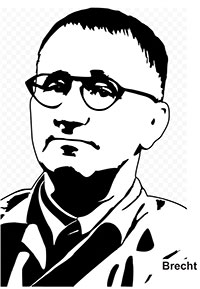
To create a clearer picture of how to craft an idea of memory with great amplitude and rich potential, we can start with a modern example, the work of Bertolt Brecht, which Lankans have been quite familiar with (since the mid 1960’s), in all three languages. He famously created an ‘epic theatre’ and a theory of modern epic practice, as opposed to the traditional ‘dramatic theatre’. He called traditional dramatic theatre Aristotelian because it followed the basic structures analysed by the Greek philosopher in his Poetics. Walter Benjamin wrote several essays defending Brecht’s idea of epic theatre because what Brecht did was something quite unusual within the history of European theatre at the time. Instead of following the 1920s avant-garde German Expressionist theatre or French Surrealist theatre or constructivist Soviet practice, he looked to classical Asiatic theatrical forms such as Peking opera and its conventions of staging and highly formalised abstract forms of acting, to create a modern epic practice. For some artists of the left, Brecht’s theory appeared to be a strange move, looking to traditional Asian practice of the deep feudal past – not at all modern. Benjamin showed how Brecht’s modern epic form was suited to their time of the rise of fascism in Germany and its appeal to irrational emotions and ideas of racial purity and superiority. According to Aristotle the epic form contains three genres in one. That is, the lyric or ‘first person’ expression of subjective feeling as in love poetry, the dramatic as in actions and reactions organised in dialogue, in ‘second person’ and narration, which is the power to tell a story or narrate in ‘third person’. Therefore the ample epic mode can combine all three genres with ease, which means that it has the power to shift focus from one to the other, in complex combinations.
The traditional idea of ‘epic memory’ itself has an act of performance built into it through what is sung and is not something private and personal but consists of mythic stories, legends common to a people. But there is a crucial distinction Brecht and Benjamin made here between myth, on the one hand, and the epic form, on the other. The epic as a genre is a much later historical development from myth and though it does deploy myth, it does so on its own terms. Because, historically speaking, the epic is a later human achievement than myth, it also has had the rational power to comment on the myths it uses. That is to say, the epic form, with its many flexible techniques, has the power to create a sense of distance from the mythic universe of the ancients, which appears irrational and fated.
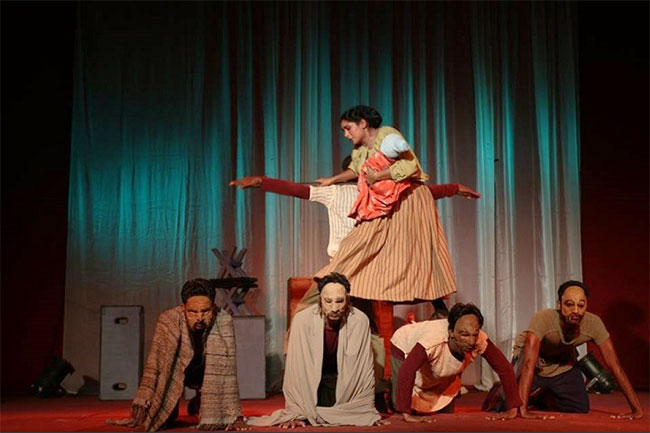
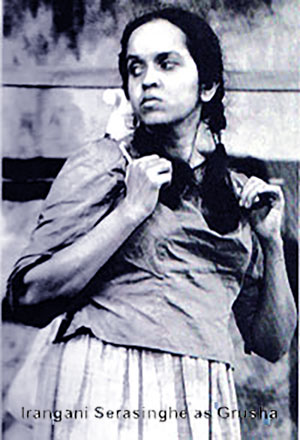
This idea of a historical ‘distance’ of the epic form (from the original myths), was taken up by Brecht and made into a method of constructing his epic drama. He called it, using a long German compound word, ‘verfremdungseffect’, variously translated as ‘distanciation’ or ‘Alienation-effect’ or ‘de-familiarisation’ or ‘making-strange’. Fine scholarship is available on this idea, my favourite was developed by Eugenio Barba and his Odin Theatret in Denmark. To create a dramatic situation which can immediately be ‘frozen’ and turned into a scene which is narrated and commented on, is one of the well-known ways in which Brecht’s Caucasian Chalk Circle was performed in Colombo, in the 1965 by Ernest Macintyre’s ‘Stage and Set’ production. The tender scene of a lyrical song sung by Grusha to her adopted infant son, can swiftly change to a bawdy commentary by the chorus. Sudden changes of point of view, mood and tone, are calibrated to give the spectator a chance to perceive a situation from more than one angle. It’s a way to introduce the exercise of reason into the spectacle of theatre, according to Brecht, to break its spell even as it is deployed. Brecht was here influenced by Eisenstein’s theory of montage, which he introduced into theatre. Eisenstein’s theory of montage created a clash between one shot and another, so as to produce a new idea in the mind of the spectator. So the continuously flowing conventional dramatic action could be interrupted, fragmented and anything-what-ever from ‘the memory of the world’ could be inserted to break the flow. So it’s the introduction of a radical film technique, montage, into theatre to make the mind constantly alert and instantly beguiled and then relaxed by the commentary of the chorus. These disjunctions can be very subtle or very direct depending on the skill of both actor and director.
Professor Saumya Liyanage’s recent article, on the play ‘Sanga Veda Guru Govi Kamkaru’, clearly indicated that the brilliant young playwright-director Chamila Priyanka had created an epic mode of theatre, which the judges of the drama competition failed to understand, (The Island, 11/5). Liyanage said that there is a to and fro movement between empathy and distance in the way the play was constructed and directed. The current Prime Minister Ranil Wickremesinghe referred to Brecht in parliament, comparing his current task (to save Lanka), to that of the selfless Grusha’s action of saving the baby, treading on the rickety bridge. Whether he wanted empathy or analytical distance by offering this parable from the Caucasian Chalk Circle we don’t know, but he could assume that Lankans at large would know the reference. But we also know the play well enough to see what a thoughtless comparison it was.
The Artists’ Protest March
I saw a Brechtian epic mode in full flight in the artists’ protest march (#GotaGoGama), the other day on the streets of Colombo, which converged on Gall Face. Actors wearing handmade cardboard masks of the various yakas and the sunniyas were doing wild dancing moves using these marvellous creatures of the folk imagination of Lanka to exorcise the political demons sucking the people’s life-blood. These performers were such a refreshing counter to the expensive kitsch fascist-mythic-nationalist spectacles and films made under the Rajapaksa regime. And to see and hear a group of women walking rhythmically and playing the heavy drums slung across their bodies strung from their necks or tied at the waist, was a powerful moment for me, as I never imagined that Lankan women would be allowed to play these ritual drums belonging to a male tradition of such vitality. Traditionally, women only played raban pada! While the documentary camera excitedly cut between many performances very fast, I got the sense of an epic vision being performed as street theatre. Gamini Hattotuwegama’s pioneering street theatre work of the 70’s and 80’s seems to have taken on an unimaginable mass form, matured, diversified, loosening up and airing so many different stratified and compacted layers of the blood-soaked earth, of this famed ‘island of Dhamma’, Sri Lanka.
Perhaps artists can generate some ideas from these two modes of imagining memory (‘memory of the world’ and Brecht’s epic mode), which are quite distinct from personal memory. Artists working on traumatic experiences of the civil war and the formidable state ideologies that led to and orchestrated it, may find it useful to try to mobilise an ample epic mode of perception. I think so because it has this flexible montage structure, not tied to a strict linear chronology. ‘Montage’ is a term taken from engineering, of fitting different pieces of machinery together, so it contains the idea of assembling something with different components, stuff, to make something happen. While one might work on oneself and one’s sense of loss and a host of other urgent feelings that resist linguistic expression, one can also create certain disjunctions, breaks, (distanciation, make-strange the familiar), through an epic mode of composition. The need to repeatedly go back to the traumatic moment is often limitless, with no end in sight. Each repetition yields less as it becomes routine with no exit. Whereas, epic vision-memory, understood in a Brechtian way, is centrifugal not centripetal, it ripples out. It is not centred on man and nor is its vision cut to the measure of MAN. It is non-anthropocentric and non-anthropomorphic. Epic vision-memory helps us to see and feel and understand that we are part of something vaster and also much finer and subtle than ourselves. Epic vision gives us antennae like insects have. Tantric Buddhist idea of a ‘subtle body’ (Sukshama Dehaya) might be a line of investigation for those attracted to the rich visual traditions of Mahayana Buddhism which include vast scroll paintings which visually activate ‘nadi’ or a nervous system that connects many life forms too.
Brecht’s epic vision, in not giving ‘happy endings’ or resolving all the dramatic conflicts, leave us with an ability to discuss alternatives, as in say The Good Woman of Szechwan (Hita Honda Ammandi). I think the famous Chennai bonze statues of poets, (including a female one), and scholars (including an English scholar-missionary), and the epic heroine of Silappatikāram, Kannagi, lining the ocean front of the Marina really is a marvellous epic configuration that could also be understood in the Brechtian modern sense of the epic as well. They are positioned against the background of the ocean and address the people of Tamil Nadu evoking epic memory. The idea of debate so dear to Brecht also was staged when the Kannagi statue built by the Karunanidi’s DMK government was removed from her pedestal by Jaylalitha as Chief Minister, inaugurating a statue ‘battle’ and then returned from a museum, back again to her pedestal, with a change of government. There appears to be a sense of humour too in these serious political moves and counter moves, a marvellous sense of epic performance. This kind of jostling, argumentative, magnificent vision evoked by these bronze statues of Tamil Nadu is surely a modern mode of epic memory conjoined with the ocean, the sand and the sky – a memory of the world for sure.
Epic form is not the same as mythic form. The epic is Janus-faced (has two faces) facing two opposed directions. One face is turned toward myth and the other faces history. And situated in between the two, it has ample space-time to play and shuttle between the two modes of knowledge by making sure that history itself is not allowed to turn into myth.
And Laughter?
I saw on YouTube a well-known Sinhala actor perform a strange oration of excessive praise, a Rajapaksha varnanawa, invoking the glory days of Dutugamunu. What struck me was how much the brothers Mahinda and Gotabhaya laughed when they were praised in more and more exaggerated ways (drawing on the heroic parallels), by the actor who appeared to be carried away by his own brilliance at flattery and histrionic performance. I couldn’t help but think that the two brothers were looking at each other in a certain way and laughing, as much as to say, ‘does he really believe this stuff he’s spouting, what an idiot!’ They appeared to know that these were stupid but useful myths that they had themselves mobilised as history for their gain, but the true believers and the fools were the people themselves. This is just my reading of laughter of the two authoritarian brothers. Laughter is a tricky involuntary human impulse hard to control and pin down rationally. But one hopes that the last laugh will not be theirs’ to enjoy.


“My tongue in English chains.
I return, after a generation, to you.
I am at the end
of my Dravidic tether
hunger for you unassuaged
I falter, stumble.”
– Indian poet R. Parthasarathy
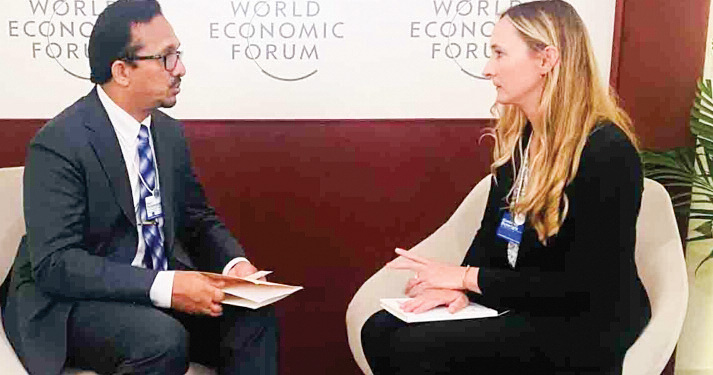
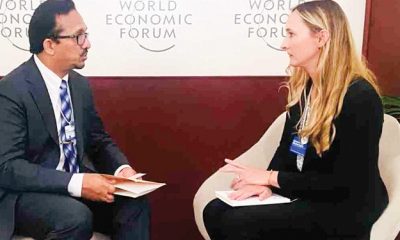
 When Minister Sunil Handunnetti addressed the World Economic Forum’s ‘Is Asia’s Century at Risk?’ discussion as part of the Annual Meeting of the New Champions 2025 in June 2025, I listened carefully both to him and the questions that were posed to him by the moderator. The subsequent trolling and extremely negative reactions to his use of English were so distasteful that I opted not to comment on it at the time. The noise that followed also meant that a meaningful conversation based on that event on the utility of learning a powerful global language and how our politics on the global stage might be carried out more successfully in that language was lost on our people and pundits, barring a few commentaries.
Now Handunnetti has reopened the conversation, this time in Sri Lanka’s parliament in November 2025, on the utility of mastering English particularly for young entrepreneurs. In his intervention, he also makes a plea not to mock his struggle at learning English given that he comes from a background which lacked the privilege to master the language in his youth. His clear intervention makes much sense.
The same ilk that ridiculed him when he spoke at WEF is laughing at him yet again on his pronunciation, incomplete sentences, claiming that he is bringing shame to the country and so on and so forth. As usual, such loud, politically motivated and retrograde critics miss the larger picture. Many of these people are also among those who cannot hold a conversation in any of the globally accepted versions of English. Moreover, their conceit about the so-called ‘correct’ use of English seems to suggest the existence of an ideal English type when it comes to pronunciation and basic articulation. I thought of writing this commentary now in a situation when the minister himself is asking for help ‘in finding a solution’ in his parliamentary speech even though his government is not known to be amenable to critical reflection from anyone who is not a party member.
The remarks at the WEF and in Sri Lanka’s parliament are very different at a fundamental level, although both are worthy of consideration – within the realm of rationality, not in the depths of vulgar emotion and political mudslinging.
The problem with Handunnetti’s remarks at WEF was not his accent or pronunciation. After all, whatever he said could be clearly understood if listened to carefully. In that sense, his use of English fulfilled one of the most fundamental roles of language – that of communication. Its lack of finesse, as a result of the speaker being someone who does not use the language professionally or personally on a regular basis, is only natural and cannot be held against him. This said, there are many issues that his remarks flagged that were mostly drowned out by the noise of his critics.
Given that Handunnetti’s communication was clear, it also showed much that was not meant to be exposed. He simply did not respond to the questions that were posed to him. More bluntly, a Sinhala speaker can describe the intervention as yanne koheda, malle pol , which literally means, when asked ‘Where are you going?’, the answer is ‘There are coconuts in the bag’.
He spoke from a prepared text which his staff must have put together for him. However, it was far off the mark from the questions that were being directly posed to him. The issue here is that his staff appears to have not had any coordination with the forum organisers to ascertain and decide on the nature of questions that would be posed to the Minister for which answers could have been provided based on both global conditions, local situations and government policy. After all, this is a senior minister of an independent country and he has the right to know and control, when possible, what he is dealing with in an international forum.
This manner of working is fairly routine in such international fora. On the one hand, it is extremely unfortunate that his staff did not do the required homework and obviously the minister himself did not follow up, demonstrating negligence, a want for common sense, preparedness and experience among all concerned. On the other hand, the government needs to have a policy on who it sends to such events. For instance, should a minister attend a certain event, or should the government be represented by an official or consultant who can speak not only fluently, but also with authority on the subject matter. That is, such speakers need to be very familiar with the global issues concerned and not mere political rhetoric aimed at local audiences.
Other than Handunnetti, I have seen, heard and also heard of how poorly our politicians, political appointees and even officials perform at international meetings (some of which are closed door) bringing ridicule and disastrous consequences to the country. None of them are, however, held responsible.
Such reflective considerations are simple yet essential and pragmatic policy matters on how the government should work in these conditions. If this had been undertaken, the WEF event might have been better handled with better global press for the government. Nevertheless, this was not only a matter of English. For one thing, Handunnetti and his staff could have requested for the availability of simultaneous translation from Sinhala to English for which pre-knowledge of questions would have been useful. This is all too common too. At the UN General Assembly in September, President Dissanayake spoke in Sinhala and made a decent presentation.
The pertinent question is this; had Handunetti had the option of talking in Sinhala, would the interaction have been any better? That is extremely doubtful, barring the fluency of language use. This is because Handunnetti, like most other politicians past and present, are good at rhetoric but not convincing where substance is concerned, particularly when it comes to global issues. It is for this reason that such leaders need competent staff and consultants, and not mere party loyalists and yes men, which is an unfortunate situation that has engulfed the whole government.
What about the speech in parliament? Again, as in the WEF event, his presentation was crystal clear and, in this instance, contextually sensible. But he did not have to make that speech in English at all when decent simultaneous translation services were available. In so far as content was concerned, he made a sound argument considering local conditions which he knows well. The minister’s argument is about the need to ensure that young entrepreneurs be taught English so that they can deal with the world and bring investments into the country, among other things. This should actually be the norm, not only for young entrepreneurs, but for all who are interested in widening their employment and investment opportunities beyond this country and in accessing knowledge for which Sinhala and Tamil alone do not suffice.
As far as I am concerned, Handunetti’s argument is important because in parliament, it can be construed as a policy prerogative. Significantly, he asked the Minister of Education to make this possible in the educational reforms that the government is contemplating.
He went further, appealing to his detractors not to mock his struggle in learning English, and instead to become part of the solution. However, in my opinion, there is no need for the Minister to carry this chip on his shoulder. Why should the minister concern himself with being mocked for poor use of English? But there is a gap that his plea should have also addressed. What prevented him from mastering English in his youth goes far deeper than the lack of a privileged upbringing.
The fact of the matter is, the facilities that were available in schools and universities to learn English were not taken seriously and were often looked down upon as kaduwa by the political spectrum he represents and nationalist elements for whom the utilitarian value of English was not self-evident. I say this with responsibility because this was a considerable part of the reality in my time as an undergraduate and also throughout the time I taught in Sri Lanka.
Much earlier in my youth, swayed by the rhetoric of Sinhala language nationalism, my own mastery of English was also delayed even though my background is vastly different from the minister. I too was mocked, when two important schools in Kandy – Trinity College and St. Anthony’s College – refused to accept me to Grade 1 as my English was wanting. This was nearly 20 years after independence. I, however, opted to move on from the blatant discrimination, and mastered the language, although I probably had better opportunities and saw the world through a vastly different lens than the minister. If the minister’s commitment was also based on these social and political realities and the role people like him had played in negating our English language training particularly in universities, his plea would have sounded far more genuine.
If both these remarks and the contexts in which they were made say something about the way we can use English in our country, it is this: On one hand, the government needs to make sure it has a pragmatic policy in place when it sends representatives to international events which takes into account both a person’s language skills and his breadth of knowledge of the subject matter. On the other hand, it needs to find a way to ensure that English is taught to everyone successfully from kindergarten to university as a tool for inclusion, knowledge and communication and not a weapon of exclusion as is often the case.
This can only bear fruit if the failures, lapses and strengths of the country’s English language teaching efforts are taken into cognizance. Lamentably, division and discrimination are still the main emotional considerations on which English is being popularly used as the trolls of the minister’s English usage have shown. It is indeed regrettable that their small-mindedness prevents them from realizing that the Brits have long lost their long undisputed ownership over the English language along with the Empire itself. It is no longer in the hands of the colonial masters. So why allow it to be wielded by a privileged few mired in misplaced notions of elitism?
Clandestine visit to Speaker’s residence:
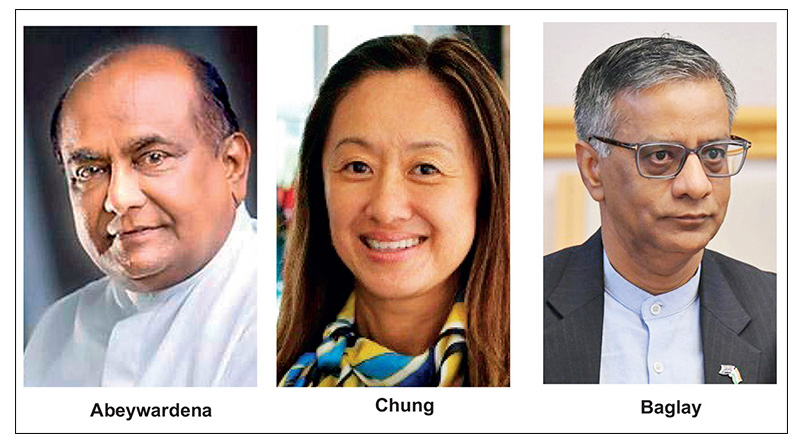
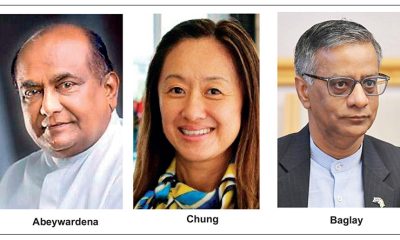
Finally, former Speaker Mahinda Yapa Abeywardena has set the record straight with regard to a controversial but never properly investigated bid to swear in him as interim President. Abeywardena has disclosed the circumstances leading to the proposal made by external powers on the morning of 13 July, 2022, amidst a large scale staged protest outside the Speaker’s official residence, situated close to Parliament.
Lastly, the former parliamentarian has revealed that it was then Indian High Commissioner, in Colombo, Gopal Baglay (May 2022 to December 2023) who asked him to accept the presidency immediately. Professor Sunanda Maddumabandara, who served as Senior Advisor (media) to President Ranil Wickremesinghe (July 2022 to September 2024), disclosed Baglay’s direct intervention in his latest work, titled ‘Aragalaye Balaya’ (Power of Aragalaya).
Prof. Maddumabandara quoted Abeywardena as having received a startling assurance that if he agreed to accept the country’s leadership, the situation would be brought under control, within 45 minutes. Baglay had assured Abeywardena that there is absolutely no harm in him succeeding President Gotabaya Rajapaksa, in view of the developing situation.
The author told the writer that only a person who had direct control over the violent protest campaign could have given such an assurance at a time when the whole country was in a flux.
One-time Vice Chancellor of the Kelaniya University, Prof. Maddumabandara, launched ‘Aragalaye Balaya’ at the Sri Lanka Foundation on 20 November. In spite of an invitation extended to former President Gotabaya Rajapaksa, the ousted leader hadn’t attended the event, though UNP leader Ranil Wickremesinghe was there. Maybe Gotabaya felt the futility of trying to expose the truth against evil forces ranged against them, who still continue to control the despicable agenda.
Obviously, the author has received the blessings of Abeywardena and Wickremesinghe to disclose a key aspect in the overall project that exploited the growing resentment of the people to engineer change of Sri Lankan leadership.
The declaration of Baglay’s intervention has contradicted claims by National Freedom Front (NFF) leader Wimal Weerawansa (Nine: The hidden story) and award-winning writer Sena Thoradeniya (Galle Face Protest: System change for anarchy) alleged that US Ambassador Julie Chung made that scandalous proposal to Speaker Abeywardena. Weerawansa and Thoradeniya launched their books on 25 April and 05 July, 2023, at the Sri Lanka Foundation and the National Library and Documentation Services Board, Independence Square, respectively. Both slipped in accusing Ambassador Chung of making an abortive bid to replace Gotabaya Rajapaksa with Mahinda Yapa Abeywardena.
Ambassador Chung categorically denied Weerawansa’s allegation soon after the launch of ‘Nine: The hidden story’ but stopped short of indicating that the proposal was made by someone else. Chung had no option but to keep quiet as she couldn’t, in response to Weerawansa’s claim, have disclosed Baglay’s intervention, under any circumstances, as India was then a full collaborator with Western designs here for its share of spoils. Weerawansa, Thoradeniya and Maddumabandara agree that Aragalaya had been a joint US-Indian project and it couldn’t have succeeded without their intervention. Let me reproduce the US Ambassador’s response to Weerawansa, who, at the time of the launch, served as an SLPP lawmaker, having contested the 2020 August parliamentary election on the SLPP ticket.
“I am disappointed that an MP has made baseless allegations and spread outright lies in a book that should be labelled ‘fiction’. For 75 years, the US [and Sri Lanka] have shared commitments to democracy, sovereignty, and prosperity – a partnership and future we continue to build together,” Chung tweeted Wednesday 26 April, evening, 24 hours after Weerawansa’s book launch.
Interestingly, Gotabaya Rajapaksa has been silent on the issue in his memoirs ‘The Conspiracy to oust me from Presidency,’ launched on 07 March, 2024.
What must be noted is that our fake Marxists, now entrenched in power, were all part and parcel of Aragalaya.
A clandestine meeting
Abeywardena should receive the appreciation of all for refusing to accept the offer made by Baglay, on behalf of India and the US. He had the courage to tell Baglay that he couldn’t accept the presidency as such a move violated the Constitution. In our post-independence history, no other politician received such an offer from foreign powers. When Baglay stepped up pressure, Abeywardena explained that he wouldn’t change his decision.
Maddumabandara, based on the observations made by Abeywardena, referred to the Indian High Commissioner entering the Speaker’s Official residence, unannounced, at a time protesters blocked the road leading to the compound. The author raised the possibility of Baglay having been in direct touch with those spearheading the high profile political project.
Clearly Abeywardena hadn’t held back anything. The former Speaker appeared to have responded to those who found fault with him for not responding to allegations, directed at him, by revealing everything to Maddumabandara, whom he described in his address, at the book launch, as a friend for over five decades.
At the time, soon after Baglay’s departure from the Speaker’s official residence, alleged co-conspirators Ven. Omalpe Sobitha, accompanied by Senior Professor of the Sinhala Faculty at the Colombo University, Ven. Agalakada Sirisumana, health sector trade union leader Ravi Kumudesh, and several Catholic priests, arrived at the Speaker’s residence where they repeated the Indian High Commissioner’s offer. Abeywardena repeated his previous response despite Sobitha Thera acting in a threatening manner towards him to accept their dirty offer. Shouldn’t they all be investigated in line with a comprehensive probe?
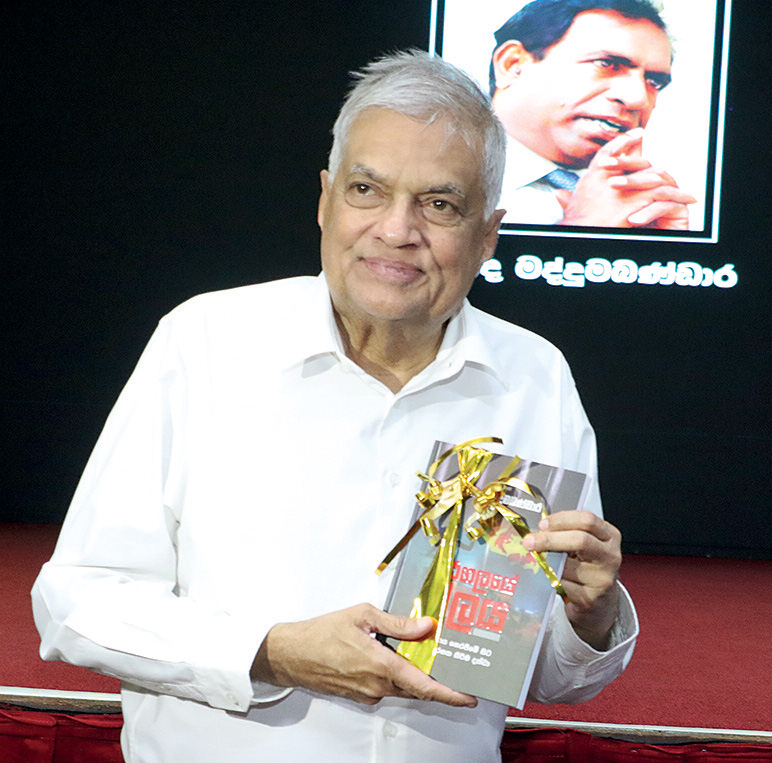
Ex-President Wickremesinghe with a copy of Aragalaye Balaya he received from its author, Prof. Professor Sunanda Maddumabandara, at the Sri Lanka Foundation recently (pic by Nishan S Priyantha)
On the basis of what Abeywardena had disclosed to him, Maddumabanadara also questioned the circumstances of the deployment of the elite Special Task Force (STF) contingent at the compound. The author asked whether that deployment, without the knowledge of the Speaker, took place with the intervention of Baglay.
Aragalaye Balaya
is a must read for those who are genuinely interested in knowing the unvarnished truth. Whatever the deficiencies and inadequacies on the part of the Gotabaya Rajapaksa administration, external powers had engineered a change of government. The writer discussed the issues that had been raised by Prof. Maddumabandara and, in response to one specific query, the author asserted that in spite of India offering support to Gotabaya Rajapaksa earlier to get Ranil Wickremesinghe elected as the President by Parliament to succeed him , the latter didn’t agree with the move. Then both the US and India agreed to bring in the Speaker as the Head of State, at least for an interim period.
If Speaker Abeywardena accepted the offer made by India, on behalf of those backing the dastardly US backed project, the country could have experienced far reaching changes and the last presidential election may not have been held in September, 2004.
After the conclusion of his extraordinary assignment in Colombo, Baglay received appointment as New Delhi’s HC in Canberra. Before Colombo, Baglay served in Indian missions in Ukraine, Russia, the United Kingdom, Nepal and Pakistan (as Deputy High Commissioner).
Baglay served in New Delhi, in the office of the Prime Minister of India, and in the Ministry of External Affairs as its spokesperson, and in various other positions related to India’s ties with her neighbours, Europe and multilateral organisations.
Wouldn’t it be interesting to examine who deceived Weerawansa and Thoradeniya who identified US Ambassador Chung as the secret visitor to the Speaker’s residence. Her high-profile role in support of the project throughout the period 31 March to end of July, 2022, obviously made her an attractive target but the fact remains it was Baglay who brought pressure on the then Speaker. Mahinda Yapa Abeywardena’s clarification has given a new twist to “Aragalaya’ and India’s diabolical role.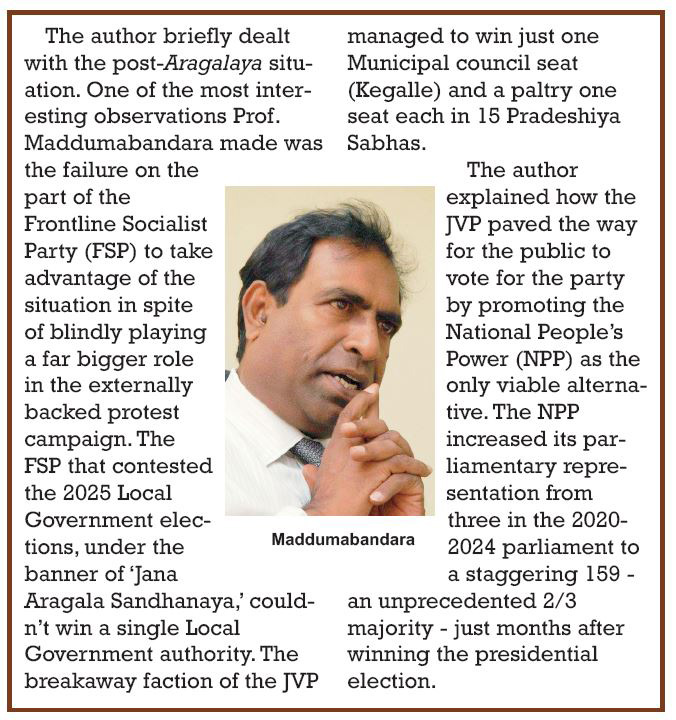
Absence of investigations
Sri Lanka never really wanted to probe the foreign backed political plot to seize power by extra-parliamentary means. Although some incidents had been investigated, the powers that be ensured that the overall project remained uninvestigated. In fact, Baglay’s name was never mentioned regarding the developments, directly or indirectly, linked to the devious political project. If not for Prof. Maddumabandara taking trouble to deal with the contentious issue of regime change, Baglay’s role may never have come to light. Ambassador Chung would have remained the target of all those who found fault with US interventions. Let me be clear, the revelation of Baglay’s clandestine meeting with the Speaker didn’t dilute the role played by the US in Gotabaya Rajapaksa’s removal.
If Prof. Maddumabandara propagated lies, both the author and Abeywardana should be appropriately dealt with. Aragalaye Balaya failed to receive the desired or anticipated public attention. Those who issue media statements at the drop of a hat conveniently refrained from commenting on the Indian role. Even Abeywardena remained silent though he could have at least set the record straight after Ambassador Chung was accused of secretly meeting the Speaker. Abeywardena could have leaked the information through media close to him. Gotabaya Rajapaksa and Ranil Wickremesinghe, too, could have done the same but all decided against revealing the truth.
A proper investigation should cover the period beginning with the declaration made by Gotabaya Rajapaksa’s government, in April 2022, regarding the unilateral decision to suspend debt repayment. But attention should be paid to the failure on the part of the government to decide against seeking assistance from the International Monetary Fund (IMF) to overcome the crisis. Those who pushed Gotabaya Rajapaksa to adopt, what they called, a domestic solution to the crisis created the environment for the ultimate collapse that paved the way for external interventions. Quite large and generous Indian assistance provided to Sri Lanka at that time should be examined against the backdrop of a larger frightening picture. In other words, India was literally running with the sheep while hunting with the hounds. Whatever the criticism directed at India over its role in regime change operation, prompt, massive and unprecedented post-Cyclone Ditwah assistance, provided by New Delhi, saved Sri Lanka. Rapid Indian response made a huge impact on Sri Lanka’s overall response after having failed to act on a specific 12 November weather alert.
It would be pertinent to mention that all governments, and the useless Parliament, never wanted the public to know the truth regarding regime change project. Prof. Maddumabandara discussed the role played by vital sections of the armed forces, lawyers and the media in the overall project that facilitated external operations to force Gotabaya Rajapaksa out of office. The author failed to question Wickremesinghe’s failure to launch a comprehensive investigation, with the backing of the SLPP, immediately after he received appointment as the President. There seems to be a tacit understanding between Wickremesinghe and the SLPP that elected him as the President not to initiate an investigation. Ideally, political parties represented in Parliament should have formed a Special Parliamentary Select Committee (PSC) to investigate the developments during 2019 to the end of 2022. Those who had moved court against the destruction of their property, during the May 2022 violence directed at the SLPP, quietly withdrew that case on the promise of a fresh comprehensive investigation. This assurance given by the Wickremesinghe government was meant to bring an end to the judicial process.
When the writer raised the need to investigate external interventions, the Human Rights Commission of Sri Lanka (HRCSL) sidestepped the issue. Shame on the so-called independent commission, which shows it is anything but independent.
Sumanthiran’s proposal
Since the eradication of the Liberation Tigers of Tamil Eelam (LTTE) in May 2009, the now defunct Tamil National Alliance’s (TNA) priority had been convincing successive governments to withdraw the armed forces/ substantially reduce their strength in the Northern and Eastern Provinces. The Illankai Thamil Arasu Kadchi (ITAK)-led TNA, as well as other Tamil political parties, Western powers, civil society, Tamil groups, based overseas, wanted the armed forces out of the N and E regions.
Abeywardena also revealed how the then ITAK lawmaker, M.A. Sumanthiran, during a tense meeting chaired by him, in Parliament, also on 13 July, 2022, proposed the withdrawal of the armed forces from the N and E for redeployment in Colombo. The author, without hesitation, alleged that the lawmaker was taking advantage of the situation to achieve their longstanding wish. The then Speaker also disclosed that Chief Opposition Whip Lakshman Kiriella and other party leaders leaving the meeting as soon as the armed forces reported the protesters smashing the first line of defence established to protect the Parliament. However, leaders of minority parties had remained unruffled as the situation continued to deteriorate and external powers stepped up efforts to get rid of both Gotabaya Rajapaksa and Ranil Wickremesinghe to pave the way for an administration loyal and subservient to them. Foreign powers seemed to have been convinced that Speaker Abeywardena was the best person to run the country, the way they wanted, or till the Aragalaya mob captured the House.
The Author referred to the role played by the media, including social media platforms, to promote Gotabaya Rajapaksa’s successor. Maddumamabandara referred to the Hindustan Times coverage to emphasise the despicable role played by a section of the media to manipulate the rapid developments that were taking place. The author also dealt with the role played by the Janatha Vimukthi Peramuna (JVP) in the project with the focus on how that party intensified its actions immediately after Gotabaya Rajapaksa stepped down.
Disputed assessment
The Author identified Ministers Bimal Rathnayaka, Sunil Handunetti and K.D. Lal Kantha as the persons who spearheaded the JVP bid to seize control of Parliament. Maddumabanda unflinchingly compared the operation, mounted against Gotabaya Rajapaksa, with the regime change operations carried out in Iraq, Libya, Egypt and Ukraine. Asserting that governments loyal to the US-led Western block had been installed in those countries, the author seemed to have wrongly assumed that external powers failed to succeed in Sri Lanka (pages 109 and 110). That assertion is utterly wrong. Perhaps, the author for some unexplained reasons accepted what took place here. Nothing can be further from the truth than the regime change operation failed (page 110) due to the actions of Gotabaya Rajapaksa, Mahinda Yapa Abeywardana and Ranil Wickremesinghe. In case, the author goes for a second print, he should seriously consider making appropriate corrections as the current dispensation pursues an agenda in consultation with the US and India.
The signing of seven Memorandums of Understanding (MoUs) with India, including one on defence, and growing political-defence-economic ties with the US, have underscored that the JVP-led National People’s Power (NPP) may not have been the first choice of the US-India combine but it is certainly acceptable to them now.
The bottom line is that a democratically elected President, and government, had been ousted through unconstitutional means and Sri Lanka meekly accepted that situation without protest. In retrospect, the political party system here has been subverted and changed to such an extent, irreparable damage has been caused to public confidence. External powers have proved that Sri Lanka can be influenced at every level, without exception, and the 2022 ‘Aragalaya’ is a case in point. The country is in such a pathetic state, political parties represented in Parliament and those waiting for an opportunity to enter the House somehow at any cost remain vulnerable to external designs and influence.
Cyclone Ditwah has worsened the situation. The country has been further weakened with no hope of early recovery. Although the death toll is much smaller compared to that of the 2004 tsunami, economic devastation is massive and possibly irreversible and irreparable.
By Shamindra Ferdinando
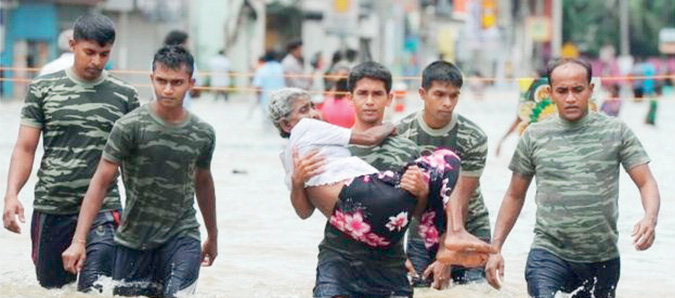
Over the desolate watery wastes,
Dulling the glow of the fabled Gem,
There opens a rainbow of opportunity,
For the peoples North and South,
To not only meet and greet,
But build a rock-solid bridge,
Of mutual help and solidarity,
As one undivided suffering flesh,
And we are moved to say urgently-
‘All you who wax so lyrically,
Of a united nation and reconciliation,
Grab this bridge-building opportunity.’
By Lynn Ockersz

Several spells of showers will occur in the Northern, North-Central, Eastern, Uva and Central provinces

Bondi Beach gunmen who killed 15 after targeting Jewish celebration were father and son, police say

Govt. urged to take action against deputy minister

India sends stock of life-saving medicines

George Keyt Foundation contributes to national disaster relief efforts

New Ambassador to South Korea appreciates job opportunities for Lankans

‘Dates have the highest sugar content to fight Coronavirus’

Sunday Island 27 December – Headlines

#SundayIsland 17th December – Headlines

Sunday Island – 28th March

Sunday Island Headlines – 21 March

Sunday Island – 21st February – Headlines
-
 Features5 days ago
Finally, Mahinda Yapa sets the record straight
-
 News6 days ago
Cyclone Ditwah leaves Sri Lanka’s biodiversity in ruins: Top scientist warns of unseen ecological disaster
-
 Features5 days ago
Handunnetti and Colonial Shackles of English in Sri Lanka
-
 Business4 days ago
Cabinet approves establishment of two 50 MW wind power stations in Mullikulum, Mannar region
-

 News7 days ago
Jetstar to launch Australia’s only low-cost direct flights to Sri Lanka, with fares from just $315^
-
 News4 days ago
Gota ordered to give court evidence of life threats
-
 Features6 days ago
An awakening: Revisiting education policy after Cyclone Ditwah
-
 Features4 days ago
Cliff and Hank recreate golden era of ‘The Young Ones’