
News
EP Governor on where Province has gone wrong despite all its potential

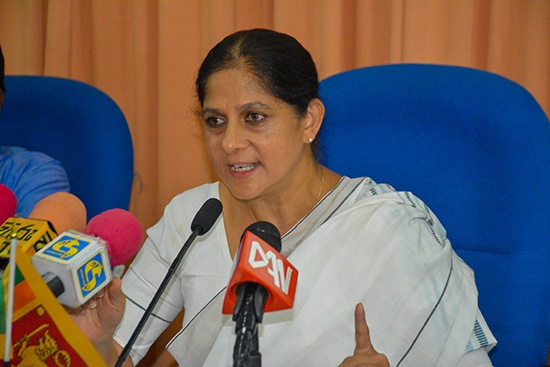
The Eastern Province blessed with huge amounts of resources remained one of the poorest provinces of the country owing to inaction and lethargy of officials, Eastern Province governor Anuradha Yahampath said yesterday.
Addressing a meeting at the Batticaloa District Secretariat to formulate a sustainable development plan in accordance with the vision of the Vistas of Prosperity programme, the Governor said: “This province accounts for 25 percent of paddy production of the country. Its fishers harvest is 25 percent of the total catch of the country. The milk production, too, is very high, but the province remains one of the poorest in the country. What is the reason for this mismatch? We have not been able to help people reap the benefits of their efforts and the resources the province has.”
The Governor said that the incumbent government was capable of bringing about a change that was hoped by the people. “This government has leaders capable of developing the country. It is led by those who won the war – a feat that had been only a dream for many because the former governments had the mindset that the war would never be won. Not even the international community thought that our leaders could achieve it. We could have done so because people all alike stood behind the government and supported its war effort. I am sure that the people will stand firm with their unwavering support if they are convinced that we are genuinely engaged in developing this country,” she said, adding that the fault lies in the hands of officials who could not commit themselves hundred percent to developing this nation.
“My objective is to turn this province into a centre of development. We must understand that time is not a luxury we have and must make use of time wisely to improve the conditions that leads to the despair of people. We should set an example by committing ourselves to this task and then people will follow suit.
“Today, I summoned this meeting for you to meet a team of experts who had worked with dedication to formulate the Vistas of Prosperity programme. I too worked with them and other experts of the Viyath Maga and know that they share the vision of not leaving the task of developing this nation and bringing the country on par with developed nations to another generation. We must be the change and that will ensure that change will take place.”
Prof Praveen Abhayaratne, Prof Lalithasiri Gunaruwan, Chairperson of the Central Environment Authority Attorney-at-Law Darshani Lahandapura, Senior Lecturer Sampath Vahala, former Deputy Director of Customs Samantha Gunasekera, Engineer Ravi de Silva, Arjuna Perera, Madhawa Boteju, Anushka Kumara, Chief Secretary of the Province Tusitha P Wanigasinghe, Secretary to the Governor L.P. Madanayake, all secretaries of the provincial ministers and directors of the provincial institutions were present on the occasion.

… talks with Moscow cover fresh coal supplies
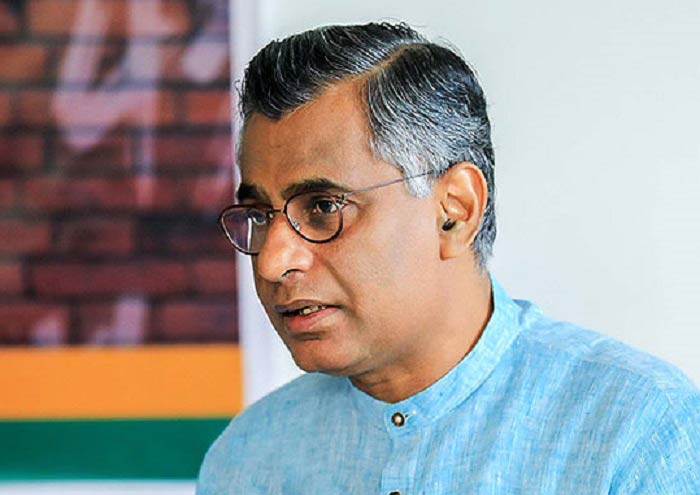
Eksath Janaraja Peramuna leader Patali Champika Ranawaka yesterday (01) said that Sri Lanka would not be able to secure oil from Russia before the reimposition of US sanctions on Russian oil. The former Minister said so at a joint Opposition media briefing in Colombo. He said it wouldn’t be possible to import Russian crude before the 12 April deadline.
Deputy Russian Energy Minister Roman Marshavin was here last week to discuss how the Russian Federation could help Sri Lanka meet its energy needs.
Sources familiar with the challenges faced by Sri Lanka, due to the disruption of crude/gas/refined products supply lines, said that the country’s only refinery needed crude to ensure the operation of the facility.
According to the Energy Ministry, during discussions with the delegation, led by Deputy Minister Marshavin, Sri Lanka was offered refined petrol, diesel and aviation fuel, in addition to crude oil. The discussions also covered the procurement of coal from Russia, according to the Ministry.
In 2025, the NPP government reached an agreement with an Indian supplier to bring in coal from South Africa. However, low-quality South African coal has caused a severe crisis due to the country’s only coal-fired power plant at Norochcholai failing to generate at the required levels, parliamentary sources said, referring to a report submitted by the CEB to the Parliament.
Meanwhile, informed sources said that there had been some discussions between Sri Lanka and India regarding the proposed move by the NPP government to procure oil directly from India.
Ranawaka said that of the six promised crude ships, four wouldn’t be coming, regardless of assurances given by the government. He alleged the government was trying to deceive the public that power cuts were inevitable due to continuing drought but the truth is the low-quality coal that caused the crisis. The recently announced electricity tariff hike, too, was due to the coal fraud, he alleged. (SF)
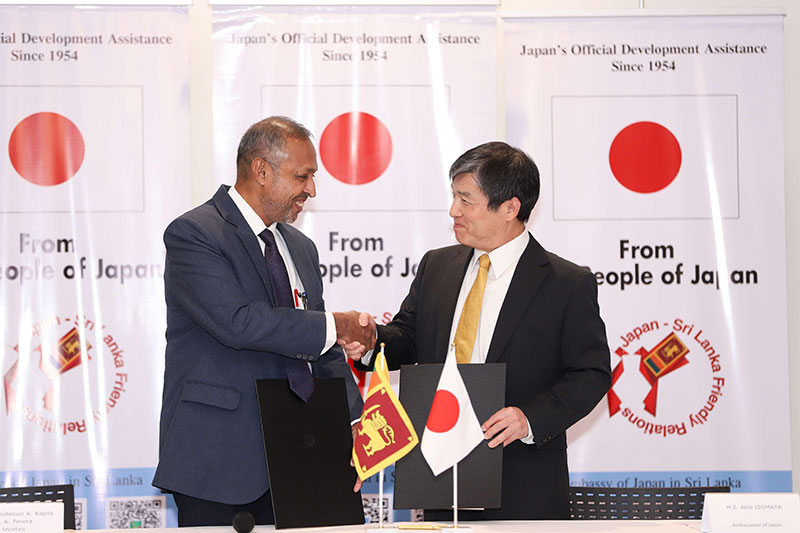
Japan will provide USD 362,476 (approx. Rs. 112 million), under “Grant Assistance for Grassroots Human Security Projects (GGP), to provide eight large low-floor buses for public transportation here.
Japanese Ambassador Akio Isomata and Transport, Highways and Urban Development Secretary Senior Professor K. Kapila C. K. Perera signed the agreement in this regard recently.
The project developed following discussions held between President Anura Kumara Dissanayake and Ms. Akiko Ikuina, the then Parliamentary Vice Minister of Foreign Affairs of Japan during her visit to Sri Lanka in February 2025, where a request was made by the President for the provision of large low-floor buses from Japan.
Emphasising the significance of the project, Ambassador Isomata remarked: “The large low-floor buses to be provided, which are completely refurbished used vehicles, comply with Euro 4 emission standards, ensuring that they are profoundly environmentally friendly. This project directly supports the “Clean Sri Lanka” initiative—one of the current administration’s most vital policies—by advancing the “greening” of the transport sector. By introducing these high-standard vehicles, we aim to address critical urban challenges: alleviating traffic congestion, enhancing economic efficiency, thus contributing to the reduction of economic losses incurred by traffic congestion. The large low-floor buses, by being accessible to the elderly people and persons with disabilities, also aligns with the concept of “human security, “which the Government of Japan adopts as one of the major pillars of its diplomacy with the aim of protecting and empowering the vulnerable people to live in dignity. I believe these buses help improve the overall Quality of Life (QOL) of the Sri Lankans by facilitating the smooth mobility of the workforce.”
Commenting on the receiving of this grant assistance, Senior Professor K. Kapila C. K. Perera, Secretary of Transport, Highways and Urban Development , stated:
“This valuable donation represents a significant step towards modernining and enhancing the efficiency of the public transport service, which plays an essential role in the day-to-day life of the people of Sri Lanka, and we believe it will provide direct and long-term benefits in improving their living standards. We express our sincere gratitude to the Government and people of Japan for their contribution towards the long-term programme to make the national vision of “A Thriving Nation – A Beautiful Life” a reality for the people of Sri Lanka, and we firmly believe that this will further strengthen the enduring and long-term relations between the two countries, fostering a collaborative effort to build a mutually beneficial future.”
Since 1989, Japan has been providing a total of USD 62 million in assistance for Sri Lanka through the GGP (Grant Assistance for Grassroots Human Security Projects) scheme.

The Examinations Department has said that 62.64 percent of the total applicants who sat the 2025 G.C.E. Advanced Level Examination qualified for university admission.
The results of the 2025 A/L Exams were released on Tuesday (31).
The Department of Examinations released the names of the students who secured the highest ranks across all subject streams.
The full list of top achievers across all streams is as follows:
Biological Science stream
• First Place: Dilan Sanjana (Royal College, Colombo)
• Second Place: Krishan Sasidu Namthara (Taxila Central College, Horana)
• Third Place: Darshana Konesh (Sri Shanmuga Hindu Ladies’ College, Trincomalee)
Physical Science Stream
• First Place: Devendan Thirukumaran (Kilinochchi Maha Vidyalaya)
• Second Place: Tharusha Gimhana Gamlath (Maliyadeva College, Kurunegala)
• Third Place: Vinura Prasad de Mel (Sri Sumangala Boys’ College, Panadura)
Commerce Stream
• First Place: Subaideen Mohamed Fardhan (Kattankudy Central College)
• Second Place: Senadi Dihasna Sumanasekara (Musaeus College, Colombo)
• Third Place: Dileepa Sandaras Karunaratne (Bandaranayake College, Gampaha)
The Commissioner General of Examinations, A.K.S. Indika Kumari Liyanage, also announced that 62.64% of candidates who sat the Examination have qualified for university entrance.
The A/L exam results were released Tuesday (31).
Out of a total of 281,810 candidates who sat the examination, 176,527 qualified for university admission. Additionally, the Department of Examinations stated that the results of 111 candidates have been withheld.
Meanwhile, a total of 7,477 school candidates, representing 3.38% of the total number of school applicants, obtained ‘A’ grades in all subjects. Furthermore, 823 private candidates also secured ‘A’ passes across all subjects.
The percentage of university admission eligibility by subject stream are as follows:
1. Biological Science – 59.56% (school candidates) and 58.43% (private candidates)
2. Physical Science – 63.96% and 61.59% respectively
3. Commerce – 72.02% and 66.29%
4. Arts – 67.57% and 63.57%
5. Engineering Technology – 64.85% and 62.65%
6. Bio Systems Technology – 71.76% (school candidates) and 70.24% overall
7. Other Subjects – 55.39% and 51.45%
Provincial distribution of candidates qualifying for university admission is as follows:
1. Western Province – 69.42%
2. North Western Province – 68.48%
3. Northern Province – 66.91%
4. Eastern Province – 66.32%
5. Southern Province – 65.69%
6. Sabaragamuwa Province – 64.97%
7. Uva Province – 63.53%
8. Central Province – 63.04%
9. North Central Province – 60.91%
Results of 111 candidates who had faced the exam have been suspended due to various reasons, according to the Department.

Sri Lanka cannot procure Russian oil before US sanctions return – Champika

Japanese boost for public transport here

2025 GCE AL: 62% qualify for Uni entrance; results of 111 suspended

Arctic link discovered: Lankan scientists trace 8,000 km seabird migration route

Intelligence services uncover several all-out plots to kill ‘Wele Suda’ held at Boossa high security prison

Colts win First Class title

‘Dates have the highest sugar content to fight Coronavirus’

Sunday Island 27 December – Headlines

#SundayIsland 17th December – Headlines

Sunday Island – 28th March

Sunday Island Headlines – 21 March

Sunday Island – 21st February – Headlines
-

 Features5 days ago
A World Order in Crisis: War, Power, and Resistance
-

 News6 days ago
Energy Minister indicted on corruption charges ahead of no-faith motion against him
-

 Sports6 days ago
SLC to hold EGM in April
-

 Opinion6 days ago
When elephants fight, it is the grass that suffers
-
 Latest News7 days ago
A strong Technical and Vocational Education and Training (TVET) system equips individuals with practical, relevant, and future-oriented skills helping to innovate responsibly towards a greener and sustainable future – PM
-
 Features6 days ago
Lest we forget
-
 Business6 days ago
Pan Asia Bank empowers export sector as Strategic Partner of NCE Export Awards
-

 News2 days ago
Tariff shock from 01 April as power costs climb across the board