
News
Economic crisis: Govt. MPs slam Cabinet, Finance Ministry


‘How come SLPA paid to Treasury just a faction of massive revenue earned in six years?’
By Shamindra Ferdinando
T wo SLPP MPs, Dr. Nalaka Godahewa and Madura Vithanage have, at different forums, lashed out at the government for the rapidly deteriorating status of the public sector finance. Godahewa has warned that economic recovery will not be possible unless the government restructured nearly 400 loss making public sector enterprises or at least take tangible measures to cut down on recurring losses.The former Media Minister, who represents the Gampaha District, said so addressing a group of Gampaha-based professionals and entrepreneurs recently.
Alleging that the failure, on the part of the government to establish an all-party government, contributed to the further deterioration of the situation, Dr. Godahewa emphasized the urgent need to curb, what he called, unbridled corruption as part of the efforts to revive the economy.The Gampaha District MP asked whether the current dispensation has addressed the issues at hand with a sense of responsibility.The MP questioned the composition of the Cabinet-of-Ministers, especially the appointment of UNP leader Ranil Wickremesinghe as the Premier, in spite of his party having just one seat in Parliament, against the backdrop of even the government parliamentary group not being properly represented.
Dr. Godahewa warned that SriLankan Airlines, the Ceylon Electricity Board, and the Ceylon Petroleum Corporation (CPC) would deny the country an opportunity to recover as they remained a massive burden on taxpayers. The One-time top level private sector executive said that the Cabinet-of-Ministers lacked the strength to take crucial decisions. But, the situation would have been different if the Cabinet-of-Ministers included representatives of the main Opposition Samagi Jana Balavegaya (SJB) and other political parties. Dr. Godahewa declared that the government couldn’t take decisions on sensitive matters as long as it didn’t command political power.
Meanwhile, Colombo District MP Vithanage has questioned the responsibility, on the part of the Finance Ministry, in the overall deterioration of public sector finance with the focus on the handling of the Sri Lanka Ports Authority (SLPA) at a recent meeting of the Committee on Public Enterprises (COPE). The lawmaker alleged that the Finance Ministry had conveniently failed to make required intervention on behalf of the government, thereby deprived the opportunity to utilize SLPA profits.
Prof. Charitha Herath chaired the meeting. Auditor General W.P.C. Wickramaratne attended the meeting whereas Ports and Shipping Secretary K.D.S. Ruwanchandra led the SLPA team.Both MP Vithanage and Prof. Herath asserted that the Finance Ministry should have intervened on behalf of the people. The COPE examined how the SLPA continuously refrained from paying the Treasury at least the minimum amounts in spite of receiving massive profits over the years. The Director General Public Enterprises, who has received that position recently, struggled to explain their failure to take up the non-transfer of SLPA profits to the Treasury. The COPE was told of Rs 69,686 mn revenue earned from 2016 to 2021, only 600 mn had been transferred to the Treasury.
Lawmaker Vithanage yesterday told The Island that the recent examinations of various enterprises and the Central Bank, by the COPE, as well as other watchdog committees, disclosed how the Finance Ministry, Central Bank and the Monetary Board contributed to the developing crisis. MP Vithanage pointed out even after the Covid-19 eruption devastated the economy, the SLPA had been able to withhold funds required by the Treasury for want of Finance Ministry intervention.Responding to queries, MP Vithanage said that the Parliament should act without further delay to ensure the Finance Ministry and the Monetary Board acted responsibly.





Bus fares have been increased by 12.19% with effect from midnight today [23rd March 2026].
The minimum fare will be increased from Rs 27 to Rs 30 while the maximum fare of Rs2159/- will be increased to 2422/-
Latest News
Public will not be served as Computer system failure at Department of Registration of Persons

The Acting Commissioner General of Registration of Persons has announced that due to an unexpected failure of the computer system of the Department of Registration of Persons, all services, including the one day service will not be held on Tuesday (24th March) at the Head Office and all Provincial offices.

Latest News
Heat Index at Caution Level in the Western, Sabaragamuwa, Southern and North-western provinces and in Anuradhapura, Mannar and Vavuniya districts
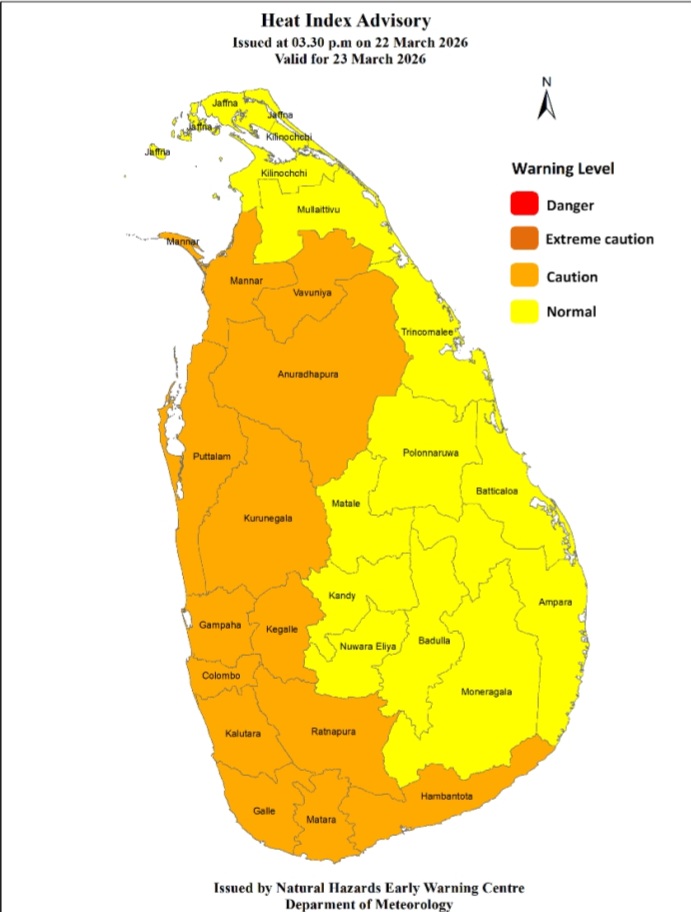
Warm Weather Advisory
Issued by the Natural Hazards Early Warning Centre of the Department of Meteorology
at 3.30 p.m. on 22 March 2026, valid for 23 March 2026.
The Heat index, the temperature felt on human body is likely to increase up to ‘Caution level’ at some places in the Western, Sabaragamuwa, Southern and North-western provinces and in
Anuradhapura, Mannar and Vavuniya districts.
The Heat Index Forecast is calculated by using relative humidity and maximum temperature and this is the condition that is felt on your body. This is not the forecast of maximum temperature. It is generated by the Department of Meteorology for the next day period and prepared by using global numerical weather prediction model data.

Effect of the heat index on human body is mentioned in the above table and it is prepared on the advice of the Ministry of Health and Indigenous Medical Services.
ACTION REQUIRED
Job sites: Stay hydrated and takes breaks in the shade as often as possible.
Indoors: Check up on the elderly and the sick.
Vehicles: Never leave children unattended.
Outdoors: Limit strenuous outdoor activities, find shade and stay hydrated.
Dress: Wear lightweight and white or light-colored clothing.
Note:
In addition, please refer to advisories issued by the Disaster Preparedness & Response Division, Ministry of Health in this regard as well. For further clarifications please contact 011-7446491.

Two killed when Air Canada jet hits fire truck at NYC’s LaGuardia Airport

Bus fares increased by 12.19% from midnight today [23]
Public will not be served as Computer system failure at Department of Registration of Persons

Trump says he is postponing strikes on Iran power plants after ‘productive’ talks on ending war

Asia stocks slide as US and Iran threaten to escalate war

Heat Index at Caution Level in the Western, Sabaragamuwa, Southern and North-western provinces and in Anuradhapura, Mannar and Vavuniya districts

‘Dates have the highest sugar content to fight Coronavirus’

Sunday Island 27 December – Headlines

#SundayIsland 17th December – Headlines

Sunday Island – 28th March

Sunday Island Headlines – 21 March

Sunday Island – 21st February – Headlines
-

 News6 days ago
CIABOC questions Ex-President GR on house for CJ’s maid
-

 News7 days ago
Sri Lankan marine scientist Asha de Vos honoured at UNGA opening
-

 News7 days ago
Australian HC debunks misleading travel risk claims for Sri Lanka
-

 News5 days ago
Bailey Bridge inaugurated at Chilaw
-

 News5 days ago
Pay hike demand: CEB workers climb down from 40 % to 15–20%
-

 News4 days ago
CIABOC tells court Kapila gave Rs 60 mn to MR and Rs. 20 mn to Priyankara
-

 Editorial6 days ago
Couple QR-based quota with odd-even rationing
-

 News3 days ago
Colombo, Oslo steps up efforts to strengthen bilateral cooperation in key environmental priority areas