
News
Easter Sunday probe in tatters: Director CID transferred following internal inquiry into Riyaj release

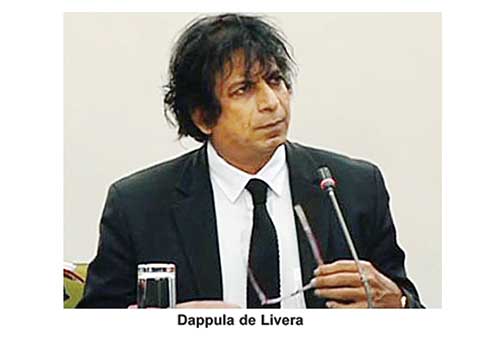
AG wants report within one month
By Shamindra Ferdinando
Close on the heels of Attorney General Dappula de Livera, PC, alleging serious lapses on the part of the Criminal Investigation Department (CID), in respect of the probe on Riyaj Bathiudeen’s alleged involvement with those responsible for the Easter Sunday attacks, the premier investigating agency’s Director SSP Prasanna de Alwis has been moved out.
The transfer took place consequent to an unprecedented meeting the AG had with the new Director CID Prasad Ranasinghe and three other officers, including SSP Alwis. The AG found fault with the CID over the way the police had released Riyaj arrested last April on the basis of irrefutable evidence of direct links with at least one Easter Sunday suicide bomber.
The National Police Commission (NPC) has cleared the CID Director’s transfer as Director, Terrorist Investigation Division (TID) whereas SSP G.N. de Zoysa received the CID Director’s post. Zoysa had been the Director of the recently formed unit responsible for inquiring into ill-gotten wealth. At the time, SSP de Alwis received appointment as Director, CID a couple of months ago, he was Director CID.
Within days after the media reported Riyaj Bathiudeen’s release, Police headquarters moved the then DIG CID Nuwan Wedasinghe out of the unit. He received an appointment as Acting DIG Western Province (North). Wedasinghe received posting as DIG, CID in late Dec last year following the change of government.
Following instructions received from the AG, who asked for a comprehensive report within a month, the police were now in the process of inquiring into the conduct of the CID.
Acting IGP C.D. Wickremaratne last week set up two special teams to probe the circumstances leading to Riyaj Bathiudeen’s release and serious lapses on the part of the CID.
Since the change of government in Nov 2019, the SSPs had held the post of Director CID. Of them, the first to hold the post was SSP W. Tilakaratne followed by de Alwis and now de Zoysa.
SSP Shani Abeysekera, who had been the director CID at the time of the change of government, is in remand custody. The police arrested him in July this year over charges of framing DIG Vass Gunawardena now on death row.
The CID is the second special unit to come under investigation this year. Earlier, the DIG, Police Narcotics Bureau (PNB) Sajeewa Medawatta and its Director SSP Manjula Senarath were transferred out after investigations launched at the behest of the AG exposed a section of the PNB dealing in heroin.
Well informed sources said that proper inquiry was needed to clean up the department. Sources explained that law enforcement apparatus was under scrutiny both by the AG and the Defence Secretary in the wake continuing accusations regarding impropriety. Sources also alleged that shortly before Riyaj’s release, his brother Samagi Jana Balavegaya lawmaker Rishad Bathiudeen met some senior CID officers.






Latest News
Sun directly overhead Dehiwala, Maharagama, Pannipitiya, Padukka, Eheliyagoda, Maskeliya, Siyambalanduwa and Pottuvil at about 12:13 noon. today (07th)


On the apparent northward relative motion of the sun, it is going to be directly over the latitudes of Sri Lanka during 05th to 15th of April in this year.
The nearest areas of Sri Lanka over which the sun is overhead today (07th) are Dehiwala, Maharagama, Pannipitiya, Padukka, Eheliyagoda, Maskeliya, Siyambalanduwa and Pottuvil at about 12:13 noon.
Latest News
Heat Index at Caution Level in the Northern, North-central, North-western and Eastern provinces and Monaragala and Hambantota districts.
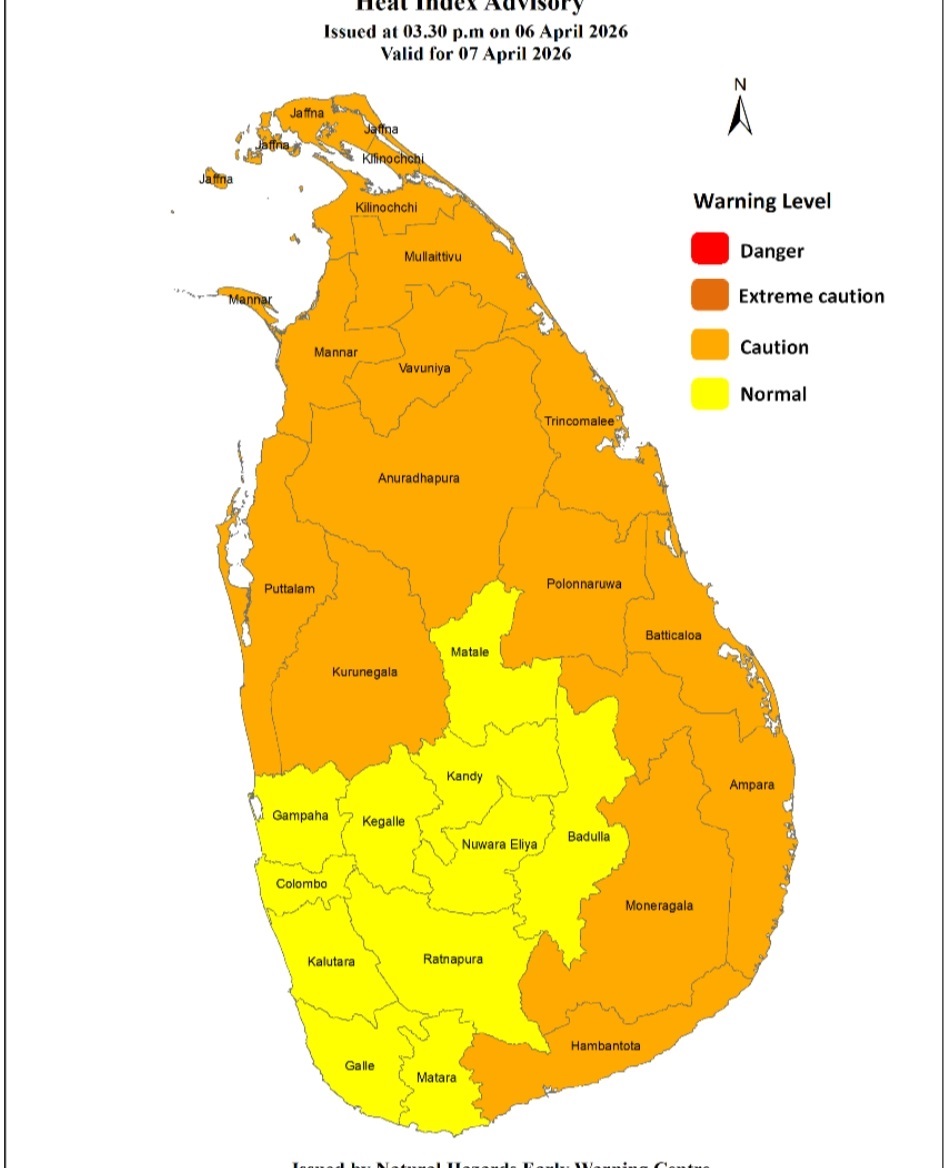
Warm Weather Advisory Issued by the Natural Hazards Early Warning Centre Issued at 3.30 p.m. on 06 April 2026, valid for 07 April 2026.
The Heat index, the temperature felt on human body is likely to increase up to ‘Caution level’ at some places in the Northern, North-central, North-western and Eastern provinces and Monaragala and Hambantota districts.
The Heat Index Forecast is calculated by using relative humidity and maximum temperature and this is the condition that is felt on your body. This is not the forecast of maximum temperature. It is generated by the Department of Meteorology for the next day period and prepared by using global numerical weather prediction model data.
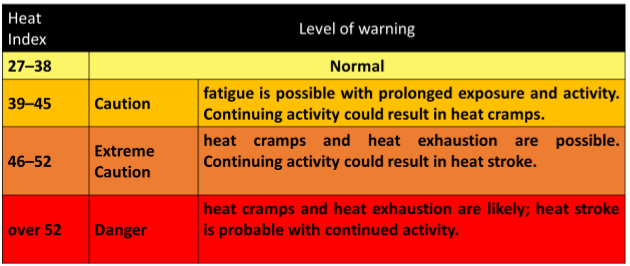
Effect of the heat index on human body is mentioned in the above table and it is prepared on the advice of the Ministry of Health and Indigenous Medical Services.
ACTION REQUIRED
Job sites: Stay hydrated and takes breaks in the shade as often as possible.
Indoors: Check up on the elderly and the sick.
Vehicles: Never leave children unattended.
Outdoors: Limit strenuous outdoor activities, find shade and stay hydrated.
Dress: Wear lightweight and white or light-colored clothing.
Note:
In addition, please refer to advisories issued by the Disaster Preparedness & Response Division, Ministry of Health in this regard as well. For further clarifications please contact 011-7446491.

… as Lakvijaya falters, power plants need over 2 mn litres of fuel daily
By Shamindra Ferdinando
The SJB yesterday (06) said that the NPP government owed an explanation as to why Litro Gas Lanka Limited and Laugfs Gas PLC were allowed to increase the prices of old stocks of domestic gas. Litro and Laugfs have increased the prices of 12.5 kg cylinder by Rs. 775 to Rs. 4,765 and by Rs. 1,070, to Rs. 5,700, respectively.
Convener of the Samagi United Trade Union Force (SUTUF) and the Samagi Joint Trade Union Alliance Ananda Palitha said they were aware of the state-owned gas supplier Litro and the private sector enterprise making a killing at the expense of consumers.
Acknowledging that gas and fuel prices had to be increased in view of the disruptions to the regular supply route through Hormuz Strait, the former petroleum sector worker emphasised it wouldn’t be fair, under any circumstances, to apply a new pricing formula to old stocks.
Taking advantage of the new West Asia war, the government (CPC) and three foreign private suppliers, namely Lanka IOC, Sinopec and R.M. Parks, increased prices of old fuel stocks, Palitha alleged, adding that his accusations, previously reported in the front-page of The Island, haven’t been disputed.
Responding to our queries, Palitha pointed out that Sri Lanka experienced gas supply disruption even just before the eruption of the Iran war.
Warning that further electricity tariff increases were around the corner due to failure on the part of the country’s only coal-fired power plant Lakvijaya to produce the required electricity, Palitha blamed the developing crisis on the use of low-quality coal for power generation.
Referring to recent media reports of fuel powered power plants needing 800,000 litres, daily, to meet the shortfall due to the crisis at Lakvijaya, Palitha said that the actual requirement was much more. Kelanitissa Combined cycle power plant alone required 1.3 mn litres of diesel daily, Palitha said, alleging the country was paying a very heavy price for corruption and mismanagement by the current dispensation.
According to Palitha Kerawalapitiya (Yugadanavi) Combined Cycle Power Plant required 750,000 litres of black oil/furnace oil. Together, those two power plants, namely Kelanitissa and Yugadanavi, required over 2 mn litres per day, the trade unionist activist said, warning the government of frightening economic consequences.
Having explained the requirements of other power stations in operation, Palitha said that the situation was so bad that the CEB, about three days back, began buying fuel worth Rs 1.7 bn from the Ceylon Petroleum Corporation on credit. Responding to another query, Palitha said that though the Iran war was having a major impact here, the NPP should accept responsibility for the corrupt coal deal and horrendous mismanagement of the power sector.
The government sought to downplay the crisis, claiming that Sri Lanka received Indian and Chinese support to meet its energy requirements, Palitha said. However, foreign powers were exploiting the situation here to advance their agendas, Palitha added, urging the government to come out clean.
India was increasing its hold on Sri Lanka, the trade union activist said, noting that Sri Lanka had recently declared its intention to develop a section of the Trincomalee oil tank farm together with India. According to Palitha, Indian Prime Minister Narendra Modi himself had asked President Anura Kumara Dissanayake to fast-track the project.

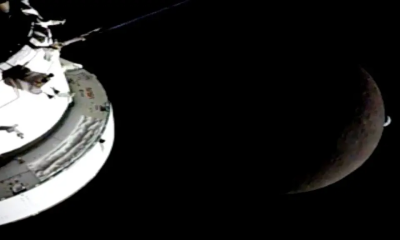
Artemis II crew head for home after travelling further from Earth than anyone before

Washout gives Kolkata Knight Riders first point after Bartlett’s new-ball burst

Hasaranga, Pathirana yet to undergo SLC-mandated fitness tests

Sun directly overhead Dehiwala, Maharagama, Pannipitiya, Padukka, Eheliyagoda, Maskeliya, Siyambalanduwa and Pottuvil at about 12:13 noon. today (07th)

Showers will occur at several places in the Northern, North-central, Central, Sabaragamuwa, Uva and Southern provinces after 1.00 p.m.

Heat Index at Caution Level in the Northern, North-central, North-western and Eastern provinces and Monaragala and Hambantota districts.

‘Dates have the highest sugar content to fight Coronavirus’

Sunday Island 27 December – Headlines

#SundayIsland 17th December – Headlines

Sunday Island – 28th March

Sunday Island Headlines – 21 March

Sunday Island – 21st February – Headlines
-

 Features2 days ago
Ranjith Siyambalapitiya turns custodian of a rare living collection
-

 News5 days ago
2025 GCE AL: 62% qualify for Uni entrance; results of 111 suspended
-

 News2 days ago
Global ‘Walk for Peace’ to be held in Lanka
-

 Business6 days ago
Hour of reckoning comes for SL’s power sector
-

 Editorial5 days ago
Search for Easter Sunday terror mastermind
-

 Opinion4 days ago
Hidden truth of Sri Lanka’s debt story: The untold narrative behind the report
-
Editorial6 days ago
Ideological confusion and identity crisis
-

 Opinion5 days ago
Is there hope for Palestine?