
Latest News
Doubling Rice yield achievable within next six harvest seasons – Secretary to the Ministry of Agriculture and Plantation

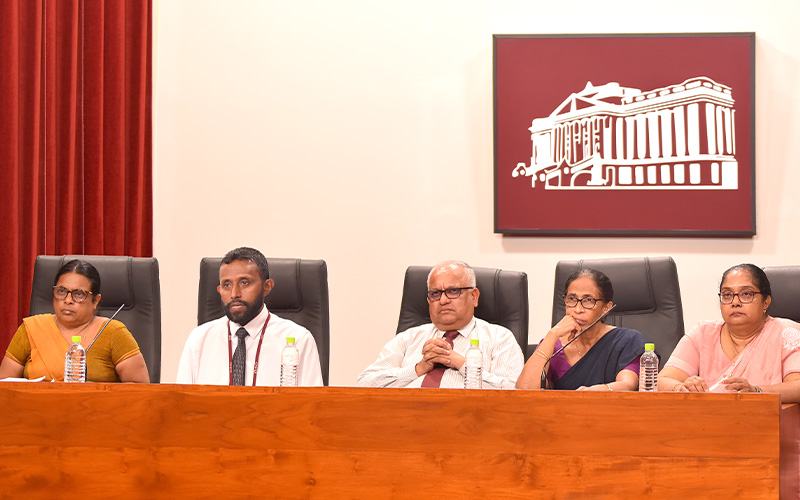
Secretary to the Ministry of Agriculture and Plantation, Janaka Dharmakeerthi, announced that necessary measures are in place to achieve President Ranil Wickremesinghe’s goal of doubling the rice harvest within the next six harvest seasons. He highlighted the introduction of a technical package aimed at this objective and emphasized that the Ministry of Agriculture is effectively handling the increasing demand for food, surpassing traditional agricultural practices.
The Agriculture and Plantation Ministry Secretary shared these updates during a press briefing titled “Two Years of Progress and Advancement” held at the Presidential Media Center (PMC) today (01). He also noted that the agriculture industry is already reaping the benefits of new technology implementations.
He further elaborated:
The Ministry of Agriculture is responsible for going beyond traditional farming methods to meet the increasing demand for food, a task that is currently being managed successfully. We have implemented the necessary measures to meet President Ranil Wickremesinghe’s goal of doubling the rice harvest within the next six cultivation seasons. To achieve this, we have introduced a technical package as part of the agricultural modernization program. Additionally, we have arranged for the utilization of all paddy fields, including fallow fields, for rice cultivation, while using the remaining cultivated land for other crops.
It is worth noting that we have already achieved successful results in paddy cultivation, with an anticipated harvest of 800,000 metric tons of rice needed for the country.
The Ministry of Agriculture cannot directly intervene in paddy prices. However, the government aims for fair price maintenance within an open economy. While occasional price hikes may occur without government intervention, persistent increases may prompt action. Currently, only two types of rice are kept in stock, but future plans include maintaining safe stocks of all rice types for market release. In the dry zone, fallow fields are being allocated to other crops based on recommendations from the Department of Agriculture, which is a positive step for food production.
To support agricultural modernization and address food needs beyond traditional cultivation, Rs.2500 million has been allocated in the budget. Interest-free loans are being provided for various agricultural activities in 26 Divisional Secretariat Divisions, and the Youth Agricultural Entrepreneurship Project is being implemented. This initiative has increased youth entrepreneurship opportunities in agriculture, plantation industries, and animal and fishery industries. The introduction of new technology has successfully attracted young people to these sectors.
Currently, special programs are being implemented to target international markets in the agricultural industry, extending beyond local boundaries. There is a growing trend in exporting fruit crops such as strawberries, mangoes, and pineapples. Additionally, a cold storage facility is being established in Dambulla to address yield fluctuations and crop losses. Although farmers are informed about suitable crops, they often produce according to the domestic needs of the country. The management of economic centers under our ministry has successfully reduced crop damage by about 50%. With the support of farmers, we are working on a systematic method to release crops to the market. We are also in discussions with the Ministry of Transport to use the railway service to reduce post-harvest damage, particularly during transportation. Efforts are being made to deploy trains from Beliatta to other provinces to facilitate this process.
[PMD]


New Zealand won the toss and elected to bowl first in the first semi-final at Eden Gardens
New Zealand: Tim Seifert (wk), Finn Allen, Rachin Ravindra, Glenn Phillips, Daryl Mitchell, Mark Chapman, Mitchell Santner (capt), James Neesham, Cole McConchie, Matt Henry, 11 Lockie Ferguson
South Africa: Aiden Markram (capt), Quinton de Kock (wk), Ryan Rickelton, Dewald Brevis, David Miller, Tristan Stubbs, Marco Jansen, Corbin Bosch, Kagiso Rabada, Keshav Maharaj, Lungi Ngidi

Around 140 people are missing after an Iranian navy ship sank off the coast of Sri Lanka.
The Sri Lankan navy says around 180 people were on board, with 32 rescued. A spokesman tells the BBC the cause of the sinking is not known
Sri Lanka’s navy has confirmed that it’s rescued 32 people after it received a distress call from Iranian navy ship ‘IRIS Dena’ early this morning.
Budhika Sampath, the spokesman of Sri Lanka’s navy says: “Though it was beyond our waters, it was within our search and rescue region. So we were obliged to respond as per international obligations.”
He adds: “We found people floating on the water, rescued them, and later when we inquired we found that those people are from an Iranian ship.”
He also says that according to the documentation of the ship 180 people are believed to have been on board, although the exact number of missing is unknown.
The spokesman says at the time of launching the rescue operations they did not see the vessel but saw oil patches on the water and floating life rafts.
He also tells the BBC that he rejects the reports of a submarine attack causing the sinking, and that the cause is unknown.
Earlier the secretary of the country’s defence ministry Air Vice Marshal Sampath Thuiyakontha told BBC Sinhala that around 140 people are thought to be missing.
So far, Sri Lanka’s military has not been able to confirm what might have caused the ship to sink.
[BBC]
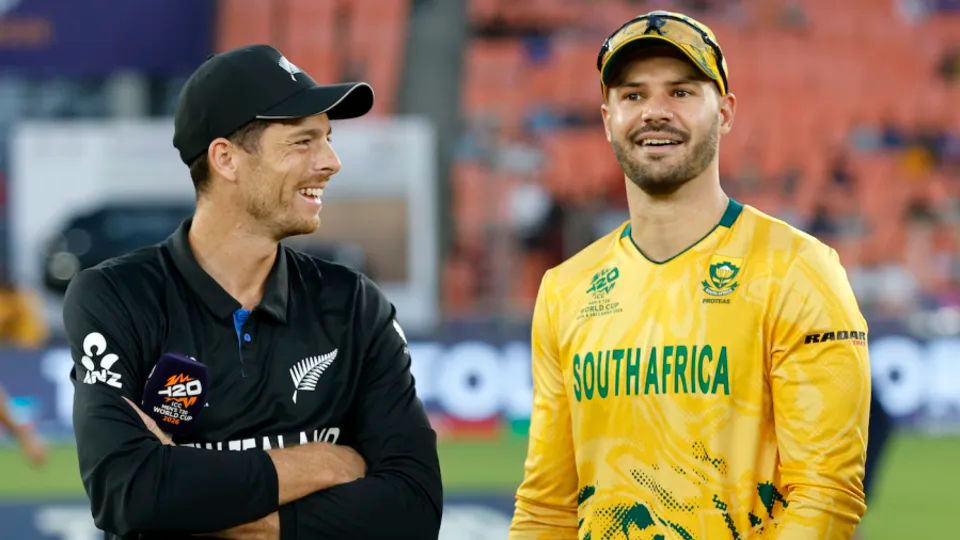
The good thing about South Africa – New Zealand semi-finals is it gives neutrals at least one team to cheer for in the final. Two generally likeable sides who have – somehow – yet to lift an ICC white-ball trophy between them since 2000 vie for yet one more crack at it, as they look to edge each other out. South Afria’s heartache c in these tournaments is well-documented, but New Zealand make semi finals more consistently than any other side over the past two decades, and are yet to string the two matches together from this stage onwards that would propel them to glory.
There is, often, little to choose between these two but, this time around, a clear favourite has emerged. South Africa are unbeaten this tournament, and that includes a trouncing, of New Zealand in the group stages. They have played all their games in India, which has allowed them to make full use of their fast bowlers without needing to turn to spin in any extensive way, which plays into their strengths.
With 268 runs at a strike rate of 175, captain Aiden Markram has been arguably the best opener in the tournament, while a middle- and lower-order comprising Dewald Brevis, David Miller, Tristan Stubbs and Marco Jansen is the envy of any side in the competition. In Jansen, Corbin Bosch, Kagiso Rabada and Lungi Ngidi – the highest wicket-taker remaining in the tournament – they have high pace as well as great variety, with Keshav Maharaj getting through the spin overs. It is hard to imagine how South Africa could have covered all bases more comprehensively.
New Zealand’s campaign has proved much less straightforward, and it is harder to gauge the true nature of their quality and their ability to contend for this title. They beat Afghanistan, Canada and the UAE through the group stages, before a washout against Pakistan and defeat to England left them relying on an external result to qualify. They owe their place in the last four to a commanding win over Sri Lanka, one which had its own hiccups along the way.
They have had to adjust, though, playing their group matches in India before going off to Sri Lanka for the Super Eight. They are back in India again, with Kolkata the venue for the semi-final, which will likely see them pull back their use of spin and turn to the quicker bowlers again. Their strength is a gun top-order, with Finn Allen and Tim Seifert in consistently explosive form, and great flexibility with the ball thanks to a surfeit of allrounders, a deep batting order, and fast bowlers than can neatly blend back into the side for spinners without disrupting the balance of the line-up.
Both sides have been knocking on the door for silverware for long enough. Once more, they chip away at it in the hope that this time, their efforts will be enough to blow the house down.
Rachin Ravindra was the stand out player in Lahore last year, the last time these two sides met in an ICC semi-final at the 2025 Champions Trophy. He scored a century that set New Zealand on its way before keeping things tight with the ball. At this tournament, he played a central two-in-one role for New Zealand in the Super Eight in Colombo where the ball gripped and stopped, but on the flatter strips of Eden Gardens it is with the bat that he will be more important to New Zealand. Ravindra has a phenomenally good ICC record, but at this tournament, his batting hasn’t quite clicked in the same way. All that can be put to rest facing a team against whom he has enjoyed big-match success.
Aiden Markram has towered over almost any other batter at this tournament, and is the highest run-scorer among sides still alive. He saved his best innings for the game against New Zealand in the groups, pulverising an unbeaten 86 off 44 to seal a comfortable win. It is one of three destructive half-centuries he has scored at this World Cup. His clean aerial hitting through the powerplay has proven almost impossible to counter for bowlers when in this kind of form, especially if he cannot be snared early, as India and Zimbabwe recently managed. Markram has also demonstrated his ability to rise to the biggest of occasions, as evidenced by his fourth innings hundred in the World Test Championship final against Australia last year. A semi-final here is unlikely to overawe him.
Matt Henry arrives in Kolkata tonight after returning home for the birth of his second child. He will not train, but is likely to line up in the XI on Wednesday. With New Zealand returning to the less spin-friendly India, Ish Sodhi might make way for Jimmy Neesham.
New Zealand: Tim Seifert (wk), Finn Allen, Rachin Ravindra, Glenn Phillips, Mark Chapman, Daryl Mitchell, Mitchell Santner (capt), Cole McConchie/Jacob Duffy, Jimmy Neesham, Matt Henry, Lockie Ferguson
South Africa’s top seven is set in stone. On a pitch as flat as Kolkata’s, they are unlikely to go with any more than one spinner.
South Africa: Quinton de Kock (wk), Aiden Markram (capt), Ryan Rickelton, Dewald Brevis, David Miller, Tristan Stubbs, Marco Jansen, Corbin Bosch, Kagiso Rabada, Keshav Maharaj, Lungi Ngidi
[Cricinfo]

Cabinet nod to accept Japanese government grant of 08 used low floorboard buses

Payment of the financial subsidy for fertilizer to farmers cultivating paddy lands for the Yala season 2026.

Ministerial Committee appointed to submit recommendations on proposed program to mitigate loss of crops to wild animals

New Zealand elect to bowl first at Eden Gardens

Cabinet approves import of Maize to meet shortfall

Cabinet nod for the removal of Cess tax imposed on imported good

‘Dates have the highest sugar content to fight Coronavirus’

Sunday Island 27 December – Headlines

#SundayIsland 17th December – Headlines

Sunday Island – 28th March

Sunday Island Headlines – 21 March

Sunday Island – 21st February – Headlines
-

 Features3 days ago
Brilliant Navy officer no more
-

 Opinion6 days ago
Jamming and re-setting the world: What is the role of Donald Trump?
-

 Features6 days ago
An innocent bystander or a passive onlooker?
-

 Features7 days ago
Ratmalana Airport: The Truth, The Whole Truth, And Nothing But The Truth
-

 Opinion3 days ago
Sri Lanka – world’s worst facilities for cricket fans
-
 Business7 days ago
IRCSL transforms Sri Lanka’s insurance industry with first-ever Centralized Insurance Data Repository
-

 Business6 days ago
An efficacious strategy to boost exports of Sri Lanka in medium term
-

 Features4 days ago
Overseas visits to drum up foreign assistance for Sri Lanka