
Foreign News
Donald Trump mistook rape accuser E Jean Carroll for ex-wife, trial told

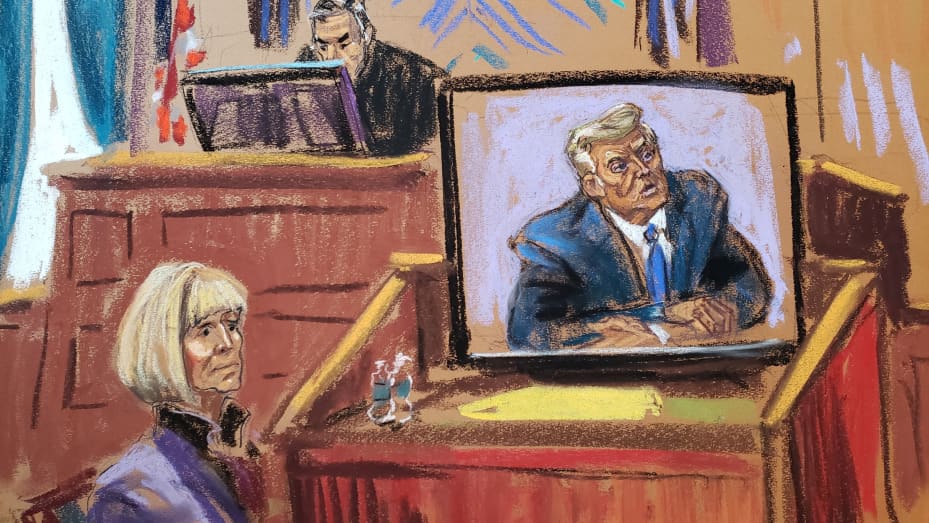
Donald Trump appeared to mistake E Jean Carroll for his ex-wife Marla Maples in a deposition played for jurors in Carroll’s civil rape suit against him.
In the video, Trump was shown a photo of himself speaking to other people at an event. “It’s Marla,” he says, before his lawyer corrects him. “No, that’s Carroll,” the lawyer says.
Carroll, 79, has accused Trump, 76, of attacking her in a New York City department store in the mid-1990s, an allegation Trump has denied.
Lawyers for Carroll have argued that Trump’s confusion over the photo undermines his claim that Carroll is “not my type”, a comment he has repeated since she first came forward with the allegation in 2019.
Trump has not yet attended the civil trial, now drawing to a close after two weeks of proceedings in Manhattan. Both sides rested their case on Thursday, though Trump’s team called no witnesses in his defence.
(BBC)



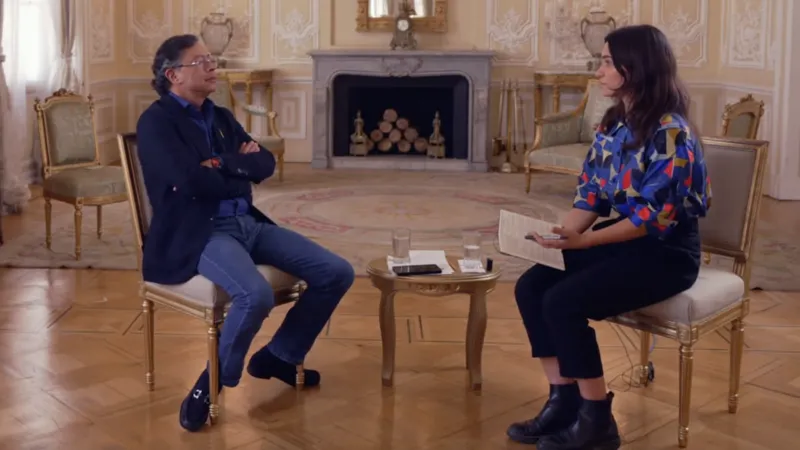
Colombia’s President Gustavo Petro has told the BBC that he believes there is now a “real threat” of US military action against Colombia.
Petro said the United States is treating other nations as part of a US “empire”. It comes after Trump threatened Colombia with military action. He said that the US risks transforming from “dominating the world” to becoming “isolated from the world.”
He also accused US Immigration and Customs Enforcement (ICE) agents of acting like “Nazi brigades”. Trump has significantly expanded ICE operations as part of what the administration says is a crackdown on crime and immigrants who illegally entered the US.
The BBC has approached the White House for comment.t
Following US strikes on Venezuela and the seizure of Nicolás Maduro, US President Donald Trump said a military operation targeting Colombia “sounds good”.
Trump has also repeatedly told Petro to “watch his ass”, remarks Petro strongly condemned.
Trump and Petro spoke by phone on Wednesday evening, after which Trump said he would meet hisColombian counterpart at the White House in the near future. Writing on his Truth Social platform late on Wednesday after the call, Trump described his conversation with Petro as a “Great Honour”. A Colombian official said at the time that the conversation had reflected a 180-degree shift in rhetoric “from both sides.”
But on Thursday, Petro’s tone suggested relations had not significantly improved.
He told the BBC the call lasted just under an hour, “most of it occupied by me,” and covered “drug trafficking Colombia” and Colombia’s view on Venezuela and “what is happening around Latin America regarding the United States.”
Petro strongly criticised recent US immigration enforcement, accusing ICE agents of operating like “Nazi brigades”.
President Trump has often blamed immigration for crime and trafficking in the US, using it to justify large-scale enforcement operations, and has accused countries like Colombia and Venezuela of not doing enough to tackle drug-trafficking.
Since returning to the White House, the US president has sent ICE agents to cities across the country. The agency enforces immigration laws and conducts investigations into undocumented immigration. It also plays a role in removing undocumented immigrants from the US.
The administration says it deported 605,000 people between 20 January and 10 December 2025. It also said 1.9 million immigrants had “voluntarily self-deported”, following an aggressive public awareness campaign encouraging people to leave the country on their own to avoid arrest or detention.
About 65,000 people were in ICE detention as of 30 November 2025, according to data obtained by the Transactional Records Access Clearinghouse’s immigration project, a compendium of government data from Syracuse University.
This week a US immigration agent shot dead a 37-year-old US citizen in the city of Minneapolis, sparking protests overnight.
Federal officials said the woman, Renee Nicole Good , had tried to run over immigration agents with her car but the city mayor, Democrat Jacob Frey, said the agent who shot her had acted recklessly and demanded agents leave the city.
Petro said ICE had “reached the point where it no longer only persecutes Latin Americans in the streets, which for us is an affront, but it also kills United States citizens.”
He added that if this continued, “instead of a United States dominating the world – an imperial dream – it is a United States isolated from the world. An empire was not built by being isolated from the world.”
Petro said the US has for “decades” treated other governments, particularly in Latin America, as an “empire” regardless of the law.
The two leaders have long been adversaries, frequently trading insults and tariff threats on social media.
Following the US’s military action in Venezuela, Petro accused Washington of seeking wars over “oil and coal,” adding that if the US had not pulled out of the Paris Agreement, where countries agreed to limit global temperature rising by reducing fossil fuel use, “there would be no wars, there would be a much more democratic and peaceful relationship with the world. And South America.”
“The Venezuelan issue is about this,” he said.
After Trump’s comments threatening military action in Colombia, demonstrations were held across the country in the name of sovereignty and democracy.
Petro told the BBC that Trump’s remarks amounted to a “real threat”, citing Colombia’s loss of territory such as Panama in the 20th century, and said “the prospect of removing [the threat] depends on the ongoing conversations.”
Asked how Colombia would defend itself in the event of a US attack, Petro said he would “prefer it to be about dialogue.” He said that “work is being done” on this.
But he added: “Colombia’s history shows how it has responded to large armies.”
“It’s not about confronting a large army with weapons we don’t have. We don’t even have anti-aircraft defenses. Instead, we rely on the masses, our mountains, and our jungles, as we always have.”
Petro confirmed he had also spoken to Delcy Rodríguez, Venezuela’s acting president and former vice president and oil minister, and invited her to Colombia.
He said Venezuela had “long been subject to interference by various intelligence agencies,” adding that while such agencies had permission to operate in Colombia, it was solely to combat drug trafficking. He denounced attempts at what he said were other “covert operations” in Colombia.
He did not directly comment when asked whether he feared the CIA could carry out covert operations similar to their actions in Venezuela in Colombia, or whether he feared his own government or inner circles may have informants.
Maduro was captured by the US army’s Delta Force, the military’s top counter-terrorism unit, after a CIA source in Venezuelan government helped the US track his location.
As the world’s largest producer of cocaine, Colombia is a major hub for the global drug trade. It also has significant oil reserves, as well as gold, silver, emeralds, platinum and coal.
The US has said it will control sales of Venezuelan oil “indefinitely” as it prepares to roll back restrictions on the country’s crude in global markets.
Speaking aboard Air Force One after the Venezuela operation, Trump described Petro as a “sick man who likes making cocaine and selling it to the United States,” adding: “He’s not going to be doing it for very long.”
Petro denied the claims, saying it has “always been proven that I’m not involved in that.”
“For 20 years I have been fighting against the drug cartels, at the cost of my family having to go into exile,” he said.
A former guerrilla, Petro has pursued a “total peace” strategy since taking office, prioritising dialogue with armed groups. Critics say the approach has been too soft, with cocaine production reaching record levels.
Asked what failed and whether he accepted responsibility, Petro said coca cultivation growth was slowing and described “two simultaneous approaches.”
“One, talking about peace with groups that are bandits. And the other, developing a military offensive against those who don’t want peace.”
He said negotiations were ongoing in southern Colombia, “where the greatest reduction in coca leaf cultivation has occurred” and “where the homicide rate in Colombia has fallen the most.” Cocaine is made from the leaves of the coca plant.
The policy of dialogue, he said, was intended to “de-escalate violence”, adding: “we’re not fools, we know who we’re negotiating with.”
(BBC)

Huge crowds of protesters have been marching through Iran’s capital and other cities, videos show, in what is said to be the largest show of force by opponents of the clerical establishment in years.
The peaceful demonstrations in Tehran and the second city of Mashhad on Thursday evening, which were not dispersed by security forces, can be seen in footage verified by BBC Persian.
Later, a monitoring group reported a nationwide internet blackout.
Protesters can be heard in the footage calling for the overthrow of Iran’s Supreme Leader Ayatollah Ali Khamenei and the return of Reza Pahlavi, the exiled son of the late former shah, who had urged his supporters to take to the streets.
It was the 12th consecutive day of unrest that has been sparked by anger over the collapse of the Iranian currency and has spread to more than 100 cities and towns across all 31 of Iran’s provinces, according to human rights groups.
The US-based Human Rights Activist News Agency (HRANA) has said at least 34 protesters – five of them children – and eight security personnel have been killed, and that 2,270 other protesters have been arrested.
Norway-based monitor Iran Human Rights (IHR) has said at least 45 protesters, including eight children, have been killed by security forces.
BBC Persian has confirmed the deaths and identities of 22 people, while Iranian authorities have reported the deaths of six security personnel.
On Thursday evening, videos on social media and verified by BBC Persian showed a large crowd of protesters moving along a major road in Mashhad, in the country’s north-east.
Chants of “Long live the shah” and “This is the final battle! Pahlavi will return” can be heard. And at one point, several men are seen climbing on an overpass and removing what appears to be surveillance cameras attached to it.
Another video posted online showed a large crowd of protesters walking along a major road in eastern Tehran.
In footage sent to BBC Persian from the north of the capital, another large crowd is heard chanting “This is the final battle! Pahlavi will return”. Elsewhere in the north, protesters were filmed shouting “Dishonourable” and “Don’t be afraid, we are all together” following a clash with security forces.
Other videos showed protestors chanting “Death to the dictator” – a reference to Khamenei – in the central city of Isfahan; “Long live the Shah” in the northern city of Babol, and “Don’t be afraid, we are all together” in the north-western city of Tabriz.
In the western city of Dezful, footage sent to BBC Persian showed a large crowd of protesters and also security personnel appearing to open fire from a central square.
The evening protests came not long after Reza Pahlavi, whose father was overthrown by the 1979 Islamic revolution and lives in Washington DC, had called on Iranians to “take to the streets and, as a united front, shout your demands”.
In a post on X, Pahlavi said “millions of Iranians demanded their freedom tonight”, describing the protesters as his “courageous compatriots”.
He thanked US President Donald Trump for holding the “regime to account”, and called on European leaders to do the same.
Pahlavi has also called for protests to continue from 20:00 local time (16:30 GMT) on Friday night.
Iranian state media downplayed the scale of Thursday’s unrest. In some cases, they denied protests had taken place altogether, posting videos of empty streets.
Meanwhile, internet watchdog NetBlocks said its metrics showed that Iran was “in the midst of a nationwide internet blackout”.
“The incident follows a series of escalating digital censorship measures targeting protests across the country and hinders the public’s right to communicate at a critical moment,” it warned, referring to previous losses of connectivity in several cities.
Earlier in the day, footage from Lomar a small town in the western province of Ilam showed a crowd chanting “Cannons, tanks, fireworks, mullahs must go” – a reference to the clerical establishment. Another showed people throwing papers into the air outside a bank that appeared to have been broken into.
Other videos showed many shuttered shops in a number of predominantly Kurdish cities and towns in Ilam, as well as Kermanshah and Lorestan provinces.
It followed a call for a general strike by exiled Kurdish opposition groups in response to the deadly crackdown on protests in the region.
At least 17 protesters have been killed by security forces in Ilam, Kermanshah and Lorestan during the unrest, and many of them have been members of the Kurdish or Lor ethnic minorities, according to Kurdish human rights group Hengaw.
On Wednesday, there were violent clashes between protesters and security forces in several cities and towns in western Iran, as well as other regions.
IHR said it had been the deadliest day of the unrest, with 13 protesters confirmed to have been killed across the country.
“The evidence shows that the scope of crackdown is becoming more violent and more extensive every day,” said the group’s director, Mahmood Amiry-Moghaddam.
Hengaw said two protesters were shot dead by security forces in Khoshk-e Bijar, in the northern province of Gilan, on Wednesday night.
Iran’s semi-official news agency Fars, which is close to the Revolutionary Guards, reported that three police officers were also killed on Wednesday.
It said two were shot dead by armed individuals among a group of “rioters” in the south-western town of Lordegan, and the third was stabbed to death “during efforts to control unrest” in Malard country, west of Tehran.
On Thursday, US President Donald Trump reiterated his threat to intervene militarily if Iranian authorities killed protesters.
“I have let them know that if they start killing people, which they tend to do during their riots – they have lots of riots – if they do it, we are going to hit them very hard,” he said in an interview with the Hugh Hewitt Show.
Separately, the US treasury secretary, Scott Bessent, said the Iranian economy was “on the ropes”.
While speaking at the Economic Club of Minnesota on Thursday, he added: “President Trump does not want them to harm more of the protesters. This is a tense moment.”
Iranian President Masoud Pezeshkian earlier called on security forces to exercise “utmost restraint” when handling peaceful protests. “Any violent or coercive behaviour should be avoided,” a statement said.
Khamenei – who has ultimate power in Iran – said on Saturday that authorities should “speak with the protesters” but that “rioters should be put in their place”.
The protests began on 28 December, when shopkeepers took to the streets of Tehran to express their anger at another sharp fall in the value of the Iranian currency, the rial, against the US dollar on the open market.
The rial has sunk to a record low over the past year and inflation has soared to 40% as sanctions over Iran’s nuclear programme squeeze an economy also weakened by government mismanagement and corruption.
University students soon joined the protests and they began spreading to other cities, with crowds frequently heard chanting slogans critical of the clerical establishment.
In messages sent to the BBC, via a UK-based activist, a woman in Tehran said despair was driving the protests. “We’re living in limbo,” she said. “I feel like I’m hanging in the air with neither wings to migrate nor hope to pursue my goals here. Life here has become unbearable.”
Another said she was protesting because her dreams had been “stolen” by the clerical establishment and she wanted it to know that “we still have a voice to shout, a fist to punch them in the face.”
A woman in the western city of Ilam said she knew of young people from families affiliated with the establishment who were taking part in protests. “My friend and her three sisters, whose father is a well-known figure in the intelligence services, are joining without their father knowing,” she said.
The protests have been the most widespread since an uprising in 2022 sparked by the death in custody of Mahsa Amini, a young Kurdish woman who was detained by morality police for allegedly not wearing her hijab properly. More than 550 people were killed and 20,000 detained by security forces over several months, according to human rights groups.
The biggest protests since the Islamic revolution took place in 2009, when millions of Iranians took to the streets of major cities after a disputed presidential election. Dozens of opposition supporters killed and thousands were detained in the ensuing crackdown.
[BBC]

A pair of twin mountain gorillas has been born in the eastern Democratic Republic of Congo – a rare occurrence for the endangered primates, conservationists at Virunga National Park say.
The community trackers, who discovered 22-year-old Mafuko hugging her newborns on Saturday, said the mother and her two baby sons all appeared to be well and healthy.
Twin births are thought to account for about 1% of all mountain gorilla births, though exact data is not widely available.
Virunga, situated in a conflict-prone part of DR Congo, is Africa’s oldest and largest national park and was set up 100 years ago to protect mountain gorillas of which there are fewer than 1,100 left in the wild
They are only found in the Virunga and in national parks over the border in Rwanda and Uganda, according to the International Union for the Conservation of Nature (IUCN), which compiles a Red List of threatened species.
The last birth of mountain gorilla twins in Virunga National Park was in September 2020.
Mafuko herself gave birth to twins in 2016, but they both died within a week.
Young gorillas rely entirely on their mothers for care and transport – and are extremely vulnerable in what can be a dangerous environment where poachers and many armed groups operate.
The authorities at the park say additional monitoring and protection measures have been put in place to ensure the twins’ survival during this critical period. Rangers would closely observe the young family and provide support if needed, they said.
A gorilla’s pregnancy lasts for about eight-and-a-half months, and females usually give birth to one infant every four years.
According to Virunga conservationists, Mafuko has had a remarkable history of survival herself.
Born in 2003 into the Kabirizi family, she lost her mother to armed attackers when she was four years old. She joined the Bageni family when she was 10 – and to date has been pregnant and given birth five times.
Conservationists at Virunga, which is a Unesco World Heritage Site, say her latest offspring represent a significant boost for efforts to protect the endangered species.
Thanks to anti-poaching patrols and community programmes – supported by the European Union and Unesco – mountain gorilla numbers in Virunga have slowly increased over the past decade.
This success which is documented by the IUCN and other partners, led to their status being upgraded from “critically endangered” to “endangered” in 2018.
Virunga spans 7,800 sq km (3,000 sq miles) and is home to an astonishingly diverse landscape – from active volcanoes and vast lakes to rainforest and mountains.
[BBC]

Colombia sees ‘real threat’ of US military action, president tells BBC

Landslide RED warnings issued to the Divisional Secretaries Divisions of Ududumbara, Nildadndahinna and Walapane

Harmanpreet, Mandhana return to DY Patil, on opposite sides this time

Huge anti-government protests in Tehran and other Iranian cities, videos show

Clinical Pakistan look to keep momentum going and wrap up series

Astronaut’s ‘serious medical condition’ forces Nasa to end space station mission early

‘Dates have the highest sugar content to fight Coronavirus’

Sunday Island 27 December – Headlines

#SundayIsland 17th December – Headlines

Sunday Island – 28th March

Sunday Island Headlines – 21 March

Sunday Island – 21st February – Headlines
-

 News3 days ago
Interception of SL fishing craft by Seychelles: Trawler owners demand international investigation
-
 News3 days ago
Broad support emerges for Faiszer’s sweeping proposals on long- delayed divorce and personal law reforms
-
 News4 days ago
Private airline crew member nabbed with contraband gold
-

 Opinion10 hours ago
The minstrel monk and Rafiki, the old mandrill in The Lion King – II
-

 News2 days ago
Prez seeks Harsha’s help to address CC’s concerns over appointment of AG
-

 Latest News1 day ago
Warning for deep depression over South-east Bay of Bengal Sea area
-

 News2 days ago
Govt. exploring possibility of converting EPF benefits into private sector pensions
-

 Features10 hours ago
The Venezuela Model:The new ugly and dangerous world order