
News
Divisional Secretaries briefed on the Government’s 2026 Development Programmes and the ‘Praja Shakthi’ Community-Driven Rural Development Approach

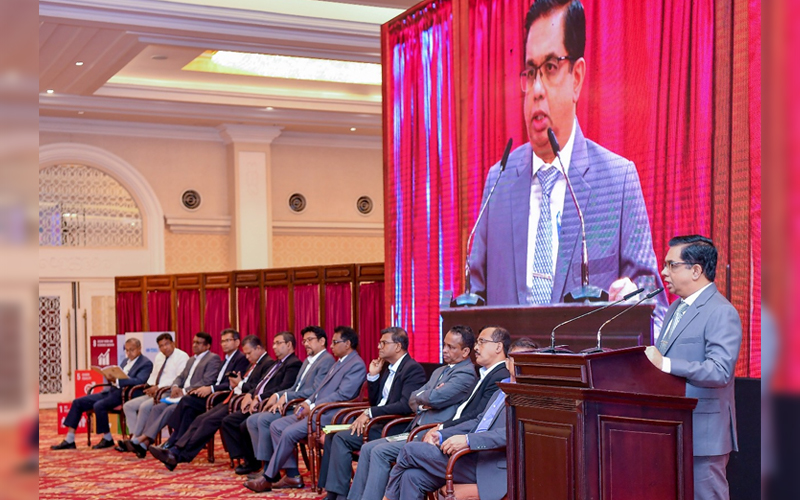
A briefing session for all Divisional Secretaries across the country on the government’s flagship “Praja Shakthi” national programme, implemented to strengthen social empowerment and ensure the fair distribution of economic benefits within society, was held on Saturday (22) at the Presidential Secretariat.
The session provided Divisional Secretaries with an extensive overview of the grassroots implementation of the Praja Shakthi programme. Discussions also covered the need for public sector reforms, the role of Divisional Secretaries in development, the digital systems and platforms used within the Praja Shakthi initiative, the responsibilities of Divisional Secretaries under the digital economy programme and securing their active contribution to the national “A Nation United” mission aimed at eradicating bribery, corruption and dangerous narcotics.
Speaking at the event, Minister of Rural Development, Social Security and Community Empowerment, Dr Upali Pannilage, noted that the aim of the Praja Shakthi national movement is to provide national-level leadership to eliminate rural poverty. He emphasised that, whereas poverty alleviation had long been handled as a fragmented responsibility limited to a single ministry or institution, Praja Shakthi seeks to transform it into a broad, collective national effort.
Secretary to the President, Dr Nandika Sanath Kumanayake, stated that multidimensional poverty, one of the country’s longstanding social issues, has been recognised as a key priority within the new development approaches. Social empowerment and strengthened social protection have been identified as primary strategies. He further stressed that public officials bear significant responsibility in ensuring that benefits reach the people effectively.
Secretary to the Ministry of Finance, Dr Harshana Sooriyapperuma, noted that Rs. 180 billion has been allocated in the 2026 Budget for rural development, including Praja Shakthi and other development programmes. He added that Divisional Secretaries would play a major role in the efforts to increase the current 5% economic growth rate to 7% and to achieve the country’s medium-term economic targets.
Minister of Rural Development, Social Security and Community Empowerment, Dr Upali Pannilage
“For many years, various programmes have been introduced in our country to eradicate poverty. I trust that all of you are familiar with the Praja Shakthi initiative launched by the present government. The Praja Shakthi movement has four main objectives.
The first is to provide national leadership to eliminate rural poverty under the Praja Shakthi national movement. Although this may appear somewhat complex, our view is that previous poverty alleviation efforts were confined to a single ministry or a single institution.
Understanding the need for national leadership, we expanded this programme. With the involvement of the Presidential Secretariat, a National Policy Council has been established, chaired by the President.
Secondly, an integrated and inter-sectoral mechanism has been introduced for eliminating rural poverty. Instead of each ministry or institution attempting to address poverty in isolation, we have adopted a unified approach. While all 25 ministries are linked to poverty alleviation, nine have been identified as directly responsible. Provincial councils and local government institutions are also integral to this structure, which requires coordinated action. For this purpose, an Integrated Operations Committee has been established within the administrative system. All ministry secretaries directly involved in the programme, as well as provincial chief secretaries, are part of this high-level integrated structure.
Thirdly, we have introduced a people-centred development approach. Although simple in concept, we believe development must move from the bottom up rather than from the top down. In practice, this requires genuine public participation at the grassroots level.
Finally, the effectiveness and efficiency of poverty alleviation initiatives must be reviewed and monitored with people’s participation. These are the core objectives of the Praja Shakthi national programme. There may be additional sub-objectives, but to implement these successfully, we need your fullest cooperation.”
Deputy Minister of the Digital Economy, Eranga Weeraratne said,
“Our government’s key expectation is to deliver services to the public efficiently, transparently, and with a sense of proximity. Each layer of the state structure must be digitised, from top to bottom. Only then can we deliver the essential services the public requires in a timely manner.
Digitisation will also significantly reduce the operational costs of Divisional Secretariats. We hope to work closely with your institutions. This is a national initiative, and therefore we expect to meet these requirements swiftly during 2026.”
Secretary to the President, Dr Nandika Sanath Kumanayake:
“This may very well be the first time we are meeting you. As Divisional Secretaries, you perform an immense service. You work closely with the people at the local level. We must improve the quality of public service delivery.
Following the recent political changes, the public expected significant transformation, especially from politicians. As you know, there were strong demands for changes in the behaviour of politicians. Next, public scrutiny turned towards public officials. Even today, society continues to direct its expectations towards government officials. As politicians have responded to public pressure and undergone transformation, public officials must also adapt to meet these expectations. This is something we must clearly understand.
For years, we have followed certain routines in the public service. But now, we must be willing to change. We must be ready to align ourselves with new approaches. Many of you are young, energetic administrators with solid experience, exactly the kind of group capable of leading this transformation. As government programmes are implemented, your institutions must become more efficient.
Even when the government allocates funds, people often claim that the work does not get done because of indifference. We must recognise this. Let us adopt new ways of thinking when implementing these programmes. Your Divisional Secretariat must align itself with this efficient framework.
The government has already allocated funds for the digitalisation of public institutions. The state is making a significant investment towards advancing digital transformation in the country.”
Participating in the discussions were Deputy Minister of Rural Development, Social Security and Community Empowerment Wasantha Piyatissa; President’s Advisor on the Digital Economy, Dr Hans Wijayasuriya; Secretary to the Ministry of Rural Development, Social Security and Community Empowerment, Sampath Manthrinayake; Secretary to the Ministry of Public Administration, Provincial Councils and Local Government, S. Aloka Bandara; Secretary to the Ministry of Digital Economy, Varuna Sri Dhanapala; Senior Additional Secretaries to the President, Roshan Gamge and Kapila Janaka Bandara; Director General of Legal Affairs at the Presidential Secretariat, J. M. Wijebandara; Director General of the Commission to Investigate Allegations of Bribery or Corruption, Ranga Dissanayake; Director General of the Department of National Budget, S.D.J. Nilukshan; and Director of the Sri Lanka Railways Department, Buddhika Jayatissa.


COPF final report on USD 2.5 mn cyber fraud recommends action against all responsible
The US$2.5 million loss incurred during Sri Lanka’s foreign debt repayment to Australia was a clear case of a cybercrime and theft, Committee on Public Finance (COPF) Chairman Dr. Harsha de Silva told Parliament yesterday.
Presenting the COPF final report on the cyber fraud, Dr. de Silva said the incident amounted to a serious financial crime and called for a comprehensive investigation, by law enforcement authorities, to identify and prosecute all those responsible.
The report revealed serious governance, procedural and operational failures that enabled the fraudulent transfer of public funds, while recommending sweeping reforms to strengthen cybersecurity, financial controls and public debt management systems.
According to the report, officials of the Treasury and the Central Bank bore responsibility for governance lapses that contributed to the failures. It also highlighted the fact that the Ministry of Finance was operating an outdated Microsoft Exchange Server after security support had ended, while basic safeguards, such as multi-factor authentication, had not been implemented.
The COPF said suspicious payment instructions linked to debt repayments involving India, the United Kingdom, Germany and Belgium had also been detected, preventing further losses. However, the US$ 2.5 million fraud materialised only in the repayment transaction involving Australia.
The report has noted that officials had failed to verify lender email domains, relied on unverified email communications and lacked adequate internal controls, allowing the fraud to continue for months.
Although the investigation uncovered system-wide weaknesses across several institutions, only four mid-level Finance Ministry officials had been suspended so far, the report said.
The COPF has recommended a special audit of the foreign debt repayment process, strengthened cybersecurity measures across state institutions, updated financial regulations and improvements to public debt management systems.
by Saman Indrajith
News
Opposition signs no-confidence motion against Justice Minister for dereliction of duty over Negombo Prison deaths

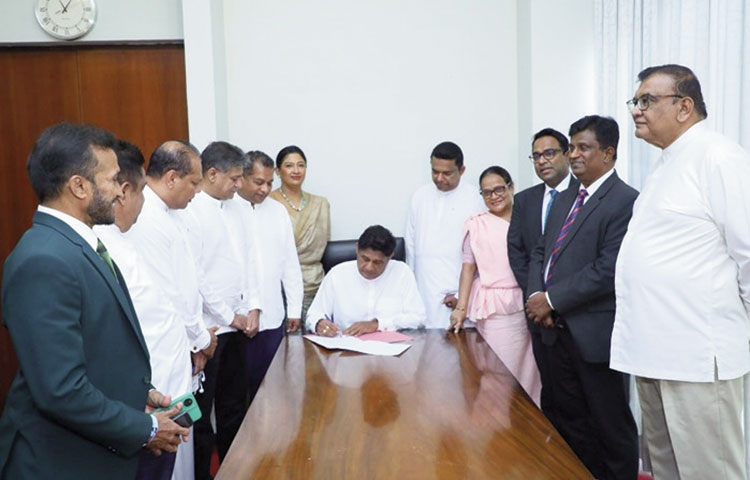
Opposition Leader Sajith Premadasa, together with Opposition MPs, yesterday signed a No-Confidence Motion (NCM) in Parliament against Justice Minister Harshana Nanayakkara.The move comes in response to the unrest at the Negombo Prison, where both prison officers and inmates were killed.
Opposition members said the Minister had failed to fulfill his responsibility and accountability regarding their safety.According to the Opposition group, the NCM seeks to hold the Minister directly accountable for lapses in ensuring protection within the prison system.

The Attorney General yesterday informed the Supreme Court that the government has decided to review the legality of agreements entered into by the previous administration to hand over the country’s electronic visa issuance operations to private companies.
Additional Solicitor General Viveka Siriwardena, appearing for the Attorney General, made the submission when the Supreme Court took up the fundamental rights petitions filed by former MPs President’s Counsel M.A. Sumanthiran, Patali Champika Ranawaka, and Rauff Hakeem, challenging the previous Cabinet’s decision to outsource the e-visa system.
The petitions were heard before a three-judge bench, comprising Chief Justice Preethi Padman Surasena and Justices Achala Wengappuli and Arjuna Obeyesekere.
The Additional Solicitor General informed court that the current Cabinet had appointed a subcommittee to examine the legality of the agreements with the private companies and requested time to report on its findings, stating that the review was still underway.
President’s Counsel Sumanthiran, appearing as one of the petitioners, told the court that although the present government had indicated its intention to cancel the transaction, the petitioners wished to proceed with the case.
He noted that members of the current Cabinet had been named as respondents in the petitions.The Supreme Court directed the petitioners to issue notice on the members of the current Cabinet, named as respondents, and fixed September 29 for further proceedings.

History takes centre stage as Mandhana, Harmanpreet fifties steer India

Spain leave it late to book semifinal date with France

Showers will occur in the Sabaragamuwa, Western and North-western provinces and in Galle, Matara, Kandy and Nuwara-Eliya districts

US$ 2.5 mn cyber heist exposes system failures

Opposition signs no-confidence motion against Justice Minister for dereliction of duty over Negombo Prison deaths

AG informs SC of e-visa agreement review

‘Dates have the highest sugar content to fight Coronavirus’

Sunday Island 27 December – Headlines

#SundayIsland 17th December – Headlines

Sunday Island – 28th March

Sunday Island Headlines – 21 March

Sunday Island – 21st February – Headlines
-

 News7 days ago
Singapore-based Buddhist monk marks nearly four decades of humanitarian service
-
 News2 days ago
Herath warns prospective migrant workers not to get fleeced by racketeers
-

 News6 days ago
AI concerned over proposed SL military deployment in Haiti
-

 Midweek Review4 days ago
Unexpected focus on ‘pieces of tin’ worn by military men
-

 Latest News5 days ago
Nyamhuri and Ngarava stun Bangladesh by defending 141
-

 News3 days ago
Negombo Prison riot: Ensuring protection of prisoners fundamental responsibility of the state – UN
-

 Features7 days ago
The NPP’s New Challenge: Balancing Easter Lawfare and Economic Welfare
-

 Editorial4 days ago
Prison riots and political battles