
News
Diego Garcia controversy: UK quietly sends back some Lankan asylum seekers “voluntarily” as Australia issues dire warning

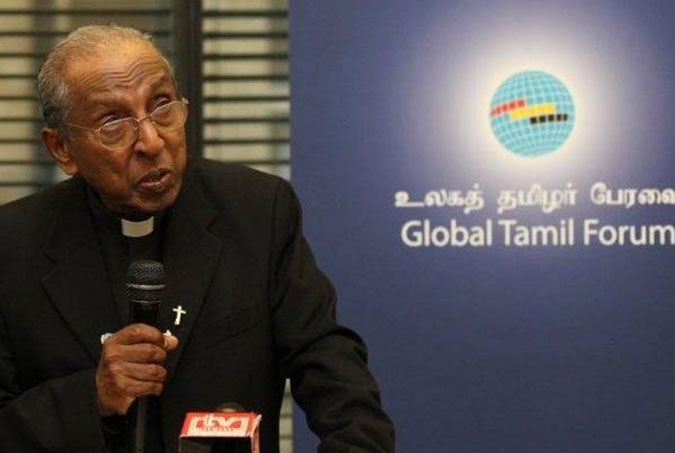
Global Tamil Forum skirts the issue
By Shamindra Ferdinando
The Global Tamil Forum (GTF) wouldn’t get involved in the ongoing controversy over the UK decision to move Sri Lankans, seeking to settle in the UK, to what the government called ‘a safe third country,’ unless they returned to Sri Lanka ‘voluntarily’.
About 120 Sri Lankans are believed to be housed in a fenced encampment in the US-British held Diego Garcia, part of the Chagos Islands which the United Nations ruled belonged to Mauritius and should be handed back by Dec. 2019.The UK calls the Indian Ocean archipelago the British Indian Ocean Territory (BIOT).Those who represent the interests of the Sri Lankan group, want the UK to allow them to settle in the UK.
The Island sought the GTF’s response to the hotly disputed British move and also asked whether the issue at hand would be raised at the Geneva-based United Nations Human Rights Council (UNHRC). The GTF spokesperson, Suren Surendiran, has sent us the following response: “The GTF, as an organization that functions internationally and not specifically in a specific country as such, doesn’t usually get involved in country specific matters, outside of Sri Lanka. The GTF is predominantly an international advocacy organization. There are various country specific Tamil organizations. There are also Tamil institutions/organizations, including legal firms, acting and lobbying on immigration policies in the UK and in various other countries.”
The Maritime Law Tribunal of the United Nations, the United Nations General Assembly and the International Court of Justice (ICJ) ruled that Chagos Islands belonged to Mauritius.The Guardian online edition, on Oct. 18, quoted Zehrah Hasan, an advocacy director for the Joint Council for the Welfare of Immigrants, as having said: “The British government has denied Tamil refugees’ basic rights in the Chagos Islands, for over a year now. In a callous move, it looks like they may expel these same refugees to a third country, similar to the Rwanda plan.”
Hassen was referring to the UK agreement with Rwanda to accommodate those denied UK refugee status.Hassan was further quoted as having told The Guardian: “Those who’ve fled persecution must have their voices heard and their right to protection, in the UK, recognized.”
Amidst the ongoing controversy, some of those who had been ‘held’ in the disputed UK territory had chosen to return “voluntarily” to Sri Lanka in the recent past. UK Foreign, Commonwealth and Development Office Minister, Jesse Norman, recently told Parliament so far over 60 Sri Lankans voluntarily returned home.Meanwhile, Australia has reiterated that illegal Sri Lankan immigrants wouldn’t be tolerated, under any circumstances. In separate statements, Home Affairs Minister Clare O’Neil, Australian Border Force Commissioner, Michael Outram, and Operation Sovereign Borders (OSB) Joint Agency Task Force (JATF) Commander Rear Admiral Justin Jones, have issued dire warnings that those who violated their laws would be dealt with.
Flanked by Commissioner Outram and Rear Admiral Jones, Minister O’Neil declared that Australian border protection polices haven’t changed. If you attempt to reach Australia by boat, you will be intercepted and turned around and you’ll end up back in Sri Lanka far worse off than when you embarked. The only way to get to Australia, legally, is with a valid visa. “
Rear Admiral Jones said that they would detect, intercept and return anyone who takes an illegal boat journey to Australia. The top official has warned that not a single boat managed to reach Australia. Australia released footage of a youth carrying a pair of slippers disembarking from an Australian vessel that had brought back a group of people, several months ago, while warning such endeavors wouldn’t be tolerated at all.
A couple of weeks before President Gotabaya Rajapaksa resigned, Minister O’Neil met the President and the then Foreign Minister Prof. G.L.Peiris to reiterate their insistence on OSB. In return for Sri Lanka’s cooperation, Australia has enhanced support for cash-strapped Sri Lanka and granted free fuel to its Navy and Air Force to sustain operations meant to discourage human smuggling.







The National Water Supply and Drainage Board (NWSDB) on Friday said the largest groundwater source discovered in Sri Lanka so far had been identified during tube-well drilling near the Pitabeddara Police Station.
Indrajith Gamage, geologist in charge of the Southern Province, said the source recorded a continuous flow of about 10,000 litres (10 cubic metres) per minute, marking the first instance in the country where a groundwater source of that magnitude had been found.
He noted that the previous largest groundwater source was discovered in the Madhu area, which recorded a flow of about 7,000 litres per minute.
According to the NWSDB, the tube well was drilled following geological studies of rock layers and the identification of underground water through fractures in rock strata using specialised technical instruments.
The Board said steps would be taken to distribute water from the newly discovered source to residents facing shortages in Pitabeddara, Morawaka and surrounding areas.

The Ceylon Chamber of Commerce has formally handed over its historical records to the National Archives Department, entrusting over a century of the nation’s commercial history to the country’s official custodians of heritage.
The archive, spanning from the CCC’s founding in 1839 to 1973, includes correspondence, meeting minutes, reports, ledgers, and publications that chronicle the development of trade, enterprise, and industry in Sri Lanka. Together, the records provide a rare and detailed account of the island’s economic evolution and the role of its business community in shaping national progress.

The Ministry of Defence said on Friday (13) that arrangements had been made to repatriate to Iran the bodies of 84 sailors who died aboard the IRIS Dena, which sank in the southern seas off Sri Lanka.
A special aircraft carrying the bodies departed from Mattala Rajapaksa International Airport on Friday, the Ministry said, adding that the repatriation was carried out in coordination with the Embassy of Iran in Sri Lanka.
The remains had been kept in two mobile cold-storage units at the Galle National Hospital before being transported to Mattala by lorry following a court order. Forty-five bodies were moved in the morning, while the remaining 39 were transported later in the day.
Earlier this month, the Iranian naval vessel suffered an incident about 40 nautical miles off Port of Galle while carrying around 180 personnel. Thirty-five rescued sailors were admitted to the Karapitiya Teaching Hospital, while 84 bodies were subsequently recovered.
Following the incident, Pete Hegseth confirmed that the Iranian vessel had been sunk in international waters by a torpedo fired from a submarine of the United States Navy.
Showers will occur at several places in the Western, Sabaragamuwa, Central, North-western and Uva provinces and in Galle, Matara, Mannar and Anuradhapura districts after 2.00 pm.

Lanka discovers largest groundwater source

Lanka’s commercial legacy preserved in National Archives

Bodies of 84 Iranian sailors flown home

Kirsten brings pedigree, but Sri Lanka must fix the system

Barrels vs bombs

‘Dates have the highest sugar content to fight Coronavirus’

Sunday Island 27 December – Headlines

#SundayIsland 17th December – Headlines

Sunday Island – 28th March

Sunday Island Headlines – 21 March

Sunday Island – 21st February – Headlines
-

 News6 days ago
Repatriation of Iranian naval personnel Sri Lanka’s call: Washington
-
 Features6 days ago
Winds of Change:Geopolitics at the crossroads of South and Southeast Asia
-

 News5 days ago
Prof. Dunusinghe warns Lanka at serious risk due to ME war
-

 Sports4 days ago
Royal start favourites in historic Battle of the Blues
-

 Sports3 days ago
The 147th Royal–Thomian and 175 Years of the School by the Sea
-

 News3 days ago
Historic address by BASL President at the Supreme Court of India
-

 Business4 days ago
BOI launches ‘Invest in Sri Lanka’ forum
-

 News4 days ago
CEBEU warns of operational disruptions amid uncertainty over CEB restructuring