
Business
Dialog Television integrates TeDi Alexa Solution to enable voice commands


Dialog Axiata PLC recently announced the integration of the AI Powered TeDi Alexa Solution to its Dialog Television decoders, enabling customers with the added convenience of controlling their TV through voice commands. Dialog also offers the Artificial Intelligence (AI) powered TeDi Alexa Smart Speaker designed to control all Infrared (IR) controlled home devices, through voice commands.
This latest Smart Home Solution extended by Sri Lanka’s premier connectivity provider aims to facilitate customers in transforming their homes into a smart home, where navigating through TV channels to changing the volume has now become a task as simple as giving a voice command. Furthermore, existing Alexa functions can be utilized on the device as per usual, and the smart speaker can be configured to control any IR-controlled device via voice commands, including air conditioners, home theatre systems, and home security systems. The integration of this convenient solution by Dialog will bring the seamless efficiency of AI combined with the power of Dialog’s connectivity to the homes of the everyday Sri Lankan consumer.
TeDi Alexa, the first integrated device to be officially launched in Sri Lanka, brought a future-fit revelation to the country. At present, TeDi Alexa is considered to be the first of Amazon’s AI devices integrated to a smart platform enabling voice activation and smart controlling of connected devices.
Customers can purchase TeDi Alexa for just Rs. 16, 990 from selected Dialog Experience Centres island-wide or they can also avail doorstep delivery when purchasing a device online. More information on the TeDi Alexa solution offered by Dialog can be accessed via https://www.dialog.lk/tedi-alexa

Business
A photograph of a Jaffna youth becomes a global symbol for Sri Lanka’s stalled reconciliation

In the world of travel photography, some images do more than showcase a destination; they act as a silent mirror to a nation’s unresolved history. When British photographer Mark Julian Edwards’ portrait, ‘The Boy on the Bus,’ claimed the People’s Choice Award at the 2026 Travel Photographer of the Year (TPOTY) awards, it did more than celebrate technical brilliance. It signaled that the global community is still fixated on the scars of a region where the promise of a post-2009 peace has yet to be fully realised.
While the current NPP government often celebrates a ‘reunited’ Sri Lanka under President Anura Kumara Dissanayake, this award-winning shot turns the gaze toward Jaffna – a city that remains the emotional and political epicenter of the North-South divide. Captured through a rusting bus window, the boy’s expression – described as ‘fragile yet incredibly resilient’ – speaks to the persistent chasm between the North and the South that has remained unbridged nearly two decades after the war’s end.
Whatever the rhetoric from political platforms regarding the end of distrust, the international resonance of this image suggests that the world recognises a different reality. The capture of a northern commute is not merely a travel detail; it is a reminder of a landscape where the path to a predictable future is still viewed through a prism of distrust and uncertainty.
The significance of this win lies in its source: the public vote. Out of 20,000 entries, thousands of people from 160 countries chose this specific face. This global endorsement serves as a poignant reminder that while the local reconciliation process may be stalled in policy and paperwork, the human element of the conflict continues to haunt the international imagination.
The boy represents a generation born after the guns fell silent, yet his quiet, searching eyes reflect the weight of a reconciliation process that many feel has been more about infrastructure than true social healing. In the North, where the dust of history is still settling, such images strip away the veneer of normalcy to reveal the underlying scars that politicians often ignore.
The success of Edwards’ work comes at a time when the Sri Lankan Tourism Bureau and Jetwing Hotels are looking to nurture the next generation of local storytellers. However, the global acclaim for ‘The Boy on the Bus’ suggests that the most vital stories to be told are not the ones that look like postcards, but the ones that acknowledge the sensitivity and professional excellence required to document a people still waiting for a ta truly inclusive future.
As this image makes its way into international galleries and media outlets like the BBC, it stands as a testament to a hard truth: a photograph can win international accolades but the bridging of the political and social chasm remains Sri Lanka’s true, unfinished business.
The 2026 Travel Photographer of the Year winners were showcased and celebrated in Sharjah – UAE, Birmingham – UK and Rome – Italy. This year’s programme includes a special mentorship and winners’ trip to Sri Lanka, hosted by the Sri Lanka Tourist Board and Jetwing Hotels.
By Sanath Nanayakkare

Pan Asia Banking Corporation PLC reported a strong financial performance for 2025, marking a year in which the Bank reinforced its position among Sri Lanka’s steadily expanding financial institutions. The Bank’s overall asset base surpassed Rs. 300 Bn, reaching Rs. 308.02 Bn its largest balance sheet to date while Profit After Tax amounted to Rs. 4.01 Bn. Earnings Per Share stood at Rs. 9.05, reflecting a solid core earnings base and disciplined balancesheet execution during a year of gradually easing macroeconomic pressures.
Total operating income grew to Rs. 16 Bn, supported by resilient net interest generation and sharp growth in non-interest revenue. Even though benchmark interest rates trended downward for much of the year reducing gross interest income at the market level, the Bank protected its core income through proactive liability repricing, careful funding management, and the retirement of high-cost borrowings. A healthier deposit mix supported by CASA growth helped reduce interest expenses by 4%, allowing the Bank to maintain profitability despite softer yields on loans and government securities.
A clearer picture of Pan Asia Bank’s true performance emerges once the nonrecurring sovereign debt gain recorded in 2024 is set aside. On this normalized basis, 2025 stands out as the Bank’s strongest year of underlying profitability in its 30-year history. Underlying Profit After Tax surged 35% to Rs. 4.01 Bn, while underlying Profit Before Tax climbed an impressive 52%, highlighting the Bank’s accelerating earnings momentum. Underlying EPS rose 35% to Rs. 9.05, supported by improved returns, with underlying ROE and ROA rising by 169 and 52 basis points, respectively. Together, these gains reflect the depth of the Bank’s core business strengths, broadbased revenue growth, and disciplined margin management during a year shaped by declining interestrate conditions.
Income diversification also played a pivotal role. Net fee and commission income expanded by 37%, supported by heightened lending activity, improved trade flows, stronger card-related transactions, and remarkable growth in remittance-related business. These developments helped offset the moderation in trading gains, which were affected by lower capital gains on unit trusts and government securities. A derecognition gain of Rs. 278.63 million on FVOCI assets and reduced marktomarket losses helped stabilize noninterest income, allowing the Bank to sustain earnings despite a more subdued trading environment.
Credit quality improved significantly. The Stage 3 loan ratio declined to 1.73% from 3.10% a year earlier one of the greatest improvements within the sector—reflecting the Bank’s continued emphasis on highquality underwriting, better borrower monitoring, and an effective earlywarning framework. Impairment expenses normalized following the unusually large reversal seen in 2024. ( Pan Asia Bank)
Business
SriLankan Cargo secures another South Asian First with IATA CEIV Live Animals Certification
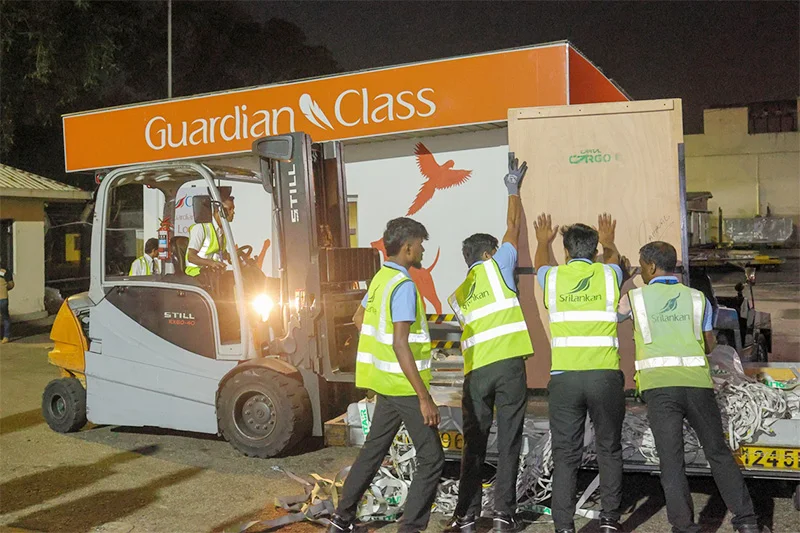
SriLankan Cargo, the air freight arm of SriLankan Airlines, has secured another regional first by becoming the first airline in South Asia to be awarded the Center of Excellence for Independent Validators (CEIV) for Live Animals Logistics Certification from the International Air Transport Association (IATA). Regarded as the premium global standard for the air transport of live animals, the certification serves as a powerful pledge to pet parents, livestock owners, conservationists and all shippers that SriLankan Cargo will transport animals in humane, safe and stress-free conditions across its worldwide network.
Chaminda Perera, Head of Cargo at SriLankan Airlines, commented on the achievement, stating, “Earning the IATA CEIV Live Animals Certification underscores our dedication to animal welfare and operational excellence, ensuring safer handling, trained teams and peace of mind for our customers.”
Sheldon Hee, Regional Vice President, Asia-Pacific, said, “The CEIV Live Animals certification is not only about compliance, but ensures the safety and welfare of live animals transported by air. This is particularly relevant as this is a market that continues to grow with more than 200,000 live animal shipments globally in 2025. We are pleased to see SriLankan Airlines achieve this important certification and ensure the implementation of the highest standards across the supply chain.”
The certification stands out for placing animal safety and welfare at the forefront, supported by best-in-class infrastructure and operational excellence. Achieving it requires a rigorous, multi-step process of training, assessment, validation, certification and recertification, ensuring that only organisations fully compliant with the IATA Live Animals Regulations and the Convention on International Trade in Endangered Species gain membership in this highly exclusive circle of airlines, which currently numbers 12 worldwide.
SriLankan Cargo remains firmly committed to upholding the highest standards stipulated in the IATA Live Animals Regulations throughout the shipment lifecycle, from acceptance and handling to loading, transportation and final delivery. Working closely with veterinary authorities, ground handlers and cargo partners, the airline ensures every check box relating to welfare and compliance is consistently ticked.
SriLankan Cargo also operates purpose-built facilities with precise temperature control procedures and robust contingency plans, enabling animals to travel in optimal conditions, including during transit. Dedicated CEIV-trained team members oversee each movement, safeguarding comfort, wellbeing and regulatory adherence at every stage.

A photograph of a Jaffna youth becomes a global symbol for Sri Lanka’s stalled reconciliation

Ganuka, Yuhansa reach semis

IMF MD gives good report card to Sri Lanka

Recognition sought for first Muslim left party

Nestlé Lanka named among Sri Lanka’s Top 10 Employers at EFC National Best Employer Awards 2025

Joint operation yields 9000 foreign cigarettes

‘Dates have the highest sugar content to fight Coronavirus’

Sunday Island 27 December – Headlines

#SundayIsland 17th December – Headlines

Sunday Island – 28th March

Sunday Island Headlines – 21 March

Sunday Island – 21st February – Headlines
-

 Life style4 days ago
Marriot new GM Suranga
-

 Business3 days ago
Ministry of Brands to launch Sri Lanka’s first off-price retail destination
-

 Features4 days ago
Monks’ march, in America and Sri Lanka
-

 Opinion7 days ago
Will computers ever be intelligent?
-

 Features4 days ago
The Rise of Takaichi
-

 Features4 days ago
Wetlands of Sri Lanka:
-

 News4 days ago
Thailand to recruit 10,000 Lankans under new labour pact
-

 News4 days ago
Massive Sangha confab to address alleged injustices against monks